
From Charleston and Columbia to Greenville, Myrtle Beach, and Rock Hill
South Carolina Tax Relief and IRS Tax Help: Resolve Income Tax Debt, State Tax Problems, and South Carolina Department of Revenue Collections
Hurricane deadlines that moved, a state income tax that keeps changing, and an IRS bill that will not wait. South Carolina taxpayers have had a lot to keep up with, and it is easy to fall behind.
Shrimpers and charter captains in the Lowcountry, state workers in Columbia, plant employees in the Upstate, and beach rental owners on the Grand Strand work with our team by phone, video, and secure upload. Nationwide reach, Eastern time hours.
Federal and state balances, one team
W-2, 1099, sales tax, and payroll filers
In-house team since 2005
Spanish-speaking clients welcome
South Carolina asks a lot of its taxpayers right now. Federal income tax, a state income tax that was rebuilt from the ground up, sales tax, and payroll taxes for anyone with employees all run on separate calendars. Miss one, and penalties and interest start stacking up on the others.
Republic Tax Relief helps individuals and businesses that owe the Internal Revenue Service, the South Carolina Department of Revenue (SCDOR), or both. Our licensed enrolled agents, CPAs, and tax attorneys work as one team from our California offices and represent South Carolinians in all 46 counties, from Oconee to Horry.
On This Page
- Why South Carolinians Owe the IRS and the State
- Hurricane Tax Relief and Penalty Errors
- South Carolina Income Tax Cuts and New Tax Problems
- From an IRS Notice to a Levy or Tax Lien
- SC Department of Revenue Collections and Payment Plans
- A South Carolina IRS Case: Lexington Payroll Taxes
- IRS Tax Relief Options for South Carolina Taxpayers
- Back Taxes, Unfiled Returns, and Substitute for Return
- Business Tax Problems: Payroll, Sales Tax, and Licenses
- Charlotte and Augusta Commuters, Military Families
- Our Tax Resolution Process Without a Local Office
- IRS Tax Relief in Charleston, Columbia, and Across SC
- Expert Insight: DIY and AI Risks With IRS Problems
- Why South Carolina Taxpayers Choose Republic Tax Relief
- Frequently Asked Questions
- Speak With a Tax Relief Professional
Why South Carolinians Face IRS Tax Issues and State Tax Debt at the Same Time
South Carolina’s economy runs on tourism, manufacturing, the military, and a fast-growing population of new arrivals. That mix creates a lot of income that is easy to under-report or under-withhold, even for careful people.
These are the patterns we see most in South Carolina households:
- Seasonal and tourism income. Servers, bartenders, golf course staff, and short-term rental owners in Myrtle Beach, Hilton Head, and Charleston often earn most of their year in a few busy months, then come up short at tax time.
- Self-employed and 1099 work. Contractors, real estate agents, and delivery drivers get no withholding and owe federal tax, self-employment tax, and state income tax together.
- New residents. People who moved from New York, Ohio, or New Jersey sometimes owe part-year returns in two states and miss one.
- Unfiled returns after a storm, a job loss, a divorce, or a death in the family. Our unfiled tax returns service brings missing federal and South Carolina returns current and stops new penalties.
- Payroll tax trouble at small restaurants, construction outfits, and family businesses after a slow season.
Not sure how much you owe or for which years? Our back tax help confirms every federal and state balance before anyone makes a promise about your tax debt.
Your story is safe here. Every conversation and document is handled under attorney-client and tax professional privilege standards, and only the licensed professional working your case ever sees it.
IRS Tax Relief Due to Hurricane: What Disaster Postponements Mean for Filing and Payment Deadlines
South Carolina knows hurricane season well. When the Federal Emergency Management Agency declares a disaster, the IRS usually postpones tax filing and payment deadlines for people who live or run a business located in the disaster area. The SCDOR often follows with its own state relief.
After Hurricane Helene, the IRS extended relief to all 46 South Carolina counties. The postponement covered individual and business returns, quarterly estimated income tax payments, quarterly payroll and excise tax returns, and penalties on certain payroll and excise tax deposits (IRS: Hurricane Helene relief in South Carolina).
Three things most people miss about disaster relief
- Penalties can be charged by mistake. The IRS later admitted that a programming error caused some South Carolina taxpayers to receive penalty assessments they should never have gotten. If a notice shows penalties for a period that was postponed, it may be wrong.
- You may qualify even if you live outside the disaster area. The IRS also gives relief when the records you need to meet a deadline are in the affected area, and to workers helping with relief activities for recognized organizations.
- State relief has limits. SCDOR relief applied to income tax and certain other returns, but not to every state tax. Sales tax and other business taxes may have stayed on their normal schedule.
Damage caused by hurricane winds or flooding to real or personal property can also affect your tax picture through casualty loss rules. We review all of it before deciding whether to request IRS penalty abatement on top of disaster relief.
South Carolina Income Tax Cuts: Why Lower Rates Can Still Create a Tax Problem
Lawmakers have passed several rounds of income tax cuts, and the latest law replaced the old brackets with a simpler two-rate system. Lower rates are good news. But the way the tax is figured changed too, and change in any tax system is where mistakes happen.
The new law starts the South Carolina calculation from federal adjusted gross income instead of federal taxable income. It removes the federal standard and itemized deduction from the state return and adds a new South Carolina deduction that phases out as income rises (Office of Governor Henry McMaster).
- Withholding may not match. If your SC W-4 or estimated payments were never updated, your state taxable income may look different than you expect.
- Software and old habits lag. People who copy last year’s numbers, or ask a chatbot trained on the old rules, can file a state return that does not match the new tax code.
- The federal side did not get cheaper. A state rate cut does nothing for an existing IRS debt or the penalties growing on it.
From a Notice From the IRS to a Levy or Tax Lien: How to Fix Your IRS Problem in Time
The IRS rarely jumps straight to taking property. It sends a series of letters first, and each one gets more serious. Where your latest notice from the IRS falls in this order tells you how much time you have.
- Balance due notices. The first bills show the tax, plus penalties and interest.
- Reminder and urgent notices. The tone sharpens, and the IRS warns that enforcement is coming.
- Notice of Federal Tax Lien. A public claim against your property, filed with your county. It can block a sale or refinance.
- Final Notice of Intent to Levy. This is the big one. You generally have 30 days to request a Collection Due Process hearing.
- Levy. The IRS can take bank funds, wages through a wage garnishment, retirement accounts, and other assets.
Do not let the 30 days pass. Ignoring a final notice can cost you the right to a hearing and the leverage that comes with it. Go by the date printed on the letter, not the day it reached your mailbox, and call us before that window closes.
See how IRS collections defense works, how we handle bank levy help, wage garnishment relief, and tax lien help, or read our guide to common IRS notices.
South Carolina Department of Revenue Collections: Warrants for Distraint, Levies, and Payment Plans
Many people fix the IRS side and let the unpaid state bill sit. That is a mistake. The Department of Revenue in Columbia has its own collection tools, and it does not wait for an IRS case to finish.
| SCDOR collection tool | What it means for you |
|---|---|
| Warrant for distraint | South Carolina’s version of a state tax lien. It is recorded with the county clerk of court, shows up in title searches, and can stall a plan to sell or refinance. |
| Bank levy and wage garnishment | The SCDOR can levy bank accounts and garnish pay. Banks are required to help the state find accounts tied to a warrant. |
| License revocation | The SCDOR can revoke any license it issues, including a state Retail License or alcohol beverage license. For a store or restaurant, that can mean closing the doors. |
| Refund offsets | State and federal refunds, and even SC Education Lottery winnings, can be applied to what you owe. |
| Private collectors | Older balances can be referred to an outside collection agency. |
The SCDOR lists these tools, including license revocation and referral to private collectors, on its compliance pages (SCDOR: Notices and Compliance).
South Carolina payment plans have strict rules
A state Payment Plan Agreement can stop most collection, but the rules surprise people. You generally must wait until the SCDOR sends a notice, you cannot already have an active levy or garnishment, and requests go through the MyDORWAY portal, not by phone.
- A non-refundable fee applies to individual income tax plans.
- Payments are drafted from your bank account, and one bounced draft can put the plan in default.
- You must file and pay every new return, including estimated taxes, while the plan is active.
The SCDOR also has an Offer in Compromise program for state debt, but an IRS settlement never guarantees a state one. That is why we plan both at once. A federal payment you cannot really afford can leave nothing for South Carolina, and that gap is often what triggers a state levy. See our IRS and state back tax relief services.
A Real South Carolina IRS Case: The Lexington Bar Owner Who Kept His Workers’ Taxes
Most tax debt is a money problem, not a crime. Payroll taxes are different, because the withheld money belongs to employees and the government the moment it leaves the paycheck. This Midlands case shows how far it can go.
The case: A Columbia man owned a patio bar and grill in Lexington with about 20 employees. For more than two years, he withheld taxes from their paychecks, did not file the quarterly returns, and spent the money on his home, a boat, and nights out.
The outcome: A federal judge sentenced him to 18 months in prison, followed by three years of supervised release (U.S. Attorney’s Office, District of South Carolina).
The lesson: Payroll tax problems turn criminal when they are hidden and drag on. Caught early and handled openly, a similar balance can usually be resolved with civil tools like a payment plan. If your business is behind on deposits, talk to a licensed tax professional now.
Behind on payroll deposits? Start with our payroll tax debt relief page, and read our payroll tax debt insights.
IRS Tax Relief Options for South Carolina Taxpayers: Installment Agreement, Offers, CNC, and More
For individuals and businesses alike, the right choice depends on income, allowable living expenses, assets, and how much time is left on the IRS collection clock. Here is how the main federal programs fit South Carolina households.
| Relief option | What it does | Often fits |
|---|---|---|
| Installment agreement | A monthly IRS payment plan that holds off levies | Steady paychecks that cannot cover the balance at once |
| Offer in Compromise | Settles your tax liability for less than the full amount, based on ability to pay | Low income and low equity compared with the debt |
| Currently Not Collectible | Pauses collection during financial hardship | Retirees on fixed income or workers rebuilding after a storm |
| Penalty abatement | Removes penalties for a clean history or reasonable cause | Serious illness, a death in the family, or hurricane damage |
| Innocent spouse relief | Separates you from a spouse’s tax debt | Errors or hidden income caused by a current or former spouse |
| Audit representation | We deal with the auditor so you do not have to | Exam letters, document requests, or a proposed balance |
For the bigger picture, see our complete guide to tax resolution services, our tax debt relief options, and the truth about the IRS Fresh Start Program.
Back Taxes, Unfiled Returns, and Substitute for Return Assessments
If you are struggling with IRS debt, the number on the notice is rarely the whole story. Missing returns, penalties, and interest often make the balance look far bigger than the original tax.
Unfiled returns come first
The IRS will not approve most relief options until every required tax return is on file. When a year is skipped, the IRS may prepare a substitute for return with none of your deductions or credits, which inflates the bill. Our team handles the tax preparation for missing years so the numbers reflect your real situation.
Penalty relief can shrink the bill quickly
Failure-to-file and failure-to-pay penalties can add a large share to the total. A first-time abatement can remove IRS penalties for one year if your record is otherwise clean, and storm damage or illness may support reasonable cause relief. Interest generally stays.
Learn more in our unfiled tax returns guide and penalty abatement insights.
Business Tax Problems in South Carolina: Payroll, Sales Tax, and Retail Licenses
South Carolina business owners juggle federal payroll deposits, state withholding, unemployment contributions, and sales tax, all on different schedules. One slow season at the beach or one lost contract can put every one of them behind.
- Federal payroll deposits. Missed deposits can lead to the Trust Fund Recovery Penalty against owners personally, as the Lexington case shows at its worst.
- Sales tax collected but not sent. Sales tax is trust money too. Falling behind can put your Retail License at risk.
- Tourism swings. Restaurants, rental companies, and shops on the Grand Strand and Hilton Head earn most of their revenue in summer but owe taxes all year.
- Selling or closing a business. Open state tax balances can follow business assets, so buyers often want clearance before closing.
The South Carolina businesses we help most often include:
- Contractors and home builders from Summerville to Fort Mill. See construction tax resolution.
- Restaurants, bars, and seafood shacks. Read our restaurant tax resolution insights.
- Medical and dental practices in Charleston, Columbia, and Greenville. See tax resolution for medical professionals.
- Real estate agents, vacation rental owners, and investors. See real estate tax resolution.
- Online sellers and small manufacturers in the Upstate. See e-commerce tax resolution.
Explore our business tax resolution services, small business tax relief, and business tax debt relief.
Upload from Beaufort or Greenville, not a drive to Columbia. Your tax returns, Social Security number, and bank statements are protected by bank-grade 256-bit encryption that fully complies with federal data protection standards.
Charlotte and Augusta Commuters, Military Families, and Multistate IRS Tax Issues
Two of South Carolina’s fastest-growing areas sit right on a state line. Add one of the largest military footprints in the Southeast, and multistate returns become everyday life for many families.
York and Lancaster Counties
Residents of Rock Hill, Fort Mill, Tega Cay, and Indian Land who work in Charlotte usually pay North Carolina tax on their wages and claim a credit at home. If the credit is figured wrong, a South Carolina balance appears.
Aiken and North Augusta
Workers commuting to Augusta, Georgia, or contracting at the Savannah River Site can end up with Georgia and South Carolina filings that do not line up.
Military Families
Service members and spouses at Joint Base Charleston, Fort Jackson, Shaw Air Force Base, and Parris Island deal with home-of-record rules, spouse income, and deployments that delay filing.
Explore our state guides for North Carolina and Georgia.
Our Tax Resolution Process for South Carolina Taxpayers Without a Local Office
We want to be upfront: we do not have an office in South Carolina. Our team works from our offices in Corona, California and Laguna Hills, California, with calls scheduled around Eastern time.
That works because the IRS is a federal agency that handles nearly all cases by phone, mail, and secure online systems. An enrolled agent can represent taxpayers in every state. Dealing with IRS staff is far easier when someone who does it every day takes those calls for you, so you never have to contact the IRS yourself.
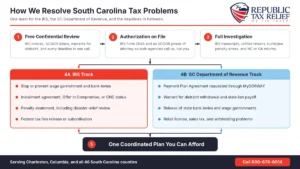
What happens after you call
- Confidential consultation. A short call about your letters, deadlines, and monthly budget.
- Authorization on file. We file IRS Form 2848 so the IRS contacts us instead of you, plus an SCDOR power of attorney for state matters.
- Full investigation. We pull IRS transcripts, check for warrants for distraint and state levies, look for hurricane penalty errors, and review any North Carolina or Georgia returns.
- Protection first. Where the law allows, we act to stop the IRS and the state from levying while we build your case.
- One coordinated plan. We negotiate in the right order and explain every option in plain English.
| Common concern | How we handle it |
|---|---|
| “The state already froze my bank account, so I can’t get a payment plan.” | We contact the SCDOR, confirm the balance, and work on resolving the levy so a plan becomes possible. |
| “The IRS and South Carolina both want monthly payments.” | We build both plans from one household budget so neither falls apart. |
| “I’m selling my house and a warrant showed up.” | We get payoff figures, request withdrawals, releases, or subordination where allowed, and keep the closing on track. |
| “Can a California firm really help me in South Carolina?” | Yes. IRS representation works the same in every state, and we handle South Carolina matters under written authority. |
IRS Tax Relief in Charleston, Columbia, and Across South Carolina
A charter boat captain in Mount Pleasant, a state employee in Columbia, and a BMW supplier in Greer face very different tax problems. We start with our two focus cities, then cover every region of the state.
Focus City: Charleston
Charleston’s tax problems often trace back to tourism, real estate, and the port. Short-term rental income, restaurant tips, boat and aerospace jobs, and storm-related gaps in filing all show up in our Lowcountry cases.
Restaurant owners, hospitality workers, and rental hosts.
Self-employed professionals, boat captains, and investors.
Port, logistics, and aerospace workers, plus military families.
Homeowners, contractors, and families with two incomes.
Focus City: Columbia
Columbia is home to the State House, the SCDOR headquarters, the university, and Fort Jackson. That means many government employees, soldiers, students with side income, and small businesses serving all of them.
State workers, lawyers, and bar and restaurant owners.
Family businesses and Lake Murray homeowners.
Soldiers, veterans, and military spouses.
Tradespeople, truckers, and warehouse workers.
Regions and Cities We Serve Across South Carolina
Upstate
Cities: Greenville, Spartanburg, Greer, Anderson, Simpsonville, Clemson
Manufacturing employees, engineers, and growing small businesses.
Grand Strand and Pee Dee
Cities: Myrtle Beach, North Myrtle Beach, Conway, Florence
Seasonal workers, golf and hospitality businesses, and retirees.
Lowcountry South
Cities: Hilton Head Island, Bluffton, Beaufort
Vacation rental owners, Marines and families, and second-home buyers.
Charlotte Metro, SC Side
Cities: Rock Hill, Fort Mill, Tega Cay, Indian Land
Two-state commuters and fast-growing new households.
Midlands and Central
Cities: Sumter, Orangeburg, Camden, Newberry
Shaw Air Force Base families, farmers, and small-town shops.
Aiken and the CSRA
Cities: Aiken, North Augusta, Edgefield
Savannah River Site contractors, horse farm owners, and Georgia commuters.
Don’t see your town? We help taxpayers in all 46 South Carolina counties, from the Blue Ridge to the barrier islands. Call 800-676-6014 and we will tell you right away whether we can help. You can also browse all of our service locations.
Expert Insight: The Risks of Dealing With IRS Tax Problems Alone or With AI
Many South Carolinians try to handle a tax problem on their own first, and more now ask chatbots to write their IRS letters. We understand that. But self-managed cases tend to go wrong in a few predictable ways, and some mistakes cannot be undone.
- Missing a disaster penalty error. If the IRS charged penalties for a postponed period, the fix is often a simple request. People who just pay the bill never get that money back.
- Your financial statement is sworn. Payment plans and settlements often require a Collection Information Statement signed under penalty of perjury. Once the IRS has your numbers, they shape every later decision.
- Allowable expenses depend on your county. The IRS uses local housing and utility standards. A family in Charleston County may be allowed different amounts than one in Marlboro County, and generic advice usually misses it.
- Fixing the IRS can break the state plan. The SCDOR will not give a payment plan while a levy is active. Getting the order wrong can lock you out of the simplest state option.
- Trusting AI on new South Carolina rules. Chatbots often describe the old brackets, the old deduction rules, or an expired hurricane deadline as if it still applies. A confident wrong answer leads to a costly decision.
- Pasting private data into public tools. Uploading returns, bank statements, or your Social Security number to a free chatbot creates a privacy risk you cannot take back. AI also cannot sign a power of attorney, pull transcripts, or speak with a revenue officer.
Our take: AI is fine for learning what a term means. A licensed enrolled agent, CPA, or tax attorney should make the decisions and give the advice. We explain why in Can AI get a better settlement than a tax attorney?
Want to read more first? Try our Offer in Compromise guide, IRS payment plans explained, and tax negotiation insights.
Why South Carolina Taxpayers Choose Republic Tax Relief
Hiring help with tax debt is a trust decision. Since 2005, founding partner Mark Ladd and our in-house team of enrolled agents, CPAs, and tax attorneys have provided IRS representation and tax relief services that help resolve tax problems for individuals and businesses nationwide. We work every case ourselves, with no outsourcing.
| Cases resolved | 18,000+ |
| Client balances settled | $220M+ |
| Average client rating | 4.9 / 5 |
| Credentials | Enrolled agents, CPAs, and tax attorneys |
| Scheduling | Eastern time morning, lunch, and evening call windows |
| Languages | English and Spanish |
- Federal and South Carolina handled together. One team, one budget, one plan for every agency.
- Disaster relief know-how. We check postponed periods for penalties that should not be there.
- Two-state experience. North Carolina and Georgia returns are part of our everyday work.
- Results-focused approach. We recommend the option that fits your finances, not the one that sounds best in an ad.
- Honest answers. If a settlement is not realistic, we say so and show you a better path.
- Recognized work. See our awards and recognition.
Results vary based on each taxpayer’s facts and finances. Past results do not guarantee a similar outcome.
Your secrets stay sealed. Your files stay encrypted.
South Carolina Tax Relief Frequently Asked Questions
Can you help me if you don’t have an office in South Carolina?
Yes. IRS cases are handled by phone, mail, and secure online systems, and we represent you under a signed power of attorney. Our team works from California and serves clients in Charleston, Columbia, and all 46 South Carolina counties.
I owe both the IRS and the South Carolina Department of Revenue. Can you handle both?
Yes. We review both balances, build one household budget, and negotiate with the IRS and the SCDOR in the right order so the two plans fit together.
What is a warrant for distraint in South Carolina?
It is the SCDOR’s main tool for unpaid state tax. Once recorded with the county clerk of court, it works like a state tax lien against your property and allows the state to pursue levies.
Can I get an SCDOR payment plan if my bank account is already levied?
Generally not. The SCDOR does not set up a Payment Plan Agreement while a levy or garnishment is active, and you must first receive a notice. A professional can work on the levy and the plan in the right order.
Was I charged penalties I didn’t owe because of the hurricane?
Possibly. The IRS has acknowledged that some South Carolina taxpayers received penalty assessments in error for a hurricane relief period. If a notice shows penalties for a postponed period, have it reviewed before you pay.
What should I do after a Final Notice of Intent to Levy?
Act quickly. You generally have 30 days from the notice date to request a Collection Due Process hearing, which can pause the levy while your case is reviewed. Call a licensed tax professional before that window closes.
Can I settle IRS debt for less than the full amount owed?
Sometimes. The IRS accepts an Offer in Compromise when your income, expenses, and assets show you cannot pay the full balance before the collection period ends. Many people do not qualify, so we review your finances before recommending it.
Do you handle county property tax or city business license debt?
Our core work is IRS and South Carolina state tax debt. Bring any county or city notices to your consultation. We will explain how they affect your overall plan and tell you plainly if a local issue needs a different specialist.
What should I bring to my free confidential consultation?
Any IRS or SCDOR letters, your latest tax return if you have one, any North Carolina or Georgia returns, and a rough idea of your monthly income and bills. If records were lost in a storm, we can request IRS transcripts for you.
More answers: tax resolution questions, IRS collections defense questions, penalty abatement FAQs, and IRS payment plan questions.
Sources
- IRS: Tax relief for victims of Hurricane Helene in South Carolina
- South Carolina Department of Revenue: Notices and Compliance
- Office of Governor Henry McMaster: Income tax bill signing
Republic Tax Relief is a private firm and is not affiliated with the IRS, the South Carolina Department of Revenue, or any South Carolina county or municipality. This page offers general guidance, not legal or tax advice for your specific situation. Tax laws, deadlines, and agency procedures change, so consult a qualified tax professional or contact the agency directly before acting.
Speak With a Tax Relief Professional About Your South Carolina Tax Debt
Storms pass. Tax debt does not. One call can show you the way out.
Whether the letter came from the IRS, Columbia, or both, a short call shows you where you stand, what is at risk, and which options fit. Your consultation is free and confidential.
About Republic Tax Relief
Republic Tax Relief helps individuals and businesses nationwide resolve IRS and state tax problems, including back taxes, levies, liens, unfiled returns, audits, and payroll tax debt. Since 2005, our in-house team of enrolled agents, CPAs, and tax attorneys has resolved more than 18,000 cases. From our offices in Corona and Laguna Hills, California, we represent clients in all 50 states, including South Carolina. Call 800-676-6014 or contact us online for a free, confidential consultation.