
Owing the IRS money you don’t have is stressful, but it is also one of the most common tax problems there is. A payment plan, formally called an installment agreement, can stop most levies and turn one big bill into a monthly payment.
The hard part is that the IRS decides what you can afford, and its math often leaves out costs you really pay. Our in-house enrolled agents, tax attorneys, and CPAs take over IRS contact, check every number, and negotiate a plan that fits your actual budget.
- Helping taxpayers since 2005
- 18,000+ cases resolved
- A+ BBB rating
- In-house EAs, tax attorneys, and CPAs
Got a balance-due notice or a levy warning?
Interest and penalties grow every month you wait. Find out today which plan you qualify for and what your payment should be.
How Our Payment Plan Help Works
You should not have to sit on hold with the IRS or guess which form to file. Once you hire us, we handle the process from start to finish.
- Free, confidential review. We go over your notices, deadlines, and goals, then explain your options in plain English.
- Power of attorney and records. We file IRS Form 2848 so the IRS talks to us, then pull your IRS transcripts to confirm what you really owe.
- Balance clean-up. We look for penalties that can be removed and check your collection deadline before picking a plan.
- Negotiation. We prepare any required financial statement using IRS expense standards and push for the lowest payment the rules allow.
- Follow-through. We watch for IRS letters, help you avoid default, and step in if your income changes.
What You Get That the IRS Website Won’t Give You
- A second look at the balance. IRS records are not always right, and some penalties can be removed.
- A payment based on every allowed expense. Leaving out a single cost can raise your payment by hundreds of dollars a month.
- The right plan for your collection deadline. In some cases, paying less each month is legal and the smarter choice.
- A buffer between you and the IRS. Calls, letters, and revenue officer visits go through us.
Signs You Need Professional Help
If you owe a small amount and can pay it off quickly, you can often set up a plan on your own. Bring in a professional if any of these apply to you:
| Your Situation | Why It Matters |
|---|---|
| You owe more than $50,000 | The IRS requires a full financial statement, and your payment comes from its formula. |
| A levy, garnishment, or final notice has arrived | Deadlines are short, and a missed one can cost you appeal rights. |
| A revenue officer is assigned to you | Field collection moves fast and can include visits to your home or business. |
| You owe payroll taxes | Owners can become personally liable for unpaid trust fund taxes. |
| You have unfiled returns | Most long-term plans are blocked until every return is filed. |
| You can’t afford the payment the IRS wants | You may qualify for a partial payment plan or a collection pause instead. |
A word of caution: Please don’t negotiate with the IRS based on a generic AI chatbot or a do-it-yourself online estimate. Those tools can’t see your IRS transcripts, your collection deadline, or the expense limits for your county, and one wrong number can lock you into a payment you can’t keep.
Have questions about how representation works? See our payment plan representation FAQ.
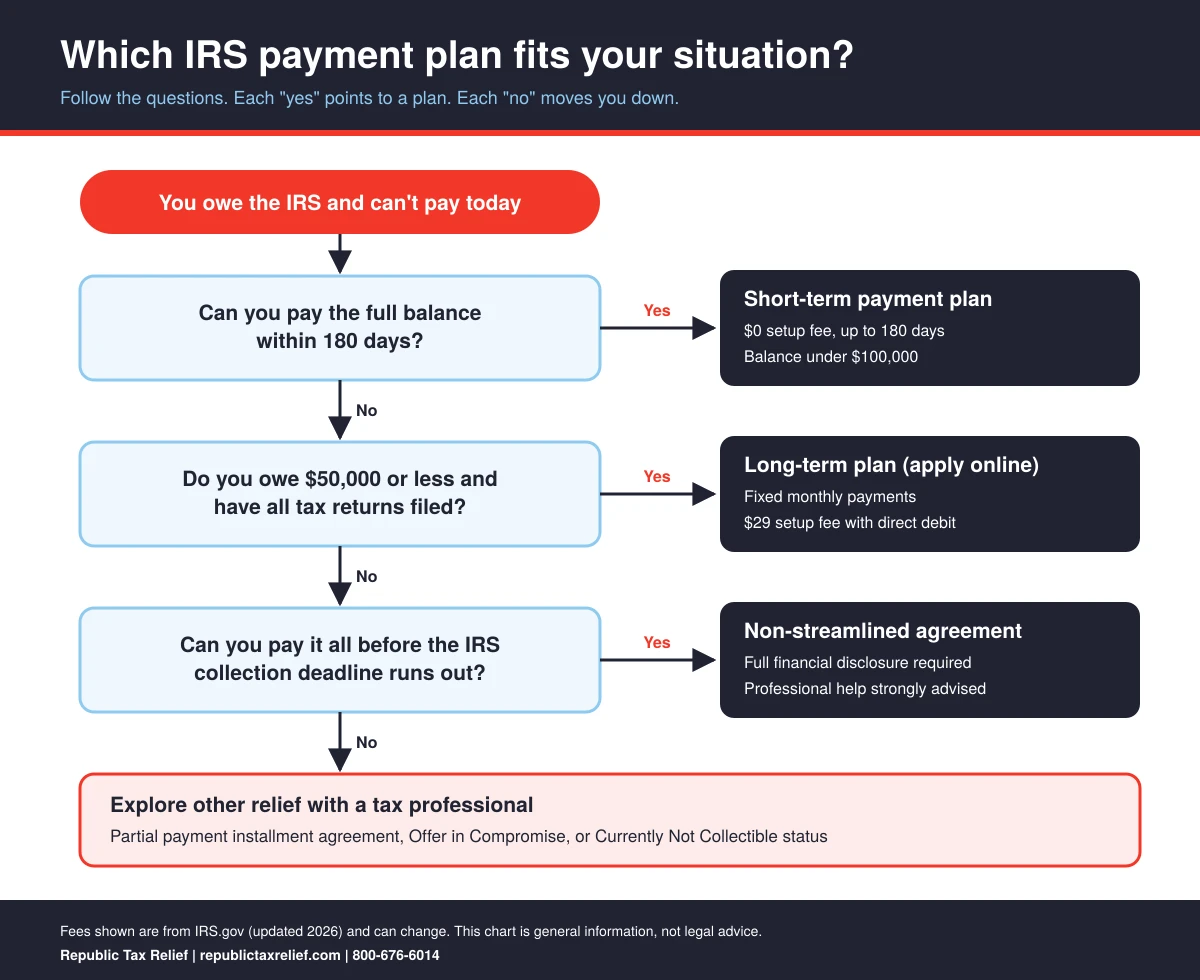
Which IRS Payment Plan Fits You?
The right plan depends on how much you owe, how fast you can pay, and whether your returns are filed. Here is a quick overview.
| Plan | Best For | Balance Limit | Financial Statement? |
|---|---|---|---|
| Short-term plan | Paying in full within 180 days | Under $100,000 | No |
| Simple payment plan | Monthly payments on a moderate balance | $50,000 or less ($25,000 for business trust fund taxes) | No |
| Non-streamlined installment agreement | Larger balances you can still pay in full in time | Above Simple plan limits | Yes |
| Partial payment installment agreement | When you can’t pay it all before the collection deadline | Case by case | Yes, detailed |
Source: IRS.gov, updated 2026.
What Changed in 2026
The IRS replaced its old streamlined rules with Simple payment plans. Qualifying balances can now be paid through the collection deadline, usually 10 years from assessment, instead of a strict 72-month limit (IRS Simple Payment Plans).
A longer term means a smaller monthly payment, but more interest overall. The cheapest plan is still the shortest one you can comfortably keep.
Want a deeper look at each plan type? Read our guide, IRS payment plans explained.
How the IRS Calculates Your Monthly Payment
When the IRS reviews your finances, it doesn’t ask what you’d like to pay. It uses a simple ability-to-pay formula, and the result becomes your monthly payment.
What Each Part Means
- Monthly income: Wages, self-employment profit, Social Security, pensions, rent you collect, and any other money coming in. The IRS checks it against pay stubs and bank statements.
- Allowable living expenses: Costs the IRS lets you keep paying, based on its Collection Financial Standards. These cover food, clothing, housing, utilities, car costs, health care, and current taxes, and many are capped by family size and county.
- IRS monthly payment: What is left over. The IRS expects that amount to go toward your tax debt.
To see whether a payment will clear the debt in time, compare it with this quick check:
Interest (7% a year for the fourth quarter of 2026, compounded daily) and penalties come on top of that, so the real amount needed is higher (IRS Newsroom).
Example: How One Missed Expense Changes Everything
Lisa is a self-employed hair stylist who owes $62,000. Because she owes more than $50,000, the IRS asks for a financial statement. Here is her monthly budget (sample numbers only):
| Item | Lisa Fills It Out Alone | After Professional Review |
|---|---|---|
| Monthly income | $6,200 | $6,200 |
| Housing and utilities | $2,150 | $2,150 |
| Car payment and operating costs | $900 | $900 |
| Food, clothing, and personal care | $1,050 | $1,050 |
| Health insurance and medical costs | Left off | $550 |
| Current-year estimated tax payments | Left off | $700 |
| Payment the IRS expects | $2,100 | $850 |
Two missing lines would have cost Lisa $1,250 more every month, a payment she could never keep up with.
Sample Payment Estimates
Here is how the formula plays out in three common situations. Find the one closest to yours.
| Small Balance | Lisa (Example Above) | Larger Balance | |
|---|---|---|---|
| Total balance owed | $24,000 | $62,000 | $95,000 |
| Months left before collection deadline | 108 | 108 | 60 |
| Payment needed before interest | About $222 | About $574 | About $1,583 |
| Monthly income minus allowable expenses | Not required | $6,200 − $5,350 = $850 | $7,400 − $6,600 = $800 |
| Likely plan | Simple payment plan. You choose a payment that clears the balance in time. | Non-streamlined agreement at about $850 a month. | Partial payment installment agreement may fit, since $800 can’t clear the debt in time. |
Sample numbers for illustration only. Real results depend on IRS expense caps, interest, penalties, and your exact collection deadline.
Why a do-it-yourself estimate is risky: The IRS caps many expenses at local standards, may refuse costs you consider necessary, and can ask for months of bank records to prove each one. A professional review makes sure every allowable expense is counted and backed up the way the IRS requires.
Want your real number, not an estimate?
We’ll pull your IRS transcripts, apply the correct expense standards, and tell you the lowest payment you qualify for. The review is free and confidential.
What a Payment Plan Costs
Every plan has two layers of cost: a one-time IRS setup fee, plus the interest and penalties that keep growing until the balance is paid.
| How You Apply | Payment Method | IRS Setup Fee |
|---|---|---|
| Online | Direct debit from checking | $29 |
| Online | Other payment method | $69 |
| Phone, mail, or in person | Direct debit | $107 |
| Phone, mail, or in person | Other payment method | $178 |
| Low-income taxpayers | Direct debit | Waived |
| Short-term plan (180 days or less) | Any | $0 |
Source: IRS.gov, updated 2026. Fees can change.
Client Review
“I don’t usually leave reviews, but this one is very earned! After a pretty frustrating experience elsewhere, working with Ryan and Rebecca at Republic Tax Relief was a completely different story. They were both incredibly clear, professional, and just easy to work with. They helped me tackle back taxes that I’d been putting off because it felt so overwhelming. Ryan especially made sure I understood every step, which I really appreciated. Thank you you both so much!” ~Dela Meskienyar
Interest and Penalties
Interest is reset every quarter and compounds daily, and it continues while you are on a plan (IRS interest rules). The late-payment penalty is normally 0.5% a month, but it drops to 0.25% while an approved plan is in place if you filed on time (IRS penalties).
That is why we check for penalty relief before a plan starts. Every dollar removed up front is a dollar you don’t pay interest on for years.
Business and Payroll Tax Payment Plans
Businesses can’t apply for a plan online. Owners have to call the IRS business line or work through a representative.
Payroll tax debt deserves extra care. The withheld portion belongs to your employees, and the IRS can hold owners and managers personally liable through the Trust Fund Recovery Penalty. To get and keep a business plan, you generally need:
- All payroll and income tax returns filed
- Current deposits made on time through the Electronic Federal Tax Payment System (EFTPS)
- A business financial statement, often Form 433-B, for larger balances
Falling behind on deposits can end a plan and lead to a fast levy on business accounts. Learn more about payroll tax debt relief and IRS collections defense.
Already facing a levy, garnishment, or revenue officer?
Asking for a payment plan can pause most levies. Let us file it correctly the first time.
Keeping Your Plan in Good Standing
Getting approved is only half the job. The IRS can cancel a plan if you miss a payment, skip a tax return, or run up a new balance. To stay safe:
- Pay at least the required amount on time, every month.
- File every future tax return by the deadline.
- Pay new taxes in full, including estimated payments if you’re self-employed.
- Expect future refunds to go toward your debt, and keep paying anyway.
If a payment slips, the IRS usually sends a warning notice first, and many plans can be reinstated if you act quickly. If a plan ends, the IRS can move to wage garnishment or a bank levy, so read every letter and check our guide to IRS notices.
A federal tax lien can still be filed while you’re on a plan, especially on larger balances. Our tax lien help page explains release and withdrawal options.
When a Payment Plan Is Not the Right Fit
Payment plans work best when you can eventually pay the full balance. If you can’t, paying for years may only delay a bigger problem. Other paths include:
- Offer in Compromise: Settle for less than you owe if you qualify. See how the OIC program works and our article on the Fresh Start program.
- Currently Not Collectible status: Pauses collection when paying would cause real hardship. Learn about Currently Not Collectible status.
- Penalty relief: Removes penalties for reasonable cause or a clean history. See IRS penalty abatement.
- Other legal options: Some older tax debts can be handled in other ways. Our attorney explains whether bankruptcy gets rid of tax debt.
State agencies like the California Franchise Tax Board run their own plans with different rules. We work with clients across Southern California, including Corona, Irvine, and Murrieta, and with taxpayers nationwide on both IRS and state back taxes. Compare all your tax debt relief options or see our full tax resolution services.
Frequently Asked Questions
Do penalties and interest stop once I’m on a plan?
No. Interest and penalties continue until the balance is paid in full. However, the late-payment penalty drops from 0.5% to 0.25% per month during an approved plan if you filed your return on time.
Can I set up a payment plan if I have unfiled tax returns?
Usually not for a long-term plan. The IRS requires all returns to be filed first. A tax professional can help you file missing returns and request a plan at the same time.
What is the cheapest way to set up a payment plan with the IRS?
Paying in full within 180 days has no setup fee. For a long-term plan, applying online with direct debit carries the lowest fee, currently $29, and low-income taxpayers may have the fee waived.
What if I already have a payment plan I can’t afford?
You can ask the IRS to lower it. Individuals can revise a plan online for a $6 fee, or by phone or mail for $89. If your income dropped, a new financial statement may support a lower payment, a partial payment plan, or a collection pause.
Can I have an IRS plan and a state plan at the same time?
Yes. The IRS and state agencies like the California Franchise Tax Board run separate plans with separate rules. Both payments have to fit your budget, so it helps to plan them together before either agency locks in an amount.
How long does it take to get a payment plan approved?
Simple plans requested online are often approved the same day. Plans that need a financial statement can take several weeks or longer, depending on IRS review. Most levies are generally paused while a request is pending.
Find More Answers about IRS payment plan Representation
Speak With a Tax Relief Professional
You don’t have to guess which plan is right or deal with the IRS alone. One conversation can show you your real options and a payment that fits your life.
Get professional help with your IRS debt today.
Free, confidential review. No pressure. Clear answers about your options and costs before any work starts.
🔒 Your privacy is protected. Every tax return, bank statement, and Social Security number you share stays strictly confidential, transmitted and stored securely, and seen only by the professionals working your case.
About Republic Tax Relief
Republic Tax Relief helps individuals, families, and business owners resolve IRS and state back taxes. Since 2005, our in-house enrolled agents, tax attorneys, and CPAs have resolved more than 18,000 cases, and we hold an A+ rating with the BBB. Call 800-676-6014 or visit our contact page to get started.
Keep Learning
- IRS Payment Plans Explained: Types, Fees, and How to Choose
- Payment Plan Representation: Your Questions Answered
- Back Tax Help
- Frequently Asked Questions About Hiring a Tax Relief Company
Sources and References
- IRS: Payment Plans; Installment Agreements
- IRS: Simple Payment Plans for Individuals and Businesses
- IRS: Collection Financial Standards
- IRS: Interest Rates for the Fourth Quarter of 2026
- IRS: Publication 594, The IRS Collection Process
- IRS: Interest and Penalties
- IRS: Taxpayer Bill of Rights
Disclaimer: This page provides general information, not legal or tax advice. IRS fees, thresholds, and rules change. Sample figures are for illustration only. Contact a qualified tax professional about your specific situation.