
Oct
A balance-due notice from the IRS can make your stomach drop. The good news is that owing money you can’t pay today is one of the most common tax problems in the country, and the IRS has a set system for handling it.
The hard part is picking the right agreement. The type you choose affects your setup fee, how long you have to pay, whether the IRS asks for your financial records, and whether a tax lien gets filed. This guide compares every option in plain English, including the rule changes that took effect in 2026.
Installment Agreement Basics: What Every Plan Has in Common
Installment agreement is the IRS’s formal name for a long-term payment plan. It lets you pay your tax debt over time instead of all at once. Short-term plans give you up to 180 days to pay in full.
No agreement erases what you owe, but every type gives you breathing room. While a request is pending and while a plan is active, the IRS generally can’t levy your wages or bank accounts.
- Every plan does: stop most levies, turn one large bill into a predictable payment, and cut the late-payment penalty in half for many taxpayers.
- No plan does: stop interest from building, remove an existing tax lien on its own, or protect future refunds, which the IRS keeps and applies to your balance.
Practical takeaway: Request a plan before the IRS sends a final notice of intent to levy. It is much easier to set up a plan than to undo a levy after money has left your account.
The 5 Types of IRS Installment Agreements Compared
The right agreement depends mostly on how much you owe and whether you can pay the full balance before the IRS collection deadline. That deadline, called the collection statute expiration date, is usually 10 years from the date the tax was assessed.
| Agreement Type | Balance Limit | Time to Pay | Financial Statement? | Best For |
|---|---|---|---|---|
| Short-term payment plan | Under $100,000 | Up to 180 days | No | A bonus, refund, or sale is coming soon |
| Guaranteed installment agreement | $10,000 or less in tax | Up to 3 years | No | Small balances with a clean filing history |
| Simple payment plan (formerly streamlined) | $50,000 or less (individuals) | Up to the collection deadline | No | Most individuals who need monthly payments |
| Non-streamlined installment agreement | Over $50,000 | Up to the collection deadline | Yes (Form 433-F or 433-A) | Larger balances you can still pay in full |
| Partial payment installment agreement (PPIA) | Case by case | Until the collection deadline | Yes, full review | When you can’t pay it all in time |
Sources: IRS Payment Plans; Installment Agreements and IRS Simple Payment Plans.
1. Short-Term Payment Plan
This isn’t technically a long-term agreement, but it is often the cheapest option. You get up to 180 days to pay in full with no setup fee. Interest and penalties still apply until the balance is paid.
2. Guaranteed Installment Agreement
The IRS must approve this plan if you owe $10,000 or less in tax (not counting penalties and interest), can pay within three years, and have filed and paid on time for the past five years without another plan. It is a small but useful safety net for people with a good track record.
3. Simple Payment Plan
This is the most common route. Individuals qualify with $50,000 or less in combined tax, penalties, and interest. Businesses qualify with up to $25,000 if trust fund taxes are involved, or $50,000 if they are not.
The IRS doesn’t require a financial statement or a lien determination for these plans, and most people can apply online.
4. Non-Streamlined Installment Agreement
Owe more than $50,000? The IRS will ask for a detailed financial statement and set your payment based on what it believes you can afford. See how the IRS calculates your monthly payment for the formula it uses.
5. Partial Payment Installment Agreement (PPIA)
A PPIA lets you pay a monthly amount you can actually afford, even if it won’t clear the full balance before the collection deadline. Whatever is left when the deadline passes is generally no longer collectible.
The trade-off is a detailed review of your income, expenses, and assets, and the IRS may check your finances again every two years.
Example: Maria owes $68,000 and can afford $400 a month after basic living costs. That won’t clear the debt in time, so a standard plan doesn’t work. A PPIA built around a carefully documented budget may be her best option.
Business owners with payroll tax balances have extra rules to consider. See our guide to payroll tax debt relief.
Simple Plan vs. Partial Payment Agreement: Side by Side
These two are the most often confused. Here is how they differ.
| Simple Payment Plan | Partial Payment Installment Agreement | |
|---|---|---|
| Pays off the full balance? | Yes | No, the rest may expire at the collection deadline |
| Financial statement | Not required | Required, with proof of income and expenses |
| How the payment is set | You choose an amount that clears the balance in time | The IRS sets it based on your ability to pay |
| Can apply online? | Usually, for individuals | No |
| Ongoing reviews | None | Possible every two years |
| Asset review | No | Yes, the IRS may ask you to use equity first |
What Changed for IRS Installment Agreements
A lot of older advice online is now out of date. These are the changes that matter most:
- Streamlined became “Simple.” The IRS now processes streamlined agreements under its Simple payment plan rules.
- No more strict 72-month limit. Simple plans can now run up to the collection deadline, which means lower payments for many people (but more interest).
- Business plans expanded. Since December 3, 2025, more businesses qualify for Simple plans, including longer terms for trust fund balances up to $25,000 (CPA Practice Advisor).
- Direct debit is no longer required for individual Simple plans between $25,000 and $50,000.
- Automatic penalty relief. The IRS’s new Automatic Exemption from Penalty program can skip late-filing and late-payment penalties for taxpayers with a clean three-year history (IRS).
Installment Agreement Fees
The IRS charges a one-time user fee to set up a long-term plan. How much you pay depends on how you apply and how you pay each month (IRS):
| Plan and Payment Method | Apply Online | Apply by Phone, Mail, or In Person |
|---|---|---|
| Short-term plan (180 days or less) | $0 | $0 |
| Long-term plan with automatic bank debit | $29 | $107 |
| Long-term plan with other payment methods | $69 | $178 |
| Low-income taxpayers with automatic debit | Waived | Waived |
| Low-income taxpayers, other methods | $43 (may be reimbursed) | $43 (may be reimbursed) |
| Changing an existing plan | $6 | $89 |
Practical takeaway: Applying online with automatic bank debit is the cheapest long-term setup, and it protects you from accidentally missing a payment.
How Term Length Changes What You Pay
Now that Simple plans can run longer, it’s tempting to pick the lowest payment. But a longer term means more months of interest. The IRS charges 7% a year for the fourth quarter of 2026, compounded daily, and resets the rate every quarter (IRS Newsroom).
Here is how it plays out for James, who owes $30,000 (sample numbers, interest only, rounded):
| Term | Monthly Payment | Total Paid | Interest Cost |
|---|---|---|---|
| 3 years (36 months) | About $926 | About $33,350 | About $3,350 |
| 6 years (72 months) | About $511 | About $36,830 | About $6,830 |
| 9 years (108 months) | About $375 | About $40,500 | About $10,500 |
Assumes a steady 7% rate. The late-payment penalty (usually 0.25% a month on an approved plan) adds more on top.
Practical takeaway: Pick the shortest term you can truly keep up with, and pay extra when you can. There is no prepayment penalty, and every extra dollar cuts future interest.
How to Choose the Right Agreement: 4 Questions
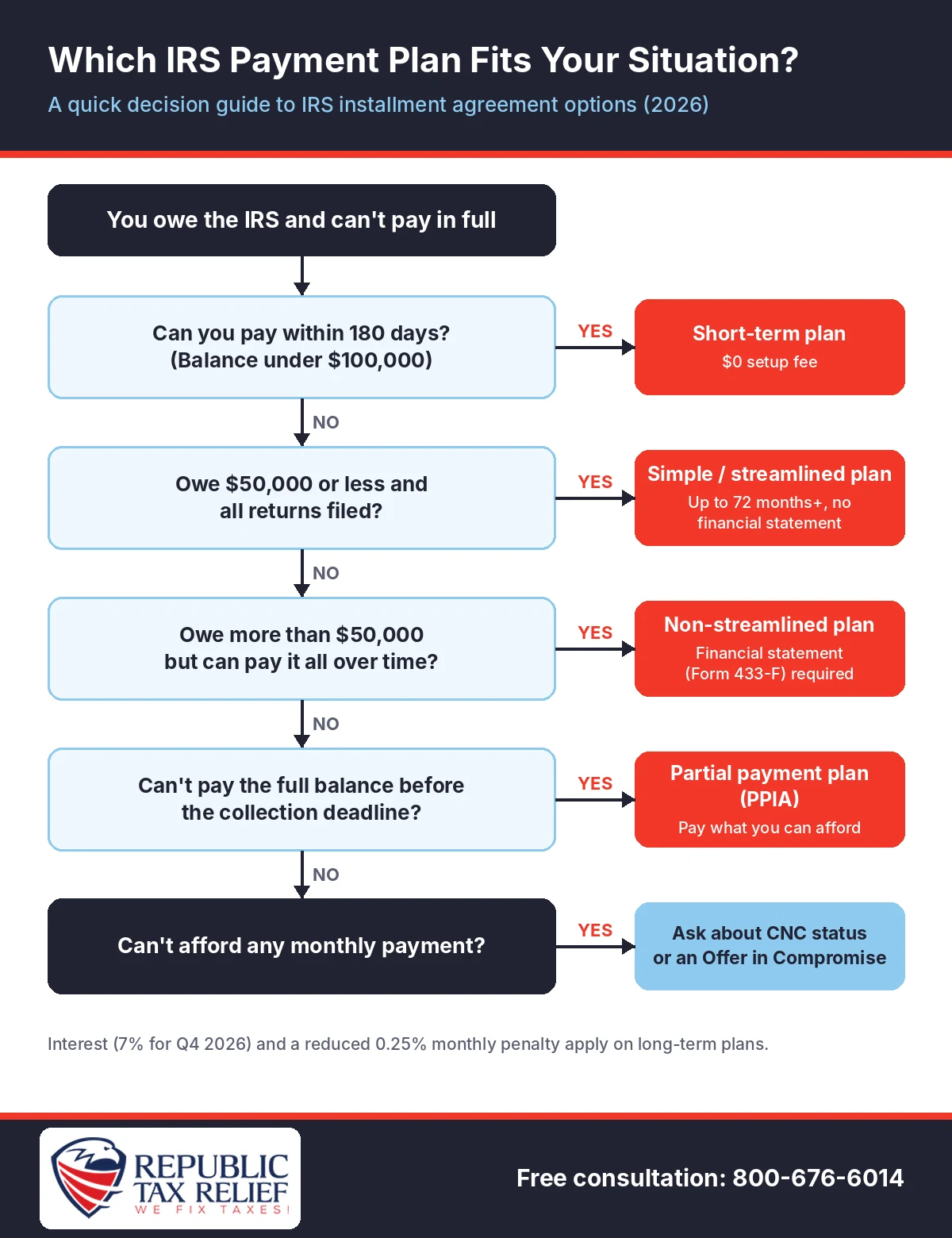
- Can you pay in full within 180 days? Use a short-term plan and skip the setup fee.
- Do you owe $50,000 or less with all returns filed? A Simple plan is usually the easiest route.
- Do you owe more, but can pay it all before the collection deadline? Expect a non-streamlined agreement and a financial statement.
- Is your budget too tight to pay it all in time? Look at a PPIA, Currently Not Collectible status, or an Offer in Compromise.
Every required tax return must be filed before most long-term plans are approved. If you’re behind, start with our guide to unfiled tax returns.
Mistakes That Can Cancel Your Installment Agreement
Getting approved is only half the job. The IRS can end your agreement if you break its terms, and then collection can start again.
- Missing a payment: The IRS usually sends Notice CP523 before ending the plan, which gives you about 30 days to respond.
- Owing new tax: A new balance next April can put the whole plan in default. Adjust your withholding or estimated payments now.
- Filing late: Every future tax return must be filed on time.
- Ignoring IRS notices: A missed letter can lead to a missed deadline. Our guide to IRS notices explains what each one means.
What About Tax Liens?
On larger balances, the IRS may file a Notice of Federal Tax Lien even after you agree to a plan. A lien can make it harder to sell property or get financing. Our tax lien help page explains release and withdrawal options.
Practical takeaway: If you get a CP523, act right away. Many defaulted plans can be reinstated inside the 30-day window.
When an Installment Agreement Isn’t the Right Fit
A long-term plan works when you can make steady monthly payments. If your finances can’t support one, other options may fit better:
- Currently Not Collectible status if you can’t cover basic living expenses.
- An Offer in Compromise if you may qualify to settle for less than you owe.
- Penalty abatement to lower your balance before you lock in a payment.
State tax agencies run their own plans with different rules. Compare all your tax debt relief options before you commit.
When to Get Professional Help
You can set up a Simple plan yourself. For balances over $50,000, a PPIA, payroll taxes, or an active levy, the way your financial statement is prepared can change your payment by hundreds of dollars. Learn more about our IRS payment plan help.
“Republic Tax Relief helped me relieve my Tax debt painlessly, I’m glad that they were able to help me in my situation. If you’re in Tax trouble call Republic Tax Relief 💪🏿”
Paul Bailey, Google Review
Summary: Choosing the Right Installment Agreement
- There are five main options: short-term, guaranteed, Simple, non-streamlined, and partial payment.
- Owe $50,000 or less? A Simple plan usually needs no financial statement and can now run up to the collection deadline.
- Short-term plans are free. Long-term setup fees run from $0 to $178.
- A longer term lowers your payment but raises your total cost.
- Can’t pay it all in time? A PPIA may help.
Installment Agreement FAQs
How long can an IRS installment agreement last?
Short-term plans last up to 180 days. Under the Simple plan rules, long-term agreements can run up to the end of the IRS collection period, which is usually 10 years from the date the tax was assessed.
Does an installment agreement stop wage garnishment?
Generally, yes. The IRS usually does not levy while a plan request is being considered or while a plan is active. If a garnishment is already in place, you may need help getting it released. Learn more about wage garnishment relief.
What is the difference between a streamlined and non-streamlined installment agreement?
A streamlined agreement, now called a Simple payment plan, covers balances of $50,000 or less and needs no financial statement. A non-streamlined agreement covers larger balances, requires a detailed financial statement, and sets your payment based on your ability to pay.
Can I pay off an IRS payment plan early?
Yes. There is no prepayment penalty. You can pay extra any month or pay the full balance at any time, and every extra dollar reduces the interest you owe going forward.
Can I have more than one IRS agreement at a time?
Generally, no. The IRS usually covers all your federal balances under one agreement. If you owe for a new tax year, you can ask to add it to your existing plan, which may raise your monthly payment.
Can the IRS reject my installment agreement request?
Yes. The IRS can reject a request if returns are unfiled, the proposed payment is too low, or financial information is incomplete. You can appeal a rejection, and most levies stay on hold for 30 days afterward.
More questions? See our payment plan representation FAQ.
Speak With a Tax Relief Professional
Not sure which agreement fits? Our team will review your IRS account, explain every option in plain terms, and handle the negotiation for you.
Get a free, confidential review of your IRS balance.
🔒 Your tax returns, Social Security number, and bank statements stay protected by strict client-privilege confidentiality and bank-grade 256-bit encryption, so you can share what we need with complete peace of mind.
About Republic Tax Relief
Republic Tax Relief helps individuals and businesses resolve IRS and state tax debt, stop wage garnishments and bank levies, and get back on solid financial ground. Since 2005, our in-house enrolled agents, tax attorneys, and CPAs have resolved more than 18,000 cases. Call 800-676-6014 for a free, confidential consultation or contact us online.
Sources and References
- IRS: Payment Plans; Installment Agreements
- IRS: Simple Payment Plans for Individuals and Businesses
- IRS: Interest Rates for the Fourth Quarter of 2026
- IRS: Administrative Penalty Relief
- IRS: About Form 9465, Installment Agreement Request
- IRS: Publication 594, The IRS Collection Process
- CPA Practice Advisor: IRS Simple Payment Plans Have Expanded to Businesses
This article is for general information only and is not legal or tax advice. Sample figures are for illustration. Results vary based on each taxpayer’s situation.