
When you owe the IRS money you just don’t have, every envelope in the mailbox can feel like a threat. Maybe you lost a job, got sick, or watched your business slow to a crawl. You want to make things right, but paying the IRS would mean missing rent or skipping groceries.
The IRS has a program built for this exact moment. Currently Not Collectible status tells the IRS to stop active collection because paying now would leave you unable to cover your basic living expenses. This guide explains how it works, who qualifies, what it does and doesn’t do, and when IRS Currently Not Collectible help from a professional is worth it.
Table of Contents
- What Currently Not Collectible Means at the IRS
- How CNC Status Pauses IRS Collection
- Who Can Qualify for Currently Not Collectible
- How the IRS Reviews Your Financial Situation
- How to Request CNC Status
- What to Expect While Your Account Is in CNC
- CNC and the IRS Statute of Limitations
- CNC vs. Other IRS Debt Relief Options
- State Tax Debt and Hardship Programs
- Why Work With a CNC Tax Attorney
- Currently Not Collectible FAQs
- Speak With a Tax Relief Professional
What Does Currently Not Collectible Mean at the IRS?
Currently not collectible (CNC) is a status the Internal Revenue Service places on your account when it agrees you can’t pay your tax debt right now. You still owe the money. The IRS simply agrees to stop trying to collect it for the time being.
According to the IRS, it may delay collection when paying would keep you from meeting reasonable basic living expenses (IRS.gov). You may also hear it called hardship status, IRS uncollectible status, or currently non collectible status. They all describe the same thing.
What CNC Is Not
People often confuse CNC with other programs. Here is what it does not do:
- It does not erase your debt. The balance stays on your account.
- It is not a payment plan. You make no monthly payments while in CNC.
- It is not permanent. The IRS can review your finances and restart collection if your income improves.
If you want a broader look at every path out of tax debt, see our guide to tax debt relief options and how taxpayers get a fresh start.
How CNC Status Pauses IRS Collection Actions
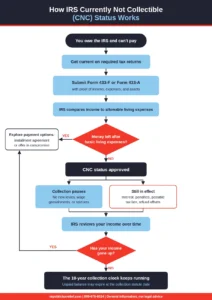
Once the IRS approves your request, it generally stops enforced collection. For most people, that means the fear of losing a paycheck or bank balance finally goes away.
While your account is in CNC, the IRS usually will not:
- Place a new bank levy on your checking or savings account
- Start a wage garnishment through your employer
- Seize property such as vehicles or equipment
- Send a steady stream of demand letters (you will still get a yearly reminder of your balance)
What If a Levy Is Already in Place?
Federal law requires the IRS to release a levy that is causing economic hardship, meaning it leaves you unable to pay basic living expenses (26 U.S.C. § 6343). A strong hardship case can support both a levy release and CNC at the same time. Learn more about how the IRS collection process works and how to stop a levy.
Who Can Qualify for Currently Not Collectible?
Qualifying for CNC comes down to one question: after paying for life’s basic needs, is anything left over? If the answer is no, and you don’t have assets you could sell or borrow against, you may be a good fit.
People who often qualify include:
- Workers who recently lost a job or had hours cut
- People facing serious medical bills or long-term illness
- Retirees or people on disability living on fixed monthly income
- Families whose income barely covers housing, food, and transportation
- Former business owners whose company closed with tax debt left behind
Basic Requirements
The IRS usually looks for these before it will place an account in CNC:
- Your income doesn’t exceed allowable expenses. There is no money left to pay the debt.
- You have little or no equity in assets. This includes home equity, extra vehicles, or investment accounts.
- You are current on required tax filings. If you have missing years, see our page on catching up on unfiled tax returns.
- You provide full financial information. The IRS will not grant hardship status on your word alone.
Can a Business Qualify?
CNC is most common for individuals and for businesses that have closed. An operating business, especially one that owes payroll taxes, faces much tougher review because the IRS expects current taxes to be paid. A professional can help determine if you qualify or whether another option fits your business better.
|
Client Review |
|
“Christina was amazing to work with. She took the time to explain everything clearly and made a stressful situation feel manageable. I never felt rushed or confused, and she was always responsive when I had questions. You can tell she genuinely cares about her clients and wants the best outcome for them. Highly recommend her if you’re dealing with tax issues.” ~Bradley Crowder |
How the IRS Reviews Your Financial Situation
The IRS doesn’t guess about your ability to pay. It uses a collection information statement, usually Form 433-F or the more detailed Form 433-A for individuals, and Form 433-B for businesses (IRS Form 433-F).
These forms list your monthly income, expenses, and assets. The IRS then compares your numbers against its own spending limits, called the Collection Financial Standards (IRS.gov).
How the IRS Measures Living Expenses
| Expense Category | How the IRS Measures It | Examples |
|---|---|---|
| National Standards | Set amounts based on household size | Food, clothing, personal care, housekeeping supplies |
| Out-of-Pocket Health Care | Set amount per person, based on age | Co-pays, prescriptions, doctor visits |
| Local Standards: Housing | Caps based on your county and family size | Rent or mortgage, utilities, insurance |
| Local Standards: Transportation | Caps based on your region | Car payment, gas, insurance, public transit |
| Other Necessary Expenses | Actual costs, if proven and necessary | Health insurance, child care, court-ordered payments, current taxes |
Why the Numbers Matter
Small mistakes can cost you. If you leave out a real expense or overstate income, the IRS may decide you can pay when you actually can’t. A trained professional knows which costs the IRS allows, which ones it questions, and how to document your financial hardship clearly.
How to Request CNC Status
The process to request CNC status is simple on paper but detailed in practice. Here is what it generally involves:
- Get compliant. File any missing tax return the IRS requires.
- Gather proof. Pay stubs, bank statements (often the last three months), bills, and loan statements.
- Complete the financial forms. The IRS will want Form 433-F or Form 433-A with every figure backed up.
- Present the case. Smaller balances may be handled by phone. Larger cases may go to a revenue officer.
- Answer follow-up questions. The IRS reviews your financial information and may ask for more documents.
- Receive a decision. If approved, collection stops and your account moves into CNC.
Some people try to call the IRS on their own. That can work for simple cases, but long hold times, confusing questions, and one missed document can derail a CNC application. Having a representative handle communication with the IRS keeps the process moving and protects you from saying something that hurts your case.
Your privacy matters to us. Your story stays with us. Everything you share, from tax returns to bank statements, is protected by strict confidentiality standards and seen only by the professionals working on your case.
What to Expect While Your Account Is in CNC
CNC status allows you to breathe, but it doesn’t freeze everything. Knowing what continues helps you avoid surprises down the road.
| What Stops | What Continues |
|---|---|
| New bank levies | Interest and penalties keep growing |
| Wage garnishments | The IRS may file a Notice of Federal Tax Lien |
| Property seizures | The IRS may keep future tax refunds |
| Frequent demand letters | You must file and pay future taxes on time |
| Collection calls | The IRS may review your income each year |
Tax Liens During CNC
Being placed in CNC does not stop the IRS from filing a Notice of Federal Tax Lien. A federal tax lien is a public claim against your property that can make selling or refinancing harder. If a lien is already a problem, see our guide to releasing or removing a federal tax lien.
Annual Reviews and Income Changes
The IRS reviews accounts in CNC from time to time, often by checking your tax return for higher income. If your monthly income rises well above your allowable expenses, the IRS may take you out of CNC and ask for payment. Staying current on all new tax filings is the best way to keep your status.
CNC Status and the IRS Statute of Limitations
Here is the part many people don’t know. The IRS generally has 10 years from the date a tax is assessed to collect it. This deadline is called the Collection Statute Expiration Date, or CSED (26 U.S.C. § 6502).
CNC does not pause that clock. If your account stays in CNC until the collection statute runs out, the remaining balance generally expires and the IRS can no longer collect it.
What Can Pause the Collection Clock
Some actions do stop the 10-year clock, which is why strategy matters:
- A pending offer in compromise
- A pending installment agreement request
- A Collection Due Process hearing
- Living outside the U.S. for six months or more
- Filing for bankruptcy (learn more in our article, Does Bankruptcy Get Rid of Your Tax Debts?)
A tax professional can pull your IRS account transcripts, calculate each CSED, and help you choose an option that doesn’t add time to the clock by accident.
Non Collectible Status vs. Other IRS Debt Relief Options
CNC is one tool among several. The best choice depends on your income, assets, and long-term outlook.
| Option | Best For | Monthly Payment | Reduces Debt? |
|---|---|---|---|
| Currently Not Collectible | No money left after basic living expenses | None | No, but debt may expire at the CSED |
| Installment Agreement | Can pay something each month | Yes | No |
| Partial Payment Installment Agreement | Can pay some, but not the full balance before the CSED | Yes, reduced | Remaining balance may expire |
| Offer in Compromise | Can’t pay the full debt, now or in the future | Lump sum or short-term payments | Yes, if accepted |
| Penalty Abatement | Penalties caused by reasonable cause or first-time issues | Not applicable | Penalties only |
When CNC Is a Stepping Stone
For some people, CNC is a pause while life stabilizes. Once income returns, an installment agreement or a program like an offer in compromise may make sense. The IRS uses your ability to pay for both, so the same financial work often serves more than one purpose. Read how the OIC program works or our explainer on the Offer in Compromise and Fresh Start Program.
State Tax Debt and Hardship Programs
Your state tax agency plays by its own rules. Some states offer hardship programs that work like the IRS version, while others offer fewer protections.
In California, for example, the Franchise Tax Board generally has 20 years to collect, twice the federal period. The FTB can also garnish wages and levy bank accounts. If you owe both the IRS and your state, a coordinated plan matters because a win with one agency doesn’t stop the other.
Our team handles federal and state cases together. Learn more about our tax relief services for IRS and state back taxes.
Why Work With a Tax Attorney for Currently Not Collectible Status?
You can apply on your own, but the stakes are high. A denied request can leave levies in place, and a poorly prepared financial statement follows you into future IRS negotiations.
A Currently Not Collectible status attorney can:
- Speak to the IRS for you. With a signed Form 2848, your representative handles the calls and letters.
- Build a stronger hardship case. We document every allowable expense and present it the way the IRS expects.
- Stop active collection quickly. We can request a collection hold while your case is reviewed.
- Protect your long-term options. We check your collection statute dates and plan around them.
- Handle both federal and state tax liabilities. One team, one plan.
Our Tax Resolution Currently Not Collectible Process
- Free, confidential consultation. We listen first and learn about your tax issues.
- Account investigation. We pull your IRS transcripts to confirm balances, years, and deadlines.
- Financial analysis. We compare your monthly income to IRS standards to see if CNC fits.
- Strategy. If CNC isn’t the best path, we tell you honestly and explain your other choices.
- Negotiation. We prepare your forms and deal with the IRS on your behalf.
- Ongoing support. We help you stay compliant so your status holds.
Signs You Should Get IRS Hardship Status Assistance Now
- You received a final notice of intent to levy
- Your bank account or paycheck has already been hit
- You owe several years of back taxes and have unfiled returns
- You owe both the IRS and a state tax agency
If any of these sound familiar, our back tax help services and our complete guide to tax resolution services are good next reads.
Currently Not Collectible FAQs
How long does CNC status last?
There is no set end date. Your account can stay in CNC as long as your financial situation doesn’t improve, up to the end of the 10-year collection period. The IRS may review your income periodically.
Does CNC status hurt my credit?
The IRS does not report to credit bureaus, and the major credit bureaus stopped including tax liens on credit reports in 2018. However, a filed federal tax lien is still public record and can show up when lenders search property records.
Will the IRS take my tax refund while I’m in CNC?
Usually, yes. The IRS can apply future federal tax refunds to your balance while your account is in CNC. Adjusting your withholding can help reduce the amount at risk.
Can I get CNC if I have unfiled tax returns?
In most cases, the IRS expects all required returns to be filed first. A tax professional can help you get compliant and request a collection hold at the same time.
Do penalties and interest keep growing during CNC?
Yes. Interest and some penalties continue to add up until the debt is paid or the collection period ends. That is why it pays to review your options regularly.
Can the IRS take me out of CNC?
Yes. If your income goes up, you stop filing returns, or you take on new tax debt, the IRS may resume collection. Staying compliant protects your status.
Is CNC better than an offer in compromise?
It depends. CNC pauses collection but doesn’t reduce your debt. An offer in compromise can settle your tax debt for less, but it pauses the collection clock and requires a strong case. A professional can compare both for your situation.
Can a business be placed in CNC?
It is possible, especially for businesses that have closed. Operating businesses, particularly those with payroll tax debt, face stricter review and often need a different solution.
Speak With a Tax Relief Professional
You don’t have to face the IRS alone, and you don’t have to choose between paying the IRS and feeding your family. If you can’t afford to pay, CNC may give you the breathing room you need, and we can tell you in one conversation whether it fits.
Call 800-676-6014 or request your free, confidential consultation today.
About Republic Tax Relief
Republic Tax Relief helps individuals and businesses resolve IRS and state tax debt, including back taxes, bank levies, wage garnishments, tax liens, and unfiled returns. Our team of tax professionals, including tax attorneys, handles each case with honesty, discretion, and a clear plan to help you move forward. Call 800-676-6014 or contact us online to get started.
Sources
- IRS: Temporarily Delay the Collection Process
- IRS: Collection Financial Standards
- IRS: About Form 433-F, Collection Information Statement
- IRS: Internal Revenue Manual 5.16.1, Currently Not Collectible
- 26 U.S.C. § 6343, Release of Levy
- 26 U.S.C. § 6502, Collection After Assessment
Disclaimer: This page provides general information, not legal or tax advice. Reading it does not create an attorney-client relationship. Results depend on the facts of each case.