
Falling behind on payroll taxes can feel like the walls are closing in. Maybe cash got tight, a client paid late, or a bookkeeper made a mistake. Whatever the reason, you are not the first business owner in this spot, and you have more options than you think.
This guide explains how payroll tax debt works, why the IRS treats it so seriously, and which relief options can protect your business and your personal assets. You will also learn when it makes sense to bring in a tax professional to deal with the IRS for you.
Table of Contents
- What Unpaid Payroll Taxes Mean for Your Business
- IRS Penalties on Unpaid Payroll Taxes
- The Trust Fund Recovery Penalty Explained
- How IRS Collection Works for Payroll Taxes
- Payroll Tax Relief Options
- State Payroll Taxes and EDD Debt
- Our Payroll Tax Resolution Process
- Why Hire a Tax Relief Professional
- Frequently Asked Questions
- Speak With a Tax Relief Professional
What Is Payroll Tax Debt and Why Does the IRS Treat It Differently?
Payroll taxes are the taxes every employer must withhold from employee paychecks and send to the government. When those deposits are late, short, or never made, the balance becomes a debt owed to the Internal Revenue Service.
What makes this debt different is who the money belongs to. Part of it was taken from your employees’ wages and held “in trust” for the government. The IRS sees unpaid trust fund taxes as money that was never yours to spend, so it collects them faster and harder than most other tax debts.
What Counts as Payroll Taxes?
Most payroll tax obligations are reported on two federal forms:
| Tax Type | Reported On | Who Pays | Trust Fund Tax? |
|---|---|---|---|
| Federal income tax withheld | Form 941 | Employee (withheld by employer) | Yes |
| Employee share of Social Security and Medicare | Form 941 | Employee (withheld by employer) | Yes |
| Employer share of Social Security and Medicare | Form 941 | Employer | No |
| Federal unemployment tax (FUTA) | Form 940 | Employer | No |
Unpaid 941 tax debt is usually the biggest concern because it contains the trust fund portion. Form 940 unemployment tax debt is smaller, but it still builds penalties and interest and can trigger collection.
Common Reasons a Business Falls Behind on Payroll Taxes
- A slow season or a large client who pays late
- Using tax deposits to cover rent, inventory, or wages “just this once”
- A payroll company or bookkeeper who failed to make deposits
- Rapid growth that outpaced cash flow
- Illness, divorce, or a family crisis that pulled attention away from the business
None of these reasons makes you a bad business owner. They do mean it is time to act before the IRS takes the next step.
IRS Penalties and Interest on Unpaid Payroll Taxes
Payroll tax penalties stack quickly. The IRS can charge several penalties on the same quarter, and interest keeps growing on both the tax and the penalties.
The failure to deposit penalty alone climbs based on how late the deposit is, according to the IRS Failure to Deposit Penalty guidance:
| How Late the Deposit Is | Penalty on the Unpaid Deposit |
|---|---|
| 1 to 5 days late | 2% |
| 6 to 15 days late | 5% |
| More than 15 days late | 10% |
| Still unpaid more than 10 days after an IRS notice | 15% |
On top of that, the IRS may add failure-to-file penalties for missing Form 941 returns and failure-to-pay penalties for balances left unpaid. For a business that has missed several quarters, these IRS penalties can add thousands of dollars to the original tax.
The good news is that some of these charges can be reduced or removed. We cover that in the relief options section below.
The Trust Fund Recovery Penalty: When Business Tax Debt Becomes Personal
This is the part many business owners do not know until it is too late. Under Internal Revenue Code Section 6672, the IRS can hold certain people personally liable for the unpaid trust fund portion of payroll taxes.
That means your corporation or LLC does not fully shield you. The trust fund recovery penalty can follow you personally, even if the business closes.
Who Can Be Held Responsible?
The IRS looks for anyone who was both “responsible” and “willful.” According to the IRS page on employment taxes and the Trust Fund Recovery Penalty, this can include:
- Owners, officers, and shareholders
- Partners and LLC members
- Bookkeepers or employees with authority to sign checks or decide which bills get paid
- In some cases, payroll service providers
“Willful” does not require bad intent. If you knew the taxes were owed and chose to pay other bills first, the IRS may treat that as willful.
How the TFRP Process Works
- A revenue officer investigates and often requests an interview using Form 4180.
- The IRS sends Letter 1153, which proposes the penalty against specific people.
- You generally have 60 days to file an appeal.
- If no appeal is filed, the IRS assesses the penalty and can begin personal collection.
The interview and the appeal window are where skilled representation matters most. What you say, and what you sign, can decide whether the penalty lands on you.
How IRS Collection Works When a Business Falls Behind on Payroll
Payroll tax cases move faster than most IRS debts. Many are assigned to a revenue officer, a field agent who can visit your business in person and demand financial records.
Here is what IRS collection can look like if the debt is not addressed:
- Notices and demands: Letters requesting payment and missing Form 941 returns
- Federal tax liens: A public claim against business and personal property. Learn more about tax lien help and lien release.
- Bank levies: The IRS can freeze and take funds from business accounts. See our bank levy help services.
- Accounts receivable levies: The IRS can contact your customers and take payments owed to you
- Wage garnishment: For owners assessed the TFRP, personal wages can be garnished. See wage garnishment relief.
- Asset seizure: In serious cases, equipment, vehicles, or property can be seized
The IRS also watches for “pyramiding,” which happens when a business keeps missing new deposits while old ones remain unpaid. Revenue officers may push hard to stop the pattern, sometimes by pressuring the business to close.
For a deeper look at how collection works and how levies are stopped, read our guide to IRS collections defense.
Payroll Tax Relief Options for Business Owners
Every case is different, but most payroll tax debt resolution plans rely on one or more of the options below. The right choice depends on whether your business is still open, how much you owe, and what you can realistically afford.
Most 941 payroll tax relief starts with one rule that applies to almost every option: the IRS expects you to stay current. That means filing all required returns and making every new payroll tax deposit on time while your old debt is being resolved.
Installment Agreement
An installment agreement lets your business pay the balance over time in monthly payments. For smaller balances, the IRS offers streamlined options for businesses that are still operating, which may not require full financial disclosure.
Larger balances usually require detailed financial statements and negotiation with a revenue officer. A professional can help build a payment plan the IRS will accept and your business can actually afford. Learn more about IRS payment plans and installment agreements.
Offer in Compromise
An offer in compromise allows some taxpayers to settle payroll tax debt for less than the full amount owed. The IRS reviews your income, expenses, and assets to decide what it can reasonably collect.
Payroll offers are harder to win than personal income tax offers, especially for the trust fund portion. The business must be fully compliant before the IRS will even consider it. Read how the OIC program works and our explainer on the offer in compromise or “Fresh Start” program.
Penalty Abatement
Penalties often make up a large share of back payroll taxes. The IRS may remove them if you qualify for first-time abatement or can show reasonable cause, such as a serious illness, a natural disaster, or a payroll provider’s failure.
Removing penalties shrinks the balance and lowers the interest that builds on it. See our guide to IRS penalty abatement.
Currently Not Collectible Status
If paying anything would create real financial hardship, the IRS may place the account in Currently Not Collectible status. Collection pauses, though penalties and interest continue.
This option is rarely available to operating businesses. It is more common for closed businesses or for individuals assessed the trust fund recovery penalty. Learn about Currently Not Collectible status.
Challenging or Reducing the Trust Fund Recovery Penalty
Sometimes the best relief is proving the penalty should not apply to you at all. We review who truly had control over finances and whether the facts support a “willful” finding.
We can also help direct voluntary payments toward the trust fund portion first. This can reduce the amount that can be assessed against you personally.
Comparing Your Relief Options
| Option | Best For | Reduces the Balance? | Stops Collection? |
|---|---|---|---|
| Installment Agreement | Businesses that can pay over time | No (penalties may continue) | Yes, while payments are current |
| Offer in Compromise | Businesses or owners who cannot pay in full | Yes, if accepted | Usually paused during review |
| Penalty Abatement | Taxpayers with a clean history or reasonable cause | Yes, removes penalties | No, used with other options |
| Currently Not Collectible | Closed businesses or owners in hardship | No | Yes, temporarily |
| TFRP Defense | Owners and officers facing personal liability | Yes, if successful | Depends on the case |
For a broader view of every path available, see our overview of tax debt relief options.
State Payroll Taxes and EDD Debt
Federal payroll taxes are only part of the picture. Most states also require employers to withhold state income tax and pay state unemployment insurance.
In California, the Employment Development Department (EDD) collects these taxes and can file liens and levy bank accounts, much like the IRS. Many businesses behind on payroll owe both federal and state tax at the same time.
We coordinate IRS and state cases together, so one agency’s plan does not undercut the other. Learn more about our tax relief services for IRS and state back taxes.
Our Payroll Tax Resolution Process
When you work with Republic Tax Relief, you get a clear plan instead of guesswork. Here is how we resolve your payroll tax problems from first call to final resolution.
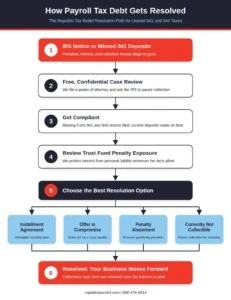
The six-step path Republic Tax Relief uses to resolve unpaid 941 and 940 payroll taxes.
- Free, confidential review. We listen to your situation, review IRS notices, and explain your risks in plain language.
- Protect you right away. We file a power of attorney so the IRS contacts us, not you, and we request a hold on collection when possible.
- Get your filings in order. We help bring missing Form 941 back taxes and 940 returns up to date. If other returns are missing, see our guide to unfiled tax returns.
- Assess personal exposure. We review trust fund recovery penalty risk for every owner and officer.
- Negotiate the best outcome. We present the strongest case for an installment agreement, offer in compromise, penalty abatement, or hardship status.
- Keep you on track. We help you stay compliant so the problem does not come back.
Why Hire a Tax Relief Attorney or Tax Professional for Payroll Tax Issues?
You can contact the IRS yourself. But payroll cases involve revenue officers, personal liability, and fast deadlines, and one wrong answer in an interview can cost you.
An experienced tax team knows how revenue officers think, what documents they expect, and which relief options fit your numbers. That knowledge often means better terms and less stress.
Handling It Alone vs. Working With Republic Tax Relief
| Handling It Alone | With Republic Tax Relief | |
|---|---|---|
| Who talks to the IRS | You | Our licensed professionals |
| TFRP interview | You answer questions without guidance | We prepare you or attend with you |
| Relief options | Easy to miss the best fit | Every option reviewed for your case |
| Deadlines and appeals | Easy to miss | Tracked and handled for you |
| Stress level | High | Much lower |
Why Business Owners Choose Republic Tax Relief
- Experience since 2006 helping individuals and businesses resolve IRS and state tax debt
- Veteran-owned and operated, built on integrity and follow-through
- Nationwide service for federal cases, with deep experience in California state tax matters
- Full-service resolution, from back tax help to lien releases and levy removal
- Honest guidance, including telling you when an option is not a good fit
Want to see how the full process works? Read our complete guide to tax resolution services.
What Our Clients Say
★★★★★
“I can’t thank Republic Tax enough for their help, especially Jennifer, who was absolutely amazing throughout the entire process. She helped me save $15,000 through an Offer in Compromise and represented me in front of the IRS with professionalism and care.
Jennifer was not only incredibly knowledgeable, but also kind, patient, and always available to answer my questions. She made a very stressful situation feel manageable, and I always felt like I had someone truly on my side.
If you’re dealing with tax debt or IRS issues, I highly recommend Republic Tax.”
Robin, Google Review
Results vary based on each client’s unique financial situation. Past results do not guarantee a similar outcome.
Your Information Is Safe With Us
Your story stays between you and your tax professional. Every case is protected by strict attorney-client and tax professional privilege standards, so you can share everything openly and safely.
Frequently Asked Questions About Unpaid Payroll Taxes
Can the IRS hold me personally responsible for my company’s unpaid payroll taxes?
Yes. Through the trust fund recovery penalty, the IRS can hold owners, officers, and others with financial control personally liable for the withheld income tax and employee share of Social Security and Medicare. A tax professional can help you challenge or limit that liability.
Can I settle my payroll taxes for less than I owe?
Possibly. An offer in compromise may allow a business or responsible person to pay less if the IRS agrees it cannot collect the full amount. Payroll offers are held to a high standard, so strong documentation and full compliance are essential.
What happens if my business closes with unpaid 941 taxes?
Closing the business does not erase the debt. The IRS can still pursue the business’s remaining assets and assess the trust fund portion against responsible people personally. For closed businesses, hardship status or an installment agreement may be available.
Can penalties on Form 941 back taxes be removed?
Often, yes. First-time abatement may apply if you have a clean compliance history, and reasonable cause relief may apply if events beyond your control caused the problem. Removing penalties also reduces the interest charged on them.
Will the IRS shut down my business for unpaid payroll taxes?
It can happen, but it is not the first step. Revenue officers are more likely to push for closure when a business keeps missing new deposits. Getting current and working with a professional early is the best way to protect your business.
Does bankruptcy wipe out unpaid payroll taxes?
Trust fund payroll taxes generally cannot be discharged in bankruptcy. Other options are usually a better fit. Read our article on whether bankruptcy gets rid of tax debts for more detail.
How long does it take to resolve payroll tax problems?
Simple installment agreements can be set up in a few weeks. Offers in compromise and trust fund penalty appeals can take several months. We keep you informed at every stage.
Speak With a Tax Relief Professional Today
Payroll tax problems do not fix themselves, and every missed deposit makes the next step harder. The sooner you act, the more options you keep on the table.
Let our team review your case, explain your choices, and deal with the IRS so you can get back to running your business.
Speak With a Tax Relief Professional or call 800-676-6014 for a free, confidential consultation.
About Republic Tax Relief
Republic Tax Relief is a veteran-owned tax resolution firm that has helped individuals and businesses resolve IRS and state tax debt since 2006. Our licensed tax professionals handle unpaid payroll taxes, back taxes, liens, levies, wage garnishments, penalty abatement, and offers in compromise with honesty and care. Call 800-676-6014 or contact us online to schedule your free, confidential consultation.
This page is for general information only and is not legal or tax advice. Every situation is different. Speak with a qualified tax professional about your specific case.
Sources
- Internal Revenue Service, Failure to Deposit Penalty
- Internal Revenue Service, Employment Taxes and the Trust Fund Recovery Penalty (TFRP)
- Cornell Law School Legal Information Institute, 26 U.S. Code § 6672