
A letter from the IRS about unpaid business taxes can make your stomach drop. Maybe payroll deposits slipped during a slow season, or sales tax money went to cover rent. You are not the first business owner in this spot, and there is a way out.
IRS business tax debt works differently from personal tax debt. The IRS moves faster on payroll taxes, and owners can become personally liable for money the business owes. This guide explains your relief options, how collection works, and when to bring in a tax professional who can deal with the IRS for you.
On this page:
- Key Takeaways on Business Tax Debt
- What Is Business Tax Debt?
- Payroll Tax Debt Relief and the Trust Fund Recovery Penalty
- How Penalties and Interest Grow Your Balance
- How the IRS Collects Business Tax Debt
- Business Tax Debt Relief Options
- Sales Tax and State Tax Debt Resolution
- Who Qualifies for a Relief Program?
- How a Tax Professional Helps You Resolve Business Tax Debt
- Common Mistakes That Make IRS Debt Worse
- Tax Planning to Avoid Tax Debt in the Future
- What Our Clients Say
- Frequently Asked Questions
- Speak With a Tax Relief Professional
Key Takeaways on Business Tax Debt
- Payroll taxes come first for the IRS. Owners, officers, and even bookkeepers can be held personally liable for unpaid withholding.
- Penalties and interest stack up fast. Late filing, late payment, and late deposit penalties can push a balance far above the original tax.
- You have real relief options. Installment agreements, an offer in compromise, currently not collectible status, and penalty abatement are the main paths.
- Compliance comes before relief. In most cases, you must file missing returns and stay current on deposits to qualify.
- You do not have to face the IRS alone. A licensed tax professional can speak for you, request collection holds, and negotiate the best outcome.
What Is Business Tax Debt?
Business tax debt is any unpaid federal, state, or local tax your company owes. It often starts small, then grows once penalties and interest kick in. The type of tax you owe shapes how hard the government pushes and which relief options are open to you.
The most common forms of debt we see include:
- Payroll taxes (Forms 941 and 940): Income tax withheld from employees, Social Security and Medicare taxes, and federal unemployment tax.
- Corporate tax debt: Federal income tax owed by a C corporation, plus state income or franchise tax.
- Sales and use tax: Money collected from customers that belongs to the state.
- Pass-through income tax: For sole proprietors, partners, and S corporation owners, business profit flows to the personal tax return and is taxed there.
- Local tax: City business taxes, county property taxes on equipment, and similar local charges.
Who Is Responsible for the Debt?
Your business structure decides whose name is on the bill. Some owners are surprised to learn that forming an LLC or corporation does not fully shield them.
| Business Structure | Who Usually Owes the Tax | Personal Risk for Owners |
|---|---|---|
| Sole proprietorship | The owner personally | All business tax liabilities are personal |
| Partnership | The partnership | General partners may be personally liable |
| LLC | The LLC, based on its tax election | Unpaid payroll withholding can become personal |
| S or C corporation | The corporation | Unpaid payroll withholding can become personal |
Payroll Tax Debt Relief and the Trust Fund Recovery Penalty
When you withhold taxes from employee paychecks, that money never really belongs to the business. The IRS treats it as funds held “in trust” for the government. That is why unpaid 941 tax debt draws faster, more aggressive collection than almost any other tax.
If the business does not pay, the IRS can assess the Trust Fund Recovery Penalty (TFRP) against any “responsible person” who willfully failed to pay. The penalty equals 100% of the unpaid trust fund taxes, which are the withheld income tax and the employee share of Social Security and Medicare (IRS: Trust Fund Recovery Penalty).
Who Can Be a “Responsible Person”?
- Owners and shareholders who control business finances
- Corporate officers, such as the president or CFO
- Managers or bookkeepers with check-signing authority
- Anyone who decides which bills get paid
Why the TFRP Matters So Much
Once assessed, the TFRP becomes your personal debt. It can follow you after the business closes, and it can lead to liens on your home or levies on your personal bank account. Many owners assume bankruptcy wipes it out, but trust fund taxes are generally not dischargeable. Our article on whether bankruptcy gets rid of tax debts explains why.
The good news is that the TFRP process has built-in protections. You usually get a chance to appeal a proposed assessment, and a professional can argue that you were not responsible or did not act willfully. Acting early is the key to payroll tax debt relief.
How Penalties and Interest Grow a Business Tax Balance
The original tax is often only part of what you owe. Penalties and interest can add thousands of dollars to your balance within a single tax year. Here is how the main federal tax penalties work.
| Penalty | How It Is Figured | Maximum |
|---|---|---|
| Failure to file | 5% of unpaid tax for each month or part of a month the return is late | 25% |
| Failure to pay | 0.5% of unpaid tax for each month it stays unpaid | 25% |
| Failure to deposit (payroll) | 2%, 5%, 10%, or 15%, depending on how late the deposit is | 15% |
| Interest | Federal short-term rate plus 3%, compounded daily | Runs until paid |
The failure to deposit penalty is unique to employers. It starts at 2% for deposits made one to five days late and climbs to 15% if the tax stays unpaid more than 10 days after your first IRS notice (IRS: Failure to Deposit Penalty).
These charges hurt twice. Under federal tax laws, penalties paid to the IRS are generally not a deductible business expense, so you cannot write them off to lower your taxable income. The tax implications add up quickly, which is why getting ahead of the balance matters.
How the IRS Collects Business Tax Debt
The IRS process follows a pattern, but payroll cases can move much faster than personal ones. Many IRS business tax debt cases are assigned to a revenue officer, an IRS employee who works cases in person and has broad power to collect.
A typical path looks like this:
- Balance due notices: The IRS sends letters showing the amount owed plus penalties and interest.
- Intent to levy: A notice such as CP504 warns that the IRS may seize certain property.
- Final notice with appeal rights: You generally get 30 days to request a Collection Due Process hearing before a levy.
- Enforcement: If the debt stays unresolved, the IRS can use its collection tools.
IRS Collection Tools Business Owners Face
- Federal tax lien: A public claim on business property that can block loans and hurt credit. See our guide to tax lien help.
- Bank levy: The IRS can freeze and take funds in business accounts. Learn how our bank levy attorney help works.
- Levy on receivables: The IRS can contact your customers and direct them to pay the government instead of you.
- Wage garnishments: After a TFRP assessment, owners can face garnishment of personal wages. Our wage garnishment relief services can help.
- Asset seizure: Equipment, vehicles, and property can be seized in serious cases.
The IRS generally has 10 years from the date of assessment to collect. For a deeper look at how enforcement works and how to stop it, read about our IRS collections defense.
Should You Try Contacting the IRS Directly?
You can, but it carries risk. Revenue officers often ask for detailed financial statements, and anything you say or submit becomes part of your file. A small mistake on those forms can limit your options or speed up enforcement.
Business Tax Debt Relief Options
There is no one-size-fits-all fix. The right path depends on how much you owe, your cash flow, your assets, and whether the business is still operating. Here is a quick comparison of the main relief options.
| Option | Best For | What It Does | Key Requirement |
|---|---|---|---|
| Installment agreement | Businesses that can pay over time | Spreads the balance into monthly tax payments | Current on filings and deposits |
| Offer in compromise | Owners who cannot pay in full | Lets you settle the debt for less than the full amount | Proof of limited ability to pay |
| Currently not collectible | Severe financial hardship | Pauses active collection | Expenses meet or exceed income |
| Penalty abatement | Clean history or good reason for the delay | Removes some or all penalties | First-time relief or reasonable cause |
| TFRP defense | Owners facing personal liability | Challenges or limits personal assessments | Timely appeal |
Installment Agreements
A payment plan is the most common way to resolve business tax debt. The IRS offers several types of installment agreements, and businesses with smaller balances can often set one up with limited paperwork. Larger balances usually require a full financial statement and closer review.
Once a plan is in place, the IRS generally stops levies as long as you make payments and stay current on future tax deposits. Learn more about IRS payment plans and installment agreements.
Offer in Compromise: Settle Business Tax Debt for Less
An offer in compromise lets qualifying taxpayers pay less than the full amount owed. The IRS looks at your income, expenses, and asset equity to decide what it can reasonably collect (IRS: Offer in Compromise). If your offer matches or beats that figure, the IRS may accept it.
This is true debt settlement, but it is not a shortcut. Operating businesses must be current on filings and current-quarter deposits before applying. Read how the OIC program works or our news article on the Offer in Compromise and Fresh Start Program.
Currently Not Collectible Status
If paying anything would leave you unable to cover basic expenses, the IRS may place the account in currently not collectible (CNC) status. Collection stops while the hardship lasts. Interest and penalties still grow, and the IRS may file a lien.
CNC often works best for sole proprietors and owners of closed businesses. See our guide to IRS currently not collectible status.
Penalty Abatement
Penalties can make up a large share of what you owe. First-time abatement may remove failure to file, failure to pay, and failure to deposit penalties if your record is clean for the prior three years. Reasonable cause relief may apply if illness, disaster, or events outside your control caused the problem.
Learn how to request IRS penalty abatement.
Trust Fund Recovery Penalty Defense
If the IRS proposes a TFRP against you, you usually have a limited window to appeal. A strong defense can show you lacked authority over payments or did not act willfully. Even when the penalty sticks, it may be resolved through the same relief options listed above.
Lien Withdrawal, Discharge, and Subordination
A federal tax lien can make it hard to get financing or sell assets. Depending on your situation, the IRS may withdraw a lien, release specific property from it, or let a lender move ahead of it. Our tax lien help page covers the details.
Catching Up on Unfiled Business Returns
The IRS will not approve most relief programs until every required tax return is filed. If you are behind, a professional can prepare missing returns and file them in the right order to protect your options. Visit our page on unfiled tax returns.
Innocent Spouse Relief for Married Owners
If you filed joint returns and your spouse’s business caused the debt, you may not have to pay it. Innocent spouse relief can remove or reduce your share of the liability in the right circumstances. Learn about the four types of innocent spouse relief.
When the Debt Came From an Audit
Sometimes business tax debt comes from an audit where records were missing or the business did not respond. Audit reconsideration may reopen the case if you have new documents. Our IRS audit representation team can review whether this fits.
Sales Tax and State Tax Debt Resolution
State tax authorities can move just as fast as the IRS, and sometimes faster. States can suspend seller’s permits, revoke business licenses, or suspend a corporation’s legal status. That can stop you from operating at all.
In California, for example, several agencies may be involved:
- CDTFA: Sales and use tax
- EDD: State payroll taxes
- FTB: State income tax and corporate franchise tax
Many states hold officers personally liable for unpaid sales tax, much like the federal TFRP. Sales tax debt resolution often requires working with more than one agency at the same time. Many states, including California, offer their own payment plans and settlement programs, but the rules differ from IRS programs.
For a broader view of federal and state cases, see our tax resolution services guide.
Who Qualifies for a Business Tax Debt Relief Program?
Eligibility depends on your finances and your filing record. The IRS wants proof that you are following current tax obligations before it agrees to help with old ones.
Most relief options require that you:
- Have filed all required federal tax returns
- Are making current-quarter payroll deposits on time
- Are not in an open bankruptcy case
- Can provide accurate financial information about the business and its owners
Your situation also shapes which path fits best:
- Steady cash flow: An installment agreement may be the cleanest fit.
- Limited income and few assets: An offer in compromise may let you settle for less.
- Serious financial hardship: CNC status may give you breathing room.
- Penalties from a one-time problem: Penalty abatement may reduce the entire debt by a meaningful amount.
- Closed business: Options often expand, but personal TFRP exposure may remain.
If you cannot afford to pay your tax in full, be careful of anyone who promises a guaranteed result before reviewing your file. Real eligibility can only be judged after a full review of your IRS records. Our overview of tax debt relief options explains more.
How a Tax Professional Helps You Resolve Business Tax Debt
Resolving business tax debt takes more than filling out forms. It takes knowing what the IRS will accept, how revenue officers think, and which option saves you the most money. A licensed tax professional can take over communication so you can focus on running your business.
Here is what professional help usually includes:
- Filing IRS authorization forms so your representative can speak for you
- Pulling your full IRS and state records to find every balance and deadline
- Requesting collection holds while your case is reviewed
- Preparing missing returns and accurate financial statements
- Negotiating with revenue officers and state agencies
- Defending you against personal TFRP assessments
- Building a plan that prevents new debt issues
Tax Attorney, CPA, or Enrolled Agent?
All three can represent you before the IRS. The best choice depends on your case.
| Professional | Strengths | Good Fit When |
|---|---|---|
| Tax attorney | Legal privilege, appeals, and complex disputes | Large balances, TFRP disputes, or legal exposure |
| CPA | Accounting, financial statements, tax preparation | Messy books or multiple years of returns |
| Enrolled agent | IRS-licensed specialist in tax matters | Negotiating payment plans, offers, and penalty relief |
At Republic Tax Relief, experienced attorneys, CPAs, and enrolled agents work in-house, so your case gets the right expertise under one roof.
How to Choose a Tax Relief Firm
Not every tax firm or tax provider is the same. Use this checklist before you sign anything.
Green flags:
- A free consultation with a clear review of your options
- Licensed professionals you can verify
- Written fees explained up front
- Strong reviews and a solid BBB record
Red flags:
- Guarantees to get your debt for less before seeing your records
- “Pennies on the dollar” promises for everyone
- Pressure to pay large fees on the first call
- No named, licensed professional handling your case
Our Business Tax Debt Resolution Process
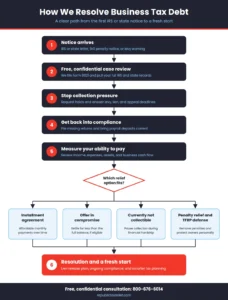
Our six-step process takes you from the first notice to a lasting resolution.
- Notice arrives: You receive an IRS or state letter, a 941 penalty notice, or a levy warning.
- Free, confidential review: We file Form 8821 and pull your full IRS and state records.
- Stop collection pressure: We request holds and answer levy, lien, and appeal deadlines.
- Get back into compliance: We file missing returns and help bring deposits current.
- Measure your ability to pay: We review income, expenses, assets, and cash flow.
- Resolution and a fresh start: We secure the best option and help you stay compliant.
For more on what professional support looks like, explore our tax relief services and back tax help.
Your Information Stays Protected
Your tax records, SSN, and bank statements are protected by bank-grade 256-bit encryption and strict attorney-client confidentiality standards. We meet federal data security requirements, so your information stays private, always.
Common Mistakes That Make IRS Debt Worse
Stress leads to rushed decisions. These are the mistakes we see most often, and each one can make IRS debt harder to fix.
- Using payroll withholding to pay other bills. This is the fastest path to personal TFRP liability.
- Ignoring IRS letters. Missing a deadline can cost you appeal rights and invite a levy.
- Falling behind on current deposits. New debt while you are resolving old debt can sink a payment plan or an offer.
- Filing returns out of order or with errors. This can create new balances or trigger an audit.
- Giving a revenue officer incomplete financial information. Inaccurate forms can hurt your credibility and your options.
- Hiring a firm based on promises alone. Guarantees are a warning sign, not a plan.
- Assuming bankruptcy solves everything. Many business taxes survive it, no matter the type of bankruptcy.
Tax Planning to Avoid Tax Debt in the Future
Once your case is resolved, the goal is to keep it that way. Good tax planning protects your relief agreement and your peace of mind.
- Keep a separate payroll account. Move withholding into it every pay period so it is never spent.
- Set aside sales tax daily or weekly. Treat it as the state’s money from the moment you collect it.
- Follow your deposit schedule. Know whether you are a monthly or semiweekly depositor.
- Make quarterly estimated payments. This helps owners of pass-through businesses avoid a surprise at tax season.
- Keep books current every month. Clean records make tax preparation easier and support every deduction you claim.
- Review tax rates and changes each year. A quick check-in with your tax professional can catch problems early.
- Expect refund offsets. The IRS can apply a future tax refund to an open balance, so plan for that.
Strong tax compliance is also what keeps an installment agreement or offer in good standing.
What Our Clients Say
From payroll tax problems to IRS levies and unfiled returns, Republic Tax Relief brings the same care and results to every service we offer. Since 2005, we have resolved more than 18,000 cases, settled over $220 million in tax debt, and earned a 4.9/5 average client rating.
“I had a fantastic experience working with Ryan at Republic Tax. He was incredibly knowledgeable and made the entire process of filing my 2023, 2024, and 2025 taxes so much easier. He took the time to explain every detail, answered all my questions, and ensured I got the best return possible. I highly recommend him to anyone needing tax help!”
Arturo Aguilar, Google Review
Results vary based on each client’s circumstances.
Frequently Asked Questions About Business Tax Debt
Can the IRS come after me personally for my business’s tax debt?
Yes, in many cases. Sole proprietors are always personally liable. For LLCs and corporations, the IRS can assess the Trust Fund Recovery Penalty against owners, officers, or others responsible for unpaid payroll withholding.
Can I settle business tax debt for less than I owe?
Possibly. An offer in compromise lets qualifying taxpayers settle for less than the full balance when they cannot realistically pay it. The IRS bases its decision on income, expenses, and asset equity, and you must be current on filings and deposits.
How long does the IRS have to collect IRS business tax debt?
The IRS generally has 10 years from the date a tax is assessed to collect it. Certain events, such as an offer in compromise or bankruptcy filing, can pause that clock.
Can the IRS shut down my business?
It can, though it is uncommon. The IRS can levy bank accounts and receivables, seize assets, and in serious repeat payroll cases seek to close a business. Resolving the debt early is the best way to keep your doors open.
Can IRS penalties on my business be removed?
Often, yes. First-time abatement may remove failure to file, pay, or deposit penalties if your record is clean for the prior three years. Reasonable cause relief may apply if events outside your control caused the problem.
What if my business has closed but still owes taxes?
The debt does not disappear when the doors close. Sole proprietors remain personally liable, and owners of other entities may still face the Trust Fund Recovery Penalty. Closed businesses often have more options, such as an offer in compromise or currently not collectible status.
How much does business tax debt help cost?
Fees depend on the size and complexity of your case. Republic Tax Relief starts with a free, confidential consultation and explains fees clearly before any work begins.
Do I need a tax attorney, or can a CPA or enrolled agent help?
All three can represent you before the IRS. A tax attorney is often best for complex disputes or legal exposure, while CPAs and enrolled agents handle many payment plans, offers, and penalty requests. Our firm has all three in-house.
Speak With a Tax Relief Professional
Every day you wait, penalties and interest keep growing, and the IRS gets closer to a levy. You do not have to figure this out alone. Our team will review your IRS and state records, explain your options in plain language, and start protecting your business right away.
Call now: 800-676-6014 for a free, confidential consultation.
Speak With a Tax Relief Professional
About Republic Tax Relief
Republic Tax Relief has helped individuals and businesses resolve IRS and state tax problems since 2005. Our in-house team of tax attorneys, CPAs, and enrolled agents has resolved more than 18,000 cases and settled over $220 million in tax debt. Call 800-676-6014 or contact us online for a free, confidential consultation.
Sources
- Internal Revenue Service. Trust Fund Recovery Penalty.
- Internal Revenue Service. Failure to Deposit Penalty.
- Internal Revenue Service. Offer in Compromise.
This page provides general information and is not legal or tax advice. Tax laws and IRS guidance change, and every case is different. Speak with a qualified tax professional about your specific situation.