
Running an online store moves fast. Orders come in from dozens of states, payouts land from Amazon, Shopify, PayPal, and Stripe, and taxes often get pushed to “later.” Then a letter from the IRS or a state tax agency shows up, and later is suddenly now.
If that sounds familiar, you are not alone, and you are not out of options. Tax Resolution for E-Commerce Businesses is about fixing the debt you already have, protecting your accounts and inventory, and setting your store up so this does not happen again. This page explains how online sellers end up owing, which relief programs fit e-commerce businesses, and when it makes sense to bring in a professional.
Your privacy is protected at every step. We guard your tax returns, SSN, and bank records with bank-grade 256-bit encryption and strict client confidentiality, fully compliant with federal data security standards.
On This Page
- Why E-Commerce Sellers End Up Owing the IRS
- Understanding Sales Tax, Nexus, and Economic Thresholds
- Common IRS and State Tax Problems for Ecommerce Businesses
- IRS Debt Relief Options for E-Commerce Sellers
- Sales Tax Audits and State Tax Compliance Problems
- Amazon, Shopify, and Dropshipping Business Tax Issues
- How Our E-Commerce Tax Resolution Process Works
- Why Online Sellers Hire a Tax Professional
- What Our Clients Say
- Simplify Tax Compliance After Your Case Is Resolved
- E-Commerce Tax Resolution FAQs
- Speak With a Tax Relief Professional
Why E-Commerce Sellers End Up Owing the IRS
Most online sellers who owe back taxes did not set out to avoid them. The money simply moved faster than their bookkeeping. Here are the patterns we see most often.
Platform Payouts Are Not the Same as Profit
A Shopify or Amazon deposit feels like income, but it is not your take-home pay. Fees, returns, refunds, shipping, ad spend, and payments to your supplier all come out of it. Sellers who do not track this carefully either overpay or, far more often, underpay and build a balance with the IRS.
Form 1099-K and IRS Income Matching
Payment platforms and marketplaces report seller payments to the IRS on Form 1099-K. For calendar years 2025 and 2026, a platform generally must issue the form when a seller receives more than $20,000 in payments across more than 200 transactions.¹ Every dollar of business income is still taxable, even below that threshold.
When the numbers on your tax return do not match what the platforms reported, the IRS computer flags the gap. That often leads to a CP2000 notice, a proposed balance due, and penalties and interest. Many sellers first learn they need to file Form 1099-K amounts correctly only after that letter arrives.
Missed Deductions and Cost of Goods Sold
Many e-commerce business owners never claim the deductions they are entitled to. Cost of goods sold, platform fees, software subscriptions, shipping supplies, and home office costs can all lower the tax you owe. Without good records and a receipt for each business expense, those tax deductions are hard to prove.
Falling Behind on Filings
One missed year turns into two or three. Without returns on file, the IRS may prepare a “substitute for return” that ignores your expenses and inflates your tax liability. Our team can help with unfiled tax returns as part of your overall resolution plan.
Understanding Sales Tax, Nexus, and Economic Thresholds
Income tax is only half the picture. Understanding sales tax is where many online sellers get blindsided, because the rules change from state to state.
What Nexus Means for Online Sellers
Nexus is the connection between your business and a state that gives that state the right to tax you. If you have nexus in a state, you may need to collect sales tax from customers in that state and file returns there. In 2018, the U.S. Supreme Court ruled in South Dakota v. Wayfair that states can require remote sellers to collect tax even without a physical presence in the state.²
Types of Nexus That Affect E-Commerce
| Type of Nexus | What Creates It | Why It Matters for Online Sellers |
|---|---|---|
| Physical nexus | An office, employees, or inventory stored in a state | Amazon FBA warehouses can create nexus in states you never visited |
| Economic nexus | Passing a state’s sales or transaction threshold | Many states use $100,000 in sales; some, like California, set a higher amount |
| Marketplace facilitator rules | Selling through Amazon, Etsy, Walmart, or eBay | The marketplace often collects for you, but not on your own website sales |
| Affiliate or click-through nexus | Paid referral partners in a state | Some states still apply these older sales tax laws |
Why Multi-State Sales Tax Becomes Debt
Sales tax compliance gets messy when you sell through several channels at once. A seller might be covered by Amazon’s marketplace collection but still be required to collect sales tax on Shopify orders shipped to the same state. Tax rates, product or service categories, and what counts as exempt also differ across different states.
When sales tax goes uncollected, the state still expects to be paid. Because sales tax is treated as money held in trust for the state, many states can hold owners personally responsible for the unpaid balance, plus penalties and interest.
Common IRS and State Tax Problems for Ecommerce Businesses
Online businesses face a mix of federal tax and state tax issues. Here are the problems we help e-commerce clients solve most often.
| Problem | What It Looks Like | How We Help |
|---|---|---|
| Unpaid income tax | Balance due notices, CP14, CP501, CP504 | IRS payment plans, settlements, hardship status |
| Unpaid payroll taxes | Missed Form 941 deposits for your staff | Payroll tax debt relief and trust fund penalty defense |
| Bank levy | Business checking frozen or emptied | Bank levy help to request a release |
| Federal tax lien | Lien filed against business or personal assets | Tax lien help for release, withdrawal, or subordination |
| Wage garnishment | IRS taking part of a W-2 paycheck from a side job or spouse | Wage garnishment relief |
| Sales tax audit | State agency reviewing years of marketplace and website sales | Audit representation and negotiation |
| IRS business audit | Questions about deductions, inventory, or reported income | Business IRS audit representation |
If the IRS has already moved to enforced collection, our IRS collections defense team can step in fast. The sooner you act, the more options you keep.
IRS Debt Relief Options for E-Commerce Sellers
There is no single fix for every online business. The right program depends on how much you owe, your cash flow, your assets, and whether your filings are current. Below are the main programs that make IRS debt relief for online sellers possible, and how each one fits an e-commerce business.
Installment Agreements
A payment plan lets you pay your balance over time in monthly amounts you can manage. This is often the fastest way to stop collection activity and keep your store running. For larger balances, the IRS asks for financial details, and having a professional present them can make a big difference in the monthly payment.
Offer in Compromise
An Offer in Compromise lets some taxpayers settle for less than the full amount owed. The IRS looks at your income, expenses, asset equity, and ability to pay.³ Learn more in our guide to how the OIC program works and our article on the Fresh Start program.
Currently Not Collectible Status
If paying anything right now would leave you unable to cover basic living expenses, the IRS may pause collection. Currently Not Collectible status can be a lifeline for sellers whose store has slowed down or closed.
Penalty Abatement
Penalties can add 25 percent or more to what you originally owed. If you have a clean history or faced a serious hardship, you may qualify for IRS penalty abatement. Removing penalties can also lower the interest that builds on them.
Innocent Spouse Relief
If you filed jointly and your spouse ran the online store without your knowledge of the tax problems, you may not have to pay their share. Read about the four types of innocent spouse relief.
Comparing Your Options
| Option | Best For | Main Benefit | Things to Know |
|---|---|---|---|
| Installment agreement | Sellers with steady cash flow | Stops most collection, keeps business open | Interest continues until paid |
| Offer in Compromise | Sellers who truly cannot pay in full | Settle for less than owed | Strict financial review, must stay compliant |
| Currently Not Collectible | Sellers in serious hardship | Pauses collection | Debt remains, and the IRS reviews it later |
| Penalty abatement | Sellers with good history or reasonable cause | Removes penalties | Does not erase the tax itself |
| Lien or levy release | Sellers facing frozen accounts or filed liens | Restores access to funds and credit | Usually paired with a payment solution |
For a wider look at every program, see our guide to tax debt relief options. Some owners also ask whether bankruptcy wipes out taxes. The short answer is “sometimes,” and our article on bankruptcy and tax debt explains why.
Sales Tax Audits and State Tax Compliance Problems
State agencies are getting better at finding online sellers. They pull marketplace data, compare it to your state filings, and send audit letters covering several years at once.
What Triggers a Sales Tax Audit
- Passing an economic nexus threshold without registering
- Big gaps between platform-reported sales and your state returns
- Selling taxable products as if they were exempt
- Late or missing sales tax returns
- A tip from a competitor or a former employee
How an E-Commerce Sales Tax Audit Attorney or Tax Professional Helps
An e-commerce sales tax audit attorney or experienced tax representative can control communication with the state, so you are not answering auditors on your own. They can challenge sampling methods, show which sales were collected by a marketplace facilitator, and document exempt sales. In many cases, they can also negotiate penalty relief or a payment plan with the state.
Voluntary Disclosure for Past Sales Tax
If you have not been contacted yet but know you missed sales tax collection in some states, a voluntary disclosure agreement may help. Many states limit how many years they look back and waive some penalties when you come forward first. A professional can approach the state on your behalf before you share identifying details.
Amazon, Shopify, and Dropshipping Business Tax Issues
Each selling model brings its own tax rules. Knowing which ones apply to you shapes the resolution plan.
Amazon Seller Tax Debt Resolution
Amazon sellers often face nexus in every state where FBA stores their inventory. They also receive 1099-K forms that show gross sales before Amazon’s fees. Amazon seller tax debt resolution usually starts by rebuilding true profit from settlement reports, which can greatly reduce the balance the IRS thinks you owe.
Shopify Business Back Tax Relief
Shopify stores sell from your own website, so marketplace facilitator laws usually do not cover them. That means you may need to collect sales taxes yourself once you pass a state threshold. Shopify business back tax relief often combines IRS income tax solutions with state sales tax negotiation.
Dropshipping Business Tax Concerns
A dropshipping business has unique sales tax issues because the supplier, the seller, and the customer may all be in different states. Resale certificates, supplier invoices, and third-party shipping records all matter. Missing paperwork here can turn into an unexpected state assessment.
Wholesale Business and Multi-Channel Sellers
If you run a wholesale business alongside retail sales, you need to track which sales are for resale and exempt. Multi-channel sellers using Amazon, Etsy, eBay, and their own site at once face the most complex tax reporting. Sellers who also work in Canada or sell heavily to Canadian buyers may face GST or HST questions that should be reviewed by a cross-border CPA.
How Our E-Commerce Tax Resolution Process Works
Our e-commerce tax resolution services follow a clear path from your first call to a closed case. You will always know where things stand.
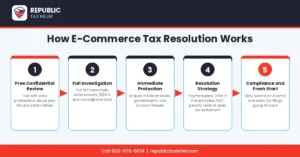
- Free confidential review. You talk with our team about your notices, sales channels, and goals.
- Full investigation. We pull your IRS transcripts and state records and compare them to your 1099-K and marketplace data.
- Immediate protection. Where possible, we request holds on levies, garnishments, and account freezes while we build your case.
- Resolution strategy. We match you with the best program, such as a payment plan, Offer in Compromise, hardship status, penalty relief, or a state sales tax settlement.
- Compliance and fresh start. We help you stay compliant with future income and sales tax filings so the problem does not return.
Want a deeper look at how resolution works in general? Visit our complete guide to tax resolution services.
Why Online Sellers Hire a Tax Professional
You built a business from scratch, so it is natural to want to handle this yourself too. But IRS debt relief for e-commerce involves tax law, collection procedures, and state rules that change often.
Tax Software vs. CPA vs. Tax Resolution Firm
| Option | What It Does Well | Where It Falls Short |
|---|---|---|
| Tax software | Basic tax preparation and tax filing | Cannot negotiate with the IRS or a state |
| CPA | Tax preparation, accounting, and planning | Many CPAs do not focus on collections or settlements |
| Tax resolution firm | Represents you with the IRS and states, stops collections, negotiates relief | Works best alongside your ongoing bookkeeping |
A good CPA keeps your books clean. A tax resolution team, on the other hand, is built to deal with revenue officers, levies, liens, and settlement offers. Many of our clients work with both.
What to Look for in an E-Commerce Tax Expert
- Experience in tax resolution, not just income tax service or tax preparation
- Knowledge of online selling, including 1099-K, nexus, and marketplace rules
- Authority to represent you before the IRS and state agencies
- Clear, upfront pricing with flexible payment options
- Honest guidance, including telling you when a program will not work
Business owners with larger balances or entity-level problems can also review our business tax debt relief and business tax resolution services pages, which cover corporate tax and partnership issues.
What Our Clients Say
★★★★★ Google Review
“As of today, June 23rd, Republic Tax Relief has been awesome. I have always been skeptical of using these tax companies. But, I decided to take a chance because of I couldn’t get anywhere with the IRS by myself. I had 3 companies on my list, Republic Tax Relief, TRA Tax Relief and Optima Tax Relief. I was about to go with TRA but they were tremendously high, so I decided to call Republic and gave me an affordable price based upon my situation. I never got a chance to call Optima because I was impressed with the communication and cost with RTR. I started off with Ken at RTR, then I spoke to Chris, and now I’m working with Rebekah. All three have been great communicating and answering my very thorough questions. They gave me a level of comfort to trust them. Now, it is just a waiting game and in 3 years I will be able to come back and provide an update. Also, RTR has allowed me to pay my fees to them in 6 installments making it very worthy to use them. Thank you Ken, Chris, and Rebekah!”
~Alwynn VanBuren
Simplify Tax Compliance After Your Case Is Resolved
Most relief programs require you to stay current on future taxes. Breaking that rule can undo an installment agreement or an accepted offer, so ongoing tax compliance is part of every plan we build.
A few habits make a big difference:
- Use accounting software that connects to your sales channels and payment system
- Turn on sales tax automation so the correct tax is charged in each state where you have nexus
- Keep records of all transactions, including every receipt, refund, and supplier invoice
- Make estimated tax payments each quarter so tax time does not bring a surprise bill
- Review your nexus once or twice a year as your amount of sales grows
Think of this as basic tax management for an online business, not a full tax guide. Our role is to resolve the debt and point you toward the right habits, so your bookkeeper or CPA can keep things on track. For more on how ongoing relief works, see our page on tax relief services.
E-Commerce Tax Resolution FAQs
Can the IRS see my Amazon, Shopify, or Etsy sales?
Yes. Marketplaces and payment processors report seller payments to the IRS on Form 1099-K once you pass the federal reporting threshold. The IRS compares those forms to your tax return, and gaps often lead to notices and proposed balances.
What happens if I did not collect sales tax in states where I had nexus?
The state can still bill you for the tax you should have collected, plus penalties and interest. In many states, owners can be held personally responsible. A tax professional may be able to reduce the amount through audit defense, voluntary disclosure, or penalty relief.
Can I settle my e-commerce tax debt for less than I owe?
Possibly. An Offer in Compromise allows some taxpayers to settle IRS debt for less than the full balance based on their ability to pay. Not everyone qualifies, so a full financial review comes first.
Can the IRS freeze my business bank account or payment processor funds?
Yes. The IRS can levy bank accounts and money owed to you by third parties, which may include platform payouts. Acting quickly gives you the best chance to request a release and set up a resolution before funds are taken.
Am I personally liable for my online store’s tax debt?
It depends on how your business is set up and what type of tax is owed. Sole proprietors are personally liable for business income tax. Owners of LLCs and corporations can still be held personally liable for unpaid payroll trust fund taxes and, in many states, unpaid sales tax.
Do I need a CPA or a tax resolution firm?
A CPA is great for bookkeeping, tax preparation, and planning. If you are facing collections, liens, levies, audits, or need to negotiate a settlement, a tax resolution firm is usually the better fit. Many sellers use both.
How long does e-commerce tax resolution take?
Simple payment plans can be set up in a few weeks. Offers in Compromise, audits, and multi-state sales tax cases often take several months or longer. Your case timeline depends on the program, the agencies involved, and how quickly records can be gathered.
Speak With a Tax Relief Professional
You do not have to face the IRS or a state tax agency alone. Whether you sell on Amazon, run a Shopify store, or manage a dropshipping business, Tax Resolution for E-Commerce Businesses starts with one honest conversation about where you stand.
Our team will review your notices, explain your options in plain language, and give you a clear, affordable plan. Many clients are able to spread their fees over several payments.
Speak With a Tax Relief Professional or call 800-676-6014 today for a free, confidential consultation.
About Republic Tax Relief
Republic Tax Relief helps individuals, online sellers, and business owners resolve IRS and state back taxes. Our licensed tax professionals handle installment agreements, Offers in Compromise, penalty abatement, lien and levy releases, payroll tax problems, and audit representation. To get back tax help from a team that answers your questions and keeps you informed, call 800-676-6014 or contact us online.
This page provides general information and is not legal or tax advice. Every tax situation is different, and results depend on your specific facts and eligibility. Past results do not guarantee future outcomes.
Sources
- Internal Revenue Service, “Understanding Your Form 1099-K,” irs.gov/businesses/understanding-your-form-1099-k
- Supreme Court of the United States, South Dakota v. Wayfair, Inc., 585 U.S. 162 (2018), supremecourt.gov/opinions/17pdf/17-494_j4el.pdf
- Internal Revenue Service, “Offer in Compromise,” irs.gov/payments/offer-in-compromise