
A letter from the IRS can make your stomach drop, especially when your business depends on every dollar coming in. Maybe payroll taxes slipped during a slow season. Maybe returns went unfiled while you focused on keeping the doors open.
You are not the first business owner in this spot, and you are not out of options. As a business tax resolution company, Republic Tax Relief helps individuals and businesses settle what they owe to the Internal Revenue Service and state tax agencies, stop collections, and get back to work. Our tax attorneys, CPAs, and enrolled agents know federal tax law and state tax codes, and we deal with the IRS so you do not have to.
This page explains how tax resolution works for companies, which relief options exist, and how to choose the right tax professional for your case.
On this page:
- What Tax Resolution Means for Your Business
- Common Business Tax Problems and Payroll Tax Issues
- IRS Notice Warning Signs That Need Fast Action
- Small Business Tax Debt Relief Options
- Our Tax Resolution Process, Step by Step
- Tax Attorneys, Enrolled Agents, and CPAs: Who Handles Your Case
- Corporate Tax Resolution Services for Every Business Type
- How to Choose Among Tax Resolution Companies
- Client Reviews
- Confidential, Secure Tax Representation
- Business Tax Debt FAQs
- Speak With a Tax Relief Professional
Reviewed by the Republic Tax Relief resolution team, a group of tax attorneys, CPAs, and IRS enrolled agents who represent taxpayers before the IRS and state tax authorities. Last updated: October 1, 2026.
🔒 Your story stays between you and your tax team. Every return, Social Security number, and bank statement you share is protected by bank-grade 256-bit encryption and strict professional confidentiality standards.
What Tax Resolution Means for Your Business
Tax resolution is the work of settling a tax problem with the IRS or a state tax agency. That can mean lowering what you owe, setting up payments you can afford, removing penalties, or stopping a levy before it drains your accounts.
For a business, the stakes run higher than for most individual taxpayers. Tax agencies can freeze business bank accounts, take payments your customers owe you, and in payroll cases, go after owners personally.
Strong resolution services cover three things:
- Protection: pausing or stopping collection action while your case is reviewed.
- Compliance: getting missing returns filed so the agency will agree to a deal.
- Resolution: negotiating the best outcome the tax law allows for your tax situation.
For the full picture, see our complete guide to tax resolution services.
Common Business Tax Problems and Payroll Tax Issues
Most business tax challenges fall into a handful of groups. Many companies face more than one at the same time, which is why a single plan matters.
Payroll Tax Debt and the Trust Fund Recovery Penalty
Unpaid payroll tax is the most serious tax issue a business can have. When you withhold income tax and Social Security from employee paychecks, that money belongs to the government, which is why it is called “trust fund” tax.
If the business does not pay it over, the IRS can assess the Trust Fund Recovery Penalty against the people responsible. According to the IRS, the penalty equals the full unpaid trust fund amount, and a “responsible person” can be an owner, officer, partner, or even an employee with control over the money (IRS: Trust Fund Recovery Penalty).
In plain terms, your LLC or corporation may not shield you. Getting help before the revenue officer’s interview (Form 4180) can make a real difference in who ends up owing.
IRS Audits and Business Tax Controversy
An IRS audit or state tax audit can produce a large new bill when records are incomplete. A business tax controversy often involves worker classification, unreported income, disallowed deductions, or sales tax.
Having professional tax representation during the audit keeps you from saying something that hurts your case. Your representative can meet with the auditor, organize records, and push back when findings are wrong.
Unfiled Business Tax Returns
No tax agency will settle a tax balance it cannot measure. If Forms 941, 1120, 1120-S, 1065, or Schedule C returns are missing, they must be filed before most relief options open up.
Unfiled years can also lead to substitute returns prepared by the government, which usually overstate what you owe. Learn more about catching up on unfiled tax returns.
Liens, Levies, and Garnishments
When balances go unpaid, collection turns forceful. A federal tax lien attaches to business property and can block financing, while a levy can empty a bank account or seize money your customers owe you.
- Tax lien help to release or remove a federal tax lien
- Bank levy help for frozen IRS and California accounts
- Wage garnishment relief when an owner’s personal pay is targeted
- IRS collections defense to stop a levy before it hits
State and Local Tax Debt
State tax agencies can be just as tough as the IRS, and sometimes faster. In California, a business may deal with the Franchise Tax Board for income tax, the CDTFA for sales and use tax, and the EDD for payroll tax.
State and local tax debt runs on its own rules. We handle IRS and state tax matters together so that one agreement does not make the other impossible to afford.
| Business Tax Problem | What It Can Lead To | How Soon to Act |
|---|---|---|
| Unpaid payroll taxes (Form 941) | Trust Fund Recovery Penalty against owners | Immediately |
| IRS or state tax audit | Higher tax bill, tax penalties, interest | Before the first meeting |
| Unfiled business returns | Government-prepared returns, no access to relief | Now, before more years pile up |
| Federal tax lien | Credit damage, trouble selling or financing | Within weeks |
| Bank or receivables levy | Frozen accounts, missed payroll | Within days |
| Unpaid sales or state payroll tax | State levies, permit or license problems | Right away |
IRS Notice Warning Signs That Need Fast Action
Not every IRS notice means trouble is close, but some do. These are the letters business owners should never set aside:
- CP14 or CP161: first balance-due notices. You still have the most choices at this stage.
- CP504: notice of intent to levy certain assets, such as state tax refunds.
- LT11 or Letter 1058: final notice of intent to levy, plus your right to a hearing. You generally have 30 days to request a Collection Due Process hearing.
- Letter 1153: a proposed Trust Fund Recovery Penalty against you personally. The window to appeal is short.
- Audit or examination letters: an IRS audit has started, and what you say next matters.
If one of these arrives, it is time to bring in a tax resolution professional. Waiting rarely makes the bill smaller, because penalties and interest grow every month.
Small Business Tax Debt Relief Options
There are several ways to resolve tax debt. The right fit depends on what you owe, what your business earns, and what assets you hold.
IRS Installment Agreements
An installment agreement lets you pay your balance over time. Smaller balances may qualify for streamlined plans with less paperwork, while larger debts require full financial disclosure.
A business that is still open must stay current on new payroll deposits while it pays down old debt. See our guide to IRS payment plans.
Offer in Compromise
An offer in compromise may let you settle your tax debt for less than the full amount. The agency reviews your ability to pay, including income, expenses, and the equity in your assets.
Not every business qualifies, and a weak offer can waste months. Read how the OIC program works or learn about the IRS Fresh Start program.
Currently Not Collectible Status
If paying anything would keep you from covering basic living costs, the agency can mark your account currently not collectible. Collection pauses, although interest keeps building.
This option often fits owners whose business has closed and who have little income left. Learn more about currently not collectible status.
Penalty Relief and Abatement
Penalties can add 25% or more to a tax bill. They may be removed through first-time abatement for taxpayers with a clean history, or for reasonable cause such as serious illness, a natural disaster, or other events outside your control.
Penalty relief is often the fastest win in a case. Here is how to request IRS penalty abatement.
Lien Release, Withdrawal, and Subordination
A federal tax lien does not have to be permanent. Depending on your case, a lien can be released after payment, withdrawn from public records, or subordinated so you can refinance or get a business loan.
Appeals and Tax Dispute Resolution
If you disagree with an audit result, a penalty, or a collection action, you have appeal rights. The IRS Independent Office of Appeals offers dispute resolution outside of the collection or exam team, and a timely Collection Due Process hearing can pause a levy while your case is reviewed.
Innocent Spouse Relief
Business owners who file joint returns sometimes learn that a spouse underreported business income. Innocent spouse relief may remove your share of tax you knew nothing about. See the four types of innocent spouse relief.
| Option | Best For | What It Does | Key Requirement |
|---|---|---|---|
| Installment Agreement | Businesses that can pay over time | Spreads the balance into monthly payments | All filings and deposits current |
| Offer in Compromise | Limited income and assets | Settles debt for less than owed | Ability to pay is below the balance |
| Currently Not Collectible | Severe financial hardship | Pauses collection | Income does not cover basic expenses |
| Penalty Abatement | Clean history or reasonable cause | Removes some or all penalties | Clean record or documented hardship |
| Appeals or CDP Hearing | Disputed bills or proposed levies | Independent review, can pause a levy | Request filed on time |
| Innocent Spouse Relief | Joint filers unaware of errors | Removes your share of liability | You did not know, and holding you liable is unfair |
For a wider view, compare these tax debt relief options or read about back tax help and our tax relief services.
Our Tax Resolution Process, Step by Step
Every case is different, but our tax resolution process follows the same proven path. You will always know which stage you are in and what comes next.
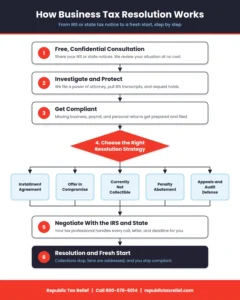
- Free, confidential consultation. We review your IRS or state tax notices and listen to your story.
- Investigate and protect. We file a power of attorney (Form 2848), pull your IRS transcripts, and ask for collection holds where possible.
- Get compliant. Missing business, payroll, and personal returns are prepared and filed so you can qualify for relief.
- Choose the right strategy. We compare every option and recommend the one that fits your finances best.
- Negotiate. Your tax professional handles every call, letter, and deadline with the IRS and state.
- Resolve and stay compliant. Once your agreement is approved, we help you meet your tax obligations so it stays in good standing.
Tax Attorneys, Enrolled Agents, and CPAs: Who Handles Your Case
Only certain licensed professionals can represent taxpayers before the IRS on any matter. At Republic Tax Relief, we match your case to the right expert based on how complex it is.
When You Need a Tax Attorney
An IRS business tax resolution attorney is the right choice when there is legal risk. That includes possible fraud penalties, criminal exposure, Tax Court cases, or situations where attorney-client privilege matters.
Enrolled Agents for Collections, Offers, and Audits
Enrolled agents are federally licensed and focus only on tax. Enrolled agent business tax resolution works well for payment plans, offers, penalty relief, and most audits.
CPAs and Corporate Tax Relief Specialists
CPAs bring deep accounting skill, which helps when books are messy or returns need to be rebuilt. A corporate tax relief specialist with a CPA background can reconstruct records and clean up years of payroll filings.
| Professional | Can Represent You Before the IRS | Best For |
|---|---|---|
| Tax attorney | Yes, on all matters, plus Tax Court | Legal risk, criminal exposure, privilege |
| Enrolled agent | Yes, on all matters | Collections, offers, audits, penalties |
| CPA | Yes, on all matters | Bookkeeping, financial analysis, rebuilding returns |
| Uncredentialed preparer | Very limited or none | Preparing returns only |
Corporate Tax Resolution Services for Every Business Type
Whether you run a one-person shop or a company with hundreds of employees, we offer a full range of services. Our corporate tax resolution services cover:
- Sole proprietors and freelancers with Schedule C tax debt
- LLCs and partnerships filing Form 1065
- S corporations and C corporations filing Forms 1120-S and 1120
- Restaurants, contractors, trucking companies, medical practices, and other payroll-heavy businesses
- Closed businesses with leftover tax liabilities
When you need help with business IRS debt, your entity type shapes the strategy. A C corporation’s income tax debt usually stays with the company, while unpaid trust fund taxes can follow owners personally, and a sole proprietor’s business taxes are personal debt from the start.
Small business tax debt relief also has to protect cash flow. We plan around your payroll cycles and slow seasons so any deal fits how your business actually makes money.
How to Choose Among Tax Resolution Companies
Not all tax resolution companies work the same way, and the wrong choice can cost you time and money. Use this checklist before you sign with anyone:
- Check credentials. Look up the professional in the IRS Directory of Federal Tax Return Preparers with Credentials, which lists attorneys, CPAs, and enrolled agents with active PTINs (IRS Preparer Directory).
- Read reviews. Look at Google reviews and the company’s Better Business Bureau profile.
- Be wary of guarantees. No honest firm can promise a specific result before reviewing your file, so be careful with anyone who says they can settle for “pennies on the dollar” on the first call.
- Ask who works your case. You should know whether a licensed tax professional or a salesperson handles your file.
- Get fees in writing. You should understand what you pay and what it covers before work begins.
What Our Clients Say
“Review update: I spoke to a nice very informative representative named Gaby. She collected my information contacted the Internal Revenue Service schedule an appointment for me to speak to their legal team. I had 4 year of non filed years and I owed about 12,400 to the IRS. After republic tax filed my returns they settled with the IRS and I didn’t have to pay anything back. My settlement was just approved now I am just waiting on my approval letter and I will get a refund this year for the first time in years.
I received my approval letter! I now longer owe the IRS and I am all up to date on my taxes. Jennifer helped set up my taxes for 2024 taxes they were filed on time. I came out even didn’t owe so that’s a good thing. Maybe next year I will get a refund.”
Danny Hernandez, Google Review
Every case depends on its own facts. Past results do not guarantee a similar outcome.
Confidential, Secure Tax Representation
To build your case, we will ask for sensitive records like tax returns, bank statements, payroll reports, and IRS notices. We know that can feel like a lot to hand over, especially when you are already stressed.
🔒 What you tell us stays with us. Our tax attorneys, CPAs, and enrolled agents follow strict client confidentiality standards, including attorney-client privilege where it applies, so you can speak openly.
Business Tax Debt FAQs
Can the IRS come after me personally for my business’s tax debt?
It depends on the type of tax and how your business is set up. Sole proprietors are personally liable for business taxes. For corporations and LLCs, the government can assess the Trust Fund Recovery Penalty against owners or others who were responsible for unpaid payroll taxes and willfully failed to pay them.
How long does the tax resolution process take?
A simple payment plan can often be set up within a few weeks. An offer in compromise or an appeal usually takes several months, and an IRS audit can run longer. Getting missing returns filed quickly is the biggest factor you control.
Can you stop an IRS levy on my business bank account?
In many cases, yes. Acting before the levy date gives you the most options, such as a Collection Due Process hearing or a payment arrangement. If a levy has already hit, a tax professional can request a release when there are grounds for one.
Can my business settle its tax debt for less than it owes?
Some businesses can, through an offer in compromise. The government accepts less only when it believes it cannot collect the full amount within the time the law allows. Open businesses with payroll tax debt face extra review, so a careful financial analysis comes first.
Do I need a tax attorney or an enrolled agent?
Most collection and audit cases can be handled by an enrolled agent or CPA. You need a tax attorney when there is a risk of criminal charges, fraud penalties, or a Tax Court case. We assign the right professional after reviewing your file.
Does bankruptcy wipe out business tax debt?
Some older income tax debts can be discharged, but payroll trust fund taxes generally cannot. Bankruptcy carries serious tradeoffs, so talk with a professional first. Our article on whether bankruptcy gets rid of tax debt explains more.
What if my business also owes state tax?
We handle IRS and state tax matters together, including California’s Franchise Tax Board, CDTFA, and EDD. Coordinating both keeps one payment plan from making the other impossible to afford.
Speak With a Tax Relief Professional
You do not have to face the IRS alone, and the sooner you act, the more options you keep. Our team will review your notices, explain your choices in plain English, and tell you honestly what is possible.
Call 800-676-6014 or schedule your free, confidential consultation.
🔒 Your documents. Your privacy. Fully protected. Bank-grade 256-bit encryption and strict confidentiality guard every file from upload to resolution.
About Republic Tax Relief
Republic Tax Relief helps individuals and businesses resolve IRS and state tax debt. Our tax attorneys, CPAs, and enrolled agents provide tax representation for audits, payroll tax issues, liens, levies, wage garnishments, unfiled returns, and settlement negotiations. Call 800-676-6014 or visit our contact page to speak with a tax relief professional today.
Sources
- Internal Revenue Service, “Employment Taxes and the Trust Fund Recovery Penalty (TFRP),” irs.gov/TFRP
- Internal Revenue Service, “Directory of Federal Tax Return Preparers with Credentials and Select Qualifications,” irs.treasury.gov/rpo
This page provides general information and is not legal or tax advice for your specific situation. Speak with a licensed professional about your facts.