
Opening a letter from the IRS can make your stomach drop. Maybe you missed a few filing deadlines, fell behind on payroll taxes, or just are not sure your business is doing things right. You are not alone, and this problem has a fix.
Tax compliance means filing every required return on time and paying the right amount of tax. When that slips, penalties and interest pile up, and the Internal Revenue Service can start collection. This guide explains what compliance requires, what happens when you fall out of it, and how business tax resolution and trusted professional help can put you back on solid ground.
Table of Contents
- What Is Tax Compliance?
- Tax Compliance Requirements for Businesses
- What Happens During an IRS Compliance Check
- Consequences of Tax Non-Compliance
- How to Get Back Into Tax Compliance
- Business Tax Resolution Options
- Tax Compliance Services: Why Hire a Professional
- What Our Clients Say
- Your Information Stays Confidential and Secure
- Tax Compliance FAQs
- Speak With a Tax Relief Professional
What Is Tax Compliance?
Tax compliance means meeting all of your legal tax obligations. For a taxpayer, that includes filing tax returns on time, reporting all income honestly, and making tax payments by the due date. It applies at the federal tax, state, and local tax levels.
The U.S. tax system runs on voluntary reporting. The IRS expects you to report your own income and figure the amount of tax you owe. When your numbers do not match what the IRS sees on W-2s, 1099s, and bank records, a notice usually follows.
Examples of Tax Compliance
- Filing personal or corporate income tax returns by the deadline or extended deadline.
- Depositing payroll taxes withheld from employees on schedule.
- Collecting sales tax from customers and sending it to your state.
- Making estimated tax payments each quarter if you are self-employed.
- Keeping tax records that back up every number on your return.
- Answering IRS notices before the response date printed on the letter.
Falling Behind Is Not the Same as Tax Evasion
Tax evasion means willfully hiding income or lying to avoid paying tax. Most people who fall behind simply got overwhelmed by a hard year, a slow season, or complex tax regulations. That is usually a civil problem with civil solutions, and the sooner you act, the more options you keep.
Tax Compliance Requirements for Businesses
Tax compliance for businesses goes well beyond one yearly return. Depending on your structure and location, you may owe several kinds of tax on different schedules. Missing any one of them can trigger a penalty.
| Tax type | Who it affects | Typical filing or payment schedule |
|---|---|---|
| Corporate income tax | C corporations | Annual Form 1120, plus quarterly estimates |
| Pass-through income tax | S corps, partnerships, LLCs, sole owners | Annual returns; owners make estimated tax payments quarterly |
| Payroll taxes | Any business with employees | Regular deposits, quarterly employment tax returns (Form 941), annual Form 940 and W-2s |
| Sales and use tax | Businesses selling taxable goods or services | Monthly, quarterly, or annual state returns |
| Local tax | Businesses in certain cities and counties | Varies: gross receipts, business license, property tax |
| Estate tax | Large estates after a death | Form 706, generally due nine months after the date of death |
Why Payroll Taxes Get Extra Attention
Unpaid payroll taxes are one of the most serious compliance problems a business can have. The money withheld from employee paychecks belongs to the government, so the IRS treats it as held in trust. Owners and other responsible people can be held personally liable through the Trust Fund Recovery Penalty.
State, Local, and Global Tax Compliance
Every state sets its own tax rules, and many cities add more. A business that sells across state lines may owe sales tax in several states at once. Companies with overseas income or foreign accounts also face international tax reporting under global tax regulations, on top of U.S. rules.
What Happens During an IRS Compliance Check
A compliance check is a review of whether you are meeting your filing and reporting requirements. It is usually narrower than a full audit. The IRS may confirm that you filed required returns, issued 1099s to contractors, or kept proper books.
Tax compliance checks can still lead to bigger trouble. If the IRS finds missing returns or unreported income, the review can grow into an audit, a new tax bill, or collection action.
Common Triggers for a Compliance Check
- Unfiled returns for one or more tax years
- Third-party income reports that do not match your tax return
- Late or missing payroll tax deposits
- Large swings in deductions or business losses
- Sales tax gaps flagged by a state tax agency
What Is a Tax Compliance Certificate?
A tax compliance certificate is an official document, usually from a state tax agency, confirming that you have filed all returns and paid what you owe. Some states call it a tax clearance certificate. You may need one to renew a license, sell or close a business, or bid on government contracts.
Consequences of Tax Non-Compliance
Tax non-compliance rarely stays small. Penalties and interest start the day after a deadline passes, and the IRS has strong tools to collect unpaid tax. State agencies, like California’s Franchise Tax Board, have similar powers.
| Consequence | What it means for you |
|---|---|
| Failure-to-file penalty | 5% of the unpaid tax for each month a return is late, up to 25% |
| Failure-to-pay penalty | 0.5% of the unpaid tax per month, up to 25% |
| Interest | Added to unpaid tax and penalties until the balance is paid |
| Substitute for return | The IRS files a return for you using only the income it knows about, often without your deductions |
| Federal tax liens | A public claim against your property that can hurt credit and block a sale or refinance |
| Levies and garnishments | The IRS can take money from bank accounts, wages, and receivables |
| Trust Fund Recovery Penalty | Owners and managers can owe unpaid payroll taxes personally |
| Criminal exposure | Rare, and reserved for willful tax evasion or fraud |
Source: IRS, Failure to File Penalty. The IRS notes the late-filing penalty is generally far larger than the late-payment penalty, which is why filing matters even when you cannot pay.
If collection has already started, see our guides on IRS collections defense, releasing a federal tax lien, stopping a bank levy, and wage garnishment relief.
How to Get Back Into Tax Compliance
The compliance process follows a clear path, even when your situation feels messy. A professional handles the IRS contact so you can keep running your life and your business. Here is how it typically works.
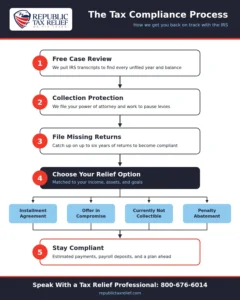
- Free case review. We pull your IRS account transcripts to see every unfiled year, balance, and penalty on record.
- Collection protection. With your signed power of attorney, we contact the IRS for you and work to pause or stop levies and garnishments.
- Catch up on missing returns. The IRS generally expects the last six years of tax returns before it will agree to most relief, under its Policy Statement 5-133 (Journal of Accountancy). Learn more about unfiled tax returns.
- Resolve the balance. Once you are current, we match you with the relief option that fits your income, assets, and goals.
- Stay compliant. We help you set up estimated tax payments, payroll deposits, and a plan so the problem does not come back.
Business Tax Resolution Options
Once your filings are current, you have real choices. The right option depends on what you can afford to pay each month and what you own. Here are the most common paths, with deeper guides for each.
| Option | Best fit for | What it does |
|---|---|---|
| Installment agreement | Taxpayers who can pay over time | Monthly payments that stop most collection action |
| Offer in Compromise | People who cannot pay the full debt | Settles the tax debt for less based on ability to pay |
| Currently Not Collectible | Those facing real financial hardship | Pauses collection while hardship lasts |
| Penalty abatement | First-time or reasonable-cause cases | Removes some or all penalties |
| Innocent spouse relief | Spouses hurt by a partner’s errors | Removes liability for tax you should not owe |
| Lien release or withdrawal | Owners needing to sell, refinance, or borrow | Clears or subordinates the public claim |
Curious how settlements work? Read our explainer on the Offer in Compromise and Fresh Start program. Some older income tax debts can also be discharged in bankruptcy under strict rules, which our tax lawyer covers in Does Bankruptcy Get Rid of Tax Debt?
For a full overview, visit our guides to tax resolution services, tax relief services, tax debt relief options, and back tax help.
Tax Compliance Services: Why Hire a Professional
You do not have to face the IRS alone. A tax professional who can legally represent you knows the IRS’s deadlines and procedures, and can often stop collection faster than you could by phone. They also spot relief options most people never hear about.
Tax software can handle a simple return, but it cannot negotiate with a revenue officer. When you owe back taxes or have years of unfiled returns, you need a person in your corner.
What Our Tax Compliance Work Includes
- IRS and state account reviews, including transcript analysis
- Tax preparation for unfiled and amended returns
- Representation during audits and compliance checks
- Negotiating payment plans, settlements, and penalty relief
- Tax compliance management for ongoing filings and deposits
- Tax planning and tax advice to help you stay current
CPA Tax Compliance Services vs. Tax Resolution Help
Many CPAs focus on tax preparation and tax reporting. That work matters, but it is different from negotiating with IRS collections. Tax resolution professionals focus on the collection side: levies, liens, settlements, and appeals.
| What you need | Typical CPA firm | Tax resolution firm |
|---|---|---|
| Current-year tax return | Core service | Often available |
| Several years of unfiled returns | Sometimes | Core service |
| Stopping a levy or garnishment | Rarely | Core service |
| Negotiating a settlement or payment plan | Rarely | Core service |
| Ongoing compliance support | Core service | Core service |
Small Business and Corporate Tax Compliance
Small business tax compliance often breaks down when the owner is wearing every hat. Corporate tax compliance adds layers like multi-state filings, corporate income tax returns, and payroll for larger teams. Either way, a dedicated team keeps your filing tax returns, deposits, and payments on schedule.
Should You Outsource Tax Compliance Services?
Many owners choose to outsource tax compliance services so they can focus on running the business. Business tax compliance consulting and tax compliance advisory services can help you:
- Avoid missed deadlines and the penalties that follow
- Have one point of contact with tax authorities
- Catch problems before they turn into a tax bill
- Spend less than you would on stacking penalties and interest
How to Choose a Tax Compliance Firm
Not every company that advertises tax relief is the right fit. Look for these signs of a trustworthy partner:
- Licensed professionals authorized to represent you before the IRS, such as tax attorneys, CPAs, or enrolled agents
- Clear fees explained in writing before work begins
- No promises of a guaranteed result, since no honest firm can guarantee what the IRS will accept
- Strong reviews from real clients
- Secure, confidential handling of your documents
What Our Clients Say
Real people, real IRS problems, real relief. Here is what one client shared on Google.
★★★★★ “This process wasn’t easy… but without this place it would have been impossible! Let me tell you! The IRS isn’t something I wanted to face alone. I called and was so lucky to get Cristina as my representative. Thank God for her. She made things simple. She didn’t complicate it, she didn’t make me feel like a piece of trash for being in this situation. She was kind and compassionate. Chris Bess also was really great. Thank you both for figuring this mess out for me and getting me a settlement of $500!!! I couldn’t have done it by myself.”
~Victoria Crespin, Google Review
Every case is different. Results depend on your income, assets, and the facts of your tax liabilities, and past results do not guarantee a future outcome.
Your Information Stays Confidential and Secure
We know you are about to share some of the most private details of your life. That trust is not something we take lightly.
Your story and your documents stay between you and us. We protect every tax return, Social Security number, and bank statement with bank-grade 256-bit encryption and strict client confidentiality standards.
Tax Compliance FAQs
What does tax compliance mean for a small business?
It means filing every required return and paying every tax on time. For most small businesses, that covers income tax, payroll taxes, sales tax, and any local tax that applies. Staying current also means keeping records that support what you report.
How many years of returns does the IRS require to be compliant?
In most cases, the IRS asks for the last six years of tax returns. It can ask for more in cases involving large balances, business taxes, or fraud. A professional can confirm exactly which years the IRS shows as missing.
Is an IRS compliance check the same as an audit?
No. A compliance check confirms that you are meeting filing and reporting requirements, while an audit examines whether the numbers on a return are correct. A check can turn into an audit if the IRS finds problems, so it deserves a careful response.
Can I get back into compliance if I cannot pay what I owe?
Yes. Filing your returns is the first goal, even if you cannot pay right away. Once you are current, options like payment plans, an Offer in Compromise, or Currently Not Collectible status may be available.
Will the IRS remove my penalties once I am compliant?
Sometimes. First-time penalty relief and reasonable-cause relief can remove some or all penalties if you qualify. Interest is harder to remove, but it drops when the penalties it was charged on are removed.
How long does it take to resolve a tax compliance problem?
It depends on how many years are unfiled and which relief option fits. Simple payment plans can be set up in weeks, while an Offer in Compromise can take several months. Getting professional help early usually shortens the process.
Is my personal and financial information safe with Republic Tax Relief?
Yes. We protect every document with bank-grade 256-bit encryption and follow strict client confidentiality standards. Your information is used only to work on your case.
Speak With a Tax Relief Professional
Every month you wait, penalties and interest grow and your options can shrink. The good news is that one phone call can change the direction of your case. You can stop worrying about the IRS on your own and start working toward a real fix.
Speak With a Tax Relief Professional or call 800-676-6014 for a free, confidential case review.
About Republic Tax Relief
Republic Tax Relief helps individuals and business owners resolve IRS and state back taxes, unfiled returns, liens, levies, and wage garnishments. Our team handles business tax resolution from the first IRS call to the final agreement, with compassion and without judgment. Call 800-676-6014 or contact us online to get started today.
Sources
- Internal Revenue Service. Failure to File Penalty.
- Journal of Accountancy. Bringing a Nonfiler Back Into Compliance (discusses IRS Policy Statement 5-133).