
Construction runs on thin margins and slow payments. When a general contractor holds back retainage or a big client pays 90 days late, payroll still has to go out on Friday. That gap is how many good contractors fall behind with the IRS.
If you are reading this, you may already have a letter on your desk, a frozen bank account, or a lien that is costing you bids. You are not the first, and your situation can be fixed. Our construction tax resolution services help contractors, subcontractors, and builders stop IRS and state collections, sort out the numbers, and get back to work.
Reviewed by the Republic Tax Relief tax resolution team of licensed tax professionals. Last updated October 2026.
Table of Contents
- Why Construction Companies Owe the IRS
- Common Construction Industry Tax Problems
- IRS Collection Actions Against Contractors
- Tax Resolution Options for Contractors
- Our Construction Tax Resolution Process
- Why Hire a Construction Payroll Tax Attorney or Tax Professional
- How to Choose the Best Tax Relief Companies
- What Our Clients Say
- Construction Tax Relief FAQ
- Speak With a Tax Relief Professional
Why Construction Companies Owe the IRS: The Construction Industry Tax Problem
Most contractors who owe back taxes are not trying to cheat anyone. They are juggling cash flow problems that are built into the way the industry works. Knowing the cause helps us pick the right fix.
Cash Flow Gaps and Retainage
Retainage can tie up 5% to 10% of a contract until the job closes out. Meanwhile, materials, equipment payments, and crews all need to be paid now. Payroll tax deposits are often the first bill that slips.
Seasonal Work and Fast Growth
A slow winter or a sudden jump in projects can wreck a budget. Many builders grow faster than their bookkeeping can keep up. Estimated payments get missed, and a large tax liability builds quietly in the background.
Complex Tax Rules for Construction Companies
Contractors deal with payroll across multiple job sites, prevailing wage jobs, subcontractor 1099s, and sometimes several states. Each layer adds federal tax and state tax rules to follow. One mistake can snowball into years of notices.
For a broader overview of how businesses get out from under these debts, see our guide to business tax debt relief.
Common Construction Industry Tax Problems We Resolve
The table below shows the tax issues we see most often with construction contractors and how we handle each one.
| Tax Issue | What It Means for You | How We Help |
|---|---|---|
| Unpaid Form 941 payroll taxes | Penalties and interest grow every quarter | Stop collections and negotiate a payment or settlement plan |
| Trust Fund Recovery Penalty | Owners and managers can become personally liable | Defend the TFRP interview and challenge the assessment |
| Worker misclassification | Back employment taxes on workers paid as 1099 | Audit defense and relief program review |
| Unfiled business returns | IRS may file substitute returns with a higher tax bill | Prepare and file missing returns to restore compliance |
| State payroll and sales tax debt | State agencies can levy, suspend licenses, and file liens | Negotiate with state tax authorities on your behalf |
Form 941 Payroll Tax Debt for Contractors
Form 941 payroll tax debt is the most serious problem a contractor can have with the IRS. The money withheld from your crew’s paychecks belongs to the government the moment you hold it. The IRS treats unpaid payroll tax as a top priority and moves quickly.
Learn more about payroll tax debt relief for business owners.
IRS Trust Fund Recovery Penalty in Construction
When payroll taxes go unpaid, the IRS can hold owners, officers, or even bookkeepers personally responsible. The IRS explains that the Trust Fund Recovery Penalty equals the full amount of unpaid trust fund taxes and applies to anyone who was responsible for paying them and willfully failed to do so (IRS: Trust Fund Recovery Penalty).
This means an LLC or corporation does not always protect your personal assets. Having a professional with you at the TFRP interview (Form 4180) can change the outcome.
1099 vs W2 Worker Misclassification Audit
Paying crew members as independent contractors when they work like employees is a common audit trigger in construction. The IRS looks at behavioral control, financial control, and the relationship between the parties to decide worker status (IRS: Independent Contractor or Employee).
States like California apply a stricter ABC test, so a worker may pass the federal test and still fail at the state level. We review whether options like Section 530 relief or the Voluntary Classification Settlement Program fit your case.
Unfiled Business Tax Returns for Contractors
Busy seasons turn into missed filings. If you have unfiled business tax returns, the IRS may create a substitute return that ignores your expenses and inflates what you owe. Getting current is the first step toward any settlement.
See how we help with unfiled tax returns.
IRS Collection Actions Against Contractors and How to Stop Them
The IRS usually sends several notices before taking property. The final warning is a Final Notice of Intent to Levy, which gives you 30 days to request a Collection Due Process hearing. Acting inside that window protects your appeal rights.
IRS Tax Lien on Construction Equipment
A federal tax lien attaches to everything your business owns, including trucks, excavators, and tools. It can hurt your bonding capacity, block equipment financing, and make general contractors think twice about hiring you. In some cases a lien can be withdrawn, subordinated, or released.
Read our guide to tax lien help and lien release.
Stop an IRS Bank Levy on Your Construction Business
A bank levy freezes the money in your business account, often right before payroll. Banks generally hold levied funds for 21 days before sending them to the IRS. That short window is your best chance to get the levy released.
Get help with a bank levy or learn about IRS collections defense.
General Contractor Wage Garnishment Relief
If you draw a salary from your company, the IRS can garnish your personal wages. It can also levy payments owed to you by customers and general contractors. Both can stop once a resolution is in place.
Learn about wage garnishment relief.
Tax Resolution Options for Contractors: IRS Debt Relief That Fits Your Business
There is no single fix for every contractor. The right option depends on what you owe, your cash flow, your assets, and whether your business is still running. Here is how the main resolution options compare.
| Option | Best For | Key Benefit |
|---|---|---|
| Installment Agreement | Contractors with steady income | Monthly payments while collections stop |
| Offer in Compromise | Those who cannot pay the full tax | May settle your tax debt for less |
| Currently Not Collectible | Severe financial hardship | Pauses active collection |
| Penalty Abatement | Good history or reasonable cause | Removes or reduces penalties |
| Audit Representation | Payroll or misclassification audits | A professional speaks for you |
IRS Installment Agreements
A payment plan lets you pay over time and usually keeps the IRS from levying while you stay current. For in-business payroll debt, the IRS also requires you to stay current on new deposits. We help set terms you can actually keep.
Read more about IRS payment plans.
Offer in Compromise
An Offer in Compromise lets some taxpayers settle for less than the full balance. The IRS bases its decision on your ability to pay, income, expenses, and asset equity (IRS: Offer in Compromise). Equipment values matter a lot here, so an accurate valuation is key.
See how the OIC program works and our article on the Fresh Start program.
Currently Not Collectible Status
If paying anything would keep you from covering basic living costs, the IRS may pause collection. Interest still adds up, but levies and garnishments stop. This option often helps owners after a business closes.
Learn about Currently Not Collectible status.
Penalty Relief
Penalties can add 25% or more to a construction tax bill. First-time abatement and reasonable cause relief (such as a serious illness, disaster, or a payroll company that failed you) can remove them.
See our guide to IRS penalty abatement. If a spouse’s business created a joint tax debt, innocent spouse relief may also apply.
Payroll and Business Audit Defense
Employment tax audits often lead to new tax assessments for construction companies. We handle IRS contact, document requests, and appeals so you can stay on the job site.
Learn about business IRS audit representation.
A note on bankruptcy: Payroll trust fund taxes are generally not wiped out in bankruptcy. Read our article on whether bankruptcy gets rid of tax debts before making that decision.
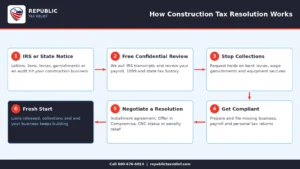
Our Construction Tax Resolution Process: Resolution Solutions Step by Step
Our construction tax resolution services follow a clear path, so you always know what comes next.
- Free resolution consultation. We listen to your story and look at the notices you have received.
- Review your tax history. With your permission (Form 2848), we pull IRS transcripts and state records to see exactly what is owed.
- Protect your business. We contact the IRS on your behalf to request collection holds on levies and garnishments.
- Get compliant. We help you file tax returns that are missing and set up current deposits.
- Build your resolution plan. We compare every option and negotiate with the IRS or state for the best result.
- Stay on track. We guide you on tax compliance and tax planning so the problem does not come back.
For a full look at our approach, read our complete guide to tax resolution and our business tax resolution services page.
Why Hire a Construction Payroll Tax Attorney or Experienced Tax Professional
The IRS has trained revenue officers whose job is to collect. You deserve someone just as skilled on your side. A licensed tax professional knows the tax law, the deadlines, and how to negotiate with the IRS.
- You stop talking to the IRS directly. We handle calls, letters, and meetings with the IRS revenue officer.
- We know construction. Retainage, equipment depreciation, job costing, and prevailing wage records all affect what the IRS thinks you can pay.
- We cover IRS and state tax. Federal and state agencies often go after the same contractor at once.
- We protect your rights. Appeals, Collection Due Process hearings, and, when needed, tax court are part of a strong defense.
- We work as a team of tax experts. Tax attorneys, enrolled agents, and certified public accountants each bring different strengths to complex tax issues.
Your tax preparers or bookkeeper are valuable, but tax and accounting work is different from dispute resolution with the IRS. A tax resolution specialist focuses only on settling tax debt and stopping collections.
How to Choose the Best Tax Relief Companies for Contractors
Not all tax relief companies are equal. Before you sign anything, ask a few direct questions.
Signs of Trusted Tax Relief Help
- Licensed professionals (attorneys, CPAs, or enrolled agents) work on your case
- A clear, written fee agreement before work begins
- Experience with business and payroll tax cases, not just personal debt
- Honest answers about what you likely qualify for
- A dedicated caseworker who keeps you updated
Red Flags to Avoid
- Promises to “settle for pennies on the dollar” before reviewing your finances
- Pressure to pay large fees on the first call
- No license information or physical office
- Vague answers about who will actually handle your case
The best tax relief firm for you is the one that tells you the truth about your case. You can learn more on our tax relief services page and in our guide to tax debt relief options. If you also owe personally, see our back tax help page.
What Our Clients Say About Our Tax Relief Services
“I highly recommend Republic Tax for any tax-related services. If you’re behind on your taxes or facing debt with the IRS, I strongly encourage you to contact them. They were instrumental in helping me resolve my case efficiently and effectively.
The entire process went smoothly, and I experienced no issues or stress throughout. My caseworker, Jocelin Alpizar, was outstanding. She kept me informed every step of the way and provided excellent support.
Republic Tax offers reliable and professional assistance, and I would confidently recommend them to anyone dealing with IRS-related issues.” ~Merlyn Bryant,
Your information stays protected. Every document you share is guarded by strict tax professional confidentiality and bank-grade 256-bit encryption, fully compliant with federal data protection standards. Your story stays private, always.
Construction Tax Relief FAQ
Can the IRS shut down my construction business for unpaid payroll taxes?
Yes. In serious cases the IRS can seize business assets or seek a court order requiring you to make deposits. Getting professional help early usually prevents it from reaching that point.
Am I personally liable for my company’s payroll tax debt?
You may be. The Trust Fund Recovery Penalty can make owners, officers, and others who control payments personally responsible for unpaid withheld taxes, even if the business is an LLC or corporation.
Can I keep my equipment if I have an IRS tax lien?
A lien is a legal claim, not a seizure. Most contractors keep working with their equipment while a resolution is negotiated, and some liens can be subordinated so you can refinance.
What happens if I misclassified workers as 1099 contractors?
The IRS may assess back employment taxes and penalties. Programs like Section 530 relief or the Voluntary Classification Settlement Program may reduce the cost, depending on your facts.
Can I settle my tax debt for less than I owe?
Some contractors qualify for an Offer in Compromise based on income, expenses, and asset values. A full financial review is needed before anyone can tell you whether you qualify.
How fast can you stop an IRS bank levy?
We act right away once we are authorized. Banks typically hold levied funds for 21 days, and in many cases we can request a release or hold during that window.
Do you help with state tax problems too?
Yes. We help construction businesses resolve IRS and state tax issues, including state payroll, sales and use tax, and income tax debts.
Speak With a Tax Relief Professional About Your Construction Tax Debt
Every week you wait, penalties and interest grow and the IRS gets closer to your bank account and equipment. You built your business one job at a time. Let us help you protect it.
Our construction tax resolution services start with a free, confidential consultation. We will review your situation, explain your options in plain language, and give you an honest plan.
Call 800-676-6014 or request your free consultation today.
About Republic Tax Relief
Republic Tax Relief is a professional tax relief firm that helps individuals and businesses resolve IRS and state tax debt. Our team of licensed tax professionals handles payroll tax problems, liens, levies, wage garnishments, unfiled returns, audits, and settlements for clients nationwide. Call 800-676-6014 or visit our contact page to get started.
Sources
- Internal Revenue Service: Trust Fund Recovery Penalty
- Internal Revenue Service: Independent Contractor (Self-Employed) or Employee?
- Internal Revenue Service: Offer in Compromise
Disclaimer: This page is for general information only and is not legal or tax advice. Results depend on the facts of each case. Speak with a licensed tax professional about your specific situation.