
Real estate pays well when deals close. But commission checks arrive on no fixed schedule, nobody withholds taxes from them, and one slow quarter can turn a tax bill you planned to pay into a debt that grows every month.
If you are an agent, broker, or investor who owes the IRS or your state, you are not alone, and you are not out of options. This guide explains tax resolution for real estate professionals in plain language: the types of tax debt you might face, how tax authorities collect, which resolution options fit your situation, and when it makes sense to bring in professional help.
Every case is different, and this page is general education, not legal advice for your situation. For a confidential review of your case, call 800-676-6014.
In This Guide
- Why Real Estate Professionals Run Into Problems With the IRS
- Types of Tax Real Estate Professionals Can Owe
- What an IRS Notice Means for Your Real Estate Business
- IRS Resolution Options for Agents, Brokers, and Investors
- Tax Relief for Real Estate Agents
- Tax Debt Resolution for Real Estate Brokers
- Tax Help for Real Estate Investors and Commercial Real Estate Owners
- IRS Audit and Tax Audit Defense
- Property Tax, Real Estate Tax, and Personal Property Tax Problems
- State Tax Debt for Real Estate Professionals
- Why Work With a Tax Resolution Professional
- How Our Tax Resolution Services Work
- Real Estate Tax Resolution FAQs
Why Real Estate Professionals Run Into Problems With the IRS
Most real estate tax debt doesn’t start with bad intentions. It starts with income that swings up and down and a tax system built around steady paychecks.
Commission income with no withholding
Most agents work as independent contractors. Under federal tax law, licensed agents paid by commission under a written contract are treated as self-employed, so no employer withholds income tax or Social Security from your checks.
That leaves you in charge of quarterly estimated payments. Miss a few, and penalties and interest start stacking up fast.
Self-employment tax surprises
On top of income tax, self-employed workers pay a self-employment tax of 15.3% on net earnings, which covers both halves of Social Security and Medicare (IRS: Self-Employment Tax). Many newer agents don’t budget for it, and a strong first year can produce a tax due figure that feels impossible to cover.
Boom-and-bust cash flow
A great year raises your estimated payments for the next one. If the market cools, you can owe last year’s balance plus this year’s estimates while less money comes in.
Complex tax rules for investors
Rental income, depreciation, passive loss limits, and 1031 exchanges make for a complex tax return. One mistake, like a failed exchange or overstated losses, can lead to an additional tax assessment years later.
Payroll and business duties for brokers
Brokerage owners juggle payroll taxes for staff, 1099 reporting for agents, and state filings. Falling behind on payroll deposits is one of the fastest ways to draw IRS attention.
Types of Tax Real Estate Professionals Can Owe
Real estate touches many types of tax, and each one is collected by a different agency with its own rules. Knowing which kind you owe shapes the path forward.
| Type of tax | Who collects it | Common real estate trigger |
|---|---|---|
| Federal income tax | IRS | Unpaid balance on commissions or rental profits |
| Self-employment tax | IRS | Commission income with no withholding |
| Payroll tax | IRS and state | Unpaid deposits for brokerage staff wages |
| State income tax | State tax authorities, such as the California FTB | Same income as federal, plus state-specific rules |
| Real estate tax (property tax) | County or local tax office | Delinquent bills on homes, rentals, or commercial buildings |
| Personal property tax | County or local tax office | Office furniture, computers, and equipment |
| Sales and use tax | State agency, such as the CDTFA in California | Taxable purchases made without paying sales tax |
The IRS handles federal tax only. Real estate tax on your property is a local tax matter handled by your county, and it follows its own deadlines and penalties.
Got an IRS Notice? What It Means for Your Real Estate Business
An IRS notice is not a reason to panic, but it is a reason to act. The IRS sends letters in a set order, and each one moves you closer to enforced collection.
| Notice | What it means | How urgent |
|---|---|---|
| CP14 | First bill: you have a balance due | Respond promptly |
| CP501 / CP503 | Reminders that the balance is still unpaid | Moderate, penalties keep growing |
| CP504 | Notice of intent to levy certain assets, like state refunds | High |
| LT11 / Letter 1058 | Final notice of intent to levy and your right to a hearing | Very high: 30 days to request a hearing |
| CP2000 | IRS records don’t match your return, often from unreported 1099 income | Respond by the listed deadline |
That 30-day window on a final notice matters. Requesting a Collection Due Process hearing in time can pause levies and keep your right to appeal to Tax Court. Learn more about how the IRS collection process works and how to stop a levy.
If you also have unfiled returns, the IRS may file a substitute return for you that ignores your business expenses. Getting caught up on unfiled tax returns usually comes before any payment deal is possible.
IRS Resolution Options for Real Estate Agents, Brokers, and Investors
The IRS offers several ways to settle your tax debt or pay it over time. The right fit depends on how much you owe, your income, your assets (including equity in property), and whether you are current on filings.
| Option | Best for | What it does |
|---|---|---|
| Installment agreement | You can pay over time | Monthly payments that stop most collection action |
| Offer in compromise | You can’t pay in full before the collection period ends | Settles the debt for less than you owe |
| Currently not collectible | No ability to pay right now | Pauses active collection |
| Penalty abatement | Penalties from hardship or a clean history | Removes some or all penalties |
| Lien discharge, subordination, or withdrawal | A lien is blocking a sale or refinance | Frees a property or clears your record |
| Innocent spouse relief | A spouse or former spouse created the debt | Removes your share of the liability |
Installment agreements
Individuals who owe $50,000 or less in combined tax, penalties, and interest can often set up a streamlined payment plan without a detailed financial statement. Larger balances usually require full financial disclosure.
For agents with uneven income, a professional can push for a payment based on realistic average earnings, not your best month. See how to set up IRS payment plans.
Offer in compromise
An offer in compromise lets you settle for less than the full balance when the IRS agrees you can’t pay it all. The IRS looks at your income, expenses, and the equity in your assets, including rental and investment properties (IRS: Offer in Compromise).
Property equity is often the deciding factor for real estate owners. Read how the OIC program measures ability to pay, or learn more about the IRS Fresh Start program.
Currently not collectible status
If paying anything would leave you unable to cover basic living costs, the IRS can mark your account as currently not collectible. Interest still grows, but levies and garnishments stop while your finances recover. Learn about currently not collectible status.
Penalty abatement
The failure-to-file penalty runs 5% per month, and the failure-to-pay penalty adds 0.5% per month, each capping at 25%. First-time abatement or reasonable cause, such as serious illness or a disaster, can remove a large share of what you owe. Here’s how to request IRS penalty abatement.
Federal tax lien help
A federal tax lien attaches to all your property, including real estate, once the IRS files a public notice (IRS: Understanding a Federal Tax Lien). For people who buy and sell property, a lien can stall closings and refinancing.
A certificate of discharge can free one property for sale, and subordination can let a lender move ahead of the IRS for a refinance. See your options for tax lien release and removal.
Levies and wage garnishments
The IRS can levy bank accounts, wages, and even commissions your brokerage owes you. Quick action can often release a levy or stop the next one. Get help with a bank levy or wage garnishment.
Innocent spouse relief
If a spouse or former spouse hid income or overstated deductions on a joint return, you may not have to pay their share. Learn about the four types of innocent spouse relief.
Tax Relief for Real Estate Agents and Self-Employed Professionals
Self-employed real estate agent tax debt usually follows a familiar pattern: a few strong years, too little set aside, then a slowdown. Here is what relief often looks like for agents.
- Stop the debt from growing. The IRS generally wants you current on this year’s estimated payments before it approves most deals.
- Protect your commission checks. A collection hold or payment plan can stop the IRS from levying money your brokerage owes you.
- Attack the penalties. Penalties and interest can make up a big part of an agent’s balance, and some may be removable.
- Match the plan to real income. Payments should reflect your average earnings, not one great year.
- Protect your license. Some states can act against professional licenses for large unpaid tax debts.
Tax relief for real estate agents is not one-size-fits-all. A top producer with home equity has different choices than a new agent with little income. Compare your tax debt relief options or get back tax help.
Tax Debt Resolution for Real Estate Brokers and Brokerage Owners
Brokers carry the same tax risks as agents, plus the duties of running a business. Tax debt resolution for real estate brokers often starts with payroll.
Payroll taxes and personal liability
Income tax and FICA withheld from employee paychecks are “trust fund” taxes. If they go unpaid, the IRS can assess the Trust Fund Recovery Penalty against owners and managers personally, even if the business closes. Learn about payroll tax debt relief.
Worker classification
Licensed agents paid by commission can usually be treated as contractors. Unlicensed assistants and transaction coordinators are a different story, and misclassifying them can lead to back payroll taxes and penalties.
Protecting the brokerage
Business tax debt can lead to levies on operating accounts and receivables, which can freeze your office overnight. See our business tax debt relief options and business tax resolution services.
Tax Help for Real Estate Investors and Commercial Real Estate Owners
Real estate investors can look wealthy on paper while running short on cash. That gap creates its own kind of tax trouble.
Depreciation recapture and failed 1031 exchanges
When you sell, depreciation you claimed in past years is taxed again, often at rates up to 25%. If a 1031 exchange misses the 45-day identification or 180-day closing deadline, the whole gain may become taxable in that tax year.
Passive losses and real estate professional status
Rental losses are usually passive and can’t offset other income. Investors who claim real estate professional status must show they spent more than half their working time, and more than 750 hours, in real property businesses. The IRS checks these claims closely.
Commercial real estate tax issues
Commercial real estate owners face larger property tax bills, personal property tax on equipment, and partnership or entity filings. A lien on one building can also trip loan covenants across a whole portfolio.
How the IRS views your equity
The IRS sees rental equity as a way to pay, and it may push you to sell or refinance. A professional can argue for realistic numbers, such as quick-sale value and costs of sale, so your financial statement doesn’t overstate what you can pay. That kind of tax help for real estate investors can change the outcome of a case.
IRS Audit and Tax Audit Defense for Real Estate Professionals
Real estate returns have several features that tend to draw attention. Common audit triggers include:
- Real estate professional status claims with thin time records
- Large vehicle, meal, and home office deductions
- Rental losses reported year after year
- Cash rents or 1099 income that doesn’t match IRS records
- Big swings in income from one tax year to the next
An IRS audit can end with no change, a small adjustment, or a large bill. With a power of attorney, a representative can handle the auditor so you don’t have to answer questions alone. If you disagree with the result, you can appeal within the IRS and, after a notice of deficiency, generally have 90 days to file in Tax Court. Learn more about IRS audit representation.
Property Tax, Real Estate Tax, and Personal Property Tax Problems
Property tax works differently from IRS debt. Your county decides the value of the property, mails a tax statement, and collects the money. Fall far enough behind, and you can lose the property itself.
How property tax debt grows
California property tax offers a clear example. The base rate is 1% of assessed value plus local voter-approved charges, and a late installment adds a 10% penalty. Property left unpaid after June 30 becomes tax-defaulted, and after five years the county can sell residential property, sooner in some commercial cases.
Rules vary by state. In Louisiana, for example, the Louisiana Tax Commission hears assessment appeals after local review.
Assessment appeals and property valuation changes
A property valuation change after a purchase, new construction, or reassessment can raise your bill. Most counties allow appeals during a set window, and property tax consultants or property tax specialists can help reduce your property taxes when the assessed value is too high.
Property tax exemptions
Missing an exemption means paying more than you should. Common types of property tax exemptions include:
- Homeowners’ exemptions on a primary residence
- Disabled veterans’ exemptions
- Senior and disability relief programs
- Exemptions for qualifying nonprofit property
Personal property tax on business assets
Brokerages and commercial landlords may owe personal property tax on furniture, computers, and equipment. In California, many businesses file an annual business property statement, and skipping it can lead to estimated assessments and penalties.
Tax credits worth checking
Before you settle, make sure you aren’t missing a tax credit that lowers your overall tax burden. Depending on your business, this could include a research and development tax credit for firms building real estate software, a job creation tax credit program, or state programs that offer tax credits for energy-efficient upgrades. Several development tax credit programs and federal energy credits changed recently, so confirm current rules with your tax advisor.
Our focus is resolving IRS and state tax debt. When property tax issues are part of the picture, we factor them into your overall plan so one debt doesn’t undo progress on another.
State Tax Debt and Real Estate: California and Beyond
State tax authorities can collect as aggressively as the IRS. California’s Franchise Tax Board can issue bank levies and wage garnishments and record state tax liens against real property.
California can also suspend state-issued professional licenses, including real estate licenses, for people on its lists of the largest delinquent tax accounts. For an agent or broker, that puts your income at risk, not just your bank balance.
Federal and state debts often need to be resolved together, since both payment plans must fit your budget at once. We help real estate professionals across California, from Corona to Murrieta, CA, and beyond. Explore our tax relief services for IRS and state back taxes or read our complete guide to tax resolution services.
Why Work With a Tax Resolution Professional
You can call the IRS yourself. But hold times are long, the rules are dense, and one wrong number on a financial form can cost you thousands.
| Handling it alone | With a tax resolution professional |
|---|---|
| You speak to the IRS directly | Your representative speaks for you under a power of attorney |
| Deadlines are easy to miss | Deadlines and hearing rights are tracked |
| You may agree to a payment you can’t afford | Payments are based on documented ability to pay |
| Property equity may be overstated | Realistic values, such as quick-sale value, are used |
| Hard to know every option | All resolution options are compared side by side |
What to look for
- Credentials: tax attorneys, CPAs, and enrolled agents can represent you before the IRS
- Experience with commission income, rentals, and real estate tax issues
- Clear fees explained before work begins
- Honest answers instead of guaranteed outcomes
- Secure, confidential handling of your documents
Red flags
- Promises of “pennies on the dollar” before anyone reviews your finances
- Pressure to sign the same day
- Vague answers about who will actually work your case
Some people also ask whether bankruptcy can wipe out tax debt. Certain older income taxes can be discharged under strict rules, but it is a separate legal path. Our tax lawyer explains whether bankruptcy gets rid of tax debts.
How Our Tax Resolution Services Work
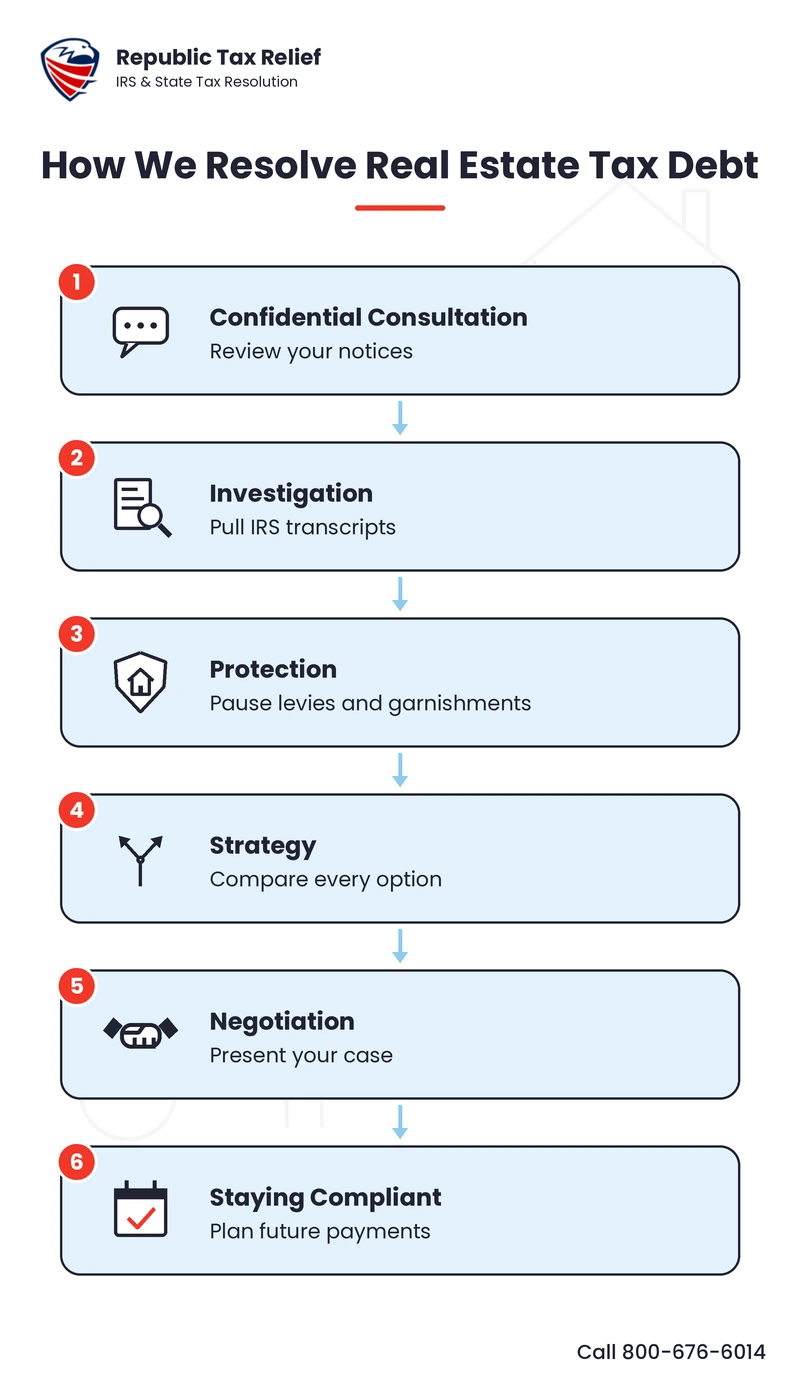
- Confidential consultation. We listen to your story and look at the notices you’ve received.
- Investigation. We pull your IRS transcripts, check filing gaps, and confirm how long the IRS has left to collect.
- Protection. We respond to notices and work to pause levies and garnishments.
- Strategy. We compare every option against your income, assets, and property equity.
- Negotiation. We present your case to the IRS or state and push for the best available result.
- Staying compliant. We help you plan estimated payments so tax year 2027 doesn’t restart the cycle.
What Our Clients Say
★★★★★
“I really enjoyed having Melisa Garcia help me get connected with Republic Tax Relief. She is very cheerful and a joy to work with as she instructed me in how to deliver my tax documents to their firm. Melisa is an exceptional person working for a great firm. I would highly recommend her and her tax firm to absolutely anyone!”
Scot Nicholson, Google Review
Real Estate Tax Resolution FAQs
What is tax resolution for real estate professionals?
It is the process of settling or managing IRS and state tax debt for agents, brokers, and investors. It can include payment plans, settlements, penalty relief, lien help, and audit defense, tailored to commission and rental income.
Can the IRS take my commission checks?
Yes. The IRS can levy commissions your brokerage owes you, along with bank accounts and wages. A payment plan, hardship status, or a timely hearing request can often stop or release the levy.
Will a federal tax lien stop me from selling a property?
Not always. The IRS can issue a certificate of discharge for a specific property, often with sale proceeds going toward the debt, so the closing can move forward.
Can I get an offer in compromise if I own rental property?
Possibly. The IRS counts your property equity when deciding what you can pay, but realistic values and costs of sale can lower that figure. A professional review shows whether an offer makes sense.
Does the IRS handle my property tax bill?
No. Property tax is billed and collected by your county or local tax office. The IRS only collects federal tax, though both debts affect your overall plan.
How long does the IRS have to collect back taxes?
Generally 10 years from the date the tax was assessed. Certain actions, like filing an offer or bankruptcy, can pause that clock.
Can I get help if I haven’t filed tax returns in years?
Yes. Most resolution options require you to be caught up on filings, so bringing past returns current is usually the first step toward relief.
How much do tax resolution services cost?
Fees depend on how complex your case is, such as the number of years involved and the type of resolution. A reputable firm explains costs clearly before any work begins.
Speak With a Tax Relief Professional
Tax debt doesn’t have to cost you your license, your properties, or your peace of mind. The sooner you act, the more options you keep.
Call 800-676-6014 or schedule your confidential consultation today.
Your story stays between you and your tax team. Every conversation and file is protected under strict attorney-client and tax professional privilege standards, so you can speak openly without worry.
Sources
- IRS: Self-Employment Tax (Social Security and Medicare Taxes)
- IRS: Offer in Compromise
- IRS: Understanding a Federal Tax Lien
About Republic Tax Relief
Republic Tax Relief helps individuals and businesses resolve IRS and state tax problems, from back taxes and unfiled returns to levies, liens, and audits. Our team of tax attorneys and tax professionals works one-on-one with each client to find a realistic path to a fresh start. Call 800-676-6014 or contact us online to speak with our team.
This content is for general information only and is not legal or tax advice. Results depend on each taxpayer’s facts and circumstances.