
You spent years in school and residency learning to care for patients. Nobody taught you how to handle a stack of IRS notices, a frozen bank account, or a payroll tax bill that keeps growing.
If you are a doctor, dentist, nurse practitioner, therapist, or practice owner who owes back taxes, you are not alone. High earners in the healthcare industry fall behind more often than most people think, and there are real ways out.
This guide explains tax resolution for medical professionals in plain terms. You will learn why these problems happen, which relief options may fit your situation, and how to choose a tax professional who can protect your income, your license, and your practice.
In This Guide
- Why Healthcare Professionals Fall Behind on Taxes
- Common Tax Problems Facing Healthcare Providers
- How IRS Collections Can Hit a Medical Practice
- Tax Relief Options for Doctors and Medical Professionals
- Medical Practice Payroll Tax Debt and 941 Tax Relief
- 1099 Medical Contractor Back Taxes
- Tax Debt Resolution for Dentists, Physicians, and Private Practices
- Resolving IRS and State Tax Debt Together
- How to Choose a Tax Professional for Your Tax Problem
- Our Resolution Services Process for Healthcare Providers
- Tax Planning for Doctors After Your Debt Is Resolved
- What Our Clients Say
- Tax Resolution FAQs for Healthcare Professionals
- Speak With a Tax Relief Professional
Why Healthcare Professionals Fall Behind on Taxes
A big income does not protect you from a big tax bill. In fact, being in a higher tax bracket means every missed payment turns into a larger balance faster.
Most medical professionals who end up owing are not careless. They are busy, and their tax situation is far more complex than a typical W-2 employee’s.
Here are the most common reasons we see:
- No withholding on business income. Practice owners and 1099 contractors must make quarterly estimated payments. Miss a few, and the balance due in April can reach five or six figures.
- Self-employment tax surprises. Independent healthcare professionals pay both the employee and employer share of Social Security and Medicare. This self-employment tax is 15.3% on net earnings up to the yearly Social Security limit.
- Slow insurance reimbursements. Claims can take weeks or months to pay. When cash runs short, tax deposits are often the first bill pushed back.
- Big startup and expansion costs. Buying medical equipment, leasing space, or buying into a practice can drain money set aside for taxes.
- Trusting the wrong person. Many doctors hand payroll to an office manager or outside service. When deposits stop, the owner is often the last to know.
- Life events. Divorce, illness, a partner leaving the group, or a malpractice claim can throw finances off track for years.
When patient care comes first, tax filing and paperwork slide. One late year becomes two or three, and penalties pile up on top of the original tax.
Common Tax Problems Facing Healthcare Providers
Every case is different, but most tax issues in medicine fall into a few groups. The table below shows what each problem looks like and why it needs fast attention.
| Tax Problem | Who It Often Affects | Why It Is Urgent |
|---|---|---|
| Unfiled tax returns | Busy physicians, 1099 contractors | The IRS may file a return for you with no deductions |
| Unpaid federal income tax | Practice owners, high earners | Penalties and interest grow every month |
| Payroll tax debt (Form 941) | Clinics and group practices | Owners can become personally liable |
| 1099 contractor back taxes | Locum tenens doctors, travel nurses, CRNAs | No withholding means large balances |
| State tax debt | California and other high-tax states | States collect fast and can affect licenses |
| IRS audits | Practices with large deductions | Can lead to new tax bills and penalties |
Unfiled Tax Returns
If you skip a year or more, the IRS can prepare a “substitute for return” on your behalf. It counts your income but leaves out the deductions and credits you are owed, so the bill is usually much higher than it should be.
The failure-to-file penalty is 5% of the unpaid tax for each month a return is late, up to a maximum of 25% (IRS.gov, Failure to File Penalty). Learn how to catch up on unfiled tax returns and stop the penalties.
Unpaid Balances on Filed Returns
Some doctors file on time but cannot pay the full amount. Interest and the failure-to-pay penalty start right away, and the balance can grow much larger over just a few years.
IRS Audits
Large deductions, cash-heavy specialties, and big swings in business income can draw attention. If your practice receives an audit letter, get representation before you respond. Our team handles business IRS audits from the first letter to the final report.
How IRS Collections Can Hit a Medical Practice
The IRS does not jump straight to seizing assets. It sends a series of notices first, and each one leaves you with less time to act.
A typical notice path looks like this:
- CP14: Your first balance-due notice.
- CP501 and CP503: Reminders that the balance is still unpaid.
- CP504: Notice of intent to levy certain assets, such as state tax refunds.
- LT11 or Letter 1058: Final notice of intent to levy and your right to a hearing.
After the final notice, you generally have 30 days to request a hearing. Once that window closes, the agency can use its strongest collection tools.
Collection Tools That Hurt Healthcare Professionals Most
- Federal tax liens. A lien is a public claim against your property. It can show up during credentialing, practice loans, or the sale of a building. See our guide to tax lien help and lien release.
- Bank levies. The government can freeze and take money from your personal or practice accounts. Learn how to stop IRS and California bank levies.
- Wage garnishment. Employed physicians at hospitals or large groups can lose a large share of each paycheck. Our wage garnishment relief services can help stop it fast.
- Levies on accounts receivable. Revenue officers can send levies to insurance companies and other payers, including Medicare, that owe money to your practice. This can cut off cash flow almost overnight.
- Passport limits. Seriously delinquent tax debt can lead the State Department to deny or revoke a passport.
Can Tax Debt Affect Your Professional License?
In some states, yes. California, for example, can suspend professional licenses for people who appear on the state’s list of the largest delinquent taxpayers.
Even when your license is not at risk, a public lien can come up during hospital privilege reviews or insurance panel applications. Acting before the final notice gives you the most choices. Our IRS collections defense team can often stop a levy and pause collection while we work on a long-term fix.
Tax Relief Options for Doctors and Medical Professionals
There is no one-size-fits-all fix. The right path depends on how much you owe, your income, your assets, and whether your practice is still open.
Real tax relief for doctors starts with picking the right program. Here is a side-by-side look at the main tax debt relief options.
| Option | Best For | What It Does |
|---|---|---|
| Installment agreement | People who can pay over time | Spreads the balance into monthly payments |
| Offer in compromise | Those who truly cannot pay in full | Settles the debt for less than the full amount |
| Currently not collectible | Severe short-term hardship | Pauses active collection |
| Penalty abatement | Clean history or reasonable cause | Removes some or all penalties |
| Innocent spouse relief | Spouses harmed by a partner’s tax errors | Removes liability tied to the other spouse |
| Lien release or withdrawal | Paid, settled, or qualifying plans | Clears or removes a public lien |
Installment Agreements
Most tax resolution for physicians ends with a payment plan. Smaller balances may qualify for a streamlined plan with less paperwork, while larger balances usually require a full financial statement.
A well-built plan sets a payment you can afford while still running your practice. Read more about IRS payment plans and installment agreements.
Offer in Compromise
An offer in compromise lets you settle your tax debt for less than the full balance. The IRS reviews your income, expenses, asset equity, and ability to pay before it accepts an offer (IRS.gov, Offer in Compromise).
To be honest, many high-earning doctors do not qualify because the IRS counts future income. An offer can make sense after income drops due to disability, retirement, a practice closing, or a major personal health crisis. See how the OIC program works and our article on the Offer in Compromise and Fresh Start program.
Currently Not Collectible Status
If paying anything would leave you unable to cover basic living costs, the IRS can mark your account as currently not collectible. Interest still grows, and the agency reviews your finances from time to time.
This option often helps providers who have stopped practicing because of illness or injury. Learn more about currently not collectible status.
Penalty Abatement
Penalties can make up a big part of what you owe. The agency may remove them under its first-time abatement policy or for reasonable cause, such as serious illness, a natural disaster, or a death in the family.
Find out how to request IRS penalty relief.
Innocent Spouse Relief
Many doctors file jointly with a spouse who runs a separate business or handles the household finances. If your spouse underreported income or hid debts, you may qualify for innocent spouse relief.
What About Bankruptcy?
Some older income tax debts can be wiped out in bankruptcy, but trust fund payroll taxes cannot. Our tax lawyers explain the rules in Does Bankruptcy Get Rid of Tax Debt?
Medical Practice Payroll Tax Debt and 941 Tax Relief
Medical practice payroll tax debt is one of the most serious problems a practice owner can face. When you withhold income tax, Social Security, and Medicare from staff paychecks, that money belongs to the government, not the practice.
The IRS calls these “trust fund” taxes. If they go unpaid, the IRS can assess the Trust Fund Recovery Penalty against any responsible person, such as an owner or office manager who controlled payments (IRS.gov, Trust Fund Recovery Penalty).
That penalty equals the full unpaid trust fund amount. It becomes a personal debt, which means it can follow you even if the practice closes.
Warning Signs of a Form 941 Problem
- Notices about missed deposits or unfiled quarterly Form 941 returns
- Letter 1153, which proposes holding you personally liable
- A request to meet with a revenue officer for a Form 4180 interview
- Repeated penalty notices for late deposits
How Medical Practice 941 Tax Relief Works
- Stay current first. The agency rarely works with a business that keeps falling further behind on new deposits.
- File every missing return. All quarterly 941s and annual 940s must be on file.
- Negotiate a plan. Many practices qualify for an in-business installment agreement that keeps the doors open.
- Challenge unfair liability. If you were not a responsible person, we can fight the proposed penalty.
- Request penalty relief. Deposit penalties can sometimes be reduced or removed.
Read more about payroll tax debt relief for business owners and business tax debt relief options that protect your company.
1099 Medical Contractor Back Taxes
Locum tenens physicians, travel nurses, CRNAs, telehealth doctors, and associate dentists are often paid as independent contractors. No one withholds taxes from those checks, so the full bill lands on you.
Common causes of 1099 medical contractor back taxes include:
- Missed quarterly estimated payments
- Self-employment tax nobody planned for
- Income earned in several states in the same tax year
- Lost records that make old returns hard to rebuild
There is good news. When we prepare late returns, we can often find legitimate deductions that were never claimed, such as continuing medical education, licensing fees, malpractice coverage, travel between assignments, and a qualifying home office for telehealth work.
Those deductions can lower your taxable income for past years and shrink the balance before we negotiate. Learn more about back tax help for IRS debt.
Tax Debt Resolution for Dentists, Physicians, and Private Practices
Different specialties tend to run into different problems. Knowing the patterns helps us build a faster, smarter plan.
Dentists
Dental practices carry heavy equipment loans, buyout debt, and large staffs. Tax debt resolution for dentists often means dealing with income tax and payroll tax at the same time, so the order of each step matters.
Physicians in Private Practice
Private practice tax debt often comes from how owners pay themselves. S corporation owners who take too little salary and too many distributions can draw attention from auditors, and partners in a group can owe tax on income they never actually received in cash.
Group Practices and Healthcare Organizations
Larger healthcare organizations face bigger payrolls, multi-state filings, and more complex tax rules. Healthcare provider tax resolution at this level often needs CPAs, enrolled agents, and attorneys working together.
Whatever your size, tax help for medical practices starts with a full review of every year and every agency. Explore our business tax resolution services.
Resolving IRS and State Tax Debt Together
Many doctors owe more than one agency. In California, that can mean the Franchise Tax Board for income tax and the EDD for payroll taxes, on top of the IRS.
States often move faster than the IRS. A state tax levy can arrive with less warning, and state payment plans follow their own rules.
A good plan handles every agency at once, so a deal with one does not leave you exposed to another. Learn how our tax relief services cover both IRS and state back taxes.
How to Choose a Tax Professional for Your Tax Problem
Not every tax advisor handles collections. Many CPAs do excellent tax preparation and accounting services but do not negotiate with revenue officers every day.
When you look for tax resolution for medical professionals, you want a team that knows both the tax code and how practices earn and spend money. Here is how the main types of help compare.
| Professional | What They Do Best | Can Represent You Before the IRS? |
|---|---|---|
| CPA | Tax returns, bookkeeping, tax planning | Yes |
| Enrolled agent (EA) | Collections, audits, IRS negotiations | Yes |
| Tax attorney | Tax law, tax controversy, legal privilege | Yes |
| Tax resolution firm | A coordinated team covering all of the above | Yes, through licensed staff |
Questions to Ask Before You Hire
- Who will actually work on my case, and what are their credentials?
- Have you helped doctors, dentists, or medical practices before?
- Will you file a power of attorney (Form 2848) so the IRS contacts you instead of me?
- How do you charge, and what is included?
- What is the backup plan if the first option is rejected?
Whether you are comparing a national company or a small team of associates, these same questions apply.
Red Flags to Watch For
- Promises of “pennies on the dollar” before anyone reviews your finances
- Pressure to pay large fees before any investigation
- No named professionals, no clear credentials, and no physical office
Our Resolution Services Process for Healthcare Providers
We follow a clear, proven process so you always know what comes next. Your job is to keep caring for patients while we handle the tax agencies.
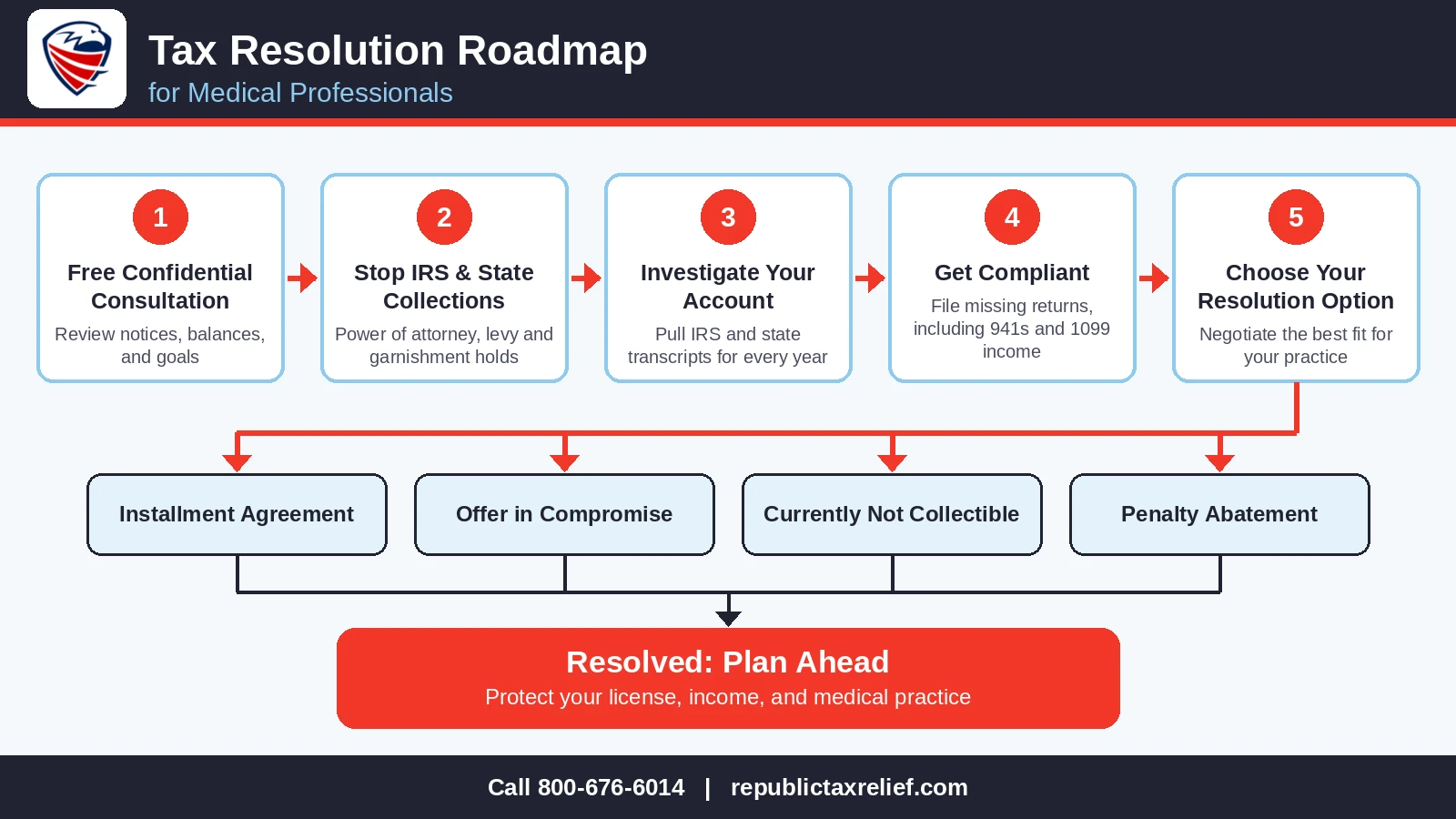
- Free, confidential consultation. We review your notices, balances, and goals.
- Protection. We file a power of attorney and request a collection hold when possible.
- Investigation. We pull IRS and state transcripts to see every year, balance, and deadline.
- Compliance. We prepare any unfiled returns, including payroll returns.
- Resolution. We negotiate the option that best fits your finances and your practice.
- Planning ahead. We work with your CPA so the problem does not come back.
For a deeper look at each step, read our complete guide to tax resolution services.
Tax Planning for Doctors After Your Debt Is Resolved
Resolving old debt is only half the job. Without a plan, many professionals end up right back where they started within a year or two.
Key tax strategies to discuss with your CPA include:
- Accurate estimated payments. Base them on current income, not last year’s guess.
- A retirement plan. Contributions to a 401(k), SEP IRA, or defined benefit plan can lower taxable income and your effective tax rate.
- The right business structure. An S corporation with a reasonable salary may offer tax advantages for some practices.
- Consistent records. Tax deductions for doctors can include medical equipment, continuing education, licensing, and professional dues, but only if you can prove them.
- The qualified business income deduction. This deduction came from the Tax Cuts and Jobs Act. Medicine is treated as a “specified service,” so higher earners face limits.
- Available credits. Small practices that improve accessibility for patients with disabilities may qualify for a federal tax credit.
- Reliable systems. A payroll service with deposit alerts and good tax software help keep you from missing a deadline.
Smart tax planning protects your financial health and can significantly reduce your tax burden over time. If your current accountant does not specialize in tax planning for medical practices, it may be worth getting a second opinion.
What Our Clients Say
★★★★★
“From the first call, Republic Tax Relief made me feel confident. The staff was knowledgeable and kept me updated at every step.”
~David Clark, Google Review
Client Story: A Practice Owner in Corona, California
J. David, a client in Corona, California, came to us after the IRS levied his practice’s bank account over unpaid payroll taxes. He was worried about making payroll and keeping his staff.
We filed a power of attorney, requested a collection hold, and brought his missing quarterly returns current. With a manageable payment plan in place, the levy was released and he could focus on his patients again.
Results vary based on each client’s facts and circumstances.
Tax Resolution FAQs for Healthcare Professionals
Can the IRS take insurance or Medicare payments owed to my practice?
Yes. The IRS can levy payments that insurers and other payers, including Medicare, owe your practice. Acting before you receive a final notice of intent to levy gives you the best chance to prevent this.
Will owing back taxes affect my medical license?
In most cases, federal tax debt alone does not cost you your license. However, some states, including California, can suspend professional licenses for large unpaid state tax debts, and public liens may come up during credentialing.
What happens if my practice falls behind on Form 941 payroll taxes?
The IRS can assess the Trust Fund Recovery Penalty against owners and other responsible people, making the debt personal. Getting current on new deposits and negotiating a plan early can protect both you and the practice.
Can a high-earning physician qualify for an offer in compromise?
It is possible but less common, because the IRS counts your future earning potential. Offers tend to work best after a real drop in income, such as disability, retirement, or closing a practice.
I am a 1099 locum tenens doctor with several unfiled years. What should I do first?
Talk to a tax professional before contacting the IRS yourself. A representative can pull your transcripts, find out which years the IRS is asking for, and prepare returns that include every deduction you are owed.
Should I hire a CPA, an enrolled agent, or a tax attorney?
All three can represent you before the IRS. A CPA is great for tax returns and planning, an enrolled agent focuses on IRS matters, and a tax attorney is best when legal issues or privilege are involved.
How long does the IRS have to collect back taxes?
The IRS generally has 10 years from the date a tax is assessed to collect it. Certain actions, such as filing for bankruptcy or submitting an offer in compromise, can pause that clock.
Speak With a Tax Relief Professional
Tax debt does not fix itself, and every month you wait adds more penalties and interest. The sooner you reach out, the more options you keep.
Republic Tax Relief provides tax resolution for medical professionals who want a clear plan and a team that picks up the phone. Whether you owe on a personal return, a payroll account, or years of unfiled 1099 income, we can help you find a way forward.
You protect patient privacy every day, and we protect yours the same way. Every document you share is guarded by strict tax professional confidentiality and bank-grade 256-bit encryption.
Call 800-676-6014 or schedule your free, confidential consultation today.
About Republic Tax Relief
Republic Tax Relief helps individuals, medical professionals, and business owners resolve IRS and state tax problems, including back taxes, unfiled returns, levies, liens, wage garnishments, and payroll tax debt. Our team of tax professionals negotiates directly with tax agencies to find the most affordable path to resolution for each client. Call 800-676-6014 or visit our contact page to get started.
Disclaimer: This page is for general educational purposes and is not legal or tax advice for your specific situation. Tax laws change, and results depend on each taxpayer’s facts. Speak with a qualified tax professional before making decisions about your tax debt.
Sources
- Internal Revenue Service, Failure to File Penalty
- Internal Revenue Service, Offer in Compromise
- Internal Revenue Service, Trust Fund Recovery Penalty