
From Philadelphia and Pittsburgh to Allentown, Harrisburg, Scranton, and Erie
IRS Tax Relief for Pennsylvania Taxpayers: Resolve IRS Back Taxes, Stop Tax Levies, and Settle Unpaid Taxes With Resolution Services Built for the Commonwealth
A letter from the IRS can ruin a whole week. In Pennsylvania, it is often not the only letter. Many households owe the federal government, the PA Department of Revenue, and a local tax office at the same time, and each one runs on its own clock.
Row home owners in South Philly, contractors in the Lehigh Valley, nurses in Pittsburgh, and farmers in Lancaster County work with our team by phone, video, and secure upload. Nationwide reach, Eastern time hours.
Federal and state balances, one team
W-2, 1099, sales tax, and payroll filers
In-house team since 2005
Spanish-speaking clients welcome
Pennsylvania stacks taxes in layers. There is federal income tax, a flat Pennsylvania state income tax, sales tax, and for most workers a local earned income tax. Philadelphia adds its own wage tax and business taxes on top. Fall behind on one, and the others keep running.
Republic Tax Relief helps individuals and business owners who owe the Internal Revenue Service, the Pennsylvania Department of Revenue, or both. Our licensed enrolled agents, CPAs, and tax attorneys work as one team from our California offices and represent Pennsylvania residents in every county, from Bucks to Erie.
On This Page
- Why Pennsylvania Taxpayers Owe the IRS and the State
- From IRS Notice to Tax Levies: What Happens Next
- Owe Pennsylvania? PA Department of Revenue Collections
- Pennsylvania State Tax Appeal Deadlines
- A Pennsylvania IRS Case: The Pittsburgh Payroll Taxes
- IRS Services Available to Pennsylvania Residents
- IRS Back Taxes, Unfiled Returns, and Tax Penalties
- Payroll and Sales Tax Problems for PA Businesses
- Cross-Border Commuters and Multistate Tax Problems
- Our Tax Resolution Process Without a Local Office
- IRS Tax Relief in Philadelphia, Pittsburgh, and Across PA
- Expert Insight: DIY and AI Risks With IRS Problems
- Why Pennsylvania Taxpayers Choose Republic Tax Relief
- Frequently Asked Questions
- Speak With a Tax Relief Professional
Why Pennsylvania Taxpayers End Up With IRS Problems and State Tax Debt at the Same Time
Pennsylvania’s flat state income tax looks simple. But it does not follow federal rules line for line, so income that is handled one way on your IRS return can be handled another way on your Pennsylvania return. That gap trips up a lot of people.
These are the patterns we see most in Pennsylvania households:
- Self-employed and 1099 income. Rideshare drivers, tradespeople, and consultants get no withholding, then owe federal tax, self-employment tax, Pennsylvania tax, and local tax together.
- Two jobs or two incomes. Each job can withhold correctly on its own and still leave a balance when the incomes are combined.
- Retirement withdrawals. Pulling from a 401(k) or IRA to cover a roof, medical bills, or a gap in work can create a large federal bill, even when Pennsylvania treats the same money very differently.
- Unfiled returns after a job loss, a divorce, a death in the family, or a business that closed. Our unfiled tax returns service brings missing federal and Pennsylvania returns current and stops new penalties.
- Payroll tax trouble at small companies after a slow season or a lost contract.
Not sure which years you owe or how much? Our back tax help confirms every federal and state balance before anyone makes a promise about your tax debt.
What you tell us stays with us. Your tax file is protected under attorney-client and tax professional privilege standards, and only the licensed professionals assigned to your case ever see it.
From an IRS Notice to Tax Levies: What Happens Next and How to Resolve Your IRS Case in Time
The IRS rarely jumps straight to taking property. It sends a series of tax notices first, and each one gets more serious. If you received an IRS letter recently, where it falls in this order tells you how much time you have.
- Balance due notices. The first bills show the amount owed, plus penalties and interest.
- Reminder and urgent notices. The tone sharpens, and the IRS warns that collection action is coming.
- Final Notice of Intent to Levy and Notice of Your Right to a Hearing. This is the big one. You generally have 30 days to ask for a Collection Due Process hearing.
- Levy. The IRS can take wages, bank funds, retirement accounts, and other assets.
A levy is the legal seizure of your property to satisfy a tax debt. The IRS explains that it can reach wages, bank accounts, Social Security benefits, and other property (IRS: What Is a Levy?).
Do not let the 30 days pass. Ignoring an IRS final notice can cost you the right to a hearing and the leverage that comes with it. Write down the date printed on the intent to levy and notice letter, not the date it reached your mailbox, and call us before that window closes.
See how IRS collections defense works, how we handle bank levy help and wage garnishment relief, or read our guide to common IRS notices.
Owe Pennsylvania? State Tax Debt, Liens, and PA Department of Revenue Collections
Many people fix the IRS side and let the Pennsylvania state bill sit. That is a mistake. The Department of Revenue in Harrisburg has its own collection tools, and it does not wait for the IRS case to finish.
| PA collection tool | What it means for you |
|---|---|
| State tax lien | Filed with your county Prothonotary’s Office and added to a public lien list. It shows up in title searches and can stall a sale or refinance. |
| Bank attachment | The Department can attach funds in your bank account administratively, without first going to court. |
| Outside collectors | Older balances can be sent to a private collection agency or the Office of Attorney General. |
| Out-of-state enforcement | Moving to Florida or the Carolinas does not end the debt. Pennsylvania pursues liens in other states too. |
| Refund offsets | State refunds can be applied to what you owe before you see them. |
The Department says it does not report liens directly to the credit bureaus, but because liens and their cancellation are public record, the bureaus can find them on their own (PA Department of Revenue: Liens).
Pennsylvania payment plans and settlements
Pennsylvania calls its payment plan a Deferred Payment Plan. Terms are usually much shorter than an IRS installment agreement, and interest keeps running while you pay. Settling a Pennsylvania state tax debt for less is generally handled as a compromise request tied to a Board of Appeals petition, so an IRS settlement never guarantees a state one.
That is why we plan both at once. A federal payment you cannot really afford can leave nothing for Pennsylvania, and that gap is often what triggers a state bank attachment. See our IRS and state back tax relief services and our tax lien help.
Pennsylvania State Tax Appeal Deadlines: 60 Days, 90 Days, and a Free Mediation Option
If the Department of Revenue sends a Notice of Assessment you disagree with, the clock starts on the mailing date. Pennsylvania uses two administrative boards before a case ever reaches Commonwealth Court.
| Level | Who runs it | General deadline |
|---|---|---|
| Board of Appeals | PA Department of Revenue | 90 days for personal income tax, employer withholding, and pass-through assessments; 60 days for most other taxes |
| Board of Finance and Revenue | Pennsylvania Treasury, independent of Revenue | 90 days for those same tax types after a Board of Appeals decision; 60 days for most others |
| Commonwealth Court | State court | Short window after the Board of Finance and Revenue rules |
The Treasury’s Board of Finance and Revenue also offers a no-cost mediated settlement conference for certain appeals, and it can grant extra time for some late personal income tax appeals when good cause is shown (Pennsylvania Treasury: Board of Finance and Revenue). Always go by the deadline printed on your own notice.
A Real Pennsylvania IRS Case: The Pittsburgh Owner Who Held Back Payroll Taxes
Most tax debt is a money problem, not a crime. Payroll taxes are different, because the withheld money belongs to employees and the government from the moment it leaves the paycheck. This Allegheny County case shows how far it can go.
The case: The sole owner of a Pittsburgh-area IT consulting company collected payroll taxes from his employees for 16 tax quarters but did not pay them over to the IRS.
The outcome: A federal court sentenced him to two years in prison and one year of supervised release, and ordered more than $2.2 million in restitution to the IRS (U.S. Attorney’s Office, Western District of Pennsylvania).
The lesson: Payroll tax problems turn criminal when they drag on for years. Caught early, the same balance can usually be handled with civil tools like a payment plan. If your company is behind on deposits, talk to a licensed tax professional now.
Behind on payroll deposits? Start with our payroll tax debt relief page, and read our payroll tax debt insights.
IRS Services Available to Pennsylvania Residents: Payment Plans, Offers, CNC, and Penalty Relief
Whether an individual or business is behind, the right option depends on income, allowable living expenses, assets, and how much time is left on the collection clock. Here is how the main federal programs fit Pennsylvania households.
| Relief option | What it does | Often fits |
|---|---|---|
| IRS payment plan | Monthly installments while levies are held off | Steady paychecks that cannot cover the balance at once |
| Offer in Compromise | A compromise to settle for less than the full amount owed, based on ability to pay | Low income and low equity compared with the debt |
| Currently Not Collectible | Pauses collection during financial hardship | Retirees on fixed income or workers between jobs |
| Penalty abatement | Removes penalties for a clean history or reasonable cause | Serious illness, a death in the family, or flood damage |
| Innocent spouse relief | Separates you from a spouse’s tax debt | Errors or hidden income caused by a current or former spouse |
| Audit representation | We deal with the auditor so you do not have to | Exam letters, document requests, or a proposed balance |
For the bigger picture, see our complete guide to tax resolution services, our tax debt relief options, and the truth about the IRS Fresh Start Program.
IRS Back Taxes, Unfiled Returns, and Tax Penalties: Why the Balance Keeps Growing
If you owe back taxes, the number on the notice is rarely the whole story. Missing returns, penalties, and interest often make the money you owe look far bigger than the original tax.
Unfiled returns come first
The IRS will not approve most relief options until every required tax return is on file. When you skip a tax year, the IRS may prepare a substitute return for you with none of your deductions, which inflates the bill. Our team handles the tax preparation for missing years so the numbers reflect your real situation.
Penalty relief can shrink the bill quickly
Failure-to-file and failure-to-pay penalties can add a big share to the total. A first-time abatement can remove IRS penalties for one year if your record is otherwise clean, and others may qualify for reasonable cause relief. Pennsylvania can waive some state penalties too, though interest generally stays.
Learn more in our unfiled tax returns guide and penalty abatement insights.
Payroll and Sales Tax Problems: Tax Resolution for Pennsylvania Business Owners
Pennsylvania business owners juggle federal payroll deposits, state employer withholding, local earned income tax withholding, unemployment contributions, and sales tax, all on separate schedules. One slow quarter can put every one of them behind.
- Federal payroll tax deposits. Missed deposits can lead to the Trust Fund Recovery Penalty against owners personally, as the Pittsburgh case shows at its worst.
- Sales tax collected but not sent. Sales tax is trust money, just like payroll withholding. Pennsylvania can hold responsible officers personally liable.
- State employer withholding. These assessments now get the longer 90-day appeal window, but only if someone files on time.
- Selling or closing a business. Open state tax balances can complicate a sale, and buyers often want clearance before closing.
The Pennsylvania businesses we help most often include:
- Contractors and trades from the Philly suburbs to the Mon Valley. See construction tax resolution.
- Restaurants, bars, and cheesesteak shops. Read our restaurant tax resolution insights.
- Medical, dental, and home health practices in Pittsburgh, Philadelphia, and Hershey. See tax resolution for medical professionals.
- Real estate agents, landlords, and investors. See real estate tax resolution.
- Online sellers and Lehigh Valley warehouse operators. See e-commerce tax resolution.
Explore our business tax resolution services, small business tax relief, and business tax debt relief.
No drive to Harrisburg with a box of paperwork. Your returns, Social Security number, and bank statements reach us through bank-grade 256-bit encryption that meets federal data protection standards.
Cross-Border Commuters: Multistate Tax Problems for Pennsylvania Residents
Pennsylvania borders six states, and thousands of residents cross a state line for work every day. Pennsylvania has reciprocal agreements with several neighbors for wages, but those agreements only help if your employer withholds the right state’s tax.
New Jersey and Delaware
Southeast Pennsylvanians who work in Camden, Cherry Hill, or Wilmington often find the wrong state was withheld all year, leaving a Pennsylvania balance at filing time.
Ohio, West Virginia, and Maryland
Western and South Central Pennsylvania commuters face the same issue. A new job across the line is the most common trigger.
Working in Philadelphia
Suburban and New Jersey residents who work in the city may still owe Philadelphia’s wage tax, on top of state and federal tax.
Explore our state guides for New Jersey, New York, Ohio, and Maryland.
Our Tax Resolution Process for Pennsylvania Residents Without a Local Office
We want to be upfront: we do not have an office in Pennsylvania. Our team works from our offices in Corona, California and Laguna Hills, California, with calls scheduled around Eastern time.
That works because the IRS is a federal agency, and it handles nearly all cases by phone, mail, and secure online systems. An IRS enrolled agent can represent taxpayers in every state. Working with the faceless IRS is a lot easier when someone who does it every day takes the calls and deals with the IRS on your behalf.
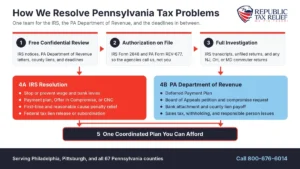
What happens after you call
- Confidential consultation. A short call about your letters, deadlines, and monthly budget.
- Authorization on file. We file IRS Form 2848 so the IRS contacts us instead of you, plus Pennsylvania Form REV-677 for state matters.
- Full investigation. We pull IRS transcripts, check for county liens and bank attachments, and review any New Jersey, Ohio, or Maryland returns that affect your balance.
- Protection first. Where the law allows, we act to stop the IRS and the state from levying while we build your case.
- One coordinated plan. We negotiate in the right order and explain every option in plain English.
| Common concern | How we handle it |
|---|---|
| “My bank account was frozen by the state.” | We contact the Department of Revenue, confirm the balance, and work toward a release and a payment plan. |
| “The IRS and Pennsylvania both want monthly payments.” | We build both plans from one household budget so neither one falls apart. |
| “I’m selling my house and a lien showed up.” | We get payoff figures, request releases or subordination where allowed, and keep the closing on track. |
| “Can a California firm really help me in Pennsylvania?” | Yes. Federal representation works the same in every state, and we handle Pennsylvania matters under written authority. |
IRS Tax Relief in Philadelphia, Pittsburgh, and Across Pennsylvania
A city worker in Philadelphia, a hospital employee in Pittsburgh, and a dairy farmer in Lancaster County face very different IRS tax problems. We start with the two biggest metros, then cover every region of the Commonwealth.
Focus City: Philadelphia
Philadelphia is the only Pennsylvania city where residents routinely deal with a big-city wage tax, state tax, and federal tax all at once. Small business owners also face city business taxes. When money gets tight, the result is often three agencies chasing one household.
Professionals, hospital staff, and commuters from the suburbs.
Restaurant owners, tradespeople, and row home landlords.
Family businesses, city workers, and retirees.
Working families, 1099 drivers, and seniors on fixed income.
Focus City: Pittsburgh
Pittsburgh’s economy runs on healthcare, universities, tech, and the trades. That mix means plenty of W-2 earners with side income, consultants paid on 1099s, and small companies managing payroll for the first time.
Office workers, restaurant owners, and startups.
Doctors, researchers, and university staff.
Homeowners, retirees, and small business owners.
Contractors, truckers, and union tradespeople.
Regions and Cities We Serve Across Pennsylvania
Philadelphia Suburbs
Cities: King of Prussia, Norristown, West Chester, Media, Doylestown, Bensalem
Bucks, Montgomery, Delaware, and Chester county professionals and business owners.
Lehigh Valley
Cities: Allentown, Bethlehem, Easton
Warehouse, logistics, and gig workers with 1099 surprises.
Northeast and the Poconos
Cities: Scranton, Wilkes-Barre, Hazleton, Stroudsburg
Small manufacturers, trades, and seasonal hospitality businesses.
South Central
Cities: Harrisburg, Lancaster, York, Reading, Hershey
State employees, farmers, and family-owned shops near the capital.
Central
Cities: State College, Altoona, Williamsport, Johnstown
University staff, landlords, and natural gas industry workers.
Southwest and Northwest
Cities: Washington, Greensburg, Butler, Erie, Meadville
Commuters into Ohio and West Virginia, plus manufacturing families.
Don’t see your town? We help taxpayers in all 67 Pennsylvania counties, from the Delaware River to Lake Erie. Call 800-676-6014 and we will tell you right away whether we can help. You can also browse all of our service locations.
Expert Insight: The Risks of Dealing With IRS Tax Problems Alone or With AI
Plenty of Pennsylvanians try to handle a tax problem on their own first, and more are now asking chatbots to write their IRS letters. We respect that instinct. But self-managed cases tend to go wrong in a few predictable ways, and some mistakes cannot be undone.
- Your financial statement is sworn. Payment plans and settlements often require a Collection Information Statement signed under penalty of perjury. Once the IRS has your numbers, they shape every later decision.
- Allowable expenses depend on your county. The IRS uses local standards for housing and utility costs. A family in Philadelphia or Chester County may be allowed different amounts than one in rural central Pennsylvania, and generic advice usually misses it.
- Fixing the IRS can break Pennsylvania. Agreeing to a federal payment that eats your whole budget often leads straight to a state bank attachment.
- Missing the right deadline. The IRS hearing window is 30 days. Pennsylvania’s appeal window is 60 or 90 days, depending on the tax. Mixing them up can cost you the appeal entirely.
- Trusting AI on Pennsylvania rules. Chatbots often apply federal rules to Pennsylvania income, describe a “PA tax forgiveness” program as if it wipes out debt, or quote old appeal deadlines. A confident wrong answer leads to a costly decision.
- Pasting private data into public tools. Uploading returns, bank statements, or your Social Security number to a free chatbot creates a privacy risk you cannot take back. AI also cannot sign a power of attorney, pull transcripts, or talk to a revenue officer.
Our take: AI is fine for learning what a term means. A licensed enrolled agent, CPA, or tax attorney should make the decisions and give the advice. We explain why in Can AI get a better settlement than a tax attorney?
Want to read more first? Try our Offer in Compromise guide, IRS payment plans explained, and tax negotiation insights.
Why Pennsylvania Taxpayers Choose Republic Tax Relief
Hiring help with tax debt is a trust decision. Since 2005, founding partner Mark Ladd and our in-house team of enrolled agents, CPAs, and tax attorneys have helped individuals and businesses resolve IRS and state tax problems. We work every case ourselves, with no outsourcing.
| Cases resolved | 18,000+ |
| Client balances settled | $220M+ |
| Average client rating | 4.9 / 5 |
| Credentials | Enrolled agents, CPAs, and tax attorneys |
| Scheduling | Eastern time morning, lunch, and evening call windows |
| Languages | English and Spanish |
- Federal and Pennsylvania handled together. One team, one budget, one plan for every agency.
- Deadline discipline. We track the IRS 30-day window and Pennsylvania’s 60- and 90-day appeal windows for you.
- Multistate commuter experience. New Jersey, Ohio, Maryland, and Delaware returns are part of our everyday work.
- Results-focused approach. We recommend the option that fits your finances, not the one that sounds best in an ad.
- Honest answers. If a settlement is not realistic, we say so and show you a better path.
- Recognized work. See our awards and recognition.
Results vary based on each taxpayer’s facts and finances. Past results do not guarantee a similar outcome.
Encrypted files. Privileged conversations. Zero exceptions.
Pennsylvania IRS Tax Relief Frequently Asked Questions
Can you help me if you don’t have an office in Pennsylvania?
Yes. IRS cases are handled by phone, mail, and secure online systems, and we represent you under a signed power of attorney. Our team works from California and serves clients in Philadelphia, Pittsburgh, and all 67 Pennsylvania counties.
I owe both the IRS and Pennsylvania. Can you handle both?
Yes. We review both balances, build one household budget, and negotiate with the IRS and the PA Department of Revenue in the right order so the two plans fit together.
What should I do after a Final Notice of Intent to Levy?
Act quickly. You generally have 30 days from the notice date to request a Collection Due Process hearing, which can pause the levy while your case is reviewed. Call a licensed tax professional before that window closes.
How long do I have to appeal a Pennsylvania state tax assessment?
Appeals involving personal income tax, employer withholding, and pass-through assessments generally allow 90 days from the notice mailing date. Most other Pennsylvania taxes allow 60 days. Always check the deadline printed on your notice.
Is a Pennsylvania state tax lien public?
Yes. The Department of Revenue files state tax liens with the county Prothonotary and publishes a lien list. The Department does not report liens to credit bureaus directly, but the bureaus can find them because liens are public record.
Can Pennsylvania take money from my bank account?
Yes. The Department of Revenue can attach bank accounts administratively for unpaid state taxes. Entering a Deferred Payment Plan or filing a timely appeal can help prevent it, so act before collection starts.
Can I settle IRS debt for less than the full amount owed?
Sometimes. The IRS offers an Offer in Compromise when your income, expenses, and assets show you cannot pay the full balance before the collection period ends. Many people do not qualify, so we review your finances before recommending it.
Do you handle Philadelphia city taxes or local earned income tax?
Our core work is IRS and Pennsylvania state tax debt. Bring any local tax notices to your consultation. We will explain how they affect your overall plan and tell you plainly if a local issue needs a different specialist.
What should I bring to my free consultation?
Any IRS or Pennsylvania letters, your latest tax return if you have one, any New Jersey, Ohio, or Maryland returns, and a rough idea of your monthly income and bills. If records are missing, we can request IRS transcripts for you.
More answers: tax resolution questions, IRS collections defense questions, IRS notices questions, and back tax help questions.
Sources
- IRS: What Is a Levy?
- PA Department of Revenue: Liens
- Pennsylvania Treasury: Board of Finance and Revenue
Republic Tax Relief is a private firm and is not affiliated with the IRS, the Pennsylvania Department of Revenue, the Pennsylvania Treasury, or any Pennsylvania county or municipality. This page offers general guidance, not legal or tax advice for your specific situation. Tax laws, deadlines, and agency procedures change, so consult a qualified tax professional or contact the agency directly before acting.
Speak With a Tax Relief Professional About Your Pennsylvania Tax Debt
Every week you wait, penalties and interest grow. One call can stop the guessing.
Whether the letter came from the IRS, Harrisburg, or both, a short call shows you where you stand, what is at risk, and which options fit. Your consultation is free and confidential.
About Republic Tax Relief
Republic Tax Relief helps individuals and businesses nationwide resolve IRS and state tax problems, including back taxes, levies, liens, unfiled returns, audits, and payroll tax debt. Since 2005, our in-house team of enrolled agents, CPAs, and tax attorneys has resolved more than 18,000 cases. From our offices in Corona and Laguna Hills, California, we represent clients in all 50 states, including Pennsylvania. Call 800-676-6014 or contact us online for a free, confidential consultation.