
Reviewed by the Republic Tax Relief team of enrolled agents, tax attorneys, and CPAs. Mark Ladd, CEO. Last reviewed November 2026.
IRS Fresh Start Program: Who Qualifies & How to Apply for Back Tax Relief
That stack of IRS letters on the counter does not have to be the end of the story. Every year, millions of people fall behind on their taxes after a job loss, a slow season, a divorce, a medical bill or a business that needed every dollar to stay open.
The IRS Fresh Start Program was built for that moment. It is not one form or a blanket forgiveness deal. It is a set of IRS rules that make payment plans easier to get, tax liens less likely, penalties easier to remove and settlements more realistic.
Below, our team answers the questions people ask most: what Fresh Start is, who qualifies, how to apply, whether you can do it yourself and whether it is still available. Want answers for your own case? Call 800-676-6014 for a free, confidential review.
What This Service Page Covers
- What Is the Fresh Start Program?
- Who Qualifies for Fresh Start Tax Relief
- Fresh Start Tax Relief Options Compared
- How to Apply for Fresh Start Tax Relief
- Can I Apply for Fresh Start on My Own?
- Is Fresh Start Still Available in 2026?
- Is the Fresh Start Program Legit?
- Fresh Start Tax Help for Business Owners
- Why Taxpayers Choose Republic Tax Relief
- Fresh Start Tax Program FAQs
- Speak With a Tax Relief Professional
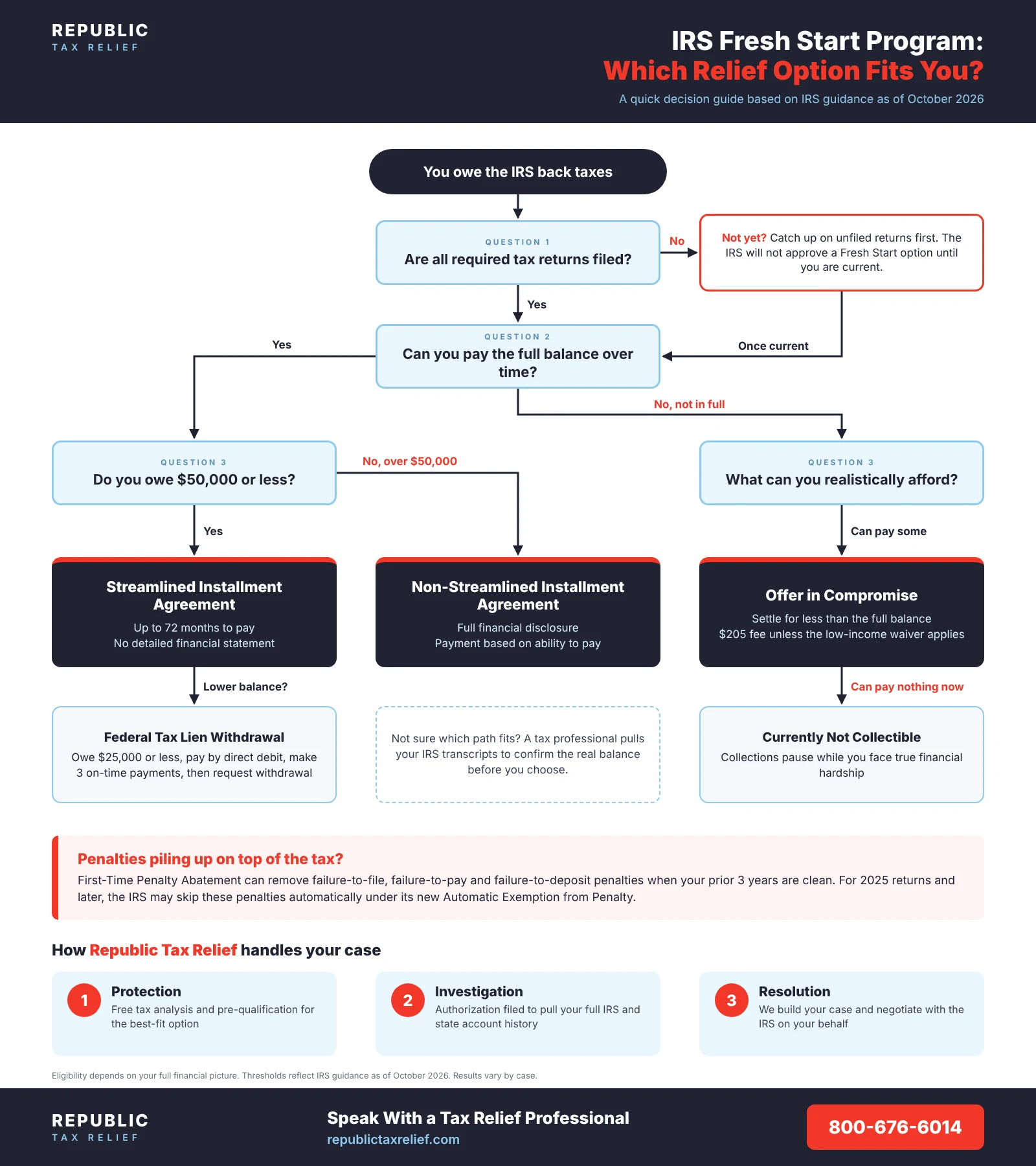
What Is the Fresh Start Program?
Fresh Start is the name the IRS gave to a group of policy changes made to help struggling taxpayers. The IRS launched the Fresh Start initiative in 2011 and expanded it the next year. Instead of creating one new program, it loosened several existing collection rules at once.
| Rule | Before Fresh Start | After Fresh Start |
|---|---|---|
| Payment plans with no detailed financial statement | Balances up to $25,000 | Balances up to $50,000 |
| Longest streamlined payment plan | 60 months | 72 months |
| When the IRS generally files a tax lien | Lower balances | Higher balances, so fewer small debts trigger a lien |
| Settlement math for an offer in compromise | Counted 4 to 5 years of future income | Counts 12 or 24 months of future income |
Is Fresh Start an IRS Forgiveness Program?
Not in the way most ads suggest. Most Fresh Start relief helps you pay over time, pause collection or remove penalties. Only an accepted offer in compromise lowers the tax debt itself.
That gap between the ads and the real rules is where scams start. We cover the most common myths in common Fresh Start misconceptions.
Who Qualifies for the IRS Fresh Start Program?
There is no single approval for Fresh Start. Each relief option has its own test. Still, almost every path starts with the same four requirements:
- All required tax returns are filed. The IRS will not approve a payment plan or an offer while returns are missing. Our unfiled tax returns team handles this first.
- You are current this year. That means proper withholding or estimated payments, plus on-time payroll deposits if you have employees.
- You are not in an open bankruptcy. Bankruptcy cases follow a different set of rules.
- Your numbers fit the option. What you owe, your income, your expenses and the equity in your assets decide which option opens up.
Quick Eligibility Check
| If this sounds like you | You may qualify for |
|---|---|
| You owe $50,000 or less and can pay over time | Streamlined installment agreement |
| You owe more than $50,000 but can pay over time | Non-streamlined installment agreement |
| You cannot realistically pay the full tax bill | Offer in compromise |
| Your income does not cover basic living costs | Currently not collectible status |
| You had a clean record before this penalty | First-time penalty abatement |
Individuals, self-employed workers, couples who filed jointly and many businesses can qualify. The real question is not “Can I use Fresh Start?” It is “Which part of it fits my numbers?”
Fresh Start Tax Relief Options Compared
Use this table as a quick map of your IRS tax debt relief options. A tax professional can confirm the right fit after reviewing your IRS account transcripts.
| Relief Option | Key Rule | What It Does |
|---|---|---|
| Streamlined installment agreement | Individuals owing $50,000 or less | Up to 72 months to pay, no detailed financial statement |
| Non-streamlined installment agreement | Balances over $50,000 | Monthly payment based on full financial disclosure |
| Offer in compromise | Offer must match what the IRS could collect | Settles tax debt for less than the full amount |
| First-time penalty abatement | No penalties in the prior 3 years | Removes failure-to-file, pay or deposit penalties |
| Currently not collectible | True financial hardship | Pauses active collection |
Streamlined Installment Agreement ($50,000 Threshold)
This is the most common Fresh Start relief option. If you owe $50,000 or less in combined tax, penalties and interest, you can generally set up a plan of up to 72 months without giving the IRS a detailed breakdown of your finances.[1]
- Businesses: The streamlined limit is generally $25,000 for business balances.
- Over the limit? Paying the balance down below $50,000 can open the streamlined door.
- Cost to keep in mind: Interest and a reduced late-payment penalty continue until the balance is paid.
Choosing a monthly amount you cannot keep is the fastest way to default. See our IRS payment plan services or read IRS payment plans explained.
IRS Offer in Compromise Qualifications
An offer in compromise lets you settle tax debt for less than the full balance. The IRS looks at your income, expenses, asset equity and ability to pay. It accepts an offer when the amount equals what it could realistically collect.[2]
- All required tax returns must be filed
- Current estimated payments and, for employers, payroll deposits must be up to date
- You cannot be in an open bankruptcy
- A $205 application fee and initial payment are due unless you meet the low-income certification
The IRS keeps your fee and payments if the offer is rejected, so weak numbers cost you. See how the offer in compromise program works or compare the two in Fresh Start vs. Offer in Compromise.
First-Time Penalty Abatement and Automatic Penalty Relief
Penalties can add 25% or more to a tax bill. First-time penalty abatement removes failure-to-file, failure-to-pay and failure-to-deposit penalties if your prior three years are clean and all required returns are filed.
The IRS now goes a step further for newer returns. Under its Automatic Exemption from Penalty, qualifying taxpayers are simply not charged these penalties. For older years, you still have to ask.[3]
Removing a penalty also removes the interest tied to it. Learn more about IRS penalty abatement.
Currently Not Collectible Status
If paying anything would leave you unable to cover rent, food or utilities, the IRS can pause collection. The debt stays on the books, but levies stop while your hardship lasts. See currently not collectible status.
How Fresh Start Affects Tax Liens
Fresh Start made the IRS less likely to file a public tax lien on smaller balances. It also opened a path to remove a filed lien notice for some taxpayers on a payment plan.
Whether withdrawal, release or discharge is the right move depends on your balance and plan. Our federal tax lien withdrawal guide walks through the rules and payment math.
How to Apply for Fresh Start Tax Relief
You do not apply for Fresh Start itself. There is no single Fresh Start form. You apply for the specific relief option that fits your case, and each one is requested in its own way.
| Relief Option | How It Is Requested | Financial Disclosure |
|---|---|---|
| Streamlined payment plan | IRS online payment agreement, Form 9465 or by phone | Usually none |
| Non-streamlined payment plan | Form 9465 with a collection information statement | Full income, expenses and assets |
| Offer in compromise | Form 656 with Form 433-A (OIC) or 433-B (OIC), plus fee | Full, with proof |
| Penalty abatement | Phone request or Form 843 | None for first-time abatement |
| Currently not collectible | Request to IRS collections with financial statement | Full income and expenses |
The order matters as much as the forms. Filing an offer before your returns are current, or locking into a payment plan before checking for penalty relief, can cost you money or months.
How We Apply on Your Behalf
- Protection. We start with a free tax analysis and pre-qualify you for the best resolution. If a levy or garnishment is active, stopping it comes first.
- Investigation. We file an IRS authorization on your behalf and pull your full federal and state account records. This shows the real balance, every open year and the collection deadline for each debt.
- Resolution. We gather your documents, prepare the request and negotiate with the IRS. We stay on it until the plan, settlement or abatement is in place.
Before your first call, it helps to have your latest IRS notice, recent tax returns, pay stubs or business income records and a rough list of monthly bills. Do not worry if your paperwork is messy. Sorting it out is part of our job.
Already facing collections? See IRS collections defense, wage garnishment relief or bank levy help.
Talk to an IRS Debt Expert
Every week you wait, penalties and interest keep growing. Find out which Fresh Start options fit your situation in a free, confidential consultation.
Can I Apply for Fresh Start on My Own?
Yes. You do not need a company to use Fresh Start relief, and anyone who says you do is a red flag. Whether going it alone makes sense depends on how complex your case is.
| Doing It Yourself Usually Works When | Professional Help Usually Pays Off When |
|---|---|
| You owe less than $50,000 and can afford the payment | You owe more than $50,000 |
| All returns are filed | You have unfiled years |
| There is no active levy or garnishment | The IRS is taking wages or bank funds |
| You only need a payment plan | You want to settle with an offer in compromise |
| Your debt is personal income tax | Your business owes payroll taxes or a revenue officer is assigned |
Our team reviews cases every week from people who tried the IRS alone first, and more and more who asked an AI chatbot. Here is what we see go wrong.
Risks of Handling the IRS Yourself
- Choosing the wrong option first. A pending offer pauses the IRS collection clock. A rejected offer can add months to the time the IRS has to collect, and the fee is gone.
- Saying too much on the phone. What you tell an IRS agent goes into your file. A casual comment about a side business or a paid-off car can raise your required payment.
- Overcommitting on a payment plan. Agreeing to a payment you cannot keep leads to default, and default can bring back levies quickly.
- Missing hidden balances. Your notice may show one year. Your transcripts may show three more, plus a state balance you did not know about.
- Leaving money on the table. Few people know to request penalty abatement or lien relief. The IRS will not offer them for you.
Risks of Using AI to Deal With the IRS
- Outdated rules. AI tools learn from older web pages. Many still miss the IRS’s automatic penalty relief or quote old fees and thresholds.
- Confident wrong answers. A chatbot can invent a form number, deadline or eligibility rule. The IRS does not accept “the AI told me” as reasonable cause.
- No privacy protection. Pasting your Social Security number or bank statements into a public AI tool is not covered by tax professional confidentiality rules.
- No one to stand in your place. Only attorneys, CPAs and enrolled agents can represent you before the IRS with a power of attorney. An app cannot answer a revenue officer or stop a levy.
- No judgment on timing. AI can explain what an offer is. It cannot read your transcripts and tell you whether filing one now helps or hurts.
AI is a fine place to learn the vocabulary. It is not a safe place to make decisions about your home, paycheck or business. We tested this in Can AI Get a Better Settlement Than a Tax Attorney?
Is the Fresh Start Program Still Available in 2026?
Yes. Fresh Start was never a limited-time offer. Its changes became part of everyday IRS collection policy, and the IRS still uses them, even though it rarely markets them under the Fresh Start name.
Here is what is in place today:
- $50,000 streamlined payment plans for individuals, with up to 72 months to pay
- Offers in compromise with a $205 application fee and a low-income waiver
- Penalty relief that is now automatic for qualifying newer returns
- Hardship status that pauses collection when you cannot pay basic living costs
The details do change over time, including fees and penalty rules. That is why a review of current IRS guidance, and your own transcripts, should come before any decision. Anyone who says the program “ends Friday” is selling pressure, not facts.
Is the Fresh Start Program Legit?
Yes, the program is real. It is official IRS policy, and taxpayers can use it directly with the IRS at no cost beyond normal IRS fees.
What is not always legit are the companies advertising it. Promises of “pennies on the dollar” before anyone reviews your records, fake deadlines and government look-alike branding are common warning signs.
Before you hire anyone, read Is the IRS Fresh Start Program Legit? It covers the scam warning signs, how real firms differ from “mills” and the questions to ask before you sign.
Fresh Start Tax Help for Business Owners
Business tax debt carries extra risk because the IRS treats unpaid payroll taxes as money held in trust for employees. Owners and managers can be held personally responsible through the Trust Fund Recovery Penalty.
- In-business plans: Businesses that owe $25,000 or less can often get a streamlined payment plan.
- Payroll deposits come first: The IRS will not approve relief while new deposits are being missed.
- Industry patterns matter: Construction, medical, real estate and online sellers each face different cash flow and audit risks.
Explore business tax debt relief, payroll tax debt relief and small business tax relief. We also help construction companies, medical practices, real estate professionals and e-commerce sellers.
Why Taxpayers Choose Republic Tax Relief
Republic Tax Relief is a full-service tax liability resolution firm that has handled IRS and state tax issues since 2005. All work is done in house by our enrolled agents, tax attorneys and CPAs.
| 18,000+ | Cases resolved |
| $220M+ | Tax debt settled |
| 20+ years | Serving taxpayers since 2005 |
| 4.9 / 5 | Average client rating, with an A+ BBB rating |
| Offices | Corona, CA and Laguna Hills, CA |
What Our Clients Say
“Don Davis is the man! he was able to help me out a lot with my Tax Dept situation. I feel more comfortable now knowing these guys are fighting the IRS for me & will soon be able to be financially free again. I highly recommend”
Enrique Cardenas, Google Review ★★★★★
Your information stays protected. You are trusting us with your most private records, and we treat them that way: strict tax professional confidentiality, bank-grade 256-bit encryption and full federal security compliance for every file you share.
See our awards and recognition or our full tax resolution services.
Results vary based on each client’s facts and finances. Past results do not guarantee a similar outcome.
Explore the IRS Fresh Start Series
Go deeper on the questions taxpayers ask before choosing a relief option.
Fresh Start vs. Offer in Compromise
Which option fits you: a payment plan or settling for less
Is the IRS Fresh Start Program Legit?
How to tell real relief from a scam before you pay anyone
How payment plans, lien relief, and penalty relief worked in real cases
Straight answers to the questions taxpayers ask most
Ready to see which option fits you? 800-676-6014 or request your free consultation.
Fresh Start Tax Program FAQs
How much do I need to owe to qualify for Fresh Start?
There is no minimum. Individuals who owe $50,000 or less usually qualify for a streamlined payment plan. Larger balances can still be resolved through a non-streamlined plan or a settlement.
Does Fresh Start forgive tax debt?
Not by itself. Most options spread payments out, pause collection or remove penalties. Only an accepted offer in compromise settles tax debt for less than the full amount owed.
What disqualifies someone from Fresh Start relief?
Unfiled tax returns, missed current-year payments or payroll deposits, an open bankruptcy and enough income or assets to pay in full are the most common reasons for denial.
How long does it take to get approved?
A streamlined payment plan set up online is often approved right away. An offer in compromise usually takes several months or longer for the IRS to review.
Will applying stop IRS collections?
In most cases, the IRS cannot levy your wages or bank account while a payment plan request or an offer is being reviewed. A tax lien can still be filed, so timing matters.
Does Fresh Start cover state tax debt?
No. Fresh Start is federal IRS policy. State agencies, such as the California Franchise Tax Board, have their own payment plan and settlement rules.
Can business owners use Fresh Start?
Yes. Businesses that owe $25,000 or less can often get a streamlined plan, and businesses may also qualify for a settlement or penalty abatement once payroll deposits are current.
Have more questions? Visit our tax debt relief questions, payment plan questions or offer in compromise questions.
Speak With a Tax Relief Professional
You do not have to keep opening those letters alone. One conversation can tell you which Fresh Start option fits, what it may cost and how fast collections can stop.
Call 800-676-6014 or request your free, confidential consultation today.
About Republic Tax Relief: Republic Tax Relief helps individuals and businesses resolve IRS and state tax debt, stop wage garnishments and bank levies, remove penalties and negotiate payment plans and settlements. Since 2005, our in-house team of enrolled agents, tax attorneys and CPAs has resolved more than 18,000 cases. Visit our offices in Corona and Laguna Hills, call 800-676-6014 or visit our contact page for a free consultation.
Sources
- Internal Revenue Service, Payment Plans and Installment Agreements
- Internal Revenue Service, Offer in Compromise
- Internal Revenue Service, Administrative Penalty Relief
This page is for general information and is not legal or tax advice for your specific situation.