
Owing money to the IRS can feel like a weight you carry everywhere. The letters keep coming, the balance keeps climbing, and every option sounds confusing or too good to be true. If you are struggling with tax debt, you are not alone, and you are not out of options.
Our IRS Debt Forgiveness Service helps individuals and business owners find the real path to relief. That might mean settling for less than you owe, setting up a payment plan you can afford, removing penalties, or stopping a wage garnishment. Below, we explain how each option works, who tends to qualify, and why the right professional can change the outcome.
Table of Contents
- What IRS Debt Forgiveness Really Means
- The IRS One-Time Forgiveness Program Myth
- IRS Tax Forgiveness Options at a Glance
- Offer in Compromise (OIC) Qualifications
- IRS Fresh Start Settlement Options
- Installment Agreement Plans
- Penalty Abatement Relief
- Stopping IRS Wage Garnishments and Levies
- Currently Not Collectible and Other Relief Options
- Business Tax Debt Forgiveness
- The Risks of Going It Alone or Using AI
- How Our Tax Resolution Process Works
- Why Taxpayers Choose Republic Tax Relief
- IRS Debt Forgiveness FAQs
- Speak With a Tax Relief Professional
What IRS Debt Forgiveness Really Means
The IRS does not simply erase tax debt because someone asks. “Debt forgiveness” is a common way to describe a group of formal programs that can lower, pause, or settle what you owe. Each program has its own rules, paperwork, and proof requirements.
In plain terms, IRS tax forgiveness can show up in a few ways:
- A reduced settlement, where the IRS accepts less than the full tax owed
- Removed penalties, which can cut thousands from a tax bill
- Paused collection, when you cannot afford to pay anything right now
- Spousal relief, when a current or former spouse caused the problem
The IRS generally has 10 years from the date a tax is assessed to collect it. That deadline, called the Collection Statute Expiration Date, shapes almost every strategy we build. Knowing where your clock stands is one of the first things we check.
The IRS One-Time Forgiveness Program Myth
You may have heard ads for an “IRS one-time forgiveness program.” There is no IRS program with that name. The phrase is a marketing label some tax relief companies use to make settlement sound automatic.
What people usually mean is one of these real programs:
- Offer in Compromise, the formal settlement program
- First-time penalty abatement, which can remove certain penalties once you have a clean history
- The IRS Fresh Start initiative, a set of 2011 policy changes that made payment plans and settlements easier to reach
Be cautious of any company that promises forgiveness before reviewing your finances. Only the IRS decides, and it bases that decision on your income, expenses, and assets. An honest firm will tell you what you are likely to qualify for, even when the answer is not what you hoped to hear.
IRS Tax Forgiveness Options at a Glance
Every tax situation is different, so there is no single best relief program. The table below compares the main tax debt relief options we use for clients.
| Relief Option | Best For | What It Does | Debt Reduced? |
|---|---|---|---|
| Offer in Compromise | People who cannot pay the full balance before the collection deadline | Settles tax debt for less than owed | Yes |
| Installment Agreement | People who can pay over time | Monthly payment plan that stops most collection | No, but stops levies |
| Partial Payment Installment Agreement | People who can pay something, but not all of it in time | Smaller payments until the deadline passes | Sometimes, in effect |
| Currently Not Collectible | People in real financial hardship | Pauses active collection | No, but pauses it |
| Penalty Abatement | People with a clean history or a good reason | Removes certain IRS penalties | Yes, penalties |
| Innocent Spouse Relief | Spouses hurt by a partner’s tax errors | Removes your share of the joint liability | Yes, for you |
The flowchart below shows how we narrow down which path fits your case.
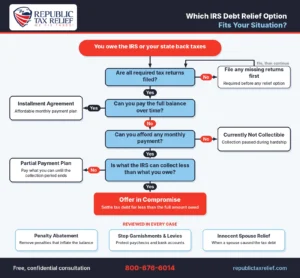
How we match taxpayers to the right IRS relief program. Every case is also reviewed for penalty abatement, garnishment protection, and innocent spouse relief.
Offer in Compromise (OIC) Qualifications
An offer in compromise lets you settle tax debt for less than owed. The IRS describes it as an agreement that resolves your tax liability for an agreed reduced amount (IRS Topic No. 202). It is the closest thing to true debt forgiveness the IRS offers.
Who Can Apply for an IRS Offer in Compromise
Before the IRS will even look at your offer, you must meet basic rules. According to the IRS, you need to have:
- Filed all required tax returns
- Received a bill for at least one tax debt in the offer
- Made all required estimated tax payments for the current year
- Made required federal tax deposits for the current quarter and two prior quarters, if you own a business with employees
You also cannot be in an open bankruptcy case. If any piece is missing, the IRS returns the offer without a decision, and months can be lost. If you have years of unfiled tax returns, our team handles those first so you stay in good standing with the IRS.
How the IRS Decides What You Can Pay
The IRS will review your income, expenses, asset equity, and ability to pay. It uses these figures to estimate what it could realistically collect from you, often called your reasonable collection potential. If that number is lower than your tax balance, a settlement may make sense.
There are three legal grounds for an offer:
- Doubt as to collectibility: you cannot pay the full balance before the collection deadline
- Doubt as to liability: there is a real question about whether you owe the tax at all
- Effective tax administration: you could pay, but doing so would cause serious hardship or be unfair
Costs to Apply
The IRS charges a $205 application fee plus an initial payment with most offers. Qualifying low-income taxpayers do not have to pay either one (IRS Tax Tip 2026-40). If the IRS processes your offer but does not accept it, the fee and payments are generally not returned, which is why getting the numbers right the first time matters.
| Offer Type | Payment Terms | Initial Payment |
|---|---|---|
| Lump sum cash offer | Paid in 5 or fewer payments | 20% of the offer amount, sent with the application |
| Periodic payment offer | Paid over 6 to 24 months | First monthly payment, then continued payments while the IRS reviews it |
While an offer is pending, the IRS is generally barred from levying your property. To go deeper, read our guide to the IRS offer in compromise or browse our OIC questions page.
IRS Fresh Start Settlement Options
The IRS Fresh Start program is not one single application. It is a set of changes the IRS made starting in 2011 to help people who were falling behind. Those changes made it easier to qualify for tax debt relief programs that already existed.
Under the Fresh Start initiative, more taxpayers gained access to:
- Larger streamlined payment plans with less financial paperwork
- More flexible offer in compromise math, which lowered the amount many people had to offer
- Higher thresholds for federal tax liens, plus easier paths to withdraw a lien after payment
Many of today’s IRS relief options trace back to these rules. Our IRS Fresh Start Program page explains each piece in more detail. If a federal tax lien is hurting your credit or blocking a sale, we can also review whether it qualifies for release or withdrawal.
Installment Agreement Plans
Not everyone qualifies for a settlement, and that is okay. An installment agreement lets you pay your tax debt in monthly amounts you can actually handle. It also stops most enforced collection while the plan stays current.
Here are the main payment plan types the IRS offers:
- Short-term plan: up to 180 days to pay in full, with no setup fee
- Simple Payment Plan: generally for individuals who owe $50,000 or less in combined tax, penalties, and interest
- Guaranteed Installment Agreement: for individuals who owe $10,000 or less in tax and meet a clean filing and payment history
- Partial Payment Installment Agreement: for people who cannot pay the full balance before the collection deadline
Interest and some penalties keep adding up during a payment plan. That is why we often pair a plan with penalty relief to shrink the total. Learn more about IRS payment plans or see answers on our payment plan representation FAQ.
Penalty Abatement Relief
Penalties can make up a large share of what you owe. In some cases, they add 25% or more to the original tax over time. Removing them is one of the fastest ways to lower a tax bill.
There are two common paths to penalty relief:
- First-time abatement: available if you have no significant penalties in the prior three tax years and are current on filing and payments
- Reasonable cause: available if a serious illness, death in the family, natural disaster, or similar event kept you from complying
The IRS wants proof, not just a story. We gather records, build a timeline, and write a request that speaks the IRS’s language. Visit our penalty abatement FAQs to see common questions.
Stopping IRS Wage Garnishments and Levies
A wage garnishment can take a large share of every paycheck. A bank levy can empty an account overnight. Both feel urgent, and both can often be stopped or released faster than people expect.
The IRS must send a final notice of intent to levy before it takes your wages or bank funds. That notice gives you a short window to request a hearing. Acting inside that window protects more of your rights.
To stop or release a levy, we typically:
- Contact the IRS right away on your behalf using a power of attorney
- Show that the levy creates an economic hardship, when it does
- Put a collection alternative in place, such as a payment plan or pending offer
See our wage garnishment relief services and bank levy help for more. If you are facing broader enforcement, our IRS collections defense team can step in.
Currently Not Collectible and Other Relief Options
Sometimes the honest answer is that you cannot pay anything right now. In that case, the IRS may place your account in Currently Not Collectible status. This pauses levies and garnishments while you get back on your feet.
Keep a few facts in mind:
- The debt does not disappear, and interest keeps growing
- The IRS may still file a tax lien
- The IRS reviews your finances from time to time
- The collection clock usually keeps running, which can work in your favor
Other forgiveness options may also apply. Innocent spouse relief can protect you from a partner’s tax mistakes. State tax agencies, like California’s Franchise Tax Board, also run their own settlement and payment programs with different rules.
Business Tax Debt Forgiveness
Business tax debt follows different rules, and the stakes are higher. Unpaid payroll taxes can become personal liability for owners and officers through the Trust Fund Recovery Penalty. The IRS also tends to move faster on business accounts.
We help companies of every size with:
- Payroll tax debt relief and trust fund penalty defense
- Business offers in compromise and in-business payment plans
- Sales tax and state tax liabilities
- Industry-specific support for construction, medical practices, real estate, and e-commerce
Explore our full business tax debt relief services or our small business tax relief page.
The Risks of Going It Alone or Using AI
It is tempting to handle the IRS yourself, or to ask an AI chatbot to write your letters. We understand the urge to save money. But after two decades of cleaning up cases that started this way, our team has seen the same costly patterns again and again.
Expert Insights From Our Resolution Team
- Your financial statement is a sworn document. Forms like the 433-A are signed under penalty of perjury. A small mistake in how you value a car, a retirement account, or a business can set your offer amount far higher than it needs to be, or raise questions about honesty.
- One wrong sentence can follow you. What you tell an IRS agent on the phone goes into your file. Casual comments about side income, cash on hand, or a pending sale can reshape your case before you realize it.
- AI tools do not know your transcript. A chatbot cannot pull your IRS account records, see your collection deadline, or spot an unassessed year. It may also mix up federal and state rules or cite outdated figures with full confidence.
- Pasting sensitive data into AI is a privacy risk. Many public AI tools may store what you type. Your Social Security number, bank statements, and tax returns deserve protected handling, not a chat window.
- A rejected offer costs time and money. You generally lose the $205 fee and your initial payment if the offer is processed and rejected. Worse, you may have given the IRS a detailed map of your assets.
- Timing is a strategy, not a detail. Filing an offer at the wrong time can extend the IRS’s collection clock. A professional knows when to file, when to wait, and when to request a hearing.
A licensed tax professional can speak to the IRS for you, so you do not have to. That alone often lowers stress and prevents mistakes you cannot undo. For a broader look, read our tax negotiation guide.
How Our Tax Resolution Process Works
Our process is built to protect you first, then find the best possible result. Here is what working with us looks like.
- Free consultation: We listen to your story and do a no-cost review of what you owe and why.
- Protection: We file a power of attorney so the IRS contacts us, not you, and we move quickly on any active levy.
- Investigation: We pull up to fifteen years of IRS and state account records to find every balance, penalty, and deadline.
- Strategy: We compare every relief option and show you which one fits, in plain language.
- Resolution: We prepare and submit your case, negotiate with the IRS, and follow it through to a final answer.
- Staying compliant: We help you stay current so the problem does not come back.
Want to see the bigger picture? Our tax resolution services guide covers the full process.
Why Taxpayers Choose Republic Tax Relief
Choosing a tax resolution firm is a big decision. You deserve real credentials, real results, and real people who answer the phone. Since 2005, our IRS Debt Forgiveness Service has been led by founding partner Mark Ladd and a team that handles every case in house.
| Our Track Record | |
|---|---|
| Cases resolved | 18,000+ |
| Tax debt settled | $220M+ |
| Average client rating | 4.9 / 5 |
| Years of experience | 20+ |
| Credentials | Enrolled agents, CPAs, and tax attorneys |
Recent Client Results
- $72,796 tax balance resolved for $500
- $46,192 tax balance resolved for $2,620
- $35,578 tax balance resolved for $4,214
Results vary based on each taxpayer’s facts and finances. Past results do not guarantee a similar outcome.
What Our Clients Say
“I typically don’t leave reviews, but my experience with Noel compelled me to share my thoughts. He was incredibly informative and knowledgeable explaining everything in layman’s terms, which made it easier for me to understand. Noel helped me resolve my tax issues efficiently and was very prompt and responding to all of my inquiries. He is definitely an asset to the company. I highly recommend his services to anyone looking for assistance.”
Gordon Simpson, Google Review ★★★★★
See our awards and recognition for more.
Your Information Is Protected
🔒 Your privacy is our first obligation. Every tax return, SSN, and bank statement you share is protected by bank-grade 256-bit encryption and strict tax professional confidentiality standards.
IRS Debt Forgiveness FAQs
Does the IRS really forgive tax debt?
Yes, in specific situations. The IRS can accept less than the full balance through an offer in compromise, remove penalties through abatement, or release a spouse from joint liability. It does not forgive debt automatically, and every program requires an application and proof.
How do I qualify for IRS tax forgiveness?
To qualify for an offer in compromise, you must file all required tax returns, be current on estimated payments, and show that you cannot pay the full amount within the collection period. The IRS looks closely at your income, expenses, and assets. A tax professional can estimate your chances before you apply.
Is there an IRS one-time forgiveness program?
No program by that name exists. The phrase usually refers to an offer in compromise, first-time penalty abatement, or the IRS Fresh Start initiative. Be careful with any company that promises forgiveness before reviewing your finances.
How much will the IRS settle for?
The IRS bases the amount on what it could reasonably collect from you, using your asset equity and future disposable income. Some people settle for a small fraction of their balance, while others do not qualify at all. The math depends entirely on your finances.
How long does an offer in compromise take?
Many offers take six months to two years. While your offer is pending, the IRS generally cannot levy your wages or bank accounts for the debts in the offer. That protection alone helps many families breathe again.
Can you stop an IRS wage garnishment?
Often, yes. The IRS may release a levy if it causes economic hardship or if you set up an approved collection alternative, like a payment plan or a pending offer. The faster you act after receiving a final notice, the more options you keep.
Will I still owe state back taxes?
IRS relief does not settle state tax debt. Many states, including California, have their own payment plans and settlement programs. We handle both federal and state cases so nothing falls through the cracks.
Do I need a tax attorney to apply for IRS relief?
You are not required to hire one, but representation often improves results. Enrolled agents, CPAs, and tax attorneys can all represent you before the IRS. They know how to present your finances, avoid common rejection reasons, and protect you during collection.
For more answers, visit our tax debt relief questions and tax relief questions pages.
Speak With a Tax Relief Professional
You do not have to face the IRS alone. Whether you need to settle your tax debt, set up an installment agreement, remove penalties, or stop a garnishment today, our team is ready to help. The first step is a free, confidential conversation.
Call 800-676-6014 or Request Your Free Consultation
About Republic Tax Relief
Republic Tax Relief helps individuals and businesses resolve IRS and state tax problems for good. Since 2005, our in-house team of enrolled agents, CPAs, and tax attorneys has resolved more than 18,000 cases and settled over $220 million in tax debt. We stop wage garnishments and bank levies, negotiate offers in compromise and payment plans, and guide clients back to good standing. Call 800-676-6014 or contact us online for a free, confidential consultation.
Sources
- Internal Revenue Service, Topic No. 202, Tax Payment Options
- Internal Revenue Service, Tax Tip 2026-40: Eligible taxpayers may be able to resolve tax debt through an offer in compromise
- Taxpayer Advocate Service, Offer in Compromise
This page provides general information and is not legal or tax advice for your specific situation. Speak with a qualified tax professional before making decisions about your tax debt.