
When you owe the IRS more than you can pay, every letter brings new questions. How much will this grow? Will they file a lien? Is there a way out?
Below are clear answers to the questions taxpayers ask us most about tax debt forgiveness, settlements, deadlines, and the dollar amounts that change your options. For a full overview of who qualifies, read our guide on what the IRS will really forgive.
This page gives general information, not legal or tax advice. Your options depend on your facts.
Table of Contents
- Who is most likely to get IRS debt forgiven?
- Why do some taxpayers settle for far less than others?
- Is the IRS forgiving people right now?
- Does IRS one-time forgiveness remove interest too?
- What can disqualify you from a tax debt forgiveness program?
- Does it cost money to settle with the IRS yourself?
- What happens when you owe the IRS over $10,000?
- What are my options if I owe the IRS $20,000?
- Why does $25,000 matter when you owe the IRS?
- How many years will the IRS give you to pay back taxes?
- How do I find out when my IRS debt will fall off?
- What is the 3 year rule for the IRS?
- What is the IRS 6 year rule?
- What is the IRS 90% rule, and why does it matter for tax debt relief?
- Should I still file my tax return if I can’t pay the IRS in full?
- Does a federal tax lien go away after tax debt forgiveness?
- Is forgiven IRS tax debt taxed as income?
- Does IRS forgiveness also cover my state tax debt?
- Can I legally opt out of paying federal taxes?
- Speak With a Tax Relief Professional
1. Who is most likely to get IRS debt forgiven?
Taxpayers whose income and assets could never cover the balance before the IRS collection deadline have the best chance. That often includes retirees on fixed income, people with a serious illness or disability, and workers with low, unstable pay and little home equity.
Age and health matter because they limit future earning power. The amount of time left on the 10-year collection window matters too. A taxpayer with a high income or valuable property usually won’t qualify for a reduced settlement, even with a large debt. Our Offer in Compromise guide explains how the IRS runs these numbers.
2. Why do some taxpayers settle for far less than others?
Settlement amounts differ because the IRS bases each offer on what it believes it could collect from you, not on the size of your debt. That figure, called reasonable collection potential, adds your equity in assets to your future disposable income.
Two people who owe $60,000 can land very different results:
- Taxpayer A rents, drives an older car, and has $150 a month left after IRS-allowed expenses. A small offer may be acceptable.
- Taxpayer B has $70,000 in home equity. The IRS will expect most of that equity in any offer.
How expenses are documented and which months of income are used can also shift the final number.
3. Is the IRS forgiving people right now?
Not through any blanket program. There is no new law that wipes out tax debt for everyone, so be cautious of ads that suggest otherwise. The IRS does, however, keep expanding penalty relief for people with good records.
In July 2026, the IRS announced an Automatic Exemption from Penalty process. It removes certain failure-to-file and failure-to-pay penalties without a request for taxpayers with a clean three-year history, starting with original returns for tax year 2025, according to the IRS administrative penalty relief page. The tax itself is still owed, and settlements still go through the regular review process.
4. Does IRS one-time forgiveness remove interest too?
Partly. When the IRS removes a penalty through first-time relief, it also removes the interest that was charged on that penalty. Interest charged on the unpaid tax itself stays on your account.
Here is how that plays out on a typical balance:
| Part of the bill | Removed by first-time relief? |
|---|---|
| Failure-to-file and failure-to-pay penalties (one tax year) | Yes, if you qualify |
| Interest on those penalties | Yes |
| Interest on the unpaid tax | No |
| The tax itself | No |
Learn more about IRS penalty abatement.
5. What can disqualify you from a tax debt forgiveness program?
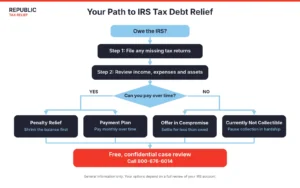
The most common disqualifiers are unfiled returns and missed current-year payments. The IRS usually returns an offer without reviewing it if you aren’t fully compliant. Other red flags include:
- An open bankruptcy case
- Employers who are behind on payroll tax deposits
- Asset equity or income that could pay the full balance over time
- Leaving assets or accounts off your financial statement
- Defaulting on a past agreement with the IRS
Most of these can be fixed before you apply. If returns are missing, start with our page on unfiled tax returns.
6. Does it cost money to settle with the IRS yourself?
Yes, an Offer in Compromise has upfront costs even without a representative. The IRS charges a $205 application fee plus an initial payment, which is 20% of the offer for a lump sum or the first monthly installment for a periodic offer, per the IRS Offer in Compromise page.
Qualifying low-income taxpayers can have both waived. If the IRS processes your offer and then rejects it, the fee and payments generally aren’t refunded, though payments are applied to your balance. Payment plans carry their own setup fees, and hardship status has no fee.
7. What happens when you owe the IRS over $10,000?
Once your balance passes $10,000, the IRS generally becomes more likely to file a Notice of Federal Tax Lien. A lien is a public claim against your property that can make it harder to sell, refinance, or borrow.
The good news is that you are still within the range for a simple payment plan, and penalty relief or a settlement may still apply. Many taxpayers also find this is the point where professional help pays for itself, because penalties and interest grow faster on larger balances. See our tax lien help page.
8. What are my options if I owe the IRS $20,000?
At $20,000, most individuals can qualify for a streamlined payment plan of up to 72 months without a full financial statement. That works out to about $278 a month before interest and penalties.
Other choices may fit better depending on your finances:
- Penalty relief to shrink the balance first
- An Offer in Compromise if you can’t realistically pay it all
- Currently Not Collectible status if paying would leave you unable to cover basic living costs
Compare plan types in our guide to IRS payment plans.
9. Why does $25,000 matter when you owe the IRS?
$25,000 is a dividing line for several IRS rules. Above it, your choices narrow a bit and the paperwork can increase.
| Rule | $25,000 or less | More than $25,000 |
|---|---|---|
| Lien withdrawal | May qualify after three on-time direct debit payments | Usually must pay down first |
| Business payment plans | Often eligible for a simplified plan | Full financial review is common |
| Individual payment plans | Standard streamlined terms | Direct debit or payroll deduction may be needed up to $50,000 |
Paying a balance down just below $25,000 can open these options, which is one reason timing matters.
10. How many years will the IRS give you to pay back taxes?
Most individuals who owe $50,000 or less can take up to 72 months, or six years, through a streamlined installment agreement. Larger balances can get longer plans with a full financial review, as long as the debt is paid before the collection deadline.
- Short-term plan: up to 180 days
- Streamlined plan: up to 72 months for balances of $50,000 or less
- Non-streamlined plan: can run until the collection deadline
- Partial payment plan: smaller payments that may never cover the full balance
11. How do I find out when my IRS debt will fall off?
Request your IRS account transcripts and find the date each tax was assessed. The IRS generally has 10 years from that date to collect, so add 10 years to get a starting estimate of your collection statute expiration date.
Each tax year has its own date, and some events push it back, such as a pending offer, a collection hearing, or time living outside the U.S. Because one wrong assumption can cost years, many people have a professional confirm the dates before deciding whether to settle, pay, or wait. Our IRS hardship blog explains how this timing fits into a long-term plan.
12. What is the 3 year rule for the IRS?
“The 3 year rule” usually refers to one of three IRS time limits:
- Audit window: the IRS generally has three years from the date you file to assess more tax.
- Refund window: you generally have three years from a return’s due date to claim a refund. After that, the money is lost, even if you owe for other years.
- Penalty relief: first-time relief requires a clean penalty record for the prior three years.
For people with back taxes, the refund window is the costly one. Late returns can forfeit refunds that might have reduced what you owe.
13. What is the IRS 6 year rule?
The IRS 6 year rule usually means the agency’s general policy of asking delinquent taxpayers to file their last six years of returns to become compliant. You may not need to file every missing year going back further than that.
A second meaning applies to audits. The IRS has six years instead of three to assess more tax if you left out more than 25% of your gross income. Filing those six years is often the first step before any settlement or payment plan can be approved.
14. What is the IRS 90% rule, and why does it matter for tax debt relief?
The IRS 90% rule says you can usually avoid an underpayment penalty if your withholding and estimated payments cover at least 90% of this year’s tax, or 100% of last year’s tax (110% for higher incomes).
This matters because the IRS expects you to stay current while it reviews any relief request. After an accepted offer, you must file and pay on time for five years. Falling short on estimated payments is one of the most common ways self-employed taxpayers lose a deal they worked hard to get.
15. Should I still file my tax return if I can’t pay the IRS in full?
Yes. File on time even if you can’t pay anything. The failure-to-file penalty is generally 5% of the unpaid tax per month, while the failure-to-pay penalty is generally 0.5% per month. Both cap at 25%.
Filing also keeps you eligible for relief. The IRS won’t approve a payment plan or settlement while required returns are missing. If you’ve already fallen behind, our tax relief services team can help you catch up and choose a plan.
16. Does a federal tax lien go away after tax debt forgiveness?
Yes, but not right away. The IRS generally releases a lien within 30 days after the debt is satisfied. With an accepted Offer in Compromise, that means after you finish paying the agreed amount, not when the offer is approved.
A lien also releases once the collection deadline passes. Keep in mind that a released lien still shows in public records as having existed. A withdrawal, which is a separate request, treats the notice as if it was never filed.
17. Is forgiven IRS tax debt taxed as income?
Generally, no. Tax, penalties, and interest the IRS gives up in an accepted offer or through penalty relief are generally not treated as taxable income, and the IRS doesn’t usually send a Form 1099-C for them.
This is different from canceled credit card or loan debt, which often is taxable. If other debts were settled in the same year, ask a tax professional to review your return so the two aren’t confused.
18. Does IRS forgiveness also cover my state tax debt?
No. Federal relief only applies to what you owe the IRS. Your state tax agency runs its own programs, rules, and deadlines, and some states move faster than the IRS on liens and wage garnishment.
California, for example, has its own offer program through the Franchise Tax Board. If you owe both, the plan needs to cover both, so one agreement doesn’t leave you exposed to the other agency.
19. Can I legally opt out of paying federal taxes?
No. There is no legal way for a U.S. citizen or resident with taxable income to opt out of federal income tax. Claims that wages aren’t income or that filing is voluntary have been rejected by the courts again and again.
Acting on these ideas can make tax debt much worse. The IRS can charge a $5,000 penalty for frivolous returns and submissions, according to the IRS guide to frivolous tax arguments. If you can’t afford what you owe, the legal path is a real relief option such as a payment plan, an offer, or hardship status.
Results depend on each taxpayer’s facts. Past outcomes do not guarantee a similar result.
Sources
- IRS: Offer in Compromise
- IRS: Administrative Penalty Relief
- IRS: The Truth About Frivolous Tax Arguments
Speak With a Tax Relief Professional
You don’t have to guess which option fits or face the IRS alone. Republic Tax Relief helps individuals and business owners resolve IRS and state back taxes through offers in compromise, payment plans, penalty relief, hardship status, and lien and levy defense. Our team reviews your account, explains every option you qualify for, and handles the IRS for you.
Your information stays private. Every tax return, Social Security number, and bank statement you share is protected by strict tax professional confidentiality and bank-grade 256-bit encryption.
Call 800-676-6014 or request your free, confidential consultation today.
Republic Tax Relief | Phone: 800-676-6014 | republictaxrelief.com
Helping individuals and businesses resolve IRS and state tax debt nationwide.
This page provides general information and is not legal or tax advice. IRS rules, fees, and thresholds can change. Speak with a qualified tax professional about your situation.