
When the IRS wants more than you have, every question feels urgent. Can they take my paycheck, is there a form to fill out, and who do I even call? This page answers the questions people ask most about applying for the IRS hardship program, in plain language.
Want to know whether your situation counts in the first place? Read our guide, What Does the IRS Consider a Financial Hardship?
On this page:
- IRS Hardship Basics and Eligibility
- How to Apply for IRS Hardship: Forms, Phone, and Letters
- What Happens at Each IRS Tax Debt Amount
- Other Places to Find Hardship Help
- Related IRS Tax Relief Questions
- Speak With a Tax Relief Professional
This page gives general information, not legal or tax advice. Your options depend on your facts.
IRS Hardship Basics and Eligibility
Does the IRS have a hardship program?
Yes and no. There is no single IRS program or application named “hardship.” The IRS hardship program is a common name for several relief tools the IRS uses when paying your tax debt would leave you unable to cover basic living expenses.
The main ones are:
- Currently Not Collectible status: pauses most collection
- Hardship levy release: stops a wage garnishment or bank levy that blocks basic bills
- Partial payment plan: a smaller monthly amount you can actually afford
- Offer in compromise: a settlement for less when you can never pay in full
Who is eligible for IRS hardship relief?
You are generally eligible when your monthly income, after IRS-allowed living expenses, leaves little or nothing to pay your tax debt. The IRS also checks your assets and whether your tax returns are filed.
| What the IRS checks | What helps you qualify |
|---|---|
| Monthly cash flow | Income barely covers basic living expenses under IRS standards |
| Assets and equity | Little home equity, savings, or retirement money available |
| Compliance | All required tax returns filed and current-year taxes being paid |
Meeting all three usually opens the door to Currently Not Collectible status or a very low payment arrangement. Our service page explains the full hardship criteria.
Does the IRS count credit card and medical debt payments as expenses?
Usually not. The IRS generally does not allow payments on unsecured debts, such as credit cards, personal loans, or old medical bills, when it measures your ability to pay. It treats your federal tax debt as a higher priority than those creditors.
Some payments do count. Ongoing out-of-pocket health care costs, health insurance premiums, court-ordered child support, and secured debts like a car loan (up to IRS limits) are typically allowed.
This is one reason so many people are surprised by IRS math. A budget that feels stretched to the limit can still show money left over once credit card payments are removed.
Can self-employed taxpayers get IRS hardship relief?
Yes, but the IRS takes a closer look. You will usually complete Form 433-A, which asks for business income, expenses, accounts receivable, and equipment, not just your household budget.
Timing matters for people with uneven income. Numbers from your best month can make you look able to pay, while an average over 6 to 12 months shows a truer picture. If you have employees, see our page on payroll tax debt relief.
How to Apply for IRS Hardship: Forms, Phone, and Letters
How do I apply for IRS hardship?
There is no application form called “hardship.” You ask for it through IRS collection, usually by phone or through a representative, and then prove it with a financial statement and documents.
A hardship request usually involves:
- Having all required tax returns filed
- A signed Form 433-F or 433-A listing your income, expenses, and assets
- Proof such as pay stubs, bank statements, and bills
- An IRS review against its own expense standards
- An IRS decision on CNC status, a levy release, or a reduced payment
The first conversation often shapes the outcome, which is why many people have a professional handle it. See how we request hardship relief for clients.
Can I apply for IRS hardship online?
Not for hardship status itself. There is no online application for Currently Not Collectible status. It is requested by phone, in person, or through a representative, with financial proof.
Some related options are online:
- Long-term payment plan: online for individuals who owe $50,000 or less and have filed all required returns
- Short-term payment plan: online if you owe less than $100,000
- Offer in compromise: the IRS has an online eligibility tool, but the offer itself is filed as a paper package
- Businesses: generally need to call rather than apply online
Before you click “agree” on an online plan, make sure the monthly amount is one you can keep. A plan that defaults can restart collection. Our team handles IRS payment plan requests when the numbers are tight.
What is the IRS hardship phone number?
There is no separate IRS hardship line. To ask for hardship status, call the phone number printed on your most recent IRS notice, which reaches the collection unit handling your account.
If you do not have a notice, individuals can call the IRS at 800-829-1040 to discuss a balance due (IRS Tax Topic 201). If an IRS problem is already causing serious harm, the Taxpayer Advocate Service can be reached at 877-777-4778.
Keep in mind that the call is a negotiation, not a formality. If you would rather not make it yourself, call Republic Tax Relief at 800-676-6014 and we can speak to the IRS for you.
What is the IRS hardship form?
There is no single IRS hardship form. Most individuals prove hardship with a Collection Information Statement, usually Form 433-F or Form 433-A, along with bank statements, pay stubs, and bills.
| Form | What it is used for |
|---|---|
| Form 433-F | Shorter financial statement used by most individuals working with IRS phone collections |
| Form 433-A | Detailed statement for wage earners and self-employed people, often with a revenue officer |
| Form 433-H | Combined payment plan request and financial statement for individuals |
| Form 656 | Offer in compromise application, filed with financial forms |
| Form 911 | Request for help from the Taxpayer Advocate Service when an IRS problem causes significant hardship |
Every one of these forms is signed under penalty of perjury. That is why many people have a tax professional prepare them.
How do I write a hardship letter to the IRS?
Keep it short and factual. The IRS decides hardship on numbers, so a letter only helps when it sits next to a signed financial statement and proof.
A useful hardship letter explains what changed, such as a layoff, diagnosis, or disaster, when it happened, and how it changed your income or expenses. Every claim in the letter should match your forms and documents, because a mismatch can hurt your credibility. A tax professional can review or write it with you.
Can I use AI to fill out my hardship forms or write my letter?
You can use AI to organize receipts, but not to decide your numbers. A chatbot cannot see your IRS transcript, may use outdated expense standards, and cannot sign forms or speak for you.
An AI-written letter that claims expenses your bank statements do not show can undermine your request, and uploading Social Security numbers to a public tool creates privacy risk. Read more in Can AI Get a Better Settlement Than a Tax Attorney?
How many years of tax returns must I file before I apply?
Usually the last six years. IRS policy generally focuses enforcement of unfiled returns on the six most recent years, and hardship status, payment plans, and settlements usually require all required returns filed first.
The IRS can ask for older returns in some cases, so the right number depends on your situation. Our team helps clients with unfiled tax returns before requesting relief.
When should you contact the Taxpayer Advocate Service for hardship?
Contact the Taxpayer Advocate Service when an IRS problem is causing significant hardship and normal channels have not fixed it. You can request help with Form 911, and the service is free.
- You face an immediate threat of adverse action, such as a pending levy
- You will face significant costs if the problem is not fixed
- You will suffer lasting harm, such as losing housing or transportation needed for work
- The IRS has not responded or resolved your issue by the date it promised
The Advocate cannot erase what you owe. It can push a stuck case forward, which is sometimes exactly what a hardship case needs.
What Happens at Each IRS Tax Debt Amount
What should you do first if you owe the IRS and can’t afford to pay?
First, file your tax return on time even if you cannot pay, because the failure-to-file penalty is much larger than the late payment penalty. Then get help before the balance reaches enforced collection.
- Open every IRS letter and note the deadline
- Pay what you can now to slow penalties and interest
- Do not ignore a final notice of intent to levy, which starts a 30-day window to request a hearing
If letters are already piling up, our guide to IRS notices explains which ones are urgent.
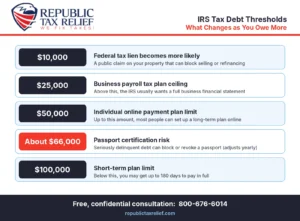
What happens when you owe the IRS over $10,000?
Once you owe more than $10,000, a federal tax lien becomes more likely. A lien is a public legal claim against your property that can make selling, refinancing, or borrowing harder.
Individuals who owe $50,000 or less can often set up a simple payment plan without a full financial statement. If a lien is already filed, see our tax lien help page.
What happens if you owe the IRS more than $25,000?
For most individuals, little changes at $25,000, because simple payment plans now cover balances up to $50,000. For businesses that owe payroll taxes, $25,000 is still a key ceiling, and above it the IRS usually wants a full financial statement.
- Individuals up to $50,000: streamlined plan, usually no financial statement
- Businesses with payroll taxes over $25,000: financial disclosure and possible personal liability review
- Owners of unpaid payroll tax: may face the Trust Fund Recovery Penalty personally
Business owners in this range should read our business tax debt relief page before calling the IRS.
What happens if you owe the IRS more than $66,000?
At about $66,000, including penalties and interest, the IRS can certify your debt as seriously delinquent to the State Department. That can block a new passport, stop a renewal, or lead to revocation. The amount is adjusted for inflation each year (IRS).
Certification only happens after the IRS has filed a lien or issued a levy and your appeal rights have run out. You are generally protected if you are in an approved payment plan, have a pending or accepted offer in compromise, have a Collection Due Process hearing pending, or have requested innocent spouse relief.
How long does the IRS give you to pay owed taxes?
The IRS gives you up to 180 days to pay through a short-term plan with no setup fee. If you need longer, a long-term plan lets you pay monthly, often across the remaining collection period, which is generally up to 10 years from the date the tax was assessed.
| Option | Time to pay | Online setup fee |
|---|---|---|
| Short-term plan | Up to 180 days | $0 |
| Long-term plan with automatic debit | Monthly payments | $29 |
| Long-term plan without automatic debit | Monthly payments | $69 |
Fees are higher by phone or mail ($107 and $178), and low-income taxpayers may qualify for a waiver (IRS). Compare plans in our IRS payment plans explained guide.
Other Places to Find Hardship Help
How can I get money if I’m struggling with tax debt?
Start with money the IRS may already owe you. Check for unclaimed refunds or credits from the last three years, such as the Earned Income Tax Credit, and adjust your paycheck withholding so you stop adding to the balance.
- Ask for a levy release if the IRS is taking money you need for rent, food, or utilities
- Look for a free Low Income Taxpayer Clinic if your income qualifies
- Call 211 for local help with housing, food, and utility bills
- Avoid high-interest loans to pay the IRS until you compare relief options
If a garnishment is already hitting your paycheck, our wage garnishment relief team can review whether a hardship release applies.
Can state tax agencies offer hardship relief too?
Yes. Many states have their own hardship options, such as payment plans, temporary collection holds, and settlement programs. California’s Franchise Tax Board and other state agencies run these separately from the IRS, with their own forms and rules.
Federal relief does not settle state tax debt. You can be in IRS hardship status and still face a state bank levy or wage garnishment, which is why it helps to plan both at once. Republic Tax Relief helps with both IRS and state back taxes.
Related IRS Tax Relief Questions
These pages go deeper on related topics:
- IRS Hardship Program: How to Qualify and Stop IRS Collections
- What Does the IRS Consider a Financial Hardship?
- IRS Currently Not Collectible Status FAQs
- IRS Fresh Start Program Questions: Settlements, Forgiveness, and Time Rules
- IRS Debt Forgiveness: Who Qualifies and What the IRS Will Really Forgive
- Frequently Asked Questions About Hiring a Tax Relief Company
Speak With a Tax Relief Professional
You do not have to figure out IRS hardship rules alone. Republic Tax Relief helps individuals and business owners resolve IRS and state back taxes through hardship status, payment plans, offers in compromise, penalty relief, and levy defense.
Our tax professionals, including tax attorneys, review your full financial picture and handle the IRS for you. Visit our Corona or Laguna Hills offices, or work with us by phone from anywhere in the country. Learn more about our team.
Your financial records are safe with us. Every tax return, bank statement, and Social Security number you share is protected by 256-bit encryption and strict tax professional confidentiality.
Call 800-676-6014 or request your free, confidential consultation today.
About Republic Tax Relief
Republic Tax Relief helps individuals and businesses resolve IRS and state tax debt, including back taxes, bank levies, wage garnishments, tax liens, and unfiled returns. Call 800-676-6014 or contact us online to get started.
Sources
- Internal Revenue Service, Payment Plans; Installment Agreements
- Internal Revenue Service, Topic No. 201, The Collection Process
- Internal Revenue Service, Revocation or Denial of Passport in Cases of Certain Unpaid Taxes
Disclaimer: This page provides general information and is not legal or tax advice. Reading it does not create an attorney-client relationship. Results depend on each taxpayer’s facts, and no outcome is guaranteed.