
Business Tax Resolution Services FAQ: What Owners Ask Google
Reviewed for accuracy by: Mark Ladd, CEO and the Republic Tax Relief resolution team of tax attorneys, CPAs, and enrolled agents | Last updated: October 2026
When your business owes the IRS, the questions pile up fast. Is that phone call real? What does the IRS actually settle for? Can you still sell the business or start a new one?
This page answers the questions business owners type into Google most often, in plain English. For a full overview of how we resolve business tax debt, visit our business tax resolution services page, read our step-by-step business tax resolution guide, or browse our general tax relief FAQs.
On this page:
- IRS Phone Calls, Voicemails, and Tax Scams
- Dollar Thresholds and IRS Rules Business Owners Ask About
- IRS Settlements and the Cost of Professional Help
- Selling, Restarting, or Protecting a Business With IRS Debt
- Secure, Confidential Tax Help
- Speak With a Tax Relief Professional
IRS Phone Calls, Voicemails, and Tax Scams
Owing back taxes makes every unknown call feel urgent. These answers help you tell a real IRS contact from a scam, and from a sales pitch.
Why am I getting calls from tax resolution services?
When the IRS files a federal tax lien, it becomes a public record at your county or state office. Some marketing companies buy that lien data and call, text, or mail every name on the list, sometimes within days of the filing.
A cold call does not mean the caller has seen your IRS file. Before you share a Social Security number or bank details, look up who you are talking to and ask whether a licensed tax professional will handle your case.
The lien itself is the bigger issue. Our tax lien help page explains how a lien can be released, withdrawn, or subordinated.
Does the IRS ever contact you by telephone?
Yes, but usually not first. The IRS starts most contacts by mail, and it may call or visit when a business has an overdue balance, an unfiled return, or a missed payroll tax deposit (IRS).
Even then, you should have received several IRS letters before the phone rings. If a call is the first you have heard of a balance, treat it with caution and verify it through the number printed on a real notice.
Does the IRS leave voicemails?
It can. A real IRS voicemail usually gives an employee name and ID number, asks you to call back, and refers to a notice or case you already received by mail.
A real message will not threaten arrest, deportation, or a license being pulled. Do not call back the number in the voicemail. Instead, call the number on your IRS notice, or the IRS business line at 800-829-4933, or ask your representative to pull your account transcript.
How do I know if a tax call is legit?
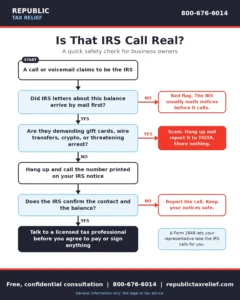
Run the call through three quick checks:
- Mail first: Did you already receive IRS letters about this exact balance?
- Payment method: Real IRS payments go to the U.S. Treasury through IRS.gov, EFTPS, or a check. Never to a gift card, crypto wallet, or personal account.
- Callback test: Hang up and call the number printed on your notice. A real employee can find your case.
If a revenue officer is assigned to your business, they carry two forms of official ID with serial numbers, and you can ask to see both. The flowchart below walks through each step.
What are the signs a tax call is really a scam?
Scammers count on panic. Compare what you hear on the phone with how the real IRS behaves.
| What the caller does | Real IRS | Scam |
|---|---|---|
| Demands payment today | No. You get a bill and appeal rights first. | Yes |
| Asks for gift cards, wire, or crypto | Never | Yes |
| Threatens arrest or police | Never | Yes |
| Threatens your business license | Cannot revoke business licenses | Yes |
| Asks for card numbers by phone | Will not ask | Yes |
| Refers to letters you received | Yes | Rarely |
If any scam sign shows up, hang up and report the call to the Treasury Inspector General for Tax Administration (TIGTA). Then check your real account status with a professional so a true balance does not slip through the cracks.
Dollar Thresholds and IRS Rules Business Owners Ask About
Owners often hear about a “$600 rule” or a “7 year rule” and wonder how it applies to their tax debt. Here is what those numbers really mean in 2026.
What happens when a business owes the IRS over $10,000?
Crossing $10,000 does not trigger a single event, but the IRS starts treating the account more seriously. A federal tax lien filing becomes much more likely, and payment plan rules tighten as the balance grows.
| Balance owed | What usually changes |
|---|---|
| Under $10,000 | Lien filing less likely; simpler payment options |
| $10,000 to $25,000 | Lien filing likely; active businesses with payroll tax debt may still qualify for a simple plan |
| Over $25,000 | Full financial disclosure (Form 433-B) often required; revenue officer assignment more likely |
Operating businesses that owe payroll taxes of $25,000 or less may qualify for an agreement that generally does not require a financial statement, with the balance paid within 24 months (IRS). See our guide to IRS payment plans for larger balances.
What is the IRS 7 year rule?
There is no IRS rule that erases tax debt after seven years. The seven-year figure comes from record keeping: the IRS suggests keeping records for seven years if you claim a loss from worthless securities or a bad debt deduction.
Collection follows a different clock. The IRS generally has 10 years from the date a tax is assessed to collect it, and that window can pause during an offer review, a bankruptcy, or a collection appeal.
- Records: Keep employment tax records at least four years.
- Collection: Roughly 10 years per assessment, with possible extensions.
- Old debt: A professional can check your exact expiration dates on your IRS transcripts.
Waiting out the clock rarely works on its own, because liens and levies continue in the meantime. In true hardship, currently not collectible status can pause collection while the clock keeps running.
What is the $600 rule?
For years, businesses had to send a Form 1099-NEC to any contractor they paid $600 or more during the year. That is the “$600 rule.”
The One Big Beautiful Bill Act raised that threshold to $2,000 for payments made in 2026, with inflation increases starting in 2027. Payments made in 2025 still follow the $600 limit.
- Missing or late 1099s can bring IRS penalties for each form.
- If a contractor never gave you a valid taxpayer ID, your business may owe backup withholding.
- Contractors still owe tax on all income, even below the reporting limit.
Information return penalties often pile onto existing business debt. Our team reviews whether penalty abatement can remove some of them.
What is the Venmo tax limit for 2026?
Payment apps like Venmo, PayPal, and Cash App send a Form 1099-K when business payments top $20,000 and more than 200 transactions in a year. That limit returned under the One Big Beautiful Bill Act.
The limit only controls when a form is issued. All business income is taxable, even if you never receive a 1099-K, while splitting a dinner bill with friends is not income at all.
When a 1099-K does not match your return, the IRS often mails a CP2000 underreporting notice. Learn how to handle IRS notices before the proposed bill becomes final.
Can a business go a year without filing taxes?
Not safely. A missed year for a business is often five or more missed returns, since payroll returns (Form 941) are due every quarter on top of the annual income tax return.
- Failure-to-file penalties can reach 25% of the unpaid tax.
- The IRS may prepare a substitute return that ignores your deductions.
- Payment plans and settlements stay off the table until returns are filed.
If you are already behind, our unfiled tax returns team can bring the business current and protect it while we do.
What is pyramiding, and why does the IRS treat it so seriously?
Pyramiding is the IRS term for a business that keeps missing new payroll tax deposits while old balances stay unpaid. Each quarter stacks a new layer of debt on top of the last one.
The IRS views this as using withheld employee taxes to fund the business. It often leads to a revenue officer, a Trust Fund Recovery Penalty against owners, and in extreme cases a court order or criminal referral.
The first fix is to stop adding to the pile by making current deposits on time. Read more about payroll tax debt relief.
IRS Settlements and the Cost of Professional Help
Ads promise “pennies on the dollar,” but real settlement numbers come from a formula. Here is how that math works and what drives professional fees.
How much does the IRS usually settle for?
There is no typical percentage. The IRS accepts an offer in compromise based on your reasonable collection potential, which is what it believes it could collect from you before the collection deadline.
That figure has two parts:
- Asset equity: Usually about 80% of fair market value (the quick-sale value), minus loans against the asset.
- Future income: Monthly income left after allowed expenses, multiplied by 12 for a lump-sum offer or 24 for a periodic payment offer.
| Example (for illustration only) | Amount |
|---|---|
| Total tax debt | $90,000 |
| Quick-sale equity in assets | $15,000 |
| Monthly disposable income ($500 x 12) | $6,000 |
| Likely minimum lump-sum offer | $21,000 |
Your result depends on your real numbers and IRS review. Learn how the offer in compromise program works.
How much do tax resolution services cost?
Fees depend on the amount of work your case needs, not on the size of your debt alone. A business case often costs more than an individual one because there are more returns and more agencies involved.
| Cost factor | Why it matters |
|---|---|
| Number of tax periods | Payroll debt is tracked by quarter, so one year can mean four separate periods |
| Unfiled returns | Returns must be prepared before any deal is possible |
| Revenue officer assigned | More meetings, deadlines, and financial documents |
| State agencies involved | California cases may include the FTB, CDTFA, and EDD |
| Messy books | Records may need to be rebuilt first |
Many firms split the work into an investigation phase and a resolution phase, so you know your options before committing to the full cost. Republic Tax Relief starts with a free, confidential consultation and puts fees in writing.
Selling, Restarting, or Protecting a Business With IRS Debt
Tax debt does not have to end your plans for the business. It does change how you sell, restart, or deal with collection staff.
Can I sell my business if it owes back taxes?
Yes, but the debt has to be dealt with as part of the sale. A federal tax lien attaches to business assets, and most buyers, lenders, and escrow companies will not close until the lien is paid off or discharged from the assets being sold.
- The IRS can issue a certificate of discharge so a specific asset can be sold, usually with proceeds going toward the debt.
- In California, a buyer can become liable for the seller’s unpaid sales tax unless enough money is held back or the seller gets a tax clearance from the CDTFA.
- Payroll trust fund penalties assessed against owners stay with them after the sale.
Bringing in a representative before you sign a letter of intent keeps the deal on track. Our tax lien help team handles discharge requests.
Can I start a new business if my old one owes the IRS?
Legally, you can. But debt that is personal to you, such as a sole proprietor’s balance or a Trust Fund Recovery Penalty, follows you into the new company, and the IRS can levy your new wages or owner draws.
If the new company runs the same business with the same owners, customers, and equipment under a new name, the IRS may treat it as a continuation of the old one and pursue it for the old debt. A clean restart usually means resolving or setting up a plan on the old balance first. See our business tax debt relief options.
Does business tax debt show up on my credit report?
The IRS does not report tax balances to the three consumer credit bureaus, and those bureaus stopped listing tax liens on personal credit reports in 2018. That does not mean the debt is invisible.
- Liens remain public records that lenders, landlords, and buyers can find.
- Some business credit agencies still pick up lien filings.
- SBA and bank lenders usually ask about tax debt directly on applications.
Getting a lien withdrawn after you enter a qualifying payment plan can help clear the public record.
Can the IRS seize business equipment, vehicles, or inventory?
Yes, though seizure of physical property is less common than a bank or receivables levy. It usually comes late in the process, after several notices and a final notice that gives you the right to a Collection Due Process hearing.
For sole proprietors, the IRS generally needs supervisory approval, or a finding that other assets are not enough, before taking property used in the business. Seizing a primary home requires a court order.
Acting at the final notice stage gives you the most options. Learn how IRS collections defense can stop a levy or release a bank levy.
What should I do if a revenue officer contacts my business?
Stay calm and do not ignore it. Since 2023, revenue officers generally schedule meetings by letter instead of showing up unannounced, which gives you time to prepare.
- Ask for both forms of official IRS ID and write down the officer’s name and ID number.
- Do not sign Form 433-A, 433-B, or 4180 until a professional reviews them.
- Note every deadline in writing, since missed deadlines can lead to levies.
- Sign Form 2848 so your representative can take meetings and calls for you.
A revenue officer case moves faster than an automated one. Our team handles business IRS debt cases like this every day.
Secure, Confidential Tax Help
Resolving a business case means sharing payroll reports, bank statements, and tax returns. We built our process so you never have to wonder where those records go.
🔒 Every SSN, return, and bank statement you send us is locked with bank-grade 256-bit encryption and handled under federal data protection standards, so your private financial life never becomes public.
Speak With a Tax Relief Professional
Every week you wait, penalties and interest grow and your options shrink. Our licensed team will review your notices, tell you honestly what is possible, and take the IRS calls off your plate.
Call 800-676-6014 or schedule your free, confidential consultation today.
About Republic Tax Relief
Republic Tax Relief has helped individuals and businesses resolve IRS and state tax problems since 2005, with more than 18,000 cases resolved. Our in-house tax attorneys, CPAs, and enrolled agents handle payroll tax debt, liens, levies, audits, unfiled returns, and settlement negotiations. Call 800-676-6014 or visit our contact page to speak with a tax relief professional. See our awards and recognition.
Sources
- Internal Revenue Service, “How to know it’s really the IRS calling or knocking on your door,” irs.gov
- Internal Revenue Service, “In-Business Trust Fund Express Installment Agreement,” irs.gov
- Taxpayer Advocate Service, “Payment Plans (Installment Agreements),” taxpayeradvocate.irs.gov
This page provides general information and is not legal or tax advice for your specific situation. Results depend on each taxpayer’s facts.