
Reviewed for accuracy by: Mark Ladd, CEO | Last updated: October 2026
A letter from the IRS about compliance can make your stomach drop. Maybe you are behind on a return, or maybe you have no idea why the IRS is asking questions. Either way, you deserve straight answers.
This page covers what people search most about IRS compliance checks, investigations, and unpaid tax debt. For a full overview of our tax compliance solutions, visit our tax compliance services page, and for a business checklist, read our tax compliance blog.
On This Page
- IRS Compliance Notices and Compliance Checks
- IRS Investigations and Audits: Warning Signs
- Unpaid IRS Balances: When the IRS Takes Action
- Unfiled Tax Returns and Missed Years
- Tax Debt vs. Tax Evasion: Know the Difference
- How We Protect Your Information
- Speak With a Tax Relief Professional
IRS Compliance Notices and Compliance Checks
Why did I get a tax compliance notice?
You most likely got a tax compliance notice because IRS records do not match what you filed, or the IRS expected a return or payment it never received. The IRS compares your return against W-2s, 1099s, and other third-party reports, and a mismatch sends out a letter automatically.
Common notices include:
- CP2000: income reported by an employer, bank, or client does not match your return.
- CP59 or CP515: the IRS has no record of a return it expected from you.
- CP14 or CP501: you have an unpaid balance.
- Letter 725-B: a revenue officer wants to schedule a meeting.
Look for the notice number in the top or bottom right corner, and note the response date. Our guide to IRS notices explains what each letter means and how a professional responds.
What does a tax compliance issue mean?
A tax compliance issue means there is a gap between what the law requires and what the IRS or your state shows on your account. That gap can be a missing return, an unpaid balance, unreported income, or a missed payroll deposit.
Issues range from simple paperwork fixes to problems that lead to liens and levies. Most are civil matters with clear solutions, especially when you act before collection starts. Business owners with payroll gaps can learn more on our payroll tax debt relief page.
How serious is a compliance check?
A compliance check is usually less serious than a full audit, but it is not something to ignore. Most checks simply confirm that you filed required returns or issued forms like 1099s, and many end with no changes.
The risk comes from what the reviewer finds. Missing returns or unreported income can turn a check into an audit, a new tax bill, or penalties. Having a representative answer the questions keeps the review focused on what was actually asked. Learn how IRS audit representation protects your rights.
What triggers a compliance check?
Compliance checks are usually triggered by data, not by someone picking you out. IRS matching programs flag returns that look different from third-party records or from similar taxpayers.
| Trigger | What the IRS sees |
|---|---|
| Mismatched income | A W-2 or 1099 shows income your return does not |
| Missing business forms | You paid contractors but filed no 1099s, or skipped payroll returns |
| Worker classification | People treated as contractors look like employees |
| Cash-heavy business | Reported income looks low for your industry |
| State data sharing | Your state found a gap and shared it with the IRS |
Some reviews are random. For a broader look at how reviews work, see our tax compliance solutions page.
How long do compliance checks take?
Most compliance checks wrap up within a few weeks to a few months. The timeline depends on how fast you respond, how many tax years are involved, and whether the reviewer finds anything that needs a deeper look.
Slow or incomplete responses cause most delays. If a check expands into an audit, expect the process to take longer, often six months to a year or more.
IRS Investigations and Audits: Warning Signs
How do you tell if the IRS is investigating you?
The IRS almost always tells you by mail when it is reviewing your return. Civil audits and compliance checks begin with a written notice, so a letter is the clearest sign you are under review.
Signs that a matter may be more serious include:
- An auditor suddenly stops working your case or stops returning calls
- Your bank, employer, or clients say they received an IRS summons for your records
- Customers, friends, or former employees are asked about your finances
- Someone who identifies as an IRS special agent, not a revenue agent, contacts you
If any of these happen, talk to a tax professional before you answer questions yourself. You can request a confidential case review today.
How do you know if you are being secretly investigated?
In civil matters, the IRS generally must give you advance notice before it contacts third parties like your bank or clients. In criminal cases, that notice is not required, so special agents can quietly gather records before you ever hear from them.
Hints of a quiet investigation include a sudden pause in an ongoing audit, third parties mentioning IRS requests, or an agent asking to meet without explaining why. You do not have to answer questions on the spot, and you have the right to representation.
What is it called when the IRS investigates you?
It depends on the type of review. A civil review of your return is called an examination or audit, and a review of basic filing requirements is called a compliance check. A criminal review is called a criminal investigation and is handled by IRS Criminal Investigation (IRS-CI).
| Name | Who handles it | What it means |
|---|---|---|
| Compliance check | IRS compliance staff | Confirms you filed and reported as required |
| Audit (examination) | Revenue agents or tax compliance officers | Reviews whether your return numbers are correct |
| Collection case | Revenue officers | Works to collect an unpaid balance |
| Criminal investigation | Special agents (IRS-CI) | Looks for willful crimes like evasion or fraud |
The job title of the person contacting you says a lot about how serious the matter is.
How do you know if the IRS is going to audit you?
You will know because the IRS mails you an audit letter. The IRS does not start audits by phone, text, email, or social media, so contact through any of those is likely a scam.
Returns are more likely to be picked when income does not match third-party records, deductions look unusually large, or business losses repeat year after year. The IRS generally has three years to audit a filed return, six years if income was understated by more than 25%, and no limit for fraud or unfiled returns. If a letter arrives, see how audit representation works.
How long do IRS investigations take?
Civil audits by mail often take three to six months, while in-person field audits can take a year or longer. Criminal investigations usually take much longer, often one to two years or more before charges are filed or the case closes.
The statute of limitations for most federal tax crimes is six years, which gives investigators time to build a case. A full, on-time response through a representative is the best way to keep a civil review from dragging on.
Do IRS agents show up at your door?
Rarely. In 2023, the IRS ended most unannounced visits by revenue officers and replaced them with appointment letters called Letter 725-B. Surprise visits now happen only in limited cases, such as serving a summons or seizing assets.
Criminal special agents may still visit without warning. If someone at your door claims to be from the IRS, ask to see two forms of official credentials and call the IRS to confirm. Real IRS employees never demand payment by gift card, wire transfer, or cryptocurrency.
Unpaid IRS Balances: When the IRS Takes Action
At what point will the IRS come after you?
The IRS begins collection as soon as a billed balance goes unpaid, but enforced collection usually starts only after a series of notices over several months. The last step before a levy is a Final Notice of Intent to Levy, which gives you 30 days to request a hearing.
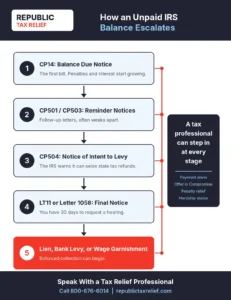
Every notice is a chance to step in before money is taken. Once a levy hits, the IRS can take funds from bank accounts, wages, and business receivables. Our IRS collections defense guide explains how a professional works to stop the process.
What happens if I owe the IRS over $10,000?
Owing more than $10,000 does not put you in criminal trouble, but it does change how the IRS handles your account. At this level, the IRS often files a federal tax lien, and you no longer qualify for the simplest guaranteed payment plan, which is limited to balances of $10,000 or less.
You still have real options:
- A streamlined installment agreement for many balances up to $50,000
- An Offer in Compromise if you cannot pay the full amount
- Currently Not Collectible status during financial hardship
- Penalty abatement if you qualify for first-time or reasonable-cause relief
If a lien has already been filed, see our tax lien help page.
What happens if I owe the IRS $20,000?
A $20,000 balance usually brings regular notices, a likely federal tax lien, and growing penalties and interest. If it goes unaddressed, it can lead to a bank levy or wage garnishment.
The good news is that $20,000 falls inside the IRS streamlined payment plan range, which often allows monthly payments without a full financial disclosure. Depending on your income and assets, a settlement or hardship status may also fit.
| Amount owed (individuals) | What it often means |
|---|---|
| $10,000 or less | May qualify for a guaranteed installment agreement |
| $10,001 to $50,000 | Lien likely; streamlined payment plan usually available |
| Over $50,000 | Detailed financial statement often required for a payment plan |
| Over about $65,000 (adjusted yearly) | Passport can be denied or revoked for seriously delinquent debt |
Facing a frozen account or a garnished paycheck? Learn about bank levy help and wage garnishment relief.
What is the longest you can go without paying taxes?
The IRS generally has 10 years from the date it assesses a tax to collect it. This deadline is called the Collection Statute Expiration Date (CSED), and once it passes, the remaining balance is usually written off.
That clock does not start until a tax is assessed, so if you never file, the IRS can pursue that year at any time. Certain actions, like requesting an Offer in Compromise or a collection hearing, also pause the clock. A professional can pull your transcripts and confirm the real expiration date for each year you owe.
What happens if you never pay federal taxes?
If you never pay, the IRS adds penalties and interest, files a public tax lien, and eventually takes money directly from your bank account, paycheck, or Social Security through levies. It can also keep future refunds and send your account to a private collection agency.
- Future tax refunds applied to your balance
- A federal tax lien that can hurt your credit and block a sale or refinance
- Bank levies and wage garnishments
- Passport denial for seriously delinquent debt
- Criminal charges in rare cases involving willful evasion
The IRS has strong collection tools, but it also has relief programs. For most people, reaching an agreement costs far less than letting the debt run. Explore your options with our tax resolution services.
Unfiled Tax Returns and Missed Years
Can you legally skip a year filing taxes?
You can skip filing only if your income is below the IRS filing requirement for your age and filing status. If your income is above that threshold, skipping a year is not legal, even if you cannot afford to pay.
Even below the threshold, filing can make sense if taxes were withheld from your pay or you qualify for credits. Refunds for an unfiled year are generally lost after three years, and self-employed people must file if net earnings reach $400.
Does the IRS forgive unfiled taxes?
No, the IRS does not automatically forgive taxes tied to unfiled returns. In fact, the time limit on how long the IRS can assess tax never starts until a return is filed.
What the IRS does offer is relief once you come forward. Penalties may be reduced, balances may be settled or paused, and filing a real return often lowers a bill the IRS built using a Substitute for Return. See how we help with unfiled tax returns.
I haven’t filed my taxes in 10 years. What should I do?
Talk to a tax resolution professional before contacting the IRS on your own. Ten years of unfiled returns is more common than most people think, and it is usually fixable as a civil matter.
In most cases, the IRS focuses on the most recent six years rather than all ten. A professional will pull your IRS transcripts, check for Substitutes for Return, assess any criminal exposure, and build a plan to get you current and resolve the balance.
Coming forward before the IRS reaches out puts you in a stronger position. Every year you wait adds penalties and narrows your choices.
Tax Debt vs. Tax Evasion: Know the Difference
Can I legally opt out of paying federal taxes?
No. There is no legal way to opt out of federal income tax if you have taxable income. Claims that filing is voluntary, that wages are not income, or that you can refuse on moral or religious grounds have been rejected by the courts many times.
The IRS lists these as frivolous tax positions, and using one on a return or IRS form can bring a $5,000 penalty on top of the tax you owe. You can legally lower your tax with deductions and credits, and you can settle debt you truly cannot pay.
What is the most common form of tax evasion?
Underreporting income is the most common form of tax evasion. This includes leaving cash payments off a return, hiding money in accounts under other names, and keeping two sets of books.
IRS tax gap studies show that underreported income makes up the largest share of taxes owed but not paid. That is why the IRS puts so much effort into matching bank, payment app, and employer records against returns.
How long until it’s considered tax evasion?
No amount of time turns late taxes into tax evasion on its own. Evasion is about intent: it means willfully trying to avoid a tax you know you owe, usually through an act like hiding income or filing false records.
Someone who falls behind for years because of illness, a failed business, or money trouble usually has a civil problem, not a criminal one. The risk rises when unpaid taxes are paired with concealment, such as moving assets or lying to an IRS employee.
| Usually a civil tax problem | May point to tax evasion |
|---|---|
| Missed deadlines during a hard year | Hiding income or assets on purpose |
| Honest mistakes on a return | False records or made-up deductions |
| A reported balance you cannot pay | Lying to the IRS about what you own |
How many people go to jail every year for not filing taxes?
Very few. IRS Criminal Investigation referred 2,043 cases for prosecution in fiscal year 2025 across all tax and financial crimes, a small number next to the millions of people who owe back taxes. The agency reported an 89% conviction rate in its FY2025 annual report.
Willful failure to file is a misdemeanor that can carry up to one year in prison for each year not filed, while tax evasion is a felony with up to five years. Criminal charges are usually saved for large amounts, many years, and clear signs of deliberate concealment.
How We Protect Your Information
Your tax returns, Social Security number, and bank records are locked behind bank-grade 256-bit encryption and handled under strict tax professional privilege standards, in full compliance with federal data protection rules.
Speak With a Tax Relief Professional
Whether you just opened a compliance notice or you have not filed in years, waiting only gives penalties and interest more time to grow. One conversation can show you where you stand and which options fit your situation.
Our team handles the IRS for you, from the first call to the final agreement, with no judgment. Results depend on your facts, and no honest firm can promise a specific outcome, but you can count on a clear plan.
Speak With a Tax Relief Professional
Prefer to talk now? Call 800-676-6014 for a free, confidential case review.
About Republic Tax Relief
Republic Tax Relief helps individuals and business owners resolve IRS and state back taxes, unfiled returns, compliance checks, liens, levies, and wage garnishments. With offices in Corona and Laguna Hills, California, our team represents taxpayers nationwide. Call 800-676-6014 or contact us online to get started.
More answers: Hiring a Tax Relief Company FAQ | Tax Resolution Questions Answered
Sources
- Internal Revenue Service. IRS Ends Unannounced Revenue Officer Visits to Taxpayers (IR-2023-133).
- Internal Revenue Service. Notice 2010-33: Frivolous Positions.
- Internal Revenue Service. IRS Criminal Investigation Annual Report, Fiscal Year 2025 (Publication 3583).
This page is for general information and is not legal or tax advice. Every situation is different, so speak with a qualified tax professional about your case.