
An IRS letter can take over your whole week. Below are short, plain answers to the questions people ask most about Fresh Start relief, IRS forgiveness, settlements, and payment plans, based on 2026 IRS rules.
For a full look at every relief option, see our IRS Fresh Start Program services, blog, or call 800-676-6014 to talk with a licensed professional.
This page gives general information, not legal or tax advice. Your options depend on your facts.
Questions on This Page
- Who qualifies for the IRS fresh start program?
- Is the IRS Fresh Start Program still available in 2026?
- Can I apply for the IRS Fresh Start Program online?
- Can I get my tax debt forgiven by the IRS?
- Does IRS forgive after 10 years?
- Does the IRS forgive unfiled taxes?
- Can I legally opt out of paying federal taxes?
- What is the IRS one time forgiveness?
- Who qualifies for the IRS one time forgiveness program?
- How much will the IRS usually settle for?
- Can I negotiate an IRS payment plan?
- Does Fresh Start stop an IRS wage garnishment?
- Does Fresh Start relief hurt your credit?
- Who qualifies for the IRS hardship program?
- What is the IRS 6 year rule?
- Can I still file my 2019 taxes and get a refund in 2024?
- Will I lose my tax refund if I use a Fresh Start option?
- Can I do the IRS fresh start program myself?
1. Who qualifies for the IRS fresh start program?
Most individuals and businesses qualify for at least one Fresh Start option if all required tax returns are filed, current-year taxes are being paid, and they are not in an open bankruptcy. Your balance, income, and assets then decide which option fits.
| Your situation | Relief option you may qualify for |
|---|---|
| Owe $50,000 or less and can pay over 6 years | Streamlined payment plan |
| Owe more than $50,000 but can pay over time | Payment plan with a financial review |
| Cannot pay in full before the collection deadline | Offer in compromise or partial payment plan |
| Income covers only basic living costs | Currently Not Collectible (hardship) status |
| Federal tax lien filed and you owe $25,000 or less | Lien withdrawal after direct debit payments |
What stops most people is not the size of the tax bill. It is a missing return or a shortfall in this year’s tax payments.
2. Is the IRS Fresh Start Program still available in 2026?
Yes. Fresh Start was never a limited-time program, so it has no expiration date. The relief rules the IRS adopted in 2011 and expanded in 2012 are still part of everyday collection policy in 2026.
Penalty relief actually got easier this year. The IRS now removes certain penalties automatically for eligible 2025 returns. Be careful with anyone who says Fresh Start “ends this month.” That is a sales tactic, not an IRS rule.
3. Can I apply for the IRS Fresh Start Program online?
Partly. You can request a payment plan online through the IRS Online Payment Agreement tool if you owe $50,000 or less as an individual.[2] An offer in compromise, lien withdrawal, and most hardship requests still require IRS forms, phone calls, or mailed packages.
For example, an offer uses the Form 656 package, and lien withdrawal uses Form 12277. Online tools also cannot tell you the right order of steps, and filing in the wrong order can give the IRS more time to collect.
4. Can I get my tax debt forgiven by the IRS?
Sometimes, but rarely in full. The IRS can reduce tax debt through an accepted offer in compromise, remove penalties through penalty relief, or stop collecting once the 10-year deadline passes. There is no program that forgives a balance simply because you ask.
You may be a candidate for a reduced balance if what you owe is far larger than your home equity and savings, and your income barely covers basic costs. Learn more about our IRS debt forgiveness program services.
5. Does IRS forgive after 10 years?
Generally, yes. The IRS has 10 years from the date a tax is assessed to collect it, a deadline called the collection statute expiration date. Once that date passes, the remaining balance usually expires, but many events can push the date later.
A pending offer, a payment plan request, an appeal, bankruptcy, or time living abroad can all stretch the clock. Each tax year also has its own date, and it starts at assessment, so a return filed late starts its clock late.
6. Does the IRS forgive unfiled taxes?
No. The IRS does not forgive tax years you never filed, and the 10-year collection clock does not start until a tax is assessed. If you never file, the IRS can prepare a substitute return for you, usually without your deductions, and collect on that.
Unfiled years also block every Fresh Start option until they are filed. See how we help with unfiled tax returns.
7. Can I legally opt out of paying federal taxes?
No. There is no legal way to opt out of federal income tax if you earn enough to be required to file. Courts have rejected arguments that taxes are voluntary or unconstitutional, and the IRS can charge a $5,000 penalty for filing a frivolous return.
What you can do legally is lower your tax through deductions and credits, and use real tax relief programs when you owe more than you can pay.
8. What is the IRS one time forgiveness?
IRS one-time forgiveness is the nickname for First-Time Abatement, a penalty waiver for taxpayers with a clean recent record. It removes failure-to-file, failure-to-pay, and failure-to-deposit penalties for one tax period. It does not reduce the tax itself.
Because the failure-to-file penalty alone can reach 25% of the unpaid tax, removing it can shrink a bill fast. Interest tied to those penalties comes off too.
9. Who qualifies for the IRS one time forgiveness program?
You generally qualify if you had no significant penalties in the three tax years before the year in question, you have filed all currently required returns or valid extensions, and you have paid the tax or set up a payment plan for it.
For eligible 2025 returns and 2026 quarterly returns, the IRS now applies this relief automatically. For older years, you still have to ask. Learn more about IRS penalty abatement.
10. How much will the IRS usually settle for?
There is no standard percentage. The IRS settles for an amount equal to your reasonable collection potential: the equity in your assets plus a set number of months of future disposable income. For some people that is a few hundred dollars. For others, it is the full balance.
For a lump-sum offer, the IRS counts 12 months of future income. For example, someone with $2,000 in equity and $100 a month left over might offer about $3,200. A lump-sum offer also requires a $205 fee and a nonrefundable 20% payment, unless you meet low-income guidelines.[1] See how the offer in compromise program works.
11. Can I negotiate an IRS payment plan?
Yes. You can negotiate the monthly amount, the payment date, and in some cases how long you pay. If you owe $50,000 or less, you can usually choose any payment that clears the balance within 72 months without sharing detailed financial records.
Above $50,000, the IRS bases your payment on a financial statement and its own expense standards, which is where negotiation matters most. Compare plans on our IRS payment plan services page.
12. Does Fresh Start stop an IRS wage garnishment?
It can. The IRS generally cannot levy while a payment plan request or offer in compromise is pending, and it must release a levy that leaves an individual unable to pay basic living expenses. An existing garnishment is usually released once a payment plan is approved.
Act fast, because a bank levy holds your money for only 21 days before it goes to the IRS. See our wage garnishment relief services.
13. Does Fresh Start relief hurt your credit?
Usually not directly. IRS payment plans and offers in compromise do not appear on credit reports, and the three major credit bureaus stopped reporting tax liens in 2018. A filed federal tax lien is still public record, though, and lenders can find it.
If you owe $25,000 or less and make three on-time direct debit payments, you can ask the IRS to withdraw the public lien notice. Our tax lien help team can explain your options.
14. Who qualifies for the IRS hardship program?
You may qualify if paying your tax debt would leave you unable to cover basic living costs like housing, food, utilities, transportation, and health care, as measured by IRS expense standards. You also need all required returns filed and a financial statement backed by documents.
Retirees on Social Security, people who lost a job, and people with heavy medical costs often qualify. Hardship status pauses collection but does not erase the debt. Learn about Currently Not Collectible status.
15. What is the IRS 6 year rule?
The IRS 6-year rule is an internal policy that generally limits enforcement of unfiled returns to the last six years. To get back in good standing and qualify for relief, most people need to file the six most recent years of required returns.[3]
The IRS can ask for older years with a manager’s approval. Don’t confuse this with the separate six-year audit window, which applies when someone leaves out more than 25% of their income.
16. Can I still file my 2019 taxes and get a refund in 2024?
No. The deadline to claim a 2019 refund was July 17, 2023, after the IRS extended the normal three-year window because of COVID-19. You can still file a 2019 return, and you may need to, but any refund for that year is gone.
In late 2026, the oldest refund you can usually still claim is for tax year 2023, and that window generally closes in April 2027.
17. Will I lose my tax refund if I use a Fresh Start option?
Often, yes. While you owe, the IRS generally applies refunds to your balance, even if you are on a payment plan. If an offer in compromise is accepted, the IRS also keeps any refund for the calendar year the offer is accepted.
Adjusting your withholding so you don’t overpay during a plan can keep more money in your pocket each month.
18. Can I do the IRS fresh start program myself?
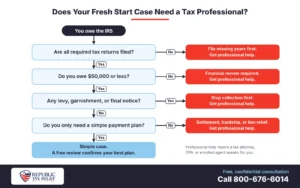
You can, but most people should not go it alone. The IRS lets taxpayers request relief on their own, yet only the simplest cases, like one tax year under $50,000 with every return filed, are safe to handle without help. Offers, hardship requests, liens, and larger balances are where costly mistakes happen.
Even a “simple” payment plan can go wrong. Pick a payment you can’t keep and the plan can default, which can bring back levies. Financial forms are signed under penalty of perjury, and anything you say on an IRS call goes into your file.
A tax attorney, CPA, or enrolled agent can review your IRS transcripts, choose the option that costs you the least, and speak to the IRS for you. A free consultation shows whether your case is truly simple before you commit to anything.
Your information stays protected. Every tax return, Social Security number, and bank statement you share is locked with bank-grade 256-bit encryption and handled in full compliance with federal data protection standards.
Speak With a Tax Relief Professional
You don’t have to sort through IRS tax debt alone. Call 800-676-6014 or request your free, confidential consultation today.
About Republic Tax Relief: Republic Tax Relief helps individuals and business owners resolve IRS and state back taxes through payment plans, offers in compromise, penalty relief, hardship status, and lien and levy defense. Since 2005, our in-house team of enrolled agents, tax attorneys, and CPAs has resolved more than 18,000 cases. Call 800-676-6014 or visit our contact page for a free consultation.
Sources
- Internal Revenue Service, Offer in Compromise
- Internal Revenue Service, Payment Plans; Installment Agreements
- Internal Revenue Manual 1.2.1.6.18, Policy Statement 5-133, Delinquent Returns: Enforcement of Filing Requirements
Results vary based on each taxpayer’s facts. IRS rules, fees, and thresholds can change.