
Oct
An IRS notice that says you owe $38,000 can make your stomach drop. Then the penalties grow, the letters get sharper, and it feels like there is no way out. There is. In 2011 the IRS rolled out a set of policy changes called the Fresh Start initiative, and those changes still shape how taxpayers settle, pay over time, and clean up liens today.
This IRS Fresh Start Program blog explains what the program really is, who qualifies, the dollar limits that matter, and when it makes sense to have a licensed tax professional handle the IRS for you. No hype, no promises of “pennies on the dollar.” Just the rules and how they apply to real situations.
Table of Contents
- What the IRS Fresh Start Initiative Actually Is
- IRS Fresh Start Program Requirements
- Streamlined Installment Agreements and the $50,000 Limit
- Offer in Compromise Guidelines Under Fresh Start
- Federal Tax Lien Thresholds and Withdrawal Rules
- Penalty Abatement Rules That Work With Fresh Start
- Fresh Start Tax Relief Options Compared
- How the Fresh Start Program Application Process Works
- Expert Insight: Risks of DIY and AI With IRS Tax Debt
- When to Hire a Tax Relief Professional
- IRS Fresh Start Program FAQs
What the IRS Fresh Start Initiative Actually Is
The biggest misunderstanding about the IRS Fresh Start initiative is that it is one program with one form. It isn’t. Fresh Start is a package of rule changes the IRS made to existing tools so it would be easier for taxpayers to resolve their tax debt without being crushed by collection.
Those changes touched four areas:
- Installment agreements: More people can get a payment plan without handing over a full financial statement.
- Offer in compromise: The IRS changed how it calculates what you can afford, which opened settlement to more people.
- Tax liens: The IRS raised the balance at which it generally files a lien and made withdrawal possible in more cases.
- Penalty relief: Penalty waivers became easier to access for people with a good track record.
Myth vs. Reality
| Common Myth | Reality |
|---|---|
| “Fresh Start forgives tax debt.” | Most fresh start programs help you pay or settle. Forgiveness of part of the balance only happens through an accepted offer. |
| “There’s a single Fresh Start application.” | You apply for the specific relief, such as a payment plan or an offer, that fits your case. |
| “The program expired.” | The core thresholds from Fresh Start remain part of IRS collection policy. |
Takeaway: If a company tells you to “apply for Fresh Start,” ask which specific relief they plan to request and why. A real answer names the option.
IRS Fresh Start Program Requirements: Who Qualifies
Every option has its own criteria, but the IRS fresh start program requirements share a common base. Before the IRS agrees to any relief, it generally expects you to:
- Have filed all required tax returns (usually the last six years for collection purposes)
- Be current on this year’s estimated payments or withholding
- For business owners, be current on federal tax deposits for payroll
- Not be in an open bankruptcy case
- Owe an amount that fits the threshold for the option you want
Example: Dana, a freelance designer, owes $31,000 but hasn’t filed for two years. No Fresh Start option is available to her until those returns are filed. Once they are, her balance may change, and so might her best option. If this sounds like you, start with our guide to catching up on unfiled tax returns.
Installment Agreement Relief: Qualifying for Streamlined Plans and the $50,000 Limit
This is where Fresh Start made the biggest everyday difference. Before 2011, the streamlined limit was $25,000. Fresh Start doubled it.
For Individuals
- Owe $50,000 or less in combined tax, penalties, and interest
- Pay the full balance within 72 months, or before the collection deadline if sooner
- Little or no detailed financial statement required
- Balances between $25,001 and $50,000 generally require direct debit payments to avoid a lien filing
For Businesses
Operating businesses that owe $25,000 or less in payroll and other taxes can often qualify for a short-term streamlined plan of about 24 months. Above that, the IRS usually wants a full financial review. Payroll balances carry extra risk for owners, which we cover in our payroll tax debt relief guide.
Example: Marcus owes $46,500. At 72 months, his payment is roughly $646 a month before interest, with no Form 433-A and no revenue officer combing through his bank statements. If he owed $56,000, a professional might first pay it down below $50,000 to keep him in the streamlined lane.
For a full breakdown of plan types, read IRS Payment Plans Explained.
Offer in Compromise (OIC) Tax Settlement Guidelines Under Fresh Start
An offer in compromise lets some taxpayers settle tax debt for less than the full amount. Fresh Start made the offer in compromise program more realistic by shortening how much future income the IRS counts. For lump-sum offers, the IRS looks at 12 months of future disposable income instead of the old 48 months. For periodic payment offers, it uses 24 months instead of 60.
The IRS still accepts an offer only when it equals or exceeds your “reasonable collection potential,” which is your equity in assets plus that future income. Current costs to apply, according to the IRS:
- A $205 application fee (waived if you meet low-income guidelines)
- A nonrefundable payment of 20% of your offer for lump-sum offers
- Monthly payments during review for periodic payment offers
Example: Lena owes $92,000. She has $6,000 in home equity and $300 a month left after allowable expenses. Her rough lump-sum calculation is $6,000 + ($300 × 12) = $9,600. If the math and documents hold up, an offer near that figure may be reasonable. If she had $80,000 in retirement savings, the picture changes entirely.
Learn more in our OIC program guide and the IRS Offer in Compromise blog.
Federal Tax Lien Withdrawal Thresholds and Filing Rules
A Notice of Federal Tax Lien tells creditors the government has a claim on your property. It can block a refinance, a home sale, or new business credit. Fresh Start changed two key numbers:
- $10,000 filing threshold: The IRS generally files a lien once you owe more than $10,000, up from $5,000. It can still file below that in some cases.
- $25,000 withdrawal path: If you owe $25,000 or less and pay through a Direct Debit Installment Agreement, you may request withdrawal after three consecutive on-time payments. The plan must pay the balance in full within 60 months or before the collection deadline, and you can’t have defaulted on a prior direct debit plan, per IRS internal guidance.
Release vs. Withdrawal
| Lien Release | Lien Withdrawal | |
|---|---|---|
| When it happens | After the debt is paid or expires | Can happen while you’re still paying |
| Public record | Shows the lien existed, then was released | Treated as if the notice was never filed |
| Best for | Closing out a paid balance | Protecting credit and pending deals |
Takeaway: If you owe $28,000 and want a lien withdrawn, paying down $3,000 first can make you eligible. See our federal tax lien help page for your options.
Penalty Abatement Rules That Work Alongside Fresh Start
Penalties and the interest on them can add 25% or more to a tax bill. Fresh Start broadened access to penalty relief, and the IRS has kept building on it. Here is where things stand in 2026:
- First Time Abate (FTA): Removes failure-to-file, failure-to-pay, and failure-to-deposit penalties for one period if you had a clean three-year history. You must ask for it.
- Automatic Exemption from Penalty (AEP): Starting summer 2026, the IRS skips those penalties automatically on 2025 and later returns for people with three years of timely compliance, per the IRS.
- Reasonable cause: Illness, disaster, or other events beyond your control can justify relief when FTA doesn’t apply.
Example: A restaurant owner with $9,000 in payroll deposit penalties for one quarter, and a clean record before that, may qualify for FTA. That could also remove the interest charged on those penalties.
Read more in our IRS penalty abatement blog.
Fresh Start Tax Relief Options Compared
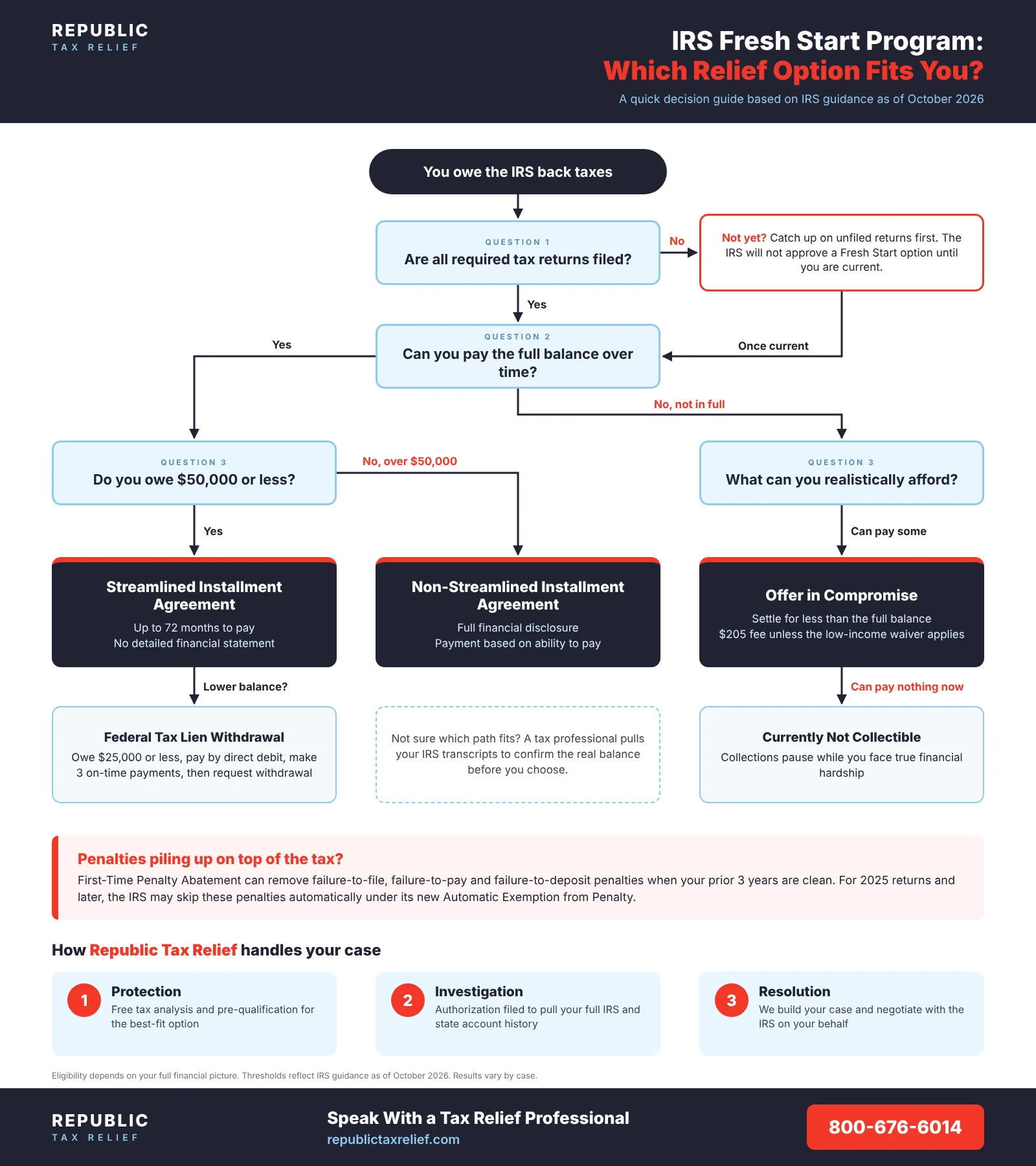
| Option | Key Threshold | Best Fit |
|---|---|---|
| Streamlined installment agreement | $50,000 or less, 72 months | Steady income, can pay over time |
| Non-streamlined agreement | Over $50,000 | Larger balances you can still pay in full |
| Offer in compromise | Offer ≥ reasonable collection potential | Limited assets and income compared to debt |
| Lien withdrawal | $25,000 or less on direct debit | Need clean credit for a loan or sale |
| Penalty abatement | Clean 3-year history or reasonable cause | Penalties are a big share of the bill |
If none of these fit because you truly can’t pay anything right now, Currently Not Collectible status may pause collection while your situation improves.
How the Fresh Start Program Application Process Works
Because there’s no single fresh start application, the process is really about building the right case for the right option. When we take on a case, the work usually looks like this:
- Pull IRS transcripts to confirm every balance, penalty, and collection deadline.
- Get compliant by filing any missing returns and fixing current-year payments.
- Map your finances against IRS allowable expense standards.
- Choose the option that costs you the least over time, not just the one that’s fastest.
- Submit and negotiate with the IRS on your behalf, including appeals if needed.
- Protect the result by keeping you compliant so the agreement doesn’t default.
Takeaway: Step 4 is where most money is won or lost. Two people who owe the same amount can land very different outcomes based on how their case is presented.
Expert Insight: The Hidden Risks of Handling IRS Tax Debt Yourself or With AI
More people are using chatbots to draft IRS letters or estimate settlement offers. AI is useful for learning terms. It is risky as your representative. Here is what we see go wrong:
- AI can’t see your account. It doesn’t have your IRS transcript, so it may miss a second year you owe, an assessed penalty, or a collection deadline that changes your best option. We dig into this further in Can AI Get a Better Settlement Than a Tax Attorney?
- Rules change faster than models. The 2026 shift from First Time Abate to automatic penalty exemption is a good example. Advice based on older rules can lead you to request relief the wrong way.
- Small math errors cost real money. An offer built on the wrong expense standards may be rejected, and the 20% payment you sent with it doesn’t come back.
- Over-disclosure backfires. Volunteering assets or income the IRS didn’t ask for on a financial statement can raise the amount it demands.
- The fine print lasts years. An accepted offer requires you to file and pay on time for five years, and the IRS keeps refunds for the year it accepts. Missing that can revive the original debt.
- No one can speak for you. A chatbot can’t sign a power of attorney, take an IRS call, or stop a levy.
A Real Client Story
“I was referred over by a friend and I am so glad I got in contact with them. When I first contacted Republic tax I was behind on my taxes and receiving threatening letters from the IRS. Republic tax relief was able to get me current on my taxes for both my personal and business and get me an outstanding settlement offer. My case manager Karla was very helpful and attentive and guided me throughout the whole process which made me feel at ease. They made me feel very confident the whole way. I definitely recommend giving them a call!”
— Arturo Gómez, Google Review
Results depend on each taxpayer’s facts. Past outcomes do not guarantee a similar result.
When to Hire a Tax Relief Professional for IRS Tax Help
Some people can set up a basic payment plan on their own. But the stakes rise fast. Consider working with a tax relief firm if:
- You owe more than $50,000 or have multiple tax years outstanding
- You received a final notice of intent to levy or a wage garnishment has started
- You have unfiled returns or payroll tax problems
- A lien is blocking a home sale, refinance, or business loan
- You think you may qualify to settle your tax debt for less
Our team communicates with the IRS on your behalf, stops most direct IRS contact once we’re authorized, and builds a plan around what you can actually afford. Learn about our IRS Fresh Start Program services, our broader tax resolution services, and the recognition our firm has earned.
Your information stays protected. Every tax return, Social Security number, and bank statement you share is guarded by strict client confidentiality and bank-grade 256-bit encryption, so you can focus on resolving your case, not worrying about your data.
IRS Fresh Start Program FAQs
Is the IRS Fresh Start Program still available in 2026?
Yes. Fresh Start isn’t a standalone program with an end date. Its thresholds, like the $50,000 streamlined installment agreement limit and the $10,000 lien filing threshold, remain part of IRS collection policy.
How much do I have to owe to qualify for Fresh Start?
There’s no minimum. Individuals who owe $50,000 or less can usually get a streamlined installment agreement. Larger balances can still qualify for other options, such as a non-streamlined plan or an offer in compromise.
Can the Fresh Start Program reduce my tax debt?
Only some options reduce the balance. An accepted offer in compromise settles the debt for less, and penalty abatement removes penalties and related interest. Payment plans spread out the full amount.
Will Fresh Start remove a federal tax lien?
It can. If you owe $25,000 or less and make three consecutive payments through a direct debit installment agreement, you may request lien withdrawal using IRS Form 12277.
Do I need a tax professional to apply for Fresh Start relief?
It isn’t required, but a licensed tax professional can pick the right option, avoid costly mistakes on financial forms, and negotiate with the IRS on your behalf.
How long does the Fresh Start process take?
A streamlined payment plan can be set up in weeks. An offer in compromise often takes six months to a year or longer, depending on IRS review times and whether an appeal is needed.
Find More Answers About IRS Fresh Start Program
Key Takeaways
- Fresh Start is a set of IRS rule changes, not one application.
- Owe $50,000 or less? A streamlined installment agreement over 72 months is often available.
- Offers in compromise are based on your reasonable collection potential, with a $205 fee and nonrefundable payments.
- Liens are generally filed above $10,000 and may be withdrawn at $25,000 or less on a direct debit plan.
- Penalty relief, including the new automatic exemption, can shrink the bill before you pay or settle.
- Being fully filed and compliant is the price of entry for every option.
Speak With a Tax Relief Professional
Every week you wait, penalties and interest keep growing. Find out which Fresh Start options fit your situation in a free, confidential consultation.
About Republic Tax Relief
Republic Tax Relief helps individuals and business owners resolve IRS and state tax debt through installment agreements, offers in compromise, penalty abatement, lien and levy relief, and full tax resolution representation. Our licensed tax professionals handle the IRS so you don’t have to. Call 800-676-6014 or contact us to get started.
This article is for general educational purposes and is not legal or tax advice for your specific situation. IRS rules and thresholds can change.
Sources
- IRS: Offer in Compromise
- IRS: Administrative Penalty Relief
- IRS: Withdrawal of Notice of Federal Tax Lien in Direct Debit Installment Agreement Situations