
Oct
You’ve probably seen the ads: “The IRS has a forgiveness program. Settle for pennies on the dollar.” If you owe the IRS money you can’t pay, those words sound like a lifeline. The truth is more useful than the hype. The IRS does reduce, pause, and sometimes erase tax debt, but only through specific programs with strict rules, and most people who apply on their own don’t get the result they hoped for.
This guide gives you realistic expectations for tax debt forgiveness. You’ll learn which IRS tax forgiveness options exist, who tends to qualify, how they compare, and the mistakes that sink good cases before they start.
In this guide:
- What Tax Debt “Forgiveness” Really Means
- IRS Tax Forgiveness Options That Actually Exist
- Direct Comparison of Tax Debt Relief Options
- How to Qualify for IRS Tax Forgiveness
- When Tax Debt Expires: The Collection Statute
- Common Pitfalls With IRS Tax Relief
- Why DIY and AI Fall Short on Complex IRS Cases
- Frequently Asked Questions
Is IRS Debt Forgiveness Real? What “Forgiveness” Really Means
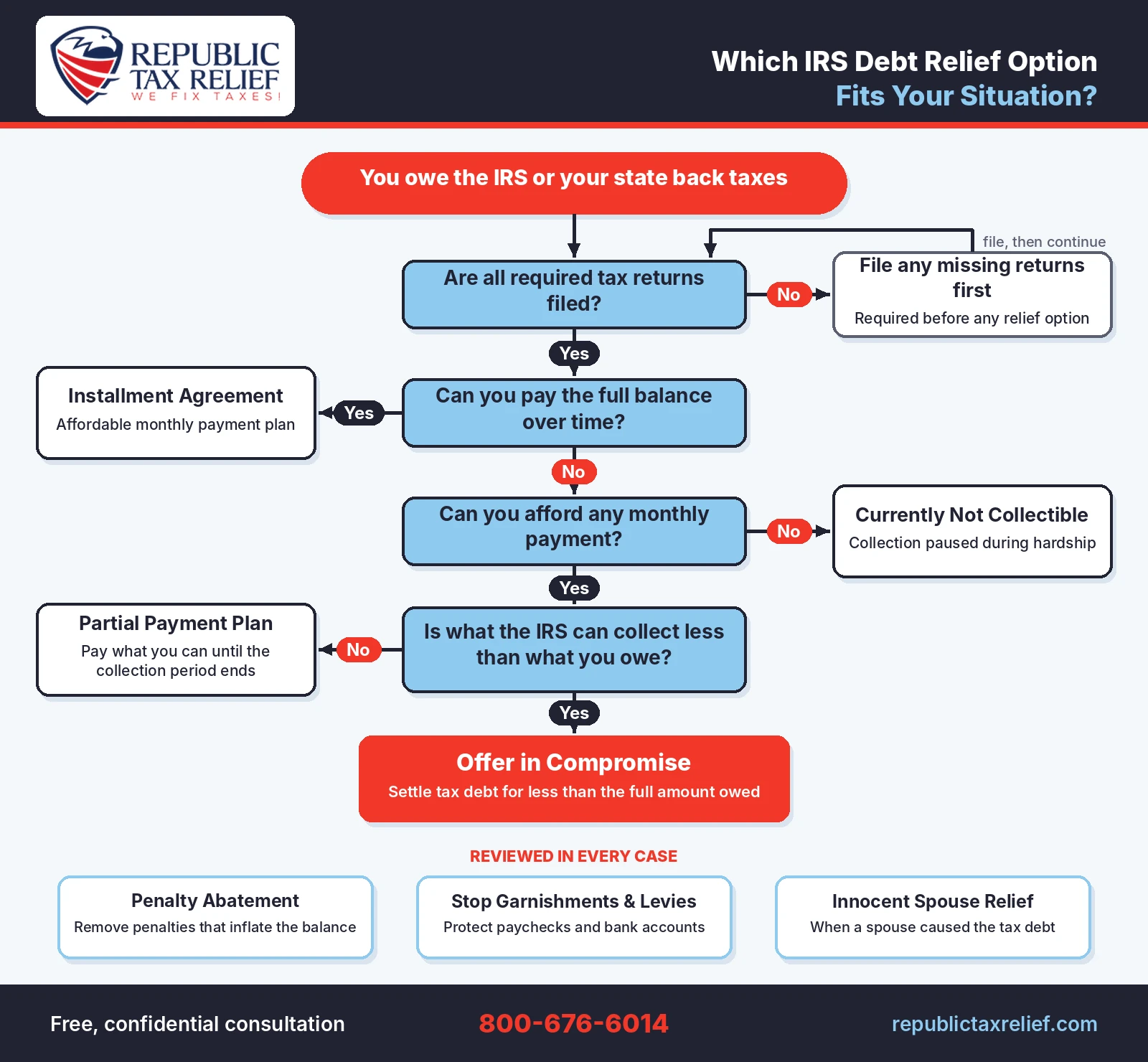
There is no single IRS forgiveness program that wipes out a tax bill because you ask. “Forgiveness” is a catch-all word people use for several different IRS relief options. Each one does something different:
- Reduce the balance – an Offer in Compromise settles the debt for less.
- Remove penalties – penalty relief can take off failure-to-file and failure-to-pay charges.
- Pause collection – Currently Not Collectible status stops levies while you’re in hardship.
- Let the clock run out – most tax debt expires once the collection statute ends.
The numbers keep expectations honest. In fiscal year 2025, taxpayers proposed 38,797 offers in compromise and the IRS accepted 5,464 of them, according to the IRS Data Book. That’s roughly one accepted offer for every seven submitted. Settlement is possible, but it isn’t the default outcome.
Practical takeaway: When someone promises a fixed percentage off your tax debt before reviewing your finances, treat it as a warning sign. A real answer starts with your income, expenses, assets, and IRS account transcripts.
IRS Tax Forgiveness Options That Actually Exist
Offer in Compromise: Settle Tax Debt for Less
An Offer in Compromise (OIC) lets you settle your tax debt for less than the full amount when paying it all isn’t realistic. The IRS compares what you owe with its own estimate of what it could collect from you, called your reasonable collection potential. That figure combines your equity in assets with a set number of months of future disposable income.
Most applications require a $205 fee plus an initial payment, though qualifying low-income taxpayers can have both waived, per the IRS Offer in Compromise page. If accepted, you must file and pay on time for the next five years. See how the math works in our guide to how the OIC program works.
Example: A retired homeowner owes $68,000, lives on Social Security, and has little home equity. Her collection potential may be far below the balance, which makes her a reasonable OIC candidate. A business owner with $150,000 in equity who owes $60,000 likely isn’t.
Currently Not Collectible: When the IRS Stops Collecting
If your income barely covers basic living costs, the IRS can mark your account Currently Not Collectible. Levies and garnishments stop. The debt doesn’t disappear, interest keeps building, and the IRS reviews your finances again later. Still, for many people in long-term hardship, this status is the bridge to the debt eventually expiring.
Penalty Relief and the “IRS One-Time Forgiveness” Option
What many people call IRS one-time forgiveness is officially First-Time Abatement. It removes certain penalties for one tax year if you have a clean record for the prior three years and are current on filing. It doesn’t touch the tax itself, but penalties can make up a large share of a bill. Reasonable-cause relief is another route when illness, disaster, or similar events kept you from complying. Learn more about IRS penalty abatement.
Fresh Start Rules and Installment Agreements
The IRS Fresh Start initiative isn’t a forgiveness program on its own. It expanded access to payment plans, raised the threshold for filing a federal tax lien, and gave the IRS more flexibility on offers. Today, most individuals who owe $50,000 or less can set up a streamlined payment plan with limited financial disclosure. Read our expert analysis of the IRS Fresh Start Program and installment agreements.
Innocent Spouse Relief
If a current or former spouse caused the tax problem on a joint return, you may be able to remove your share of the debt. Innocent spouse relief has four separate forms, each with different deadlines and tests.
Direct Comparison of Tax Debt Relief Options
| Option | Reduces What You Owe? | Best Fit | Main Catch |
|---|---|---|---|
| Offer in Compromise | Yes | Debt exceeds what the IRS could ever collect | Full financial disclosure; most offers are rejected |
| Penalty Relief | Penalties only | Clean history or a documented reasonable cause | Underlying tax and most interest remain |
| Currently Not Collectible | No (pauses collection) | Income covers only basic living expenses | Interest grows; liens and refund offsets continue |
| Installment Agreement | No | Can pay the full tax over time | Interest and some penalties keep running |
| Innocent Spouse Relief | Yes, for the qualifying spouse | Joint-return debt caused by a spouse | Strict proof and timing rules |
How to Qualify for IRS Tax Forgiveness
Every IRS relief program shares a few ground rules. If you don’t meet them, the IRS typically returns your request without reviewing it:
- All required returns are filed. If you’re behind, start with catching up on unfiled tax returns.
- Current-year payments are made. Estimated payments or withholding must cover this tax year.
- Business deposits are current. Employers must be up to date on payroll tax deposits. See payroll tax debt relief.
- Your financial picture supports the request. Pay stubs, bank statements, and expense records must match the forms.
Practical takeaway: Before choosing a relief program, gather your last three months of bank statements, recent pay stubs, a list of assets with estimated values, and any IRS notices. Those documents decide which door is open to you.
When Tax Debt Expires: The Collection Statute Expiration Date
The IRS generally has 10 years from the date a tax is assessed to collect it, under 26 U.S.C. § 6502. This deadline is called the collection statute expiration date, or CSED. When it passes, the remaining tax debt usually expires.
The catch is that certain actions pause the clock, including a pending Offer in Compromise, some installment agreement requests, collection appeals, and time spent outside the U.S. Each tax year also has its own CSED.
Example: Someone with a 2017 balance that’s eight years into its collection window files an offer and waits 14 months for a decision. If the offer is rejected, those 14 months get added to the IRS’s collection window. In some cases, staying in hardship status and letting the debt expire is the smarter path, but only after the dates are confirmed from IRS transcripts.
Avoiding Common Pitfalls With IRS Tax Relief
- Offering a number that “feels fair.” The IRS doesn’t negotiate on fairness. It accepts offers that meet its formula.
- Leaving out assets. A forgotten retirement account or vehicle can sink an offer and damage your credibility.
- Ignoring collection notices while you wait. A Final Notice of Intent to Levy starts a 30-day window to request an appeal. Learn about IRS collections defense.
- Falling behind again. Missing a future tax payment can void an accepted offer or default a payment plan.
- Forgetting the state. Federal relief doesn’t settle state tax. California and other states run their own programs.
Why DIY and AI Fall Short on Complex IRS Cases
Free tools and AI chatbots can explain what an Offer in Compromise is. Resolving a real case is different. Here’s what our team sees go wrong:
- The forms are sworn statements. Collection financial statements are signed under penalty of perjury. An AI-drafted figure that’s wrong becomes your mistake, on the record.
- AI can’t read your actual account. Your IRS transcripts show assessment dates, tolling events, and transaction codes. Without them, any advice on timing is a guess.
- Strategy order matters. Filing an offer, a payment plan, or an appeal in the wrong order can extend the collection statute or waive appeal rights.
- AI can’t represent you. A chatbot can’t sign a power of attorney, call the IRS for you, or argue your case with a revenue officer.
- Privacy risk. Pasting Social Security numbers and bank statements into public AI tools can expose data you can’t take back.
For a deeper look, read Can AI get a better settlement than a tax attorney?
Speak With a Tax Relief Professional
Every week you wait, penalties and interest keep growing. Find out which Fresh Start options fit your situation in a free, confidential consultation.
What Our Clients Say
“I was a client of Republic Tax and owed the IRS a significant amount of money. My case manager, Melisa, was incredibly helpful—she walked me through the entire process and helped me resolve my tax issue. I highly recommend anyone dealing with tax problems to reach out to this company. The staff, from start to finish, demonstrated excellent communication and customer service. Truly a great experience! Thank you again republic tax!”
— Joey Cardenas, Google Review ★★★★★
Business owners face added layers, like trust fund penalties and liens that affect credit lines. See our business tax debt relief services and options for releasing a federal tax lien.
IRS Debt Forgiveness FAQs
Does the IRS really forgive tax debt?
Yes, but only through specific programs. An Offer in Compromise can reduce the balance, penalty relief can remove penalties, and unpaid tax debt generally expires once the 10-year collection statute ends. There’s no automatic forgiveness.
What is the IRS one-time forgiveness program?
It’s a common name for First-Time Abatement, which removes certain penalties for one tax year if you have a clean three-year history and are current on filing. It doesn’t reduce the tax itself.
How do I qualify for an Offer in Compromise?
You must have filed all required returns, be current on estimated payments, and show that your reasonable collection potential is less than what you owe. The IRS reviews your income, expenses, and asset equity.
Does IRS tax debt go away after 10 years?
Generally, yes. The IRS has 10 years from assessment to collect. Offers, certain appeals, and some other actions pause that clock, so check your transcripts to find the real date.
Does Currently Not Collectible status forgive my tax debt?
No. It pauses levies and garnishments while you’re in hardship, but interest continues. If your situation doesn’t improve, the debt may expire when the collection statute ends.
Can I use AI to negotiate with the IRS?
AI can help you understand terms, but it can’t access your IRS account, represent you, or take responsibility for sworn financial statements. Complex cases benefit from a licensed tax professional.
Have more questions? Visit our tax debt relief FAQs and Offer in Compromise FAQs.
The Bottom Line on IRS Debt Relief
- IRS debt forgiveness is real, but it comes through specific programs, not a blanket pardon.
- An Offer in Compromise is the only common route that settles tax debt for less, and most offers are rejected.
- Penalty relief and Currently Not Collectible status can still make a big difference.
- The 10-year collection statute can work in your favor, but only if you protect it.
- The right strategy depends on your transcripts, finances, and timing.
Speak With a Tax Relief Professional
You don’t have to figure this out alone or bet your case on a guess. Republic Tax Relief reviews your IRS account, explains every option you qualify for, and handles the IRS for you, from the first call to the final resolution. We help individuals and businesses with IRS and state tax debt nationwide.
Your information stays protected. Every document you share is secured with bank-grade 256-bit encryption and handled under strict tax professional confidentiality standards.
Call 800-676-6014 or request your confidential consultation today.
This article is for general information and isn’t legal or tax advice. Results depend on each taxpayer’s facts, and no outcome is guaranteed.