
Oct
This article is for general education and is not legal advice. Every tax situation is different, so speak with a licensed professional about your case.
No. An AI can give you some great advice and give you the basics, but read on on what it can’t do, and this is KEY! An AI tool cannot get you a better tax settlement than a skilled tax attorney. It has no legal standing to represent you, no presence at the negotiating table, and no real-world judgment about when to push and when to hold back.
AI is fast, cheap, and available at 2 a.m. when an IRS letter is keeping you awake. That makes it tempting. But settling a tax debt is not a research project. It is a negotiation with a government agency that has the power to garnish wages, levy bank accounts, and file liens. So let’s think about it. You get an AI to prepare your settlement and audit documents. Great! You did it all by the book and per the IRS code. But what AI won’t tell you is all the tricks to the trade. The legal maneuvering and how to use the IRS against itself during the negotiation process. Read on about what we are referring to.
This guide explains what AI can and cannot do for your tax situation, why the IRS will only negotiate with a licensed human, and how to use both together to save time and money.
Table of Contents
- AI vs. Tax Attorney: The Quick Comparison
- Why the IRS Will Not Negotiate With an AI Tool
- The Hidden Dangers of Using AI for Tax Issues
- Why Human Expertise Beats AI in Tax Resolution
- Tax Relief Options a Licensed Tax Professional Can Negotiate
- How to Use AI and a Tax Lawyer Together
- When to Hire a Tax Attorney Instead of Relying on AI
- Flowchart: When to Use AI and When to Call a Pro
- Frequently Asked Questions About AI and Tax Lawyers
- Speak With a Tax Relief Professional
AI vs. Tax Attorney: The Quick Comparison at the Settlement Table
AI and a licensed attorney are built for very different jobs. One processes information. The other represents you.
Here is how they stack up when real money and real legal rights are on the line.
| Feature | Artificial Intelligence | Tax Attorney |
|---|---|---|
| Cost | Low or free | Higher hourly rates, flat fees, or retainers |
| Speed | Instant data processing | Needs time for research and review |
| IRS representation | None. It cannot legally represent you | Full authority through a signed Power of Attorney (Form 2848) |
| Strategic judgment | Generic ranges; prone to “hallucinations” | Tailored risk assessment and tactical restraint |
| Live negotiation | Cannot call the IRS or attend an appeal | Negotiates by phone, in writing, and in IRS Appeals |
| Confidentiality | No attorney-client privilege | Protected communications under professional rules |
| Accountability | No license to lose if it is wrong | Licensed and bound by IRS Circular 230 and state bar rules |
The takeaway is simple. AI can help you understand your tax matters faster. It cannot stand between you and the Internal Revenue Service. When the IRS auditor is calling you into their office or the Offer Examiner is on the phone asking you to clarify certain aspects of your substantiation, AI is not going to be there for you. AI cannot mitigate your exposure and doesn’t always have your sole and best interest in mind. Think about it; is AI going to really protect you like a tax attorney would with their clients?
Why the IRS Will Not Negotiate With an AI Tool
The IRS has strict rules about who can speak for a taxpayer. Under Treasury Department Circular 230, only certain licensed people can practice before the agency.
Who Can Legally Represent You
To give someone authority over your IRS tax account, you sign Form 2848, Power of Attorney and Declaration of Representative. The people allowed to accept that authority include:
- Attorneys in good standing with a state bar
- Certified Public Accountants (CPAs) licensed by a state board
- Enrolled Agents (EAs) licensed directly by the IRS
A chatbot is none of these. It cannot sign a Power of Attorney, pass a background check, or be held responsible for mistakes. The IRS will not discuss an Offer in Compromise or an audit settlement with software, but they will with you. But do you know how to deal with an aggressive Examiner? Do you know how to limit your exposure to bigger problems? You can have a medium-sized issue turn into a huge issue by saying the wrong thing or supplying the wrong document. Sometimes it’s not what you say, it’s what you don’t. Do you know what not to answer or divulge? Your experienced tax attorney certainly does!
State Tax Agencies Follow the Same Logic
Your state has its own version of these rules. For example, the California Franchise Tax Board uses its own power of attorney forms (FTB 3520-PIT for individuals and FTB 3520-BE for businesses). If you owe both the IRS and state tax agencies, you need a representative authorized with each one.
No Privilege, No Protection
What you tell a lawyer is generally protected by attorney-client privilege. Federal law also gives limited confidentiality protection to tax advice from other federally authorized practitioners, such as CPAs and EAs, in civil matters. They simply do one thing different: THEY HAVE YOUR BACK!
A chatbot offers none of that. Anything you type may be stored by the company that runs it. That is a serious concern if your case involves unreported income or any risk of a tax evasion investigation.
The Hidden Dangers of Using AI for Tax Issues
Generative AI writes with confidence, even when it is wrong. In tax law, a confident wrong answer can cost you thousands of dollars or your only chance at a settlement.
1. Hallucinations: Made-Up Case Law and Dead Code Sections
An AI model can invent court cases, IRS rulings, and tax code sections that sound real but do not exist. This is not rare.
- By late 2025, researchers had logged nearly 800 cases of AI citation errors across at least 25 jurisdictions. (International Tax Journal)
- In Thomas v. Commissioner, the U.S. Tax Court struck a pretrial memo that relied on cases that did not exist. (Bloomberg Law)
- In the 2026 Clinco case, a Tax Court judge said a brief looked like “something cooked up by AI” and warned the whole tax bar to check its work. (Journal of Accountancy)
- In 2026, California’s Office of Tax Appeals addressed fake citations for the first time in a state tax case. (Bloomberg Law)
Tax Notes also reported on a Tax Court opinion that found bad citations most likely came from AI use. If trained lawyers get caught by this, a stressed taxpayer working alone is at even greater risk.
2. No Authority to Act
Even a perfect AI answer is just an answer. The IRS still needs a real person to submit forms, respond to a Revenue Officer, request a collection hold, or file an appeal before a deadline passes. These conversations happen in person or on the phone. You working with your AI is not going to know how to maneuver this like a Tax Attorney or Enrolled Agent would.
3. Aggressive Traps
AI tends to find positions that are “technically allowed” without weighing the tax consequences. It cannot reliably tell when a legal but aggressive claim will trigger a harsh audit or penalties. You can easily turn a mole hill into a mountain by saying or providing the wrong thing.
A seasoned professional knows that sometimes the smartest move is restraint. That judgment comes from years of watching how the IRS actually reacts. Experience cannot be replaced by an AI that has not dealt with 100’s of different human IRS Examiners, each with a different attitude, motivation, experience level, and patience level.
4. Outdated or Generic Information
Tax rates, IRS collection standards, and filing thresholds change every year. An AI tool may pull figures from an old year, or give you national averages that do not fit your county’s living expense allowances.
5. Privacy Risk
Uploading your Social Security number, bank statements, and full tax return to a public chatbot exposes your identity to risks you cannot control. The Journal of Accountancy has flagged confidentiality and data security as major concerns with AI in tax work.
The IRS itself is paying attention. In June 2026, the IRS Office of Professional Responsibility released guidance on responsible AI use in federal tax practice, reminding practitioners that professional judgment and due diligence still apply. (Schoenberg Finkel)
Why Human Expertise Beats AI in Tax Resolution: An Interview With Our Team
In a recent discussion with tax resolution experts Mark and Ben, who bring over 20 years of hands-on experience, we broke down why AI simply cannot replace human negotiation when dealing with the IRS.
AI Only Knows What Is Public
“AI relies on published, standard resolution techniques. What it doesn’t have access to are the proprietary, unwritten negotiation strategies that experienced tax attorneys and professionals use every day.”
Legal research tools can summarize the Internal Revenue Manual. They cannot tell you how a specific collection unit tends to handle a borderline hardship case, or which documents make a Revenue Officer more willing to work with you. Sometimes the situation calls for overwhelming the examiner, and sometimes “less is more.” It’s a judgment call and feel for the situation that only your tax representative will feel out.
Real Results Happen Over the Phone
“AI operates strictly in black and white. Tax resolution live negotiation happens in the gray area. When a skilled professional gets an IRS officer on the line, we can advocate creatively, make nuanced arguments, and resolve cases in real time, often turning a rigid situation in our client’s favor.”
The Bottom Line From Our Experts
“At the end of the day, AI follows static rules. Human professionals know where the flexibility lies and how to fight for your best outcome.”
This is why AI is not the end of tax practice. It is a new tool, and like any tool, it works best in skilled hands.
Tax Relief Options a Licensed Tax Professional Can Negotiate
An AI can list the IRS programs below. Only an authorized representative can apply for them on your behalf, argue your case, and push back when the first answer is no.
| Resolution Option | Who It Helps | Why a Professional Matters |
|---|---|---|
| Offer in Compromise | Taxpayers who cannot pay the full debt | The IRS accepted only about 21% of offers in FY2024. Strong, well-documented offers stand out. |
| Installment Agreement | People who can pay over time | A pro can negotiate a payment the IRS accepts without leaving you short on rent and groceries. |
| Penalty Abatement | Those with a clean history or a good reason for falling behind | Reasonable cause arguments depend on how your story is documented and presented. |
| Currently Not Collectible | Taxpayers in real financial hardship | Requires detailed financial statements that match IRS collection standards. |
| Audit Representation and Appeals | Anyone facing a tax audit or proposed assessment | A representative can speak for you, so you never have to sit across from an auditor alone. |
| Payroll Tax and Trust Fund Defense | Business owners are behind on employment taxes | Personal liability for unpaid payroll tax is serious and moves quickly. |
A Closer Look at the Offer in Compromise
The Offer in Compromise is the “settlement” most people mean when they ask about AI vs. an attorney. It lets you pay less than the full balance when the IRS agrees it cannot reasonably collect more.
Here is why a professional matters. In fiscal year 2024, the IRS received 33,591 offers and accepted 7,199 of them, roughly one in five. (IRS Data Book, as summarized by Thorn Law Group) The offers that succeed are usually built on accurate math, complete paperwork, and a clear case for your ability to pay.
To learn more, see our guides on what the Offer in Compromise or Fresh Start Program is and tax debt relief options for a fresh start.
Business Tax Problems Need Extra Care
Business tax debt often involves more than one entity, several tax years, and both federal and state agencies. Corporate tax and payroll issues can also create personal liability for owners.
That kind of complex tax situation is where generic AI answers break down fastest. Our tax resolution services guide explains how we handle IRS and state tax debt for individuals and businesses.
How to Use AI and a Tax Lawyer Together
You do not have to choose one or the other. Used wisely, AI tools for tax work can make your professional’s job easier and lower your bill.
Smart Ways to Use AI
- Drafting first passes: Ask AI to explain an IRS notice in plain English or turn your questions into a list for your consultation.
- Organizing documents: Use AI to sort bank statements, receipts, and expense records into a clean spreadsheet.
- Cost reduction: Bring AI-organized files to your professional. Less time sorting paperwork means fewer billable hours.
- Learning the basics: AI answers can help you understand terms like “levy,” “lien,” or “reasonable cause” before you talk to an expert.
Leave These to a Licensed Professional
- Final defense: Final calculations, filing, and direct negotiations with the IRS or state
- Legal advice: Deciding which resolution option fits your facts
- Anything with a deadline: Appeals, collection due process hearings, and audit responses
- Tax court and litigation: Petitions, briefs, and settlement talks with IRS attorneys
A Quick Privacy Rule
Before you paste anything into an AI chatbot, remove your Social Security number, account numbers, and home address. Share sensitive documents only through your tax professional’s secure, encrypted portal.
When to Hire a Tax Attorney Instead of Relying on AI
Some tax problems are too serious to handle with a chatbot and a search bar. If any of these apply to you, it is time to get licensed tax representation.
Red Flags That Call for Professional Help
- You received a final notice of intent to levy or a notice of federal tax lien
- Your wages are being garnished or your bank account was frozen
- You have an open tax audit or a notice of deficiency
- You owe a large tax balance you cannot pay in full
- Your business is behind on payroll tax deposits
- You owe both the IRS and state tax agencies
- Your case involves international tax issues or foreign accounts
- You have several years of unfiled returns
- You worry about possible criminal exposure, such as a tax evasion inquiry
Tax Attorney vs. CPA vs. Enrolled Agent
All three can represent you before the IRS. The right fit depends on your case.
| Professional | Best For | Can Represent You Before the IRS? |
|---|---|---|
| Tax Attorney | Serious tax disputes, possible criminal exposure, Tax Court litigation, privileged legal advice | Yes |
| CPA | Complex tax returns, accounting records, business financials, and tax planning | Yes |
| Enrolled Agent | IRS collections, audits, and resolution; licensed by the IRS itself | Yes |
At Republic Tax Relief, our in-house team includes tax attorneys, CPAs, and enrolled agents. That means your case goes to the professional whose skills fit your problem best.
If bankruptcy has crossed your mind, that is a separate legal question. Our lawyer explains the basics in Does bankruptcy get rid of your tax debts?
Flowchart: When to Use AI and When to Call a Pro
Use this chart to see where AI fits in the process and where a licensed professional has to take over.
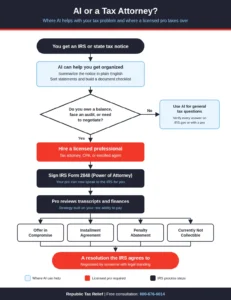
What the flowchart shows: You receive an IRS or state tax notice. AI can help summarize it and organize your documents. If you owe a balance, face an audit, or need to negotiate, you hire a licensed professional, sign Form 2848, and let them review your transcripts and finances. They then pursue the best-fit option, such as an Offer in Compromise, installment agreement, penalty abatement, or Currently Not Collectible status.
Frequently Asked Questions About AI and Tax Lawyers
Can AI represent me in front of the IRS?
No. Only attorneys, CPAs, enrolled agents, and a few other authorized individuals can represent you before the IRS. They must sign Form 2848, Power of Attorney and Declaration of Representative. An AI tool cannot sign this form or speak with the IRS for you.
Can AI calculate my Offer in Compromise amount?
AI can give you a rough estimate, but it often uses generic or outdated figures. The IRS calculates your offer using your specific income, assets, and local living expense standards. Small mistakes can lead to a rejected offer, so a licensed professional should prepare the final numbers.
Is it safe to upload my tax documents to an AI chatbot?
It is risky. Public AI tools may store what you type, and there is no attorney-client privilege with a chatbot. Remove your Social Security number and account numbers before using AI, and share sensitive files only through a professional’s secure, encrypted portal.
Can AI help me during a tax audit?
AI can explain audit terms and help you organize receipts and records. It cannot attend the audit, respond to the auditor for you, or file an appeal. A licensed representative can handle all communication with the IRS, so you do not have to.
Will using AI lower what I pay a tax lawyer?
It can. Using AI to organize bank statements, receipts, and questions before your consultation can reduce the time a professional spends sorting paperwork. Leave the strategy, calculations, and negotiations to your representative.
What is the difference between a tax attorney, a CPA, and an enrolled agent?
All three can represent you before the IRS. A tax attorney is best for serious disputes, possible criminal issues, and Tax Court. A CPA is strong with accounting and complex returns. An enrolled agent is licensed by the IRS and focuses on tax matters such as collections and audits.
How do I know if I need professional tax help?
If you face a levy, lien, wage garnishment, audit, payroll tax problem, or a balance you cannot pay, it is time to get help. The sooner a professional steps in, the more options you usually have.
Speak With a Tax Relief Professional
About Republic Tax Relief
Republic Tax Relief has helped individuals and business owners resolve IRS and state back taxes since 2005. Our in-house team of tax attorneys, CPAs, and enrolled agents has resolved more than 18,000 cases, handling everything from wage garnishments and bank levies to Offers in Compromise and payroll tax problems. Every case is handled with care, respect, and strict confidentiality. We mitigate your exposure and protect our clients while delivering an outcome that AI simply cannot match right now.
Call 800-676-6014 for a free, confidential consultation.
Your privacy is protected. Your tax returns, Social Security number, and bank statements are secured with bank-grade 256-bit encryption and held to strict attorney-client confidentiality standards, in full compliance with federal data protection rules.
Get Real Tax Help From a Real Person
AI can explain your notice. It cannot stop a levy, argue your case, or settle your debt. A licensed professional can.
If the IRS or your state is coming after you, do not wait for the next letter. Talk to someone who has done this thousands of times and knows how to fight for your best outcome.
Speak With a Tax Relief Professional or call 800-676-6014 today. Your consultation is free and 100% confidential.
Sources
- IRS, Circular 230: Regulations Governing Practice before the IRS
- Thorn Law Group, IRS Data Book: Recent Enforcement Actions and Priorities
- Journal of Accountancy, A recipe for sanctions: AI-hallucinated citations in tax (September 2026)
- Bloomberg Law, Don’t Trust AI, Always Verify. Tax Law Still Needs Humans
- Bloomberg Law, California Tax Tribunal Mulls AI Rules as Fake Citations Surface
- Bloomberg Tax, Tax Court Navigates AI Misuse Rules for Self-Represented Filers
- Tax Notes, Tax Court Finds Bad Citations Most Likely Resulted From AI Use
- Schoenberg Finkel Beederman Bell Glazer, Using AI in Federal Taxation Practice
- The International Tax Journal, Citing the Unseen: AI Hallucinations in Tax and Legal Practice