
Oct
Most people who owe the IRS don’t have a knowledge problem. They have a sorting problem. They’ve heard about settling tax debt for less, payment plans, hardship status, and penalty relief, but they can’t tell which one fits their financial situation. Picking the wrong path can cost months and a non-refundable fee, and it can leave your wages or bank account exposed while you wait.
This Tax Settlement Blog post is a decision guide for individuals and business owners facing IRS or state tax debt. It explains the main tax settlement options, how offer in compromise eligibility works, the tax consequences people overlook, and when working with a tax professional makes sense. Each section ends with a practical takeaway you can act on this week.
Table of Contents
- What IRS Tax Debt Settlement Really Means
- Tax Debt Relief Options at a Glance
- Offer in Compromise Tips: How to Qualify for an OIC
- Eligibility: Which Settlement Option Fits Your IRS Debt?
- Tax Consequences and Back Tax Mistakes to Avoid
- How a Tax Professional Helps Resolve Your Tax Debt
- What Our Clients Say
- Frequently Asked Questions
- Summary: Your Next Step
- Speak With a Tax Relief Professional
What IRS Tax Debt Settlement Really Means
“Tax settlement” isn’t one IRS program. It’s an umbrella term for any agreement that resolves your tax liabilities on terms you can manage. In some cases, the IRS allows taxpayers to settle for less than the full amount. More often, an IRS settlement means a monthly payment plan, a pause in collection, or penalty relief that shrinks the tax bill.
The IRS considers facts, not hardship stories alone. It looks at your income, necessary living expenses, assets, and how much time remains on the 10-year collection window for federal tax debt. Every path you’ll read about in IRS tax settlement articles comes back to that ability to pay calculation, which is set by the tax code and IRS procedures.
Practical takeaway: Before you compare programs, gather three months of pay stubs and bank statements, your recent tax returns, and a list of monthly expenses. Every option below starts with that picture.
Tax Debt Relief Options at a Glance
Here is how the most common debt relief paths compare. Each links to a deeper guide if you want the full detail.
| Option | Reduces what you owe? | Best fit | Key trade-off |
|---|---|---|---|
| Offer in Compromise (OIC) | Yes | You can’t pay in full before the collection deadline | Strict financial review; non-refundable $205 fee |
| Installment agreements | Usually no | Steady income, can make a monthly payment | Interest and penalties keep growing |
| Currently Not Collectible status | No (pauses collection) | Income covers only basic living costs | Debt and lien remain; IRS reviews periodically |
| Penalty abatement | Yes (penalties only) | Clean history or a documented reason for falling behind | Tax and most interest still owed |
| Innocent spouse relief | Yes (for you) | A spouse or ex caused the debt on a joint return | Proof and deadlines matter |
Two details people miss. A partial payment installment agreement allows you to pay a smaller monthly amount, and any balance left when the collection period ends generally expires. And with most options, penalties and interest still build until the balance is paid.
Business owners have extra layers. Unpaid payroll taxes can trigger the Trust Fund Recovery Penalty, which makes owners personally liable. Our guide to payroll tax debt relief covers that path. State tax agencies, such as California’s Franchise Tax Board, run their own programs with different rules.
Practical takeaway: Options can be combined. A common plan is to request penalty abatement first, then get an IRS payment plan on the smaller balance.
Offer in Compromise Tips: How to Qualify for an OIC
An IRS offer in compromise is a settlement agreement that can lower the amount owed itself. The offer in compromise program is meant for taxpayers who cannot afford to pay the full balance, and it’s also the option people misjudge most. The IRS states plainly that you should explore all other payment options first (IRS: Offer in Compromise).
Three Grounds the IRS Accepts
- Doubt as to collectibility: You can’t pay your debt in full before the collection period ends. This is the most common basis.
- Doubt as to liability: There is real doubt that the assessed tax is correct, such as an audit result based on wrong facts.
- Effective tax administration: You could technically pay, but doing so would create economic hardship or be unfair given your circumstances.
Tips From Accepted and Rejected Cases
- Run the math before applying for an offer. The IRS calculates your “reasonable collection potential” from equity in assets plus future disposable income. Offers below that number are usually rejected.
- Get current first. All required tax returns must be filed and current-year tax payments made. See our guide to unfiled tax returns.
- Plan where the settlement money will come from. The application fee is $205, and a lump-sum offer requires 20% of the offer amount upfront. Both are non-refundable, though low-income applicants may qualify for a waiver (IRS Form 656).
- Expect to give up refunds. The IRS keeps any refund or tax credit overpayment for tax periods through the year your offer is accepted.
- Document every expense. Unsupported expenses get cut to IRS standard amounts, which raises what the IRS thinks you can pay.
- Know the strings attached. You must stay compliant with filing and payment for five years after acceptance, and a federal tax lien isn’t released until the offer terms are met.
- Use the appeal window. The IRS may reject an offer, but you can appeal within 30 days using Form 13711.
Example: A self-employed contractor owes $68,000. His income dropped, he has little equity, and seven years remain on the collection clock, so an OIC may fit. A salaried nurse with the same balance and $90,000 in home equity likely won’t qualify for an offer, and an installment agreement is the more realistic path.
For program basics, read our explainer on how the OIC program works.
Eligibility: Which Settlement Option Fits Your IRS Debt?
Use these questions to narrow your path. If you answer “yes” to one, that option deserves a closer look.
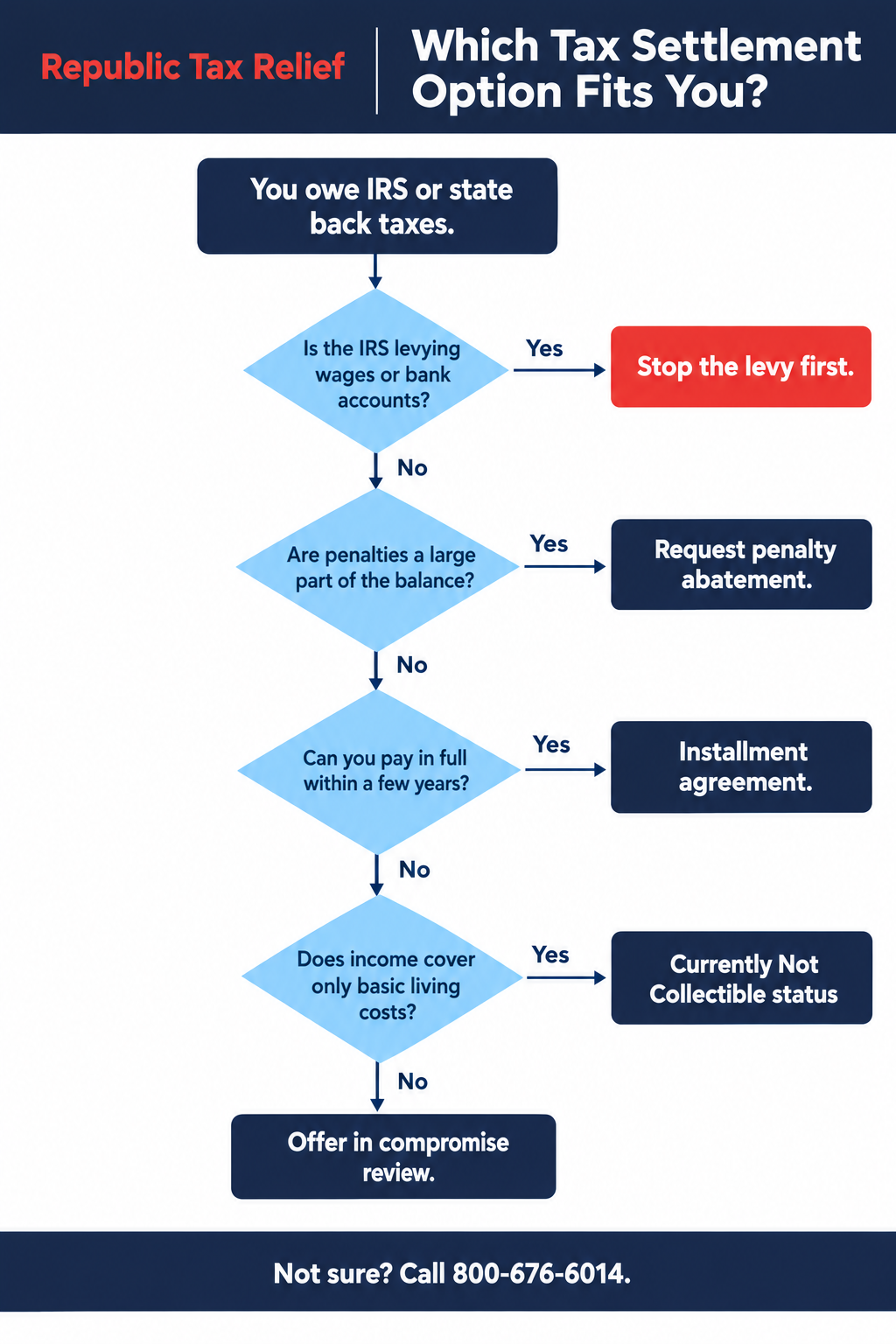
- Can you afford to pay the full balance within a few years? Installment agreements are usually faster to set up and easier to keep.
- Is your income barely covering rent, food, and transportation? Currently not collectible status can stop levies while you recover from financial hardship.
- Did penalties make up a large share of the balance? Request penalty relief before negotiating anything else.
- Would full payment be impossible before the collection deadline? An offer in compromise may be worth the review.
- Is the IRS already taking money? Stop the levy first. Our guides on wage garnishment relief and bank levies explain how.
Practical takeaway: If you’ve received a Final Notice of Intent to Levy, the clock matters more than the option. You generally have 30 days from that notice to request a Collection Due Process hearing, which protects your appeal rights.
Tax Consequences and Back Tax Mistakes to Avoid
The tax debt settlement insights below come from cases that reached our office after something went wrong. People facing overwhelming debt often act fast, and a quick fix can create a new problem.
- Ignoring notices. Each unanswered letter moves a serious tax problem closer to a lien or levy. Know how the IRS collection process escalates so you can act before a levy hits.
- Trusting “pennies on the dollar” ads. No honest firm can promise to reduce your tax debt by a set percentage before reviewing your finances. The IRS warns taxpayers about promoters who overpromise.
- Draining retirement accounts. An early withdrawal can trigger income tax and an extra penalty, turning one tax balance into two. That’s a major tax mistake when it isn’t required.
- Agreeing to a payment you can’t keep. Many people call the IRS first and accept a monthly amount that fails within months. A defaulted agreement can restart collection.
- Falling behind on current taxes. If you don’t pay taxes for the current year on time, a new balance can default an existing agreement.
There is also good news on tax consequences. Under current tax law, tax debt the IRS forgives through an accepted offer generally isn’t treated as taxable income, unlike some settled credit card debt. Confirm how it applies to your case before you settle tax debt of any significant tax size.
Practical takeaway: Open every IRS letter, note the date, and keep copies. Those notices set your deadlines and your options.
How a Tax Professional Helps Resolve Your Tax Debt
You can deal with the IRS alone. But a licensed representative, whether a tax attorney, CPA, or Enrolled Agent, can file Form 2848 and speak for you, so you don’t face revenue officers by yourself. They help you navigate complex IRS rules about which expenses count and when to request a collection hold.
Here is where a tax professional can help most:
- Pulling IRS account transcripts to confirm the real amount owed
- Calculating your ability to pay the way the IRS will
- Choosing between an offer, a payment plan, or hardship status
- Representing you in an audit or appeal
- Helping you manage your tax filings so you stay compliant after the deal
You also have legal protections. The Taxpayer Bill of Rights includes the right to retain representation and the right to challenge the IRS’s position and be heard.
At Republic Tax Relief, our seasoned tax attorneys, CPAs, and Enrolled Agents provide tax resolution and tax settlement services for individual tax and business tax issues with the IRS and state agencies. We start by reviewing your transcripts, then recommend the path that fits your numbers, even if it isn’t the one you expected. For a broader overview of resolving tax balances, see our tax debt relief options.
Practical takeaway: When you interview a tax firm, ask who will handle your case, what licenses they hold, and how they set fees. Clear answers are a good sign.
Our security promise: Your tax returns, Social Security number, and bank statements stay confidential under professional privilege standards and are protected by bank-grade 256-bit encryption from upload to resolution.
What Our Clients Say
★★★★★ “Rebekah Huffman was a wonderful associate to have worked with. She was very knowledgeable and always available to assist and advise. I would highly recommend her and this service to anyone in need.” — Alvin Barbour, Google Review
See the awards and recognition our team has earned.
Frequently Asked Questions
Can I really settle back taxes with the IRS for less than I owe?
Sometimes. An offer in compromise can reduce the balance when the IRS agrees you can’t pay in full before the collection deadline. Most taxpayers who settle back taxes with the IRS do it through a payment plan, hardship status, or penalty relief instead.
Who is eligible for an IRS offer in compromise?
You generally need all required tax returns filed and current estimated tax payments made. The IRS then compares your offer to your income, expenses, and asset equity. If the full tax could be collected within the collection period, the offer will usually be rejected.
How long does an IRS tax settlement take?
It depends on the option. Installment agreements can often be set up in weeks. An offer in compromise often takes six months or longer, and the IRS automatically accepts an offer it hasn’t decided on within two years of receiving it.
Does the IRS stop collecting while I negotiate?
In many cases, yes. Collection is generally paused while an offer in compromise is under review or an installment agreement request is pending. A representative can also request a short collection hold while the case is prepared.
Can a business settle tax debt the same way an individual can?
Yes, with differences. Businesses can use offers, payment plans, and penalty relief, but payroll tax debt brings personal liability risk for owners. Business and individual debts go on separate Form 656 applications.
Will settling my tax debt remove a federal tax lien?
Not right away. A lien is typically released once the debt is paid or the offer terms are satisfied. In some cases, a lien can be withdrawn or subordinated earlier. Our tax lien help guide explains the options.
Where can I find tax settlement updates and new guides?
This blog publishes tax settlement guides and tax settlement updates when IRS rules, fees, or forms change. For a personal review of your tax issues, call 800-676-6014.
Summary: Your Next Step
- Tax settlement covers several paths: offers in compromise, installment agreements, currently not collectible status, penalty abatement, and spouse relief.
- The IRS decides based on your income, expenses, assets, and time left to collect.
- An OIC has real costs and strict terms, so confirm eligibility before you apply.
- Stop active levies and meet notice deadlines before anything else.
- A licensed tax professional can choose the right option and deal with the IRS for you.
Bookmark this Tax Settlement Blog for future guides. When you’re ready to settle your tax debt with a plan built around your numbers, reach out.
Speak With a Tax Relief Professional
You don’t have to sort out IRS debt resolution alone. Our expert tax team will review your IRS or state tax situation, explain your options in plain language, and tell you honestly what is realistic. Results depend on each taxpayer’s facts, and we never promise a specific outcome before reviewing your case.
Call 800-676-6014 or request your free consultation today.
About Republic Tax Relief: Republic Tax Relief helps individuals and businesses resolve IRS tax debt and state tax debt through offers in compromise, installment agreements, penalty abatement, levy and garnishment release, and audit representation. Our licensed team provides confidential tax relief services nationwide. Call 800-676-6014 to speak with a tax relief professional.
This article is for general information and isn’t legal or tax advice for your specific situation.