
Oct
An IRS notice that says you owe $38,000 is not the final word. In many cases, it is the IRS’s opening position, and the tax code gives you real ways to respond.
Most people who owe back taxes don’t need a miracle. They need a clear picture of their options, honest numbers, and someone who knows how the IRS actually decides. That is what this Tax Negotiation Blog is for: practical, plain-English guidance on how IRS tax debt gets resolved, written by a team that handles these cases every day.
Below, you’ll learn which relief options the IRS can agree to, how the negotiation process works from first notice to final agreement, and when it makes sense to bring in a tax attorney or licensed tax professional.
- What It Really Means to Negotiate With the IRS
- IRS Relief Options You Can Negotiate
- How the IRS Negotiation Process Works, Step by Step
- Tax Negotiation Strategies for Business Owners and Payroll Tax Debt
- Why Professional Representation Changes the Outcome
- Frequently Asked Questions About IRS Tax Negotiation
- Summary: Your Next Move
What It Really Means to Negotiate With the IRS
Negotiating with the IRS is not haggling. The IRS doesn’t respond to pressure or clever arguments about fairness. It responds to documentation that shows your true ability to pay, measured against its own published rules.
That’s good news. It means the outcome depends on facts you can organize, not luck. A taxpayer who owes $60,000 but can only afford $400 a month after reasonable living expenses has a very different case than one with $90,000 in home equity.
The IRS looks at three things in almost every case:
- Your income and allowable expenses. The IRS uses national and local standards to decide what counts as reasonable for housing, food, transportation, and health care.
- Your assets. Bank accounts, retirement funds, vehicles, and real estate equity all factor into what the IRS believes it can collect.
- Your filing and payment compliance. The IRS generally won’t approve an agreement until all required tax returns are filed. If you have unfiled tax returns, that comes first.
Practical takeaway: Before any conversation with the IRS, gather your last three months of bank statements, pay stubs, and a list of monthly bills. These financial records drive every negotiation.
IRS Relief Options You Can Negotiate
The IRS offers several formal relief options. The right one depends on how much you owe, what you earn, and what you own. Many cases combine two of them, such as penalty relief plus a payment plan.
| Relief option | Best fit for | What it does | Key requirement |
|---|---|---|---|
| Installment agreement | Taxpayers who can pay over time | Spreads the balance into monthly payments | All returns filed; payments made on time |
| Partial payment installment agreement | Those who can pay something, but not the full balance before the collection deadline | Monthly payments; part of the balance may expire unpaid | Full financial disclosure and periodic review |
| Offer in compromise (OIC) | Those who truly cannot pay in full | Settles the debt for less than the full amount owed | Offer must meet the IRS’s collection calculation |
| Currently not collectible status | Taxpayers in financial hardship | Pauses active collection | Income barely covers basic living expenses |
| Penalty abatement | Clean history or reasonable cause | Removes or reduces IRS penalties | First-time relief or documented cause |
Installment Agreements and Partial Payment Plans
An IRS payment plan is the most common resolution. The IRS offers guaranteed, streamlined, partial pay, and regular installment agreements, and it won’t consider one until you’ve filed all your tax returns (Taxpayer Advocate Service). Interest keeps running, so the goal is a monthly installment you can actually keep.
Example: A freelance designer owing $22,000 sets up a 72-month plan at a payment that fits her budget. Collection stops as long as she stays current.
Offer in Compromise
An offer in compromise settles tax liabilities for less than the full amount owed. The IRS generally accepts one only when the offer equals or exceeds your reasonable collection potential, which is based on your assets and future income (IRS Topic 204). You can pay a lump sum or spread payments out. Read more about how the OIC program weighs your ability to pay.
Practical takeaway: An OIC is not a discount program. If your equity and income show the IRS can collect in full, an offer will likely be rejected.
Currently Not Collectible Status
If paying anything would leave you unable to cover rent, food, or medical bills, the IRS can place your account in currently not collectible status. Levies and garnishments pause, though the debt remains and the IRS reviews your situation periodically.
Penalty Abatement
Penalties can add 25% or more to a balance. Penalty abatement is often available for first-time issues or when illness, disaster, or other events outside your control caused the problem.
How the IRS Negotiation Process Works, Step by Step
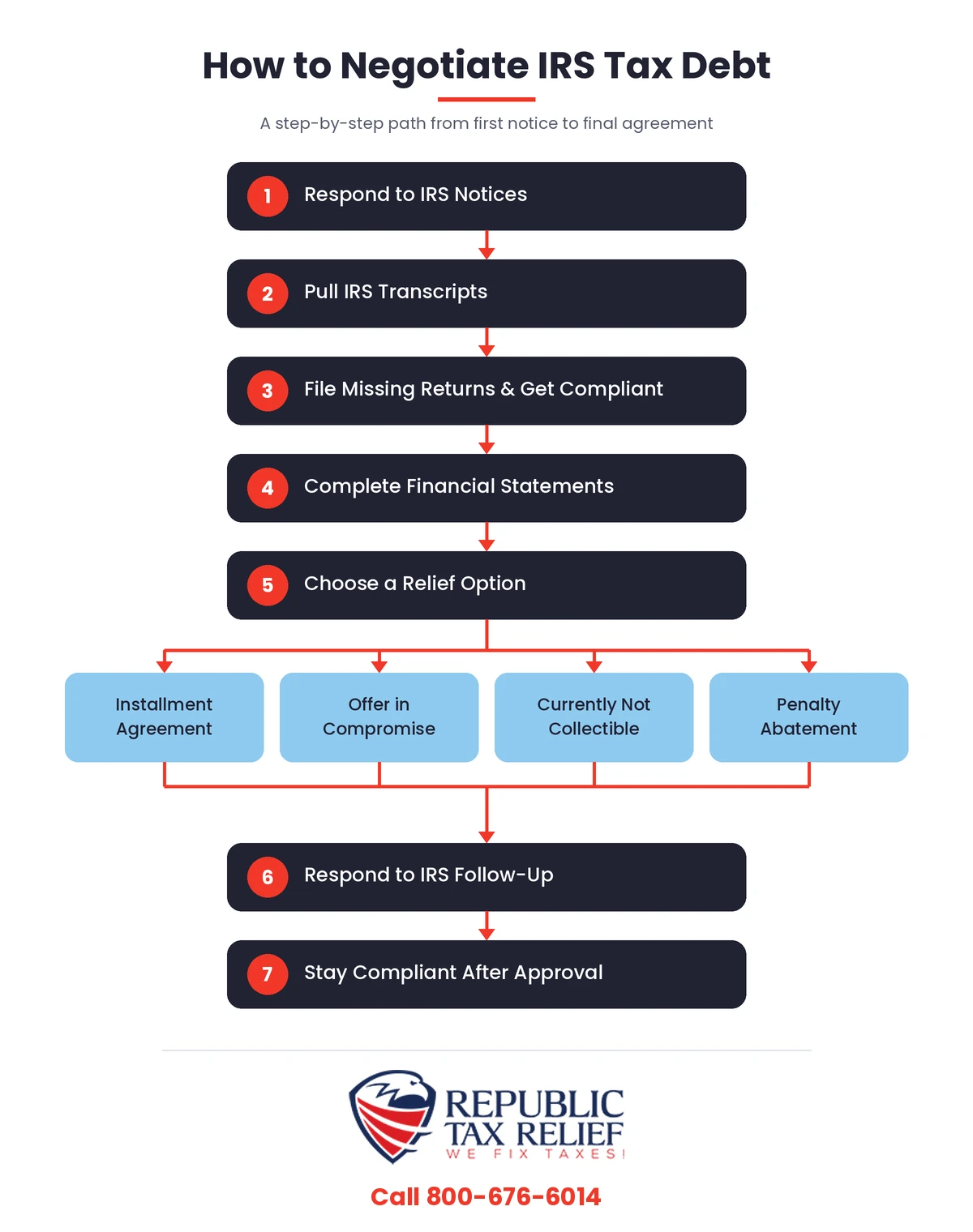
Knowing how to negotiate back taxes starts with knowing the order of events. Skipping steps is the most common reason requests get denied or delayed.
- Respond to IRS notices on time. Deadlines matter. A final notice of intent to levy gives you 30 days to request a hearing, which can pause collection. Learn more about IRS collections defense and stopping a levy.
- Pull your IRS transcripts. Transcripts show every balance, penalty, and the collection deadline for each tax year. They often reveal errors or years that are close to expiring.
- Get compliant. File any missing returns and make sure current-year estimated payments or withholding are on track. The IRS won’t negotiate while new debt is building.
- Complete financial statements. Forms such as 433-A or 433-F document your income, expenses, and assets. Accuracy here sets the terms of the deal.
- Choose and submit the right relief option. Based on the numbers, request a payment plan, offer in compromise, hardship status, or penalty relief.
- Respond to IRS follow-up. Expect requests for more documents. Slow responses can sink an otherwise strong case.
- Stay compliant after approval. File and pay on time for future tax years. A missed payment or late return can default the agreement.
Example: A restaurant owner with a bank levy requested a hearing within the 30-day window, filed two missing returns, and submitted financial statements. The levy was released and an installment agreement replaced it.
If a levy or garnishment is already in place, act quickly. See our guides on wage garnishment relief and tax lien help.
Tax Negotiation Strategies for Business Owners and Payroll Tax Debt
Business tax debt follows different rules, and payroll tax debt is the most serious kind. The IRS treats withheld employee taxes as money held in trust. If those funds aren’t paid, the IRS can hold owners and other responsible people personally liable through the Trust Fund Recovery Penalty.
Strong negotiation strategies for businesses include:
- Stop the bleeding first. Make current payroll deposits on time before asking for relief on old quarters. The IRS rarely negotiates with a business that is still falling behind.
- Separate business and personal exposure. Know which balances belong to the entity and which could become personal assessments.
- Use in-business payment plans. Many businesses qualify for installment agreements that let them keep operating while paying down the balance.
- Document cash flow honestly. Profit and loss statements, receivables, and equipment values all shape what the IRS expects.
Example: A construction company owed four quarters of payroll taxes. After bringing current deposits up to date and documenting seasonal cash flow, the owner secured a business installment agreement that kept equipment and accounts out of levy.
For industry-specific help, explore payroll tax debt relief, business tax debt relief, and our small business tax relief services. State tax agencies run their own collection programs, and the same principles of documentation and compliance apply.
Industry-specific guidance is also available for construction, real estate, medical, and e-commerce businesses.
Why Professional Representation Changes the Outcome
You have the right to handle your own case. But dealing with the IRS involves strict procedures, specific forms, and judgment calls that affect what you’ll pay for years. A tax attorney, CPA, or enrolled agent can represent you directly, so IRS calls and letters go through them instead of you.
Here is what professional tax negotiation insights bring to the table:
- Accurate option selection. A professional can spot when an offer in compromise is realistic and when a payment plan or hardship status is the smarter path.
- Correct financial disclosure. Small errors on financial statements can raise your required payment or trigger a rejection.
- Deadline protection. Representatives track appeal windows and collection dates so you don’t lose rights by missing a letter.
- Collection pauses. A professional can often request holds on levies while a resolution is in progress.
| Working alone | Working with a licensed tax professional |
|---|---|
| You field IRS calls and letters | Your representative communicates with the IRS |
| Guesswork on which program fits | Strategy based on your full tax situation |
| Risk of incomplete forms | Documents reviewed before submission |
| Missed appeal deadlines | Deadlines tracked and protected |
Republic Tax Relief’s team includes tax attorneys, CPAs, and enrolled agents who help taxpayers resolve IRS and state tax debt. Learn more about our full tax resolution services and the recognition our team has earned.
“Republic Tax Relief is very professional and transparent. We were kept informed through the process, I highly recommend and would definitely use again. Highly recommend to use.” — Thomas Novotny, Google Review
Your privacy is protected. Every tax return, Social Security number, and bank statement you share is held under strict client confidentiality and secured with bank-grade 256-bit encryption.
Practical takeaway: Ask any firm you consider who will handle your case, what credentials they hold, and how they’ll keep you updated. A trustworthy firm will not guarantee a specific settlement amount before reviewing your finances.
Frequently Asked Questions About IRS Tax Negotiation
Can you really negotiate with the IRS?
Yes. The IRS has formal programs, including installment agreements, offers in compromise, currently not collectible status, and penalty abatement. Approval depends on your documented income, expenses, assets, and filing compliance, not on persuasion alone.
How much will the IRS settle for?
There’s no standard percentage. The IRS compares your offer to its reasonable collection potential, which is based on your asset equity and future income after allowable living expenses. Some taxpayers qualify for a meaningful reduction, while others are better served by a payment plan.
Does negotiating stop a levy or wage garnishment?
Often, yes. Requesting a collection hearing on time, submitting an installment agreement request, or qualifying for hardship status can pause or release many collection actions. Timing is critical, so respond to IRS notices quickly.
Do I need a tax attorney to negotiate back taxes?
Not always, but professional representation helps when the balance is large, a levy or lien is active, payroll taxes are involved, or you’re considering an offer in compromise. A professional handles IRS communication and helps you avoid costly filing errors.
How long does IRS tax negotiation take?
Simple payment plans can be approved quickly. An offer in compromise or a case with unfiled returns can take several months or longer. Staying responsive to IRS requests is the best way to avoid delays.
Summary: Your Next Move
IRS tax debt can feel permanent, but the IRS has real programs built for taxpayers who cannot pay their tax bill in full. The key points from this guide:
- Negotiation is driven by documentation of your ability to pay, not by argument.
- Payment plans, offers in compromise, hardship status, and penalty abatement each fit different financial situations.
- Filing all required returns and staying current are prerequisites for nearly every agreement.
- Business owners with payroll tax debt face personal liability risk and should act early.
- Professional representation helps you choose the right option, avoid errors, and protect your rights.
Check back here for more IRS tax negotiation articles, tax negotiation guides, and tax negotiation updates as IRS rules change.
About Republic Tax Relief
Republic Tax Relief helps individuals and businesses resolve IRS and state tax debt through payment plans, offers in compromise, penalty relief, and collection defense. Our team reviews your full tax situation, explains your relief options in plain terms, and handles communication with the IRS on your behalf. Call 800-676-6014 for a confidential consultation.
Speak With a Tax Relief Professional
You don’t have to face the IRS alone. Get a clear, honest review of your case and a plan built around what you can actually afford.
Contact Republic Tax Relief today or call 800-676-6014 to speak with a tax relief professional.
This article is for general educational purposes and is not legal or tax advice for your specific situation. Results depend on individual facts and IRS review.