
If you owe back taxes, you probably have a knot in your stomach. Maybe you opened a scary letter, your paycheck was cut, or your bank account was frozen.
You are not out of options. Since 2005, Republic Tax Relief has provided tax relief services to individuals and business owners who owe the IRS or their state. Our licensed team handles the IRS for you, so you can stop dreading the mail.
The Short Version
Most people with tax debt qualify for at least one way to lower the bill, spread it out, or pause collection. The right fit depends on what you owe, what you earn, and how long the debt has been growing.
Here is a quick look at common situations and the tax relief options that often match them.
| Your situation | An option worth asking about |
|---|---|
| You can pay, but not all at once | Installment agreement |
| You owe more than you could ever pay | Offer in Compromise |
| You have no room in your budget right now | Currently Not Collectible status |
| Most of your bill is penalties | Penalty relief |
| The IRS is taking your wages or bank funds | Levy or garnishment release |
| Your business owes payroll taxes | Payment plan and trust fund penalty defense |
What a Tax Relief Company Actually Does for You
A good tax relief company works as your representative. It studies your records, picks the best program for your case, and talks to the IRS or your state so you do not have to.
What Our Team Handles
- Reviews your IRS account records and your state notices
- Finds missing or unfiled returns that need attention
- Builds a case for the program you are most likely to win
- Handles all calls, letters, and negotiations
- Works to stop or release levies, liens, and wage garnishments
- Keeps your case on track after an agreement is in place
Problems We Help Solve
-
Back Taxes
Balances from one year or many, owed to the IRS, your state, or both.
-
Wage Garnishment
Part of every paycheck going to the IRS before you see it.
-
Bank Levies
A frozen account and a short window to act before funds are sent to the IRS.
-
Tax Liens
A legal claim on your home, car, or business assets.
-
Unfiled Returns
Missing years that block most relief programs until they are filed.
-
IRS Audits
Representation so you never have to face an auditor alone.
What No One Can Promise
No honest company can guarantee a result. The IRS decides based on your finances and the rules.
Be careful with anyone who promises to “erase” your debt before they have seen your numbers. Real help starts with your facts, not a sales pitch.
Why Back Taxes Get Out of Hand So Fast
Tax debt grows quietly. Penalties and interest are added to your balance, and the IRS charges interest on the penalties too.
The failure-to-pay penalty alone adds 0.5% of your unpaid tax for each month, up to 25%.[5] That is why a bill you could have handled at $8,000 can feel impossible at $14,000.
Signs You Should Get Help Now
- You received a Notice of Intent to Levy or a final notice
- Your wages or bank account have been touched
- You owe for more than one year
- You have unfiled returns
- You owe more than you can pay in a year or two
- You run a business and owe payroll taxes
If any of these fit, tax relief assistance can protect your income while a plan comes together. Even if none fit, a 800-676-6014 can tell you where you stand.
IRS and State Tax Relief Solutions We Use
Each program has rules, and your history matters. Our job is to find the ones you qualify for and ask for them the right way.
Installment Agreement
An installment agreement lets you pay your balance in monthly amounts over time. While you stay on the plan, the IRS generally holds off on most collection actions.[2]
Offer in Compromise
An Offer in Compromise (OIC) lets some people settle for less than the full amount. The IRS looks at your income, expenses, assets, and ability to pay.[1]
Many offers are turned down because of paperwork mistakes or weak numbers. That is one of the main reasons people bring in help.
Currently Not Collectible Status
If paying would leave you unable to cover basic living costs, the IRS may pause collection.[3] The debt stays on the books and interest keeps building, but it can be a short-term shield after a job loss or illness.
Penalty Relief
The IRS may remove penalties if you have a clean history or a reasonable cause, such as a serious illness or a disaster.[4] It is often worth a request, and it can shrink a balance fast.
Levy, Lien, and Garnishment Help
A levy takes money or property. A lien is a legal claim against your property. A wage garnishment takes part of each paycheck.
Once your representative is in place, they can ask the IRS to release or hold off on these actions in many cases. Speed matters, because these steps can hit your rent, payroll, or daily bills.
State Tax Debt
States run their own collection programs, and the rules differ from state to state. If you owe both the IRS and a state agency, your plan needs to cover both. A single missed piece can undo the rest.
Options at a Glance
| Program | Best for | What it can do | Watch out for |
|---|---|---|---|
| Installment agreement | Steady income, can pay over time | Spreads the bill into monthly payments | Interest and penalties keep growing |
| Offer in Compromise | Real hardship, large balance | Settles for less than you owe | Strict rules and many denials |
| Currently Not Collectible | Very low income right now | Pauses collection | Debt is not erased |
| Penalty relief | Good history, one bad year | Removes some or all penalties | Needs a valid reason |
| Levy or garnishment release | Active collection | Stops wage or bank seizures | Must act quickly |
Want every program explained in depth? Read our complete guide to resolving IRS and state tax debt.
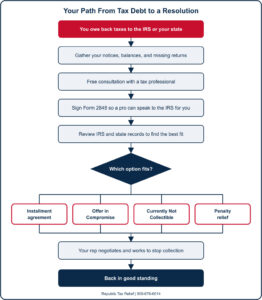
How Our Tax Relief Process Works
Most clients feel relief within the first week, simply because someone else is now taking the IRS calls.
- Free consultation. You share what you owe and what has happened so far. There is no cost and no pressure.
- Records review. We pull your IRS and state account history to see the true balance.
- Authorization. You sign IRS Form 2848, which lets your representative speak for you.[8]
- Strategy. We pick the option with the best chance of success and build your case.
- Negotiation. Your representative deals with the IRS or state agency directly.
- Follow-through. We help you stay on track so the problem does not come back.
You will get regular updates at each step. You should never be left wondering where your case stands.
What Do Tax Relief Services Cost?
Cost depends on how complex your case is, not on a one-size price. A single year with a payment plan takes far less work than five unfiled years and an Offer in Compromise.
| What affects the fee | Why it matters |
|---|---|
| How much you owe | Larger balances usually need more financial documentation |
| Number of tax years | Each year has its own records, notices, and deadlines |
| Unfiled returns | Missing returns must be prepared before most programs are possible |
| Program you qualify for | An Offer in Compromise takes more work than a simple payment plan |
| Active collection | Levies and garnishments need fast, urgent action |
| Business vs. personal | Payroll tax cases add trust fund penalty issues |
Your consultation is free. Before any work begins, we explain your fee in writing so you can compare it to the size of the problem and decide with no pressure.
Real Results for Real Clients
These are examples of accepted Offers in Compromise from past Republic Tax Relief cases.
| Tax balance | Resolved for | Savings |
|---|---|---|
| $72,796 | $500 | 99.4% |
| $46,192 | $2,620 | 94% |
| $35,578 | $4,214 | 88% |
| $27,191 | $500 | 98% |
| $19,871 | $500 | 98% |
What One Client Said
| Client | Pepe |
| Team member mentioned | Ryan Anderson |
| Review | “amazing customer service by Ryan Anderson! He is by far the most helpful person we have ran into on this stressful tax journey! Me and my wife owed over thousands to the IRS. They put into an affordable program that wiped away over $40,000. Thank you Ryan for helping us get this done!” |
| Rating | ⭐⭐⭐⭐⭐ |
Every case is different. Past results do not guarantee a future outcome.
Tax Relief Help for Business Owners
Business tax debt adds pressure because other people depend on you. Payroll taxes are the most serious kind, because the IRS treats withheld employee taxes as money held in trust.
If those taxes go unpaid, the IRS can hold owners and other responsible people personally liable through the Trust Fund Recovery Penalty.[6] That is not something to face alone.
Common Business Tax Problems
- Unpaid payroll or employment taxes
- Missed estimated tax payments
- Sales tax debt owed to a state
- Frozen business bank accounts
- Liens on business assets
We look at your cash flow and choose a plan that lets you keep operating. For example, a payment plan may protect payroll and keep your doors open while the balance shrinks.
Who Will Handle Your Case
Not everyone who offers tax help can speak for you in front of the IRS. Three types of professionals have full rights to represent taxpayers in every state.[7] Our in-house team includes all three.
| Professional | What they are | Why it matters |
|---|---|---|
| Enrolled Agent (EA) | Federally licensed by the IRS | Specializes in tax matters |
| Certified Public Accountant (CPA) | State licensed accountant | Strong on records and financial review |
| Tax Attorney | Licensed lawyer | Adds legal protection and court experience |
Before you hire anyone, ask who will actually work on your case and what license they hold.
How to Choose a Tax Relief Company You Can Trust
The right team should make you feel calmer after the first call, not more pressured.
Green Flags
- They ask detailed questions about your income, bills, and notices
- They explain your options in plain words, including the downsides
- Licensed EAs, CPAs, or attorneys work on your case
- Fees are explained in writing before you sign
- They offer a free consultation with no pressure
Red Flags
- A guarantee to cut your debt by a set amount
- Big upfront fees before any review of your case
- Pressure to sign the same day
- Advice to ignore IRS letters or stop filing returns
- No clear answer about who will handle your file
The Federal Trade Commission and the IRS both warn about companies that overpromise.[10] If a deal sounds too good to be true, slow down and ask more questions.
Frequently Asked Questions
How much does a tax relief company charge?
Fees depend on your balance, how many years are involved, and which program fits. A trustworthy firm offers a free consultation and explains costs in writing before any work begins.
How long does it take to resolve tax debt?
A payment plan can often be set up within weeks. An Offer in Compromise usually takes several months or longer, because the IRS reviews your full financial picture.
Can you stop a wage garnishment or bank levy?
In many cases, yes. Once a representative is in place, they can ask the IRS to release a levy, especially when it causes hardship or a resolution is underway. Acting fast matters, because a bank must hold levied funds for 21 days before sending them to the IRS.[9]
Do you help with state tax debt too?
Yes. We work with both IRS and state tax agencies, so one plan can cover everything you owe.
Will the IRS really work with me?
Yes. The IRS has set programs for people who cannot pay in full, and it often prefers a workable plan to no payment at all. A representative helps you ask for the right one.
How long can the IRS collect a tax debt?
In general, the IRS has 10 years from the date a tax is assessed to collect it.[5] Some events can pause that clock, so it is best to have a professional check your dates.
Should I contact the IRS myself first?
You can, but many people find the calls stressful and confusing. Anything you say can affect your case, so it helps to speak with a licensed representative before you make big decisions.
Is there help if I think the IRS made a mistake?
Yes. The Taxpayer Advocate Service is an independent organization within the IRS that helps people facing hardship or unresolved problems. A representative can also help you dispute errors on your account.
Find More Answers about Tax Relief
Sources and Further Reading
These official sources support this page. Rules and dollar amounts change, so confirm details for your case.
- IRS: Offer in Compromise
- IRS: Payment Plans and Installment Agreements
- IRS: Temporarily Delay the Collection Process
- IRS: Penalty Relief
- IRS: Failure to Pay Penalty and Time IRS Can Collect Tax
- IRS: Trust Fund Recovery Penalty
- IRS: Choosing a Tax Professional
- IRS: About Form 2848
- IRS: Information About Bank Levies
- FTC: Trouble Paying Your Taxes? and Taxpayer Advocate Service
- Tax Relief Calculator
Your information stays protected. Every document you share is handled under strict tax professional confidentiality and protected with encrypted, secure systems from your first call to your final agreement.
Speak With a Tax Relief Professional
Tax debt feels heavy, but it is solvable. Our team offers professional tax relief services for individuals and business owners facing IRS and state balances. We will review your situation, explain your choices in plain language, and help you move toward a plan that fits your life.
We serve taxpayers in all 50 states. Your consultation can take place by phone or online, and our offices in Corona and Laguna Hills are available if you prefer to meet in person.
This page is for general information only and is not legal, tax, or financial advice. Results depend on your facts, and no outcome is guaranteed.