
Oct
If you owe back taxes, the hardest part is often the first step. The letters keep coming, the balance keeps growing, and it’s hard to tell which option actually fits your situation. Waiting rarely helps, but acting without a plan can make things worse.
This back tax help blog is built to give you that plan. Below, you’ll find practical back tax resolution strategies, plain-English explanations of IRS back tax debt options, and clear signs that it’s time to bring in a professional. Each section links to a deeper guide so you can go straight to what matters for your case.
Table of Contents
- What Happens When You Ignore Back Taxes
- How to Resolve Back Taxes: A 5-Step Path
- IRS Back Tax Debt Options at a Glance
- How Back Taxes Affect Your Tax Refund and Credits
- State Tax Debt Needs Its Own Strategy
- Back Tax Help for Business Owners
- IRS Back Tax Help Tips: What to Do Right Now
- When to Hire a Tax Expert
- Frequently Asked Questions
- Key Takeaways
What Happens When You Ignore Unresolved Back Taxes
The consequences of ignoring back taxes build on each other. Penalties and interest grow the balance every month, and the IRS has strong tools to collect the taxes you owe. According to the IRS, the failure-to-file penalty is 5% of unpaid tax for each month a return is late, up to 25%. The failure-to-pay penalty adds 0.5% per month, also capped at 25%, and interest compounds daily on top of both.
| What Happens | When It Usually Starts | What It Means for You |
|---|---|---|
| Penalties and interest | Right after the tax filing deadline | Your tax balance grows every month |
| IRS notices (CP14, CP501, CP503, CP504) | Weeks to months after a balance is due | Formal demands that escalate in tone |
| Federal tax lien | After assessment and unpaid demand | A public claim against your property; can hurt credit and lending |
| Levy or wage garnishment | After a Final Notice of Intent to Levy | The IRS may take bank funds, wages, or other assets |
Example: A freelancer skips two years of filings, assuming she’ll “catch up later.” By the time she reads her mail, she faces maximum late-filing penalties on both years and a final levy notice with 30 days to respond. A professional can often still request a hearing and stop the levy, but her options are narrower than they were a year earlier.
Takeaway: The earlier you address your back taxes, the more relief options you keep. Learn how collections escalate in our guide to IRS collections defense and stopping a levy.
How to Resolve Back Taxes: A 5-Step Path
Every case is different, but most successful resolutions follow the same basic order. Skipping steps, especially the first two, is one of the most common reasons applications get rejected.
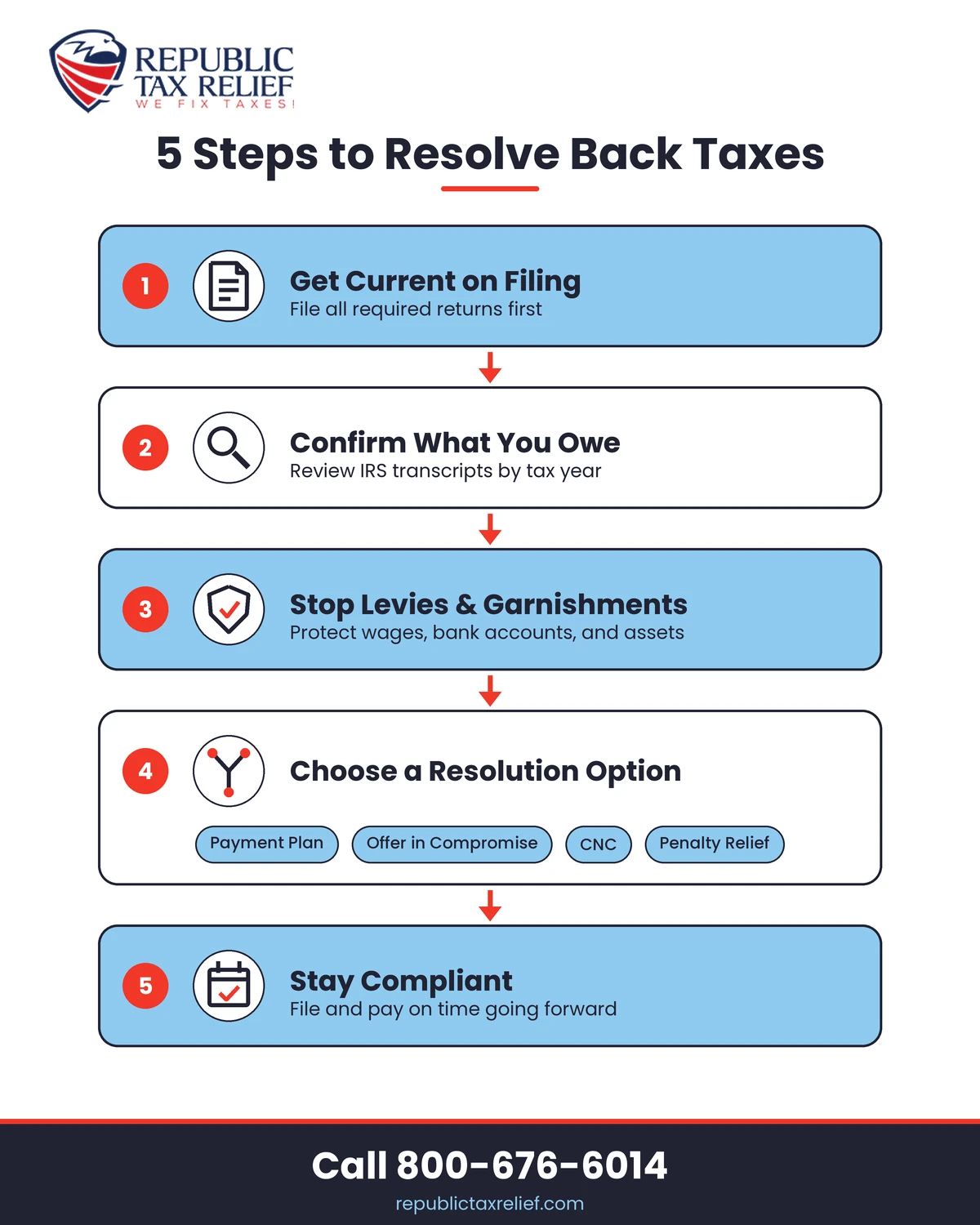
- Get current on filing. The IRS won’t approve most agreements until all required returns are filed. If you have unfiled tax returns, a professional can pull your IRS transcripts and prepare past tax returns accurately.
- Confirm the real balance. Request account transcripts to see the actual amount of tax, penalties, and interest for each tax year. Notices don’t always tell the full story.
- Stop or prevent enforcement. If a levy, garnishment, or lien is active or threatened, that becomes the first priority.
- Choose the right resolution. This is based on your income, expenses, assets, and how long the IRS has left to collect.
- Stay compliant going forward. File on time and make estimated tax payments if you’re self-employed. Missing future obligations can void an agreement.
Takeaway: Resolution is a process, not a single form. Our back tax help service page explains how we handle each stage.
IRS Back Tax Debt Options at a Glance
Several options are available to taxpayers, and the best one depends on your full financial picture. Here’s a quick comparison to help you see where you might fit.
| Option | Best For | Learn More |
|---|---|---|
| Installment agreement | You can pay over time, just not all at once | IRS payment plans |
| Offer in compromise | You truly can’t pay the full balance before the collection deadline | How the OIC program works |
| Currently Not Collectible | Paying anything right now would cause financial hardship | CNC status |
| Penalty abatement | Penalties make up a large part of your balance | Penalty relief |
| Innocent spouse relief | The debt came from a spouse’s errors on a joint tax return | Innocent spouse relief |
Types of IRS Payment Plans
- Short-term plan: Up to 180 days to pay in full.
- Streamlined installment agreement: For many individuals with a combined balance of $50,000 or less, with less financial disclosure required.
- Non-streamlined agreement: For larger balances. Requires detailed financial statements and more negotiation.
- Partial payment installment agreement: Monthly payments based on what you can afford, which may not pay off the full balance before the collection period ends.
The IRS outlines current requirements on its payment plans page.
Takeaway: An offer in compromise gets the most attention, but it isn’t the right fit for everyone. A payment plan, CNC status, or penalty relief may resolve your tax debt faster and with less risk of rejection.
How Back Taxes Affect Your Tax Refund and Credits
Many people are surprised to learn that owing back taxes affects future tax seasons, too. If you expect to get money back, the IRS will generally apply your tax refund to any outstanding federal balance first. That includes refunds driven by a refundable tax credit.
A few other points to know:
- A tax extension is not an extension to pay. It gives you more time to file a tax return, but interest and late-payment penalties still apply to any unpaid amount.
- Tax deductions and credits still matter. Claiming every tax deduction and credit you qualify for, on both current and past returns, can lower the tax liability you’re trying to resolve.
- An accepted offer comes with conditions. The IRS typically keeps refunds through the calendar year an offer is accepted, and you must stay compliant for five years.
Example: A couple expecting a $3,200 refund learns it was fully applied to a 2021 balance. Once they set up a payment plan, future refunds still go toward the debt, but their monthly payment and the remaining balance are both predictable.
Takeaway: Plan for refund offsets when you budget, and make sure past returns capture every tax benefit you’re entitled to.
State Tax Debt Needs Its Own Strategy
State tax agencies run their own collection systems, and they don’t follow IRS rules. Some move faster than the IRS, and some have longer collection windows. California’s Franchise Tax Board, for example, can generally collect for up to 20 years, compared to the IRS’s 10-year standard.
- State payment plans and settlement programs have different qualification rules.
- Resolving a federal balance doesn’t resolve a state tax balance.
- States can levy bank accounts and garnish wages, often with less notice.
Takeaway: If you owe both the IRS and your state, you need a coordinated plan so one agreement doesn’t make the other unaffordable. If your accounts have been frozen, see our guide to stopping IRS and California bank levies.
Back Tax Help for Business Owners
Business tax debt carries extra risk. Unpaid payroll taxes are treated seriously because part of that money was withheld from employees’ paychecks. The IRS can assess the Trust Fund Recovery Penalty against owners and other “responsible persons,” which makes the debt personal.
- Payroll taxes: See payroll tax debt relief.
- Audits that create new balances: See business IRS audits.
- Industry-specific challenges: We work with construction companies, medical practices, real estate professionals, and e-commerce sellers.
Takeaway: Business owners should address payroll balances first, before personal liability attaches. Our business tax debt relief page covers options that help protect your company.
IRS Back Tax Help Tips: What to Do Right Now
Do:
- Open every IRS and state letter and note the response deadline.
- Keep copies of all notices, returns, and payment records.
- File current-year returns on time, even if you can’t pay your tax in full.
- Seek professional tax help before you contact the IRS about a large or complex balance.
Avoid:
- Ignoring a Final Notice of Intent to Levy. You generally have 30 days to request a hearing.
- Agreeing to a payment you can’t keep up with. A defaulted agreement can restart collections.
- Draining retirement accounts before reviewing other options.
- Trusting any company that promises a specific settlement amount before reviewing your finances.
Takeaway: Small actions taken early, like answering a notice on time, protect your rights and keep more options open.
When to Hire a Tax Expert
You can call the IRS yourself, but dealing with the IRS on a serious balance is a negotiation. An experienced tax professional knows how the IRS evaluates your ability to pay, which expenses are allowed, and how to present your case.
Consider professional tax resolution if:
- You owe more than $10,000 or have multiple years of debt.
- A lien, levy, or wage garnishment is active or threatened.
- You have unfiled returns along with a balance due.
- You own a business with payroll tax issues.
- You’ve already been rejected for an offer or payment plan.
“Republic Tax Relief provided outstanding support and guidance. I felt confident and stress free throughout the process.”
— Constant Girard, Google Review
Our team is made up of seasoned tax professionals who handle complex tax cases every day, and our work has been recognized across the industry. For a full overview of what representation includes, read our tax resolution services guide.
Your information stays protected. Every document you share is safeguarded with bank-grade 256-bit encryption and handled under strict tax professional confidentiality standards.
Frequently Asked Questions
How far back can the IRS collect back taxes?
The IRS generally has 10 years from the date a tax is assessed to collect it. Certain actions, like filing an offer or requesting a hearing, can pause that clock.
Can I get a payment plan if I owe back taxes to the IRS?
Yes. Most taxpayers qualify for some type of installment agreement, as long as all required returns are filed. The type of plan depends on how much you owe and what you can afford.
Will the IRS take my tax refund if I owe back taxes?
Generally, yes. The IRS applies refunds to outstanding federal tax debt, including refunds from refundable tax credits.
Can penalties on back taxes be removed?
Sometimes. The IRS offers first-time penalty abatement for taxpayers with a clean recent history, and reasonable cause relief for situations like serious illness or disasters.
Does an offer in compromise work for everyone?
No. The IRS accepts offers only when the amount offered reflects what it could realistically collect. A review of your income, expenses, and assets shows whether you’re a good candidate.
Key Takeaways
- Back taxes grow quickly through penalties and interest, so acting early protects your options.
- Filing all required returns comes before almost every resolution option.
- IRS back tax debt options include payment plans, an offer in compromise, CNC status, penalty abatement, and innocent spouse relief.
- State tax debt follows separate rules and needs its own plan.
- Business owners face personal risk from unpaid payroll taxes.
- A qualified professional can stop collections and match you with the right strategy.
Speak With a Tax Relief Professional
You don’t have to figure out your tax situation alone. Republic Tax Relief helps individuals and business owners resolve IRS and state back taxes with clear plans and honest guidance. Call 800-676-6014 or request your confidential consultation today.
Sources: