
Oct
If you already know you will never pay off what you owe, an offer in compromise may be the most valuable option you are not yet using the right way. The IRS can settle a tax debt for less than the full amount owed. But it only does so when your numbers prove it cannot realistically collect more.
Here is the hard truth most people learn too late: many offers fail for reasons that have nothing to do with whether the taxpayer deserved relief. A missing tax return, a miscalculated offer amount, or a financial statement that doesn’t match bank records can sink a strong case.
This Offer in Compromise blog focuses on the practical side. You will learn how to tell whether you qualify, how the IRS calculates a fair offer, what the application process looks like, and what to do if the answer is no. If you’re brand new to the program, start with our overview, What Is an Offer in Compromise (OIC) or Fresh Start Program?, then come back here when you’re ready to size up your own case.
Quick facts (2026):
- Application form: IRS Form 656, filed with Form 433-A (OIC) for individuals or Form 433-B (OIC) for businesses
- Application fee: $205, waived for qualifying low-income taxpayers
- Who decides: the IRS, based on your income, expenses, asset equity, and ability to pay
- Free screening tool: the IRS Offer in Compromise Pre-Qualifier
Table of Contents
- The Three Types of Offer in Compromise
- OIC Eligibility: Who Can Apply
- How the IRS Calculates Your Offer Amount
- The OIC Application Process, Step by Step
- What Happens While the IRS Reviews Your Offer
- Why the IRS Rejects Offers and What to Do Next
- When Another Tax Relief Option Is the Better Fit
- Why Working With a Tax Professional Matters
- Frequently Asked Questions About the Offer in Compromise Process
- Summary: Resolving Your Tax Debt With an OIC
The Three Types of Offer in Compromise
The IRS accepts offers on three legal grounds, and picking the wrong one is a common reason an OIC application stalls. Under federal tax law, each type has its own proof requirements.
| Type of offer | When it fits | What you must prove |
|---|---|---|
| Doubt as to collectibility | You owe the tax but can’t pay it in full before the collection deadline | Your assets and future income are worth less than the full balance |
| Doubt as to liability | You believe the tax assessed is wrong | A legitimate dispute over the amount owed, with evidence |
| Effective tax administration | You could technically pay, but doing so would cause economic hardship or be unfair | Exceptional circumstances, such as serious illness or a disability that drains your income |
Offer in Compromise Doubt as to Collectibility
This is the most common type by far. The IRS compares what you owe to what it could realistically collect from you before the 10-year collection window closes. If the gap is large, a settlement may make sense for both sides.
Offer in Compromise Doubt as to Liability
This offer argues that you don’t owe the tax at all, or not as much as the IRS says. It’s filed on a separate form (Form 656-L), and the IRS doesn’t charge an application fee for it, though you still must offer more than $0. It’s often used when an IRS-prepared return or an audit result missed deductions you can document.
Effective Tax Administration
This is the rarest type. It covers people who have enough equity to pay but face circumstances that make collection unfair, such as a retiree whose only asset is a home needed for medical care.
Practical takeaway: If you disagree with the amount owed and you can’t afford it, a tax professional may recommend fixing the liability first. Reducing the balance can make a collectibility offer much stronger later.
OIC Eligibility: Who Can Apply
Before the IRS evaluates your offer amount, it checks whether you’re even allowed to apply. Miss any of these, and your offer is usually returned without a review.
Basic IRS Requirements
- You must file all required tax returns. Even one missing year can stop the process. If you’re behind, see our guide to unfiled tax returns.
- You must make all required estimated tax payments for the current year.
- Business owners with employees must be current on federal tax deposits for the current quarter.
- You can’t be in an open bankruptcy proceeding.
- You must have received a bill for at least one tax debt included in the offer.
How to Qualify for an Offer in Compromise Beyond the Checklist
Meeting the rules above only gets you in the door. To actually qualify, your financial situation has to show that paying the full amount isn’t realistic. In plain terms, the IRS must conclude it would collect less by forcing payment than by accepting your offer.
Using the IRS Offer in Compromise Pre-Qualifier
The IRS offers a free Offer in Compromise Pre-Qualifier tool that gives you a rough read on eligibility and a preliminary offer amount. It’s a useful starting point, but it has limits:
- It relies on IRS national and local expense standards, which may not reflect your actual costs.
- It can’t account for special circumstances, such as medical needs or a business that’s winding down.
- A “yes” from the tool is not an IRS approval.
Example: Maria, a self-employed hairstylist, owes $48,000. The pre-qualifier suggests she might qualify. But she hasn’t filed her 2023 return and skipped this year’s estimated tax payments. Until both are fixed, any offer she submits would be returned unprocessed.
How the IRS Calculates Your Offer Amount
The IRS doesn’t negotiate like a car dealer. It uses a set method to find your minimum acceptable offer, called your reasonable collection potential (RCP). Your offer generally has to equal or exceed that number.
The Offer in Compromise Formula
\text{RCP} = \text{Net equity in assets} + (\text{Monthly disposable income} \times \text{Months})- Net equity in assets: usually 80% of an asset’s fair market value (its “quick-sale value”), minus any loan against it.
- Monthly disposable income: what’s left after IRS-allowed living expenses.
- Months: 12 if you pay a lump sum, 24 if you choose periodic payments.
For a deeper look at how the IRS measures your ability to pay, see our page on how the OIC program works.
A Simplified IRS Reasonable Collection Potential (RCP) Example
James owes $85,000 in federal tax. Here’s how the IRS calculates a rough RCP for him (real forms include extra exclusions and adjustments):
| Item | Value |
|---|---|
| Home: $300,000 x 80% = $240,000, minus $230,000 mortgage | $10,000 |
| Vehicle: $15,000 x 80% = $12,000, minus $9,000 loan | $3,000 |
| Bank and retirement equity | $2,000 |
| Total net asset equity | $15,000 |
| Monthly disposable income | $300 |
| Lump-sum offer: $15,000 + ($300 x 12) | $18,600 |
| Periodic offer: $15,000 + ($300 x 24) | $22,200 |
If the IRS accepts, James could settle an $85,000 balance for about $18,600. That’s a real-world look at how taxpayers settle IRS tax debt for less, but only when the math supports it.
Practical takeaway: Small details move this number a lot. Claiming an expense the IRS won’t allow, or undervaluing a vehicle, can raise your RCP by thousands. Getting expenses and valuations right is where an experienced tax professional earns their fee.
The OIC Application Process, Step by Step
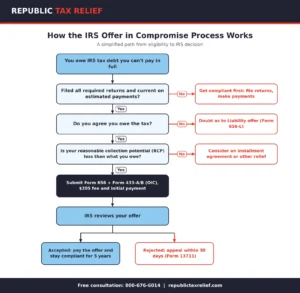
Applying for an offer takes careful paperwork, and the IRS is strict about completeness. According to the IRS Form 656-B Offer in Compromise Booklet, the fee and initial payment must be sent with your Form 656 unless you qualify for low-income certification.
- Get current on compliance. File all required tax returns and make current estimated tax payments.
- Complete your financial statement. Use Form 433-A (OIC) for individuals or Form 433-B (OIC) for businesses, with bank statements, pay stubs, and asset values attached.
- Calculate your offer amount. Base it on your reasonable collection potential, not on what feels fair.
- Choose a payment option. Lump sum or periodic (see the table below).
- Submit Form 656 with the $205 application fee and your initial payment, unless you meet low-income guidelines.
- Respond fast to IRS requests. Missed deadlines during review are a leading cause of closed offers.
Payment Options and Your Offer Amount
| Option | Paid with application | Remaining balance | Months of income counted |
|---|---|---|---|
| Lump-sum cash offer | 20% of the offer amount | Paid in 5 or fewer payments within 5 months of acceptance | 12 |
| Periodic payment offer | First monthly payment | Monthly payments while under review, finished within 24 months | 24 |
About the $205 Application Fee
The IRS keeps the 205 application fee and any payments if it reviews and rejects your offer, applying that money to your balance. That’s why it pays to confirm eligibility before submitting an offer in compromise.
Example: A contractor submits a lump-sum offer of $10,000. He sends $205 plus $2,000 (20%) with Form 656. If the IRS accepts, he pays the remaining $8,000 within five months.
What Happens While the IRS Reviews Your Offer
Once your offer is accepted for processing, an IRS offer examiner reviews your financial statement line by line. The IRS review often takes many months, so knowing what to expect helps you avoid costly missteps.
What Changes During Review
- Levies generally pause. The IRS usually can’t levy your wages or bank accounts while a processable offer is pending.
- Liens can still be filed. The IRS may file a federal tax lien to protect its interest. Learn more about federal tax lien help.
- The collection clock stops. The 10-year collection deadline is extended while the offer is pending.
- Refunds are kept. The IRS applies tax refunds to your debt, including refunds for the year your offer is accepted.
- Periodic payments continue. If you chose a periodic offer, keep paying monthly during the review.
What the IRS Evaluates
The examiner verifies your income, compares your expenses against IRS standards, and checks asset values against public records. Expect requests for updated bank statements or proof of expenses, often with tight deadlines.
If Your Offer Is Accepted
When an offer is accepted, you must stay fully compliant for five years. That means filing and paying all taxes on time. Missing this requirement can put the original debt back on the table.
Practical takeaway: Treat every IRS letter during review as urgent. If you’re facing active collection right now, our IRS collections defense team can help protect your income while your case moves forward.
Why the IRS Rejects Offers and What to Do Next
A rejected offer is frustrating, but it isn’t always the end. Knowing why the IRS rejects your offer tells you what to fix.
Common Reasons an Offer Is Rejected or Returned
- The offer amount is below your RCP. The IRS believes it can collect more than you offered.
- Missing returns or payments. Unfiled years or skipped estimated tax payments make the offer unprocessable.
- Incomplete documentation. Missing bank statements or unsigned forms lead to a returned offer.
- Hidden or undervalued assets. If records show assets you didn’t list, the IRS may reject the offer and question everything else.
- Missed IRS notices. Ignoring a request for information during review can close the case.
Your Options After a Rejected Offer
- Appeal within 30 days. You can request an appeal using Form 13711. An independent IRS Appeals officer reviews the examiner’s decision.
- Revise and resubmit. If your finances changed or the original offer had errors, a corrected offer may succeed.
- Switch strategies. Sometimes an installment agreement or hardship status is the smarter path.
Example: Derek’s offer was rejected because the IRS valued his truck $8,000 higher than he did. With a dealer appraisal showing heavy damage, his representative appealed within 30 days and the valuation was adjusted.
When Another Tax Relief Option Is the Better Fit
An OIC is one of several IRS debt settlement options, and it isn’t right for everyone. If your RCP is close to what you owe, the IRS will likely expect full payment. Here’s how the main alternatives compare:
| Situation | Option that may fit better | Learn more |
|---|---|---|
| You can pay the tax debt in full over time | Installment agreement | IRS payment plans |
| You have no money left after basic living expenses | Currently Not Collectible status | CNC status |
| Most of your balance is penalties | Penalty abatement | Penalty relief |
| The debt came from a spouse’s or ex-spouse’s errors | Innocent spouse relief | Innocent spouse relief |
| Your company owes payroll or business tax | Business-focused resolution | Payroll tax debt relief |
These options can also work together. For example, removing penalties first can lower your balance before you apply for an OIC. For a broader overview, see our guide to tax debt relief options.
Practical takeaway: The best resolution isn’t always the lowest number on paper. It’s the one you can qualify for, afford, and keep.
Why Working With a Tax Professional Matters
The IRS doesn’t require you to hire anyone to apply for an OIC. But an offer is a legal negotiation with an agency that has trained examiners on its side. Having a licensed advocate on yours can make the difference between a returned offer and a resolved case.
What Experienced IRS Representation Brings
- Strategy before paperwork. A professional checks whether an OIC is the right fit, or whether another path saves you more.
- Accurate numbers. Correct asset valuations and allowable expenses keep your offer amount defensible.
- A buffer between you and the IRS. With a power of attorney on file, the IRS contacts your representative, not you.
- Appeal readiness. If an offer is rejected, your representative already knows the file and the deadlines.
- Business know-how. Owners with payroll or business tax debt face added rules that require specialized handling.
About Republic Tax Relief
Since 2005, Republic Tax Relief has helped individuals and business owners resolve complex IRS and state tax problems. Our in-house team includes enrolled agents, tax attorneys, and CPAs who handle every stage of the offer in compromise process, from investigation to final resolution. We’ve resolved more than 18,000 cases. Every case is different, and results depend on your individual facts.
“I had a complex tax issue that was giving me headaches. Republic Tax Relief solved it faster than I thought possible!!” — Grayson Wilde, Google Review
Your privacy is protected. Everything you share is held to strict tax client confidentiality standards and secured with bank-grade 256-bit encryption, so you can send tax returns and bank statements with confidence.
Frequently Asked Questions About the Offer in Compromise Process
How much should I offer the IRS?
Your offer should generally equal or exceed your reasonable collection potential: your net asset equity plus 12 or 24 months of disposable income, depending on the payment option. Offering less than your RCP usually leads to rejection unless special circumstances apply.
How long does the OIC process take?
The IRS describes the process as lengthy, and reviews often take many months. If the IRS doesn’t make a decision within 24 months of receiving your offer, the offer is generally treated as accepted by law.
Does the IRS stop collections while my offer is pending?
In most cases, the IRS can’t levy your wages or bank accounts while a processable offer is under review, or during a timely appeal. However, the IRS may still file a federal tax lien and will keep any tax refunds.
Can a business apply for an offer in compromise?
Yes. Businesses file Form 433-B (OIC) and must be current on federal tax deposits for the current quarter. Payroll tax debts can carry personal liability for owners, so a coordinated strategy matters.
Does an accepted OIC remove a federal tax lien?
The IRS releases a federal tax lien after you pay the accepted offer amount in full. Until then, the lien generally stays in place.
Can I settle state back taxes with an IRS offer?
No. An IRS offer only covers federal tax. Many states run their own compromise programs, including California’s Franchise Tax Board, with separate rules and forms.
What happens if I miss payments after my offer is accepted?
Missing payments or failing to file and pay taxes during the five-year compliance period can put the offer in default. The IRS may then reinstate the original balance, minus what you’ve paid.
Summary: Resolving Your Tax Debt With an OIC
- An offer in compromise lets eligible taxpayers settle IRS tax debt for less than they owe, but only when the numbers prove full payment isn’t realistic.
- Choose the right type: doubt as to collectibility, doubt as to liability, or effective tax administration.
- Get compliant first: file all required tax returns and make current estimated tax payments.
- Your offer must generally meet your reasonable collection potential.
- Submit Form 656 with the $205 fee and initial payment unless you qualify for the low-income waiver.
- A rejected offer can be appealed within 30 days, and other relief options may fit better.
Speak With a Tax Relief Professional
You don’t have to guess whether you qualify or risk a rejected offer on your own. Our enrolled agents, tax attorneys, and CPAs will review your situation, run the numbers, and tell you honestly which path makes sense.
Call 800-676-6014 or request your free, confidential consultation today.
About Republic Tax Relief: Republic Tax Relief is a full-service tax resolution firm helping individuals and businesses resolve IRS and state tax debt since 2005. Our in-house team of enrolled agents, tax attorneys, and CPAs handles offers in compromise, payment plans, penalty relief, levy and garnishment release, and business tax resolution. Call 800-676-6014 for a free consultation.
This article is for general information and is not legal or tax advice. Results vary based on individual circumstances.