
Oct
An envelope from the Internal Revenue Service lands in your mailbox, and the word “examination” jumps off the page. Your stomach drops. You start wondering what you did wrong, how much you might owe, and whether you should call the number on the letter right away.
Take a breath. An audit is a review of your tax return, not an accusation of fraud. Many audits end with no change or a small adjustment. How the audit goes depends a lot on what you say, what you send, and who speaks for you.
This IRS audit representation blog explains how audits work, what the IRS is really asking for, and when it makes sense to hand the case to a licensed tax attorney, CPA, or enrolled agent. You will also learn the mistakes that turn a simple review into a bigger tax problem.
Quick answer: IRS audit representation means a licensed professional (attorney, CPA, or enrolled agent) handles the audit for you under a signed power of attorney (IRS Form 2848). They talk to the IRS agent, prepare your documents, and push back when the IRS gets it wrong, so you never have to sit across the table alone.
Table of Contents
- How to Read an IRS Audit Letter or Notice CP2000
- Types of IRS Audits: Mail, Office, and Field
- Common IRS Audit Triggers
- What to Do During an IRS Tax Audit
- Why Professional Audit Representation Matters
- The IRS Audit Appeal Process
- Audit Mistakes to Avoid
- Frequently Asked Questions
- Speak With a Tax Relief Professional
How to Read an IRS Audit Letter or Notice CP2000
The IRS starts every real audit by mail. It does not open an audit with a phone call, text, or email, so treat any of those as a likely scam.
Not every IRS letter is a full audit notice. A Notice CP2000 is an automated underreporter notice. It means the income on your tax return does not match what employers, banks, or brokers reported on W-2s and 1099s. It proposes additional tax, but you can agree, partly agree, or disagree with documents.
When any IRS letter arrives, check these four things first:
- The notice or letter number (top or bottom right corner, such as CP2000, Letter 566, or Letter 2205)
- The tax year under review
- The items in question (income, a deduction, a credit, business expenses)
- The response deadline, often 30 days from the date on the letter
Example: Maria, a freelance designer, got a CP2000 claiming $14,000 in unreported 1099 income. Her client had issued two 1099s for the same work. With a corrected form and bank records, the proposed tax was removed. A rushed “I agree” signature would have cost her thousands.
Takeaway: Never sign an agreement form on a CP2000 until you have compared every line to your own records.
Types of IRS Audits: Mail, Office, and Field
The IRS uses three main types of audits. The type tells you how serious and how broad the review is likely to be.
| Audit type | Where it happens | What it usually covers | Typical risk level |
|---|---|---|---|
| Correspondence (mail audit) | By mail | One or two items, like a credit or a single deduction | Lower |
| Office audit | At a local IRS office | Several items; you bring records in-person | Moderate |
| Field audit | Your home, business, or your representative’s office | A full review of books, often for a business owner | Higher |
Correspondence audits are the most common type, according to the IRS’s own audit overview. Office and field audits take more time and usually involve more money. Field audits often look at business tax issues such as cash income, payroll, and expense records.
Takeaway: If you receive an office or field audit notice, bring in a professional before the first meeting, not after.
Common IRS Audit Triggers
Audits can be triggered by computer scoring, random selection, or a link to another taxpayer under review. These IRS audit triggers show up often:
- Income that does not match W-2s and 1099s
- Large deductions compared to your reported income
- Years of business losses on Schedule C
- Heavy cash income (restaurants, salons, construction, rideshare)
- Large charitable gifts, especially of property
- Claiming 100% business use of a vehicle
- Home office, meals, and travel deductions without receipts
- Refundable credits, such as the Earned Income Tax Credit
Example: A contractor deducted $60,000 in vehicle and meal costs on $110,000 of income. That ratio drew a field audit. Mileage logs rebuilt from his job calendar saved most of the deduction.
Takeaway: You cannot control random selection, but you can keep receipts, logs, and bank statements organized for at least three years. The IRS can go back six years if it finds a substantial understatement of income.
What to Do During an IRS Tax Audit
The hours after you open the letter matter. Use this checklist:
- Do not ignore the deadline. Missing it can lead to a default assessment based only on the IRS’s numbers.
- Gather only what is requested. Match each document to the item on the request list.
- Do not volunteer extra years or items. Answer the question asked, nothing more.
- Keep copies of everything you send, with dates and tracking numbers.
- Ask for more time if you need it. Agents often allow an extension when asked early.
- Get representation before you speak with the IRS. You have the right to pause an interview to consult a representative.
That last point is part of the Taxpayer Bill of Rights, which includes the right to retain an authorized representative. Knowing your rights is the first step to protect your rights.
Takeaway: Polite, short, documented answers protect you. Long explanations and guesswork usually hurt.
Why Professional Audit Representation Matters
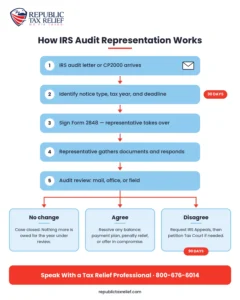
Only three kinds of tax professional have unlimited rights to represent you before the IRS: tax attorneys, certified public accountants (CPAs), and enrolled agents (EAs). Once you sign Form 2848, your audit representative can act on your behalf for the entire audit process.
Here is what IRS audit representation services usually include:
- Reviewing the audit letter and the return before anything goes to the IRS
- Preparing an organized document package that answers each request
- Attending meetings in your place, so the agent deals directly with your representative
- Challenging weak adjustments using tax law, court cases, and IRS guidance
- Negotiating penalties and preparing appeal arguments if needed
- Planning how to pay or resolve any final balance
When should you hire an IRS audit attorney instead of handling it alone? Consider a tax attorney when:
- The audit is an office or field audit
- You run a business or have payroll
- More than one tax year is involved
- The agent hints at fraud or asks about bank deposits you cannot explain
- You received a summons or a referral notice
An attorney also brings attorney-client privilege, which matters if there is any risk the case turns criminal. For business owners, our business IRS audit team handles field audits and full books reviews.
“Very strong and capable team. They knew exactly how to handle the IRS and protected my interests perfectly. I would give them more than 5 stars if I could.” — Liam Carter, Google Review ★★★★★
Takeaway: Facing the IRS alone saves a fee but often costs more in adjustments and penalties. The right representation tends to pay off when the stakes are real.
The IRS Audit Appeal Process
If you disagree with the auditor’s findings, you are not stuck with them. The IRS has an independent Office of Appeals, and IRS Publication 556 explains the steps.
- Examination report and 30-day letter. The agent sends proposed changes. You generally have 30 days to agree or request an appeal.
- Written protest. For larger amounts, your representative files a formal protest explaining the facts and the tax law.
- Appeals conference. An appeals officer, separate from the auditor, reviews the case and can settle based on the risks each side faces in court.
- Notice of deficiency (90-day letter). If there is no deal, the IRS issues this notice.
- Tax Court petition. You can petition the U.S. Tax Court within 90 days without paying the tax first.
If you agree with the result but cannot pay, the balance becomes tax debt. Options then include an IRS installment agreement, penalty abatement, or an offer in compromise. If you filed jointly and the issue came from your spouse, review innocent spouse relief.
Takeaway: Missing the 90-day Tax Court deadline cannot be undone. Track every date from the first letter.
Audit Mistakes to Avoid
These mistakes turn a small audit into a large tax problem:
- Ignoring the letter. The IRS assesses the tax anyway and moves to collections.
- Over-sharing. Handing over every file invites new questions.
- Making up records. Creating backdated receipts can turn a civil audit into a criminal case.
- Guessing on the phone. One wrong answer to an IRS agent becomes part of the record.
- Signing too fast. Agreeing to a report you do not understand can give up your appeal rights.
- Waiting to get help. A representative has the most options at the start of the audit.
Takeaway: Every audit is easier to defend early. Calm, organized, and represented beats fast and alone.
Your data is safe with us
- Confidentiality: Everything you share stays protected under strict attorney-client and tax professional privilege standards, seen only by the team handling your case.
- Document security: Your tax returns, SSN, and bank statements are protected with bank-grade 256-bit encryption, from upload to case closure.
- Bold and punchy: Your audit is private. Your documents are encrypted. Your case is handled by licensed professionals, not call centers.
Frequently Asked Questions About IRS Audit Representation
Is a Notice CP2000 the same as an IRS audit?
Not exactly. A CP2000 is an automated notice that your reported income does not match third-party records. It is not a formal examination, but it proposes additional tax and has a response deadline. Treat it as seriously as an audit.
Can my representative meet with the IRS without me?
Yes. Once you sign IRS Form 2848 (power of attorney), your attorney, CPA, or enrolled agent can speak with the IRS, attend meetings, and send documents for you. In most cases you do not need to attend unless the IRS issues a summons.
How long does an IRS audit take?
It depends on the type. Mail audits often wrap up in a few months. Office and field audits can take six months to more than a year, especially for a business owner with several tax years under review.
Should I hire a tax attorney, CPA, or enrolled agent for an audit?
All three can represent you before the IRS. A CPA or enrolled agent is often a strong fit for document-heavy audits. A tax attorney is the better choice if there is any fraud risk, a summons, or a chance the case goes to Tax Court, because of attorney-client privilege.
Can I appeal the results of an IRS audit?
Yes. You can request a review by the IRS Office of Appeals after the 30-day letter. If that fails, you can petition the U.S. Tax Court within 90 days of the notice of deficiency.
Do I need tax audit help near me, or can it be handled remotely?
Most audit work, including mail and office audits, can be handled remotely by a licensed representative. Field audits can often be moved to your representative’s office instead of your home or business.
What does audit representation cost?
Fees depend on the audit type, the number of tax years, and how complex your records are. A free consultation lets a professional review your letter and give you a clear quote before you commit.
Summary: Key Points on IRS Audit Representation
- An audit is a review, not an accusation. Many end with little or no change.
- Read the notice number, tax year, items, and deadline before doing anything else.
- Mail audits are narrow; office and field audits are broader and higher risk.
- Answer only what is asked, keep copies, and never guess.
- A licensed attorney, CPA, or enrolled agent can handle the entire audit for you.
- You have appeal rights, but the 30-day and 90-day deadlines are strict.
- Any balance after the audit can often be resolved through IRS relief programs.
Speak With a Tax Relief Professional
You do not have to face the IRS alone. Our licensed team reviews your audit letter, explains your options in plain English, and handles communication with the IRS so you can get back to work and family with peace of mind.
Call 800-676-6014 or request your free consultation today.
Everything you share is protected by strict client confidentiality and bank-grade 256-bit encryption.
About Republic Tax Relief: Republic Tax Relief helps individuals and businesses resolve IRS and state tax problems, including audits, back taxes, unfiled returns, liens, levies, wage garnishments, and payroll tax debt. Our licensed tax professionals represent clients directly with the IRS and state agencies. Learn more about our awards and recognition or call 800-676-6014.
This article is for general educational purposes and is not legal or tax advice for your specific situation. Results depend on individual facts.
Sources: