
From Newark and Jersey City to Toms River, Trenton, and Cherry Hill
New Jersey Tax Relief: Help With IRS Back Taxes, NJ State Tax Debt, and Protecting the Property Tax Relief You Count On, From ANCHOR to Stay NJ and Senior Freeze
New Jersey residents pay some of the highest property taxes in the country, and many cross a river every day to work in New York or Philadelphia. When an IRS bill or a Division of Taxation letter lands on top of all that, it can feel like the walls are closing in. We step between you and both agencies.
Commuters in Hoboken, contractors in Edison, restaurant owners in the Ironbound, and retirees down the Shore work with our team by phone, video, and secure upload. Nationwide reach, East Coast hours.
Federal and state balances, one team
W-2, 1099, sales tax, and payroll filers
In-house team since 2005
Spanish-speaking clients welcome
New Jersey is an expensive place to live, and the tax system adds up fast. You have federal income tax, one of the steepest state income tax structures in the nation at the top, sales tax, and property taxes that eat a big piece of every homeowner’s budget. Fall behind on one, and the others do not wait.
Republic Tax Relief helps individuals and business owners who owe the Internal Revenue Service, the New Jersey Division of Taxation, or both. Our licensed enrolled agents, CPAs, and tax attorneys work as one team from our California offices and represent clients in Newark and in every county in the Garden State, from Sussex to Cape May.
On This Page
- Why New Jersey Taxpayers Owe the IRS and the State
- NJ Property Tax Relief Programs: ANCHOR, Senior Freeze, and Stay NJ
- How Tax Debt Can Cost You Property Tax Relief
- A New Jersey IRS Case: The Lakewood Payroll Taxes
- NJ Division of Taxation Collections and Certificates of Debt
- Sales Tax, Payroll, and Bulk Sale Problems for NJ Businesses
- IRS vs. NJ Division of Taxation Compared
- IRS Tax Relief Options for New Jersey Residents
- Commuting to New York or Philadelphia: Multistate Tax Problems
- How Tax Resolution Works Without a Local Office
- IRS Tax Relief in Newark and Across New Jersey
- Expert Insight: DIY and AI Risks With IRS Problems
- Why New Jersey Taxpayers Choose Republic Tax Relief
- Frequently Asked Questions
- Contact Us for a Free Consultation
Why a New Jersey Taxpayer Ends Up Owing Both the IRS and the State
New Jersey’s gross income tax uses graduated rates, and the top bracket is among the highest anywhere in the country. The state return also starts from much of the same information as your federal return. So when the IRS changes your numbers, a New Jersey bill often shows up months later.
These are the patterns we see most in Jersey households:
- Commuter income in two or three states. Working in Manhattan or Philadelphia while living in New Jersey means more than one return, more than one withholding system, and plenty of room for a credit to go unclaimed or a payment to fall short.
- Two incomes, too little withholding. Each spouse’s job can withhold correctly on its own and still leave a balance when the incomes are combined.
- 1099 and side business income. Rideshare drivers, consultants, and online sellers get no withholding at all, then face federal tax, self-employment tax, and New Jersey tax together.
- Retirement withdrawals to cover property taxes or repairs. Pulling from an IRA or 401(k) can create a federal bill and, before age 59 and a half, the 10% early distribution tax.
- Unfiled tax returns after a job loss, a divorce, or a death in the family. Our unfiled tax returns service brings missing federal and New Jersey returns current and stops new penalties.
Not sure which years you owe or how much? Our back tax help confirms every federal and state balance before anyone makes a promise about your tax debt.
Jersey people don’t trust easily, and they shouldn’t have to. Your tax file is protected under attorney-client and tax professional privilege standards, and only your assigned licensed professionals ever see it.
NJ Property Tax Relief Programs: ANCHOR, Senior Freeze, Stay NJ, and Who Is Eligible
Property taxes are the bill New Jersey homeowners talk about most. The state runs three main property tax relief programs through the NJ Division of Taxation, and your local tax assessor handles a few smaller deductions. Here is a plain-English overview, so you know what you may be eligible for while we handle the tax debt side.
ANCHOR: relief for homeowners and renters
The Affordable New Jersey Communities for Homeowners and Renters program, known as ANCHOR, sends a benefit to residents who owned or rented their main home and meet certain income limits. Eligibility is tied to where you lived on October 1 of the benefit year. For the 2025 benefit year, the Division lists these amounts:
- Homeowners with 2025 income of $150,000 or less: $1,500. Income from $150,001 to $250,000: $1,000.
- Renters with income of $150,000 or less: $450, or $700 if 65 or older.
- Not eligible: homeowners over $250,000 and renters over $150,000.
Senior Freeze: property tax reimbursement for older and disabled homeowners
The Senior Freeze program, officially the Property Tax Reimbursement program, pays back increases in property taxes above your base year amount. To qualify for the 2025 benefit year, you (or your spouse) must have been 65 or older, or receiving Social Security disability benefits, by December 31, 2025. You must also have owned and lived in the home since at least the end of 2022.
Income limits apply to both years being compared: $168,268 or less for 2024 and $172,475 or less for 2025. Mobile home owners who lease a park site can also apply.
Stay NJ: up to half of a senior homeowner’s property tax bill
Stay NJ is the newest program. It is built for senior homeowners 65 and older with income up to $500,000. According to the Division of Taxation, the benefit equals 50% of the property taxes billed on your principal residence, counting taxes up to $13,000, for a maximum benefit of $6,500.
ANCHOR and Senior Freeze are figured first, and Stay NJ makes up the difference to reach half of your property tax bill. Combined benefits can never exceed the property taxes you actually paid on your main home.
One application: Form PAS-1
Seniors and disabled homeowners now file one single application, Form PAS-1, for all three programs. The online application opened February 4, 2026, and the deadline to file for the 2025 benefit year was November 2, 2026. The state expected Senior Freeze payments in July, ANCHOR payments in September, and Stay NJ payments to follow in installments (NJ Department of the Treasury: PAS-1 application).
| Program | Who it helps | Income limit (2025 benefit year) | Benefit |
|---|---|---|---|
| ANCHOR | Homeowners and renters | $250,000 owners; $150,000 renters | $450 to $1,500 |
| Senior Freeze | Homeowners 65+ or disabled | $172,475 | Reimburses increases over the base year |
| Stay NJ | Homeowners 65+ | $500,000 | Up to 50% of the bill, maximum $6,500 |
| Local deductions | Seniors, disabled residents, veterans | Varies | $250 deduction; full exemption for some disabled veterans |
Local deductions through your tax assessor
- $250 senior and disabled deduction. Homeowners who are 65 or older, or disabled, and meet the income guideline can file Form PTD with their municipal tax assessor. You must own and occupy the home by October 1 of the pretax year.
- $250 veteran deduction for eligible veterans, and a full property tax exemption for certain totally disabled veterans.
- Your state return. Homeowners and renters can also take a property tax deduction or credit on the New Jersey income tax return.
Simplified summary. Program amounts, income limits, and deadlines change each year and depend on the State Budget. Check with the Division of Taxation or your township tax assessor before you rely on any figure. Republic Tax Relief does not file PAS-1 applications; we resolve the IRS and state tax debt that can get in the way.
How Back Taxes Can Cost a NJ Resident Their Property Tax Relief Benefit and Their Home Equity
Here is the part most property tax guides leave out. Owing taxes can quietly shrink the relief you expected to receive, and it can put your home in the middle of a collection fight.
- Your benefit payment can be taken. New Jersey’s Set-Off of Individual Liability program, called SOIL, can withhold state income tax refunds and property tax relief payments to cover debts owed for New Jersey taxes and to other government agencies. You get a notice and roughly 35 days to contact the agency that claimed the debt.
- A Certificate of Debt sits on your home. A state tax judgment attaches to real estate and can hold up a sale or refinance until it is paid or released.
- A federal tax lien can follow. The IRS can file a Notice of Federal Tax Lien in your county, which shows up when you try to sell or borrow against the house.
- Unpaid property taxes are their own emergency. If you skipped the property tax bill to keep up with the IRS, your municipality can sell a tax sale certificate on your home. That is a lien held by an investor who earns interest and can eventually seek to foreclose.
The good news: the IRS counts property taxes as a necessary living expense when it figures what you can afford. A well-built case can keep your home taxes paid and still set up a realistic plan for the federal balance. See our tax lien help for how liens are released, withdrawn, or subordinated.
A Real New Jersey IRS Case: The Lakewood Owner Who Paid Everyone but the IRS
Most tax debt is a money problem, not a crime. But payroll taxes are different, because that money belongs to employees and the government from the moment it is withheld. This Ocean County case shows how fast it escalates.
The case: A Lakewood businessman ran a company that provided administrative services to nursing homes and other health care facilities he co-owned. Over two years, he knew payroll taxes were due but kept paying other expenses and salaries instead, leaving more than $10 million unpaid to the IRS.
The outcome: A federal judge in Trenton sentenced him to 30 months in prison, followed by two years of supervised release, and ordered $11.2 million in restitution (U.S. Attorney’s Office, District of New Jersey).
The lesson: Using withheld payroll taxes to keep a business afloat is the single most dangerous choice an owner can make. If your company is behind on deposits, talk to a licensed professional now, while the problem is still civil and still solvable.
Behind on payroll deposits? Start with our payroll tax debt relief page, and read our payroll tax debt insights.
NJ Division of Taxation Collections: Certificates of Debt, Bank Levies, and Offsets
Many people fix the IRS side and let the state bill sit. In New Jersey, that is a mistake. The Division of Taxation in Trenton does not need to go to trial to collect; it files a Certificate of Debt in Superior Court, and that certificate has the same force as a docketed judgment (NJ Division of Taxation: Judgments).
| NJ collection tool | What it means for you |
|---|---|
| Certificate of Debt | A public judgment that acts as a lien on your property and shows up in credit and title searches. |
| Bank levy | After the judgment, the state can use a warrant of execution to order your bank to turn over funds. |
| Vehicle enforcement | The Division coordinates with the Motor Vehicle Commission on liens against vehicles. |
| SOIL offset | State refunds and relief benefit payments can be withheld and applied to the debt. |
| Wage garnishment | Part of each paycheck can go toward the judgment before you see it. |
New Jersey payment plans and settlements
The Division offers deferred payment plans, and judgments can be released or subordinated in some hardship situations, such as a refinance. Interest keeps running while you pay, and missing a new return can undo the plan. Settling a New Jersey tax debt for less is uncommon and reviewed case by case, so an IRS settlement never guarantees a state one.
See how we handle bank levy help, wage garnishment relief, and IRS collections defense.
Sales Tax, Payroll, and Bulk Sale Problems: Business Tax Help for NJ Owners
New Jersey business owners juggle more filings than most. Federal payroll deposits, state withholding, unemployment and disability contributions, and sales tax all run on separate schedules. One slow quarter can put all of them behind at once.
- Sales tax collected but not sent. Sales tax is trust money, just like payroll withholding. The state can hold owners and responsible officers personally liable.
- Federal payroll tax deposits. Missed deposits can lead to the Trust Fund Recovery Penalty against owners personally, as the Lakewood case shows at its worst.
- Selling or closing a business. New Jersey’s bulk sale rules require notice to the Division, on Form C-9600, at least 10 business days before most business asset sales. Skip it, and the buyer can be held responsible for your state taxes, which can kill a deal.
- Tax clearance for contracts and incentives. Businesses seeking state contracts, grants, or incentives often need a tax clearance certificate. An open balance can block the very work you need to pay the IRS.
- Urban Enterprise Zones. Some Newark, Elizabeth, Paterson, and Camden businesses collect a reduced sales tax rate. Charging the wrong rate is a common audit finding.
The New Jersey businesses we help most often include:
- General contractors and trades. See construction tax resolution.
- Diners, pizzerias, and restaurants. Read our restaurant tax resolution insights.
- Medical, dental, and home health practices. See tax resolution for medical professionals.
- Real estate agents, landlords, and investors. See real estate tax resolution.
- Online sellers and warehouse operators near the Turnpike. See e-commerce tax resolution.
Explore our business audit help, business tax resolution services, small business tax relief, and business tax debt relief.
No drive to Trenton with a folder of paperwork. Your returns, Social Security number, and bank statements reach us through bank-grade 256-bit encryption that meets federal data protection standards.
IRS vs. NJ Division of Taxation: How Federal and State Tax Problems Compare
If you owe both agencies, the rules are not the same. A plan that satisfies the IRS can still leave New Jersey collecting, and the reverse.
| Question | IRS (federal tax) | NJ Division of Taxation |
|---|---|---|
| Power of attorney | Form 2848 | Form M-5008-R |
| Lien | Notice of Federal Tax Lien | Certificate of Debt filed in Superior Court |
| Before a levy | Final notice with 30 days to request a hearing | Judgment, then warrant of execution |
| Refund and benefit offsets | Federal refunds applied to balances | SOIL can take state refunds and property tax relief payments |
| Paying over time | Installment agreement | Deferred payment plan |
| Settling for less | Offer in compromise based on ability to pay | Uncommon, case by case |
| Hardship pause | Currently Not Collectible status | Case by case |
IRS Tax Relief Options for New Jersey Residents: Payment Plans, Offers, CNC, and Penalty Relief
The right option depends on your income, allowable living expenses, home equity, and how much time is left on the collection clock. Here is how the main federal programs fit Jersey households.
| Relief option | What it does | Often fits |
|---|---|---|
| IRS payment plan | Monthly installments while levies are held off | Steady paychecks that cannot cover the balance at once |
| Offer in compromise | Settles IRS debt for less based on ability to pay | Low income and low equity compared with what you owe |
| Currently Not Collectible | Pauses collection during financial hardship | Seniors on fixed income or workers between jobs |
| Penalty relief | Removes penalties for a clean history or reasonable cause | A serious illness, a death in the family, or storm damage |
| Innocent spouse relief | Separates you from a spouse’s tax debt | Errors or hidden income caused by a current or former spouse |
High property taxes cut both ways
The IRS uses national and local expense standards when it reviews what you can pay. North Jersey housing costs, including property taxes, are among the highest allowed, which can help keep a payment plan realistic. But home equity in Bergen, Morris, and Monmouth counties is often high, and the IRS counts it when you ask to settle for less. Learn how the OIC program works.
Penalty relief can shrink the bill quickly
A first-time abatement can remove IRS penalties for one year if your record is otherwise clean. Others may qualify for reasonable cause relief. Because penalties and interest can make up a big share of the total, this is one of the first places we look.
For the bigger picture, see our tax debt relief options, IRS payment plans, Currently Not Collectible status, IRS penalty abatement, innocent spouse relief, and the truth about the IRS Fresh Start Program.
Commuting to New York or Philadelphia: Multistate Tax Problems for New Jersey Residents
New Jersey sits between two big job markets, and hundreds of thousands of residents cross a state line to work. That makes multistate tax mistakes one of the most common reasons Jersey families owe.
New York commuters
You file a New York nonresident return and claim a credit on your New Jersey return. New York’s “convenience of the employer” rule can tax remote days worked from home, and a missed credit leaves a balance.
Pennsylvania and Philadelphia
New Jersey and Pennsylvania have a reciprocal agreement for wages, but Philadelphia’s city wage tax still applies to many South Jersey commuters who work in the city.
Moving out of state
Retiring to Florida or the Carolinas does not end a New Jersey balance, and IRS mail sent to an old address can mean a missed final levy notice.
Explore our state guides for New York, Connecticut, Maryland, Florida, and North Carolina.
How Our Tax Resolution Services Work for New Jersey Residents Without a Local Office
We want to be upfront: we do not have an office in New Jersey. Our team works from our offices in Corona, California and Laguna Hills, California, with calls scheduled around Eastern time.
The IRS handles nearly all cases by phone, mail, and secure online systems, and it works with authorized representatives from any state. Once you sign the forms, we contact the IRS and the NJ Division of Taxation for you. No more lunch breaks spent on hold.
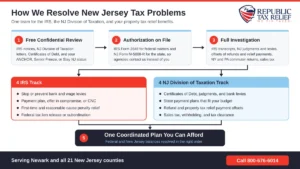
What happens after you call
- Free confidential consultation. A short call about your letters, your property tax situation, and your monthly budget.
- Authorization on file. We file IRS Form 2848 so the IRS contacts us instead of you, plus New Jersey Form M-5008-R for state matters.
- Full investigation. We pull IRS transcripts, check for Certificates of Debt and offsets, and review any New York or Pennsylvania returns that affect your New Jersey balance.
- Protection first. Where the law allows, we act to stop the IRS and the state from levying while we build your case.
- One coordinated plan. We negotiate in the right order and explain every option in plain English.
| Common concern | How we handle it |
|---|---|
| “My ANCHOR or Senior Freeze payment never came.” | We check whether a tax debt triggered an offset and work to resolve the balance behind it. |
| “The IRS and New Jersey both want monthly payments.” | We build both plans from one household budget that keeps your property taxes paid. |
| “I’m selling my house and a judgment showed up.” | We get payoff figures, request releases or subordination where allowed, and keep the closing on track. |
| “Can a California firm really help me in New Jersey?” | Yes. Federal representation works the same in every state, and we handle New Jersey matters under written authority. |
IRS Tax Relief in Newark and Across New Jersey
A commuter in Jersey City, a landlord in Paterson, and a retiree in Toms River face very different IRS problems. We start with Newark, then cover every region of the state.
Focus City: Newark and Essex County
Newark is New Jersey’s largest city and the home of the federal courthouse for northern New Jersey. Port Newark, the airport, the hospitals, and the universities employ thousands, and the city’s small business owners keep entire neighborhoods running. Each part of the city brings its own tax issues.
Restaurant owners, cash businesses, and sales tax filers.
Homeowners, two-family landlords, and multigenerational households.
Working families, 1099 drivers, and seniors on fixed income.
Commuters, professionals, and small business owners.
Regions and Cities We Serve Across New Jersey
Hudson County and the Gold Coast
Cities: Jersey City, Hoboken, Bayonne, Union City, West New York
Wall Street commuters, remote workers, and condo owners.
Bergen, Passaic, and Morris
Cities: Paterson, Clifton, Hackensack, Fort Lee, Wayne, Morristown
Business owners, high-equity homeowners, and retirees.
Union and Middlesex
Cities: Elizabeth, Edison, Woodbridge, New Brunswick, Perth Amboy
Logistics workers, contractors, and family-owned shops.
Mercer and Somerset
Cities: Trenton, Hamilton, Princeton, Ewing, Bridgewater
State employees, researchers, and Philadelphia commuters.
The Jersey Shore
Cities: Toms River, Lakewood, Brick, Asbury Park, Atlantic City, Ocean City
Seasonal businesses, casino and hospitality workers, and senior homeowners.
South Jersey
Cities: Camden, Cherry Hill, Vineland, Mount Laurel, Glassboro
Philadelphia commuters, farmers, and small manufacturers.
Don’t see your town? We help taxpayers in all 21 New Jersey counties, from High Point to Cape May Point. Call 800-676-6014 and we will tell you right away whether we can help. You can also browse all of our service locations.
Expert Insight: The Risks of Handling New Jersey IRS Problems Alone or With AI
New Jerseyans are direct, and many want to handle things themselves. We respect that. But self-managed tax cases tend to go wrong in a few predictable ways, and some mistakes cannot be undone.
- Treating the state as an afterthought. People settle up with the IRS and assume New Jersey will follow. Then a Certificate of Debt appears on a title search the week of closing.
- Missing the offset notice. A SOIL notice gives a short window to dispute a debt. Ignore it, and a refund or relief payment you planned around is gone.
- Paying the IRS with property tax money. Skipping the township bill to make an IRS payment trades one lien for another, and tax sale certificates carry steep interest.
- Mixing up three states’ rules. Commuters who amend a New Jersey return without fixing the New York or Pennsylvania side often make the balance bigger, not smaller.
- Trusting AI on New Jersey rules. Chatbots confuse ANCHOR with the old Homestead Benefit, invent “NJ tax forgiveness programs,” or give last year’s income limits as current. A confident wrong answer leads to a costly decision.
- Pasting private data into public tools. Uploading returns, bank statements, or your Social Security number to a free chatbot creates a privacy risk you cannot take back. AI also cannot sign a power of attorney, pull transcripts, or talk to a revenue officer.
Our take: AI is fine for learning what a term means. A licensed enrolled agent, CPA, or tax attorney should make the decisions and give the advice. We explain why in Can AI get a better settlement than a tax attorney?
Want to learn more first? Read our common IRS notices guide, tax negotiation insights, and complete guide to tax resolution services.
Why New Jersey Taxpayers Choose Republic Tax Relief
Hiring help with tax debt is a trust decision. Since 2005, founding partner Mark Ladd and our in-house team of enrolled agents, CPAs, and tax attorneys have helped individuals and businesses resolve IRS and state tax problems. We work every case ourselves, with no outsourcing.
| Cases resolved | 18,000+ |
| Client balances settled | $220M+ |
| Average client rating | 4.9 / 5 |
| Credentials | Enrolled agents, CPAs, and tax attorneys |
| Scheduling | Eastern time morning, lunch, and evening call windows |
| Languages | English and Spanish |
- Federal and New Jersey handled together. One team, one budget, one plan for every agency.
- Property-tax aware budgeting. We build plans that keep your township bill paid and your relief benefits protected.
- Multistate commuter experience. New York and Pennsylvania returns are part of our everyday work.
- Business owner focus. Sales tax, payroll, and bulk sale issues shape how we sequence a case.
- Honest answers. If a settlement is not realistic, we say so and show you a better path.
- Recognized work. See our awards and recognition.
Results vary based on each taxpayer’s facts and finances. Past results do not guarantee a similar outcome.
Your secrets stay sealed. Your files stay encrypted. Period.
New Jersey Tax Relief Frequently Asked Questions
Can you help me if you don’t have an office in New Jersey?
Yes. IRS cases are handled by phone, mail, and secure online systems, and we represent you under a signed power of attorney. Our team works from California and serves clients in Newark and all 21 New Jersey counties.
Can New Jersey take my ANCHOR or other property tax relief payment for back taxes?
It can. New Jersey’s Set-Off of Individual Liability program can withhold state income tax refunds and property tax relief payments to cover debts owed for New Jersey taxes and to other government agencies. You receive a notice and a short window to contact the agency that claimed the debt.
Do you file the PAS-1 or ANCHOR application for me?
No. Property tax relief applications go directly to the NJ Division of Taxation, and your tax assessor handles local deductions. We resolve the IRS and state tax debt that can reduce or block those benefits.
What is a Certificate of Debt in New Jersey?
It is a filing the Division of Taxation makes in Superior Court to secure unpaid state tax. It has the same force as a docketed judgment, acts as a lien on your property, and allows bank levies and other collection.
I work in New York. Why do I owe New Jersey?
New Jersey taxes residents on all their income and gives a credit for tax paid to New York. If the credit is figured wrong, your New York withholding falls short, or remote days are taxed differently than you expected, a New Jersey balance can result.
Can you handle my New Jersey state tax debt and my IRS debt together?
Yes. We review both balances, build one household budget that keeps your property taxes paid, and negotiate with the IRS and the NJ Division of Taxation in the right order so the two plans fit together.
Does the IRS count my property taxes when setting a payment plan?
Yes. The IRS treats housing costs, including property taxes, as necessary living expenses. That can keep a payment plan affordable, though home equity also counts when you ask to settle for less.
Can the IRS take my wages or bank account in New Jersey?
Yes. After the required notices, including a final notice of intent to levy, the IRS can levy wages, bank accounts, and other assets. Acting before that final notice expires keeps the most options open, including the right to a hearing.
What should I bring to my free consultation?
Any IRS or New Jersey letters, your latest tax return if you have one, any New York or Pennsylvania returns, and a rough idea of your monthly income and bills, including your property tax bill. If records are missing, we can request IRS transcripts for you.
More answers: tax relief questions, IRS collections defense questions, IRS payment plan questions, and business tax debt questions.
Sources
- NJ Department of the Treasury: PAS-1 Property Tax Relief Application
- NJ Division of Taxation: Judgments and Certificates of Debt
- U.S. Attorney’s Office, District of New Jersey: Ocean County Businessman Sentenced for Failing to Pay Payroll Taxes
Republic Tax Relief is a private firm and is not affiliated with the IRS, the NJ Division of Taxation, or any New Jersey county or municipality. This page offers general guidance, not legal or tax advice for your specific situation. Tax laws, program amounts, and agency procedures change, so consult a qualified tax professional or contact the agency directly before acting.
Free Consultation: Speak With a Tax Relief Professional About Your New Jersey Tax Debt
You already pay enough to live in New Jersey. Don’t let tax debt take the rest.
Whether the letter came from the IRS, the NJ Division of Taxation, or New York, a short call can show you where you stand, what is at risk, and which options fit. Your consultation is free and confidential.
About Republic Tax Relief
Republic Tax Relief helps individuals and businesses nationwide resolve IRS and state tax problems, including back taxes, levies, liens, unfiled returns, audits, and payroll tax debt. Since 2005, our in-house team of enrolled agents, CPAs, and tax attorneys has resolved more than 18,000 cases. From our offices in Corona and Laguna Hills, California, we represent clients in all 50 states, including New Jersey. Call 800-676-6014 or contact us online for a free, confidential consultation.