
Oct
Falling behind on payroll deposits usually starts with a hard choice. Payroll is due, a supplier wants payment, and the Form 941 deposit gets pushed to “next week.” A few quarters later, the balance has penalties stacked on top, and an IRS revenue officer is asking who signs the checks.
Here is what most owners don’t realize until it’s late: payroll tax debt is the one kind of business tax balance the IRS can move from your company to you personally. That makes timing everything. This guide explains why unpaid payroll taxes are treated differently, how the IRS collection process unfolds, what relief options exist, and when to bring in a professional.
Why the IRS Treats Payroll Taxes Differently
When you run payroll, part of what you owe the IRS isn’t really your money. You hold it in trust for your employees. These are called trust fund taxes, and they include:
- Federal income tax withheld from employee paychecks
- The employee’s share of Social Security and Medicare (FICA)
Your employer share of FICA and federal unemployment tax (FUTA) are business taxes, but they are not trust fund money. That difference matters. The IRS views a business that keeps employee withholding as using money that belongs to the government, which is why it collects these balances more aggressively than most business tax liabilities.
Penalties Build Faster Than Most Owners Expect
Late deposits trigger the failure to deposit penalty, which climbs based on how late the money arrives. According to the IRS failure to deposit penalty guidance, the rates work like this:
| How late the deposit is | Penalty on the unpaid deposit |
|---|---|
| 1 to 5 calendar days | 2% |
| 6 to 15 calendar days | 5% |
| More than 15 calendar days | 10% |
| Still unpaid more than 10 days after the first IRS notice | 15% |
Failure-to-file and failure-to-pay penalties, plus daily interest, can be added on top. Practical takeaway: a $30,000 missed quarter can grow by several thousand dollars before you receive your first letter.
How IRS Payroll Tax Collection Escalates
Delinquent payroll taxes rarely stay with the automated notice system for long. Larger or repeat balances are often assigned to an IRS revenue officer, a field agent who can visit your business, request financial records, and take enforcement action. Here is the typical path:
- Balance-due notices: The IRS mails letters for each unpaid quarter.
- Revenue officer assignment: An agent contacts you, often by phone or an unannounced visit, and asks for a financial statement (Form 433-B).
- IRS tax lien: A Notice of Federal Tax Lien may be filed, which can affect business credit, loans, and vendor relationships. See our tax lien help page for how liens are released.
- Final Notice of Intent to Levy: You generally have 30 days to request a Collection Due Process hearing. Missing this window gives up valuable appeal rights.
- IRS levy: The IRS can seize business bank accounts, intercept payments owed to you by customers (accounts receivable), and take other assets.
Example: A general contractor owes three quarters of Form 941 taxes. After ignoring two letters, the revenue officer issues levies to his two largest clients. Overnight, the invoices he was counting on go to the IRS instead of his bank account. Many of these levies are avoidable with an early response. Our IRS collections defense guide covers the levy process in detail.
The Trust Fund Recovery Penalty and Personal Liability
The Trust Fund Recovery Penalty (TFRP) is how the IRS reaches past your business entity. Even if you operate as an LLC or corporation, the IRS can assess 100% of the unpaid trust fund taxes against any responsible person who willfully failed to pay them. The IRS explains the TFRP as applying to anyone with the duty and authority to collect, account for, and pay these taxes.
Who Can Be a “Responsible Person”?
- Owners, officers, and directors
- Bookkeepers or office managers with check-signing authority
- Partners or managers who decide which bills get paid
“Willful” does not mean you meant to cheat. It can simply mean you knew the taxes were owed and paid other creditors instead. That is why the hard choice described at the top of this page is so risky.
What the Process Looks Like
- Interview: The revenue officer may interview you using Form 4180 to decide who is responsible. What you say here shapes the outcome.
- Proposed assessment: The IRS sends Letter 1153. You generally have 60 days to appeal.
- Personal collection: Once assessed, the penalty becomes your personal debt. Liens, bank levies, and wage garnishment can follow.
Practical takeaway: Get professional representation before the Form 4180 interview, not after Letter 1153 arrives. Your business owner payroll tax liability can often be limited, shared correctly, or challenged, but only if you act inside the deadlines.
Payroll Tax Relief Options Compared
Every option has the same starting rule: the business generally must be current on new deposits and filings. The IRS will not agree to a plan for old quarters while new ones keep going unpaid. If returns are missing, see our guide on unfiled tax returns.
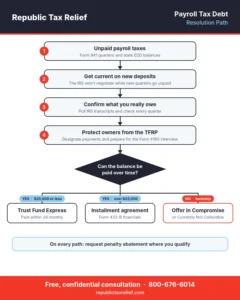
| Option | Often a fit when | Key requirement |
|---|---|---|
| In-Business Trust Fund Express payment plan | An operating business owes $25,000 or less | Paid in full within 24 months; direct debit required for balances over $10,000 |
| Standard payroll tax installment agreement | The balance is larger or the business needs more time | Full financial disclosure on Form 433-B |
| Offer in Compromise | The business or owner truly cannot pay the full amount | Strict ability-to-pay review; accepted less often for operating businesses |
| Currently Not Collectible | The business has closed, or an owner with a TFRP has no ability to pay | Documented financial hardship; interest still accrues |
| Penalty abatement | Penalties make up a large share of the balance | First-time abatement history or reasonable cause |
The IRS In-Business Trust Fund Express rules also allow a business that owes more than $25,000 to pay the balance down first and then qualify.
A Strategy Many Owners Miss: Designating Payments
When you make a voluntary payment, you can usually tell the IRS to apply it to the trust fund portion of the balance. If you don’t, the IRS applies it in the way that benefits the government. Directing payments to trust fund taxes first can shrink the amount that could be assessed against you personally.
Example: A medical practice owes $60,000 in back payroll taxes, about $40,000 of which is trust fund money. By designating payments and settling into a structured plan, the owners reduce their personal TFRP exposure while the practice keeps operating. For a step-by-step look at these programs, read our full guide to payroll tax debt relief.
California EDD Payroll Tax Problems
California employers face a second agency. The Employment Development Department (EDD) collects state income tax withholding, State Disability Insurance (SDI), unemployment insurance, and Employment Training Tax. Like the IRS, the EDD can hold responsible individuals personally liable for unpaid withholdings, file liens, and levy bank accounts.
- EDD and IRS balances are negotiated separately. A federal agreement does not stop state collection.
- State levies can arrive with little warning. Our bank levy help page explains how California levies are handled.
- A professional can coordinate both agencies so one plan doesn’t drain the cash needed for the other.
Practical takeaway: If you owe both the IRS and the EDD, plan for both at once. Budgeting for only the federal side is one of the most common reasons payment plans fail.
When to Hire a Payroll Tax Professional
Some small balances can be handled with a single phone call. Payroll tax problems usually aren’t that simple, because your business and your personal finances are both on the line. Consider professional help if any of these apply:
- A revenue officer has contacted you or visited your business
- You received Letter 1153 or were asked to schedule a Form 4180 interview
- You owe more than $25,000, or multiple quarters are unpaid
- A lien, levy, or Final Notice of Intent to Levy has been issued
- You owe both federal and California payroll taxes
What a Tax Resolution Professional Does
- Files a power of attorney so the IRS and EDD contact your representative, not you
- Pulls your account transcripts to confirm what is actually owed
- Prepares accurate financial statements that support the right resolution
- Prepares you for, or attends, the TFRP interview
- Negotiates a payroll tax settlement, payment plan, or penalty relief
At Republic Tax Relief, every case is handled in house by enrolled agents, tax attorneys, and CPAs. We have served businesses since 2005, including construction companies, medical practices, and small businesses across many industries. You can see our awards and recognition here.
“I appreciate the transparency and dedication shown by Republic Tax Relief. They took time to understand my situation and offered real solution.”
— James Wilson, Google Review ★★★★★
Your information stays protected. We follow strict tax client confidentiality standards and secure every uploaded document with bank-grade 256-bit encryption, so you can share returns and statements with total peace of mind.
Payroll Tax Questions Owners Ask
Can payroll tax debt be forgiven?
Full forgiveness is uncommon, but some balances can be reduced. An Offer in Compromise may settle the debt for less if you can prove you cannot pay in full, and penalty abatement can remove some penalties. Approval depends on your finances and filing history.
Can payroll tax debt be reduced?
Often, yes. Penalties can make up a large share of the balance, and first-time abatement or reasonable cause relief may remove them. Reviewing IRS transcripts also sometimes uncovers misapplied payments or errors.
Am I personally liable for my business’s unpaid payroll taxes?
You may be. Through the Trust Fund Recovery Penalty, the IRS can hold any responsible person personally liable for 100% of unpaid trust fund taxes, even if the business is an LLC or corporation. Employer-share taxes are generally not part of this penalty.
What happens if I close my business while owing payroll taxes?
Closing the business does not erase the trust fund portion. The IRS can still assess the TFRP against responsible individuals and collect from personal assets. Getting help before closing can protect your options.
Can my business get an IRS payment plan for payroll taxes?
Yes, if the business is current on new deposits and filings. Businesses owing $25,000 or less may qualify for an In-Business Trust Fund Express agreement, while larger balances usually require a full financial statement.
How long does the IRS have to collect unpaid payroll taxes?
The IRS generally has 10 years from the date a tax is assessed to collect it. Certain events, such as an Offer in Compromise or an appeal, can pause that clock.
Key Takeaways
- Withheld employee taxes are trust fund money, and the IRS collects them aggressively.
- Failure to deposit penalties can reach 15%, plus interest and other penalties.
- The Trust Fund Recovery Penalty can make owners and other responsible people personally liable.
- Payment plans, Offers in Compromise, Currently Not Collectible status, and penalty abatement are all possible paths, depending on your situation.
- Acting before the TFRP interview and the 30-day levy deadline gives you the most options.
Unpaid payroll taxes are serious, but they are solvable when you move early and follow a clear plan. The longer it waits, the more likely it becomes a personal problem instead of a business one.
Speak With a Tax Relief Professional
If a revenue officer is calling, a levy notice just arrived, or you simply know the quarters are piling up, you don’t have to handle it alone. Our team will review your situation, explain your options in plain language, and help you protect both your business and your personal finances.
Request your free, confidential consultation or call 800-676-6014 today.
About Republic Tax Relief
Republic Tax Relief helps individuals and businesses resolve IRS and state tax debt, stop collections, and get back on solid ground. Since 2005, our in-house team of enrolled agents, tax attorneys, and CPAs has handled payroll tax problems, liens, levies, wage garnishments, and settlement negotiations with care and confidentiality. Call 800-676-6014 or contact us for a free consultation.
This article is for general educational purposes and is not legal or tax advice for your specific situation. Results vary based on individual circumstances.