
Oct
An envelope from the Internal Revenue Service lands on your desk, and the word “examination” jumps off the page. Your stomach drops. Was it something on last year’s return? Did a competitor report you? Is your business in trouble?
Take a breath. An audit is a review, not an accusation. Most business IRS audits come down to a question about specific numbers on your tax return, and many end with small changes or none at all. This guide explains why businesses get selected, which red flags draw attention, what the process looks like step by step, and when professional IRS audit representation makes the biggest difference.
Table of Contents
- How the IRS Selects Businesses for Audit
- Common IRS Audit Triggers for Businesses
- Types of IRS Business Audits
- What Happens During a Business Tax Audit
- How to Lower Your Small Business Audit Risk
- Why Business IRS Audit Help Matters
- Business IRS Audit FAQs
How the IRS Selects Businesses for Audit
Many owners ask, “Why did the IRS audit my business?” The honest answer is that IRS audit selection is mostly driven by data, not by someone picking your name out of a hat. According to the IRS, returns are chosen through a few main methods (IRS: IRS Audits):
- Computer screening. The IRS scores returns against statistical norms for similar businesses. Returns that look unusual compared to peers get a closer look from an IRS examiner.
- Data matching. Third-party information, such as 1099 forms, W-2 forms, and payment processor reports, is compared against the business income you reported.
- Related examinations. If a partner, investor, or business you deal with is audited, your return can be pulled in too.
- Random selection. A small share of returns are chosen at random to keep the scoring models accurate.
Example: A landscaping company reports $410,000 in gross receipts on its Schedule C. Its 1099-NEC and 1099-K forms add up to $465,000. That $55,000 gap is the kind of mismatch that flags a return automatically, even if the difference has a simple explanation.
Takeaway: Being selected does not mean the IRS believes you committed fraud. It means something on your return stood out and the agency wants supporting records.
Common IRS Audit Triggers for Businesses
No one outside the IRS knows the exact formula. But tax professionals see the same patterns again and again. Here are the business tax audit triggers that come up most often.
Income That Doesn’t Match Third-Party Records
Income matching is one of the most reliable ways the IRS finds problems. If customers, banks, or platforms report paying you more than you reported, expect questions. E-commerce sellers and gig-based businesses see this often. If that sounds like your business, our page on tax resolution for e-commerce businesses covers industry-specific issues.
Deductions That Look High for Your Industry
Business expenses that are far above average for your size and industry stand out. Vehicle use, meals, travel, and home office deductions get extra scrutiny because they mix business and personal spending.
Repeated Losses
A business that reports losses year after year, especially alongside a W-2 job, may raise questions about whether it’s a real business or a hobby.
Cash-Heavy Operations
Restaurants, salons, car washes, and contractors handle a lot of cash. Because cash is harder to trace, these businesses face more scrutiny. See our guide on construction tax resolution for contractor-specific concerns.
Payroll and Worker Classification Issues
Late or missing Form 941 filings, or paying workers as contractors when they act like employees, can lead to an employment tax examination. If payroll taxes are already behind, read about payroll tax debt relief.
| Common Trigger | Why It Draws Attention | What Helps |
|---|---|---|
| Unreported 1099 or 1099-K income | Automatic data mismatch | Reconcile third-party forms to your books before filing |
| High expense ratios | Falls outside industry norms | Keep receipts, invoices, and a written business purpose |
| Multiple years of losses | Hobby-loss questions | Show a business plan and profit-seeking activity |
| Round numbers | Suggests estimates, not records | Report actual figures from accounting records |
| Contractor-heavy payroll | Possible misclassification | Document contracts and how workers operate |
Types of IRS Business Audits
Not every IRS examination means an agent showing up at your office. The audit notice will tell you which kind you’re facing.
- Correspondence audit: Handled by mail. The IRS asks for documents about one or two items. These are the most common and usually the narrowest.
- Office audit: You or your representative meet with an IRS auditor at a local IRS office. These tend to cover several issues.
- Field audit: A revenue agent visits your business. Field audits are usually broader and more common for larger businesses or those filing Form 1120, Form 1120-S, or Form 1065.
Takeaway: The broader the audit, the more valuable it is to have a tax professional control the flow of information, so you answer what’s asked without opening new issues.
What Happens During a Business Tax Audit
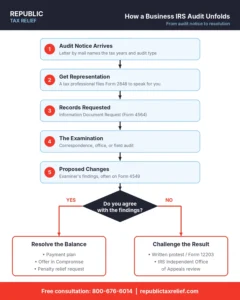
Every case is different, but most business audits follow a similar path:
- The notice arrives. The IRS contacts you by mail first. It names the tax years and the items under review. Be wary of phone calls or emails claiming to be the IRS without a prior letter.
- You get representation. A CPA, enrolled agent, or tax attorney files Form 2848 (power of attorney) so they can speak with the IRS for you.
- Records are requested. The examiner sends an Information Document Request, often on Form 4564, listing bank statements, invoices, receipts, and bookkeeping records they want.
- The examination takes place. The examiner reviews documents and may ask questions about your business operations.
- Proposed changes are issued. If the examiner finds additional tax, penalties, or interest, you’ll usually receive a report such as Form 4549.
- You agree or disagree. If you disagree, you can request review by the IRS Independent Office of Appeals. Smaller disputes may use Form 12203; larger ones generally require a formal written protest (IRS Publication 556).
Example: A medical practice was told it owed $38,000 after the examiner disallowed equipment deductions. Its representative produced lease agreements and depreciation schedules the owner hadn’t realized were relevant, and the proposed tax assessment dropped sharply. Results vary, but organized documentation changes outcomes. Medical practices can learn more on our tax resolution for medical professionals page.
How to Lower Your Small Business Audit Risk
You can’t make audit risk zero, but strong recordkeeping makes an IRS audit for small business owners far less painful.
- Reconcile monthly. Match bank statements to your accounting records every month, not just at tax time.
- Keep personal and business money separate. One business account and one business card make every transaction easier to defend.
- Document the “why.” Note who attended a business meal and what was discussed. Keep mileage logs.
- Save records long enough. The IRS generally has three years to audit a return, six years if income was understated by more than 25%, and no limit if a return was never filed or was fraudulent. Employment tax records should be kept at least four years.
- File on time. Missing returns invite attention. If you’re behind, see our guide to unfiled tax returns.
Why Business IRS Audit Help Matters
You have the legal right to be represented. The Taxpayer Bill of Rights includes the right to retain an authorized representative and the right to challenge the IRS’s position (IRS: Taxpayer Bill of Rights). Here’s what a qualified tax representative does in practice:
- Takes over communication so you’re not answering an IRS examiner’s questions on the spot.
- Reviews requests and organizes records before anything goes to the IRS.
- Pushes back on proposed changes that aren’t supported by the facts or the law.
- Handles Appeals or audit reconsideration if the result is wrong.
- Plans the next step if the audit creates a balance you can’t pay right away.
That last point matters. An audit that ends with additional tax can quickly become a collections problem. Depending on your situation, options may include an IRS payment plan, an Offer in Compromise, or IRS penalty abatement. If the IRS has already moved to collect, our IRS collections defense team can step in.
For a full look at how we defend businesses during an examination, visit our business IRS audits service page.
“Big shout out to Ryan and Chris! They helped me file all back taxes and settled all my debt!”
— Jacob Hernandez, Google Review
Business IRS Audit FAQs
What triggers an IRS audit for a business?
The most common triggers are income that doesn’t match 1099 or 1099-K records, expenses that are high for your industry, repeated losses, cash-heavy operations, and payroll or worker classification issues. Some returns are also selected at random or because a related party was audited.
How far back can the IRS audit my business?
Generally three years from the date you filed. That extends to six years if income was understated by more than 25%, and there’s no time limit for fraud or for returns that were never filed.
Do I have to meet with the IRS auditor myself?
In most cases, no. Once you sign Form 2848, a CPA, enrolled agent, or tax attorney can represent you and attend meetings in your place, unless the IRS issues a summons requiring you personally.
What if I disagree with the audit results?
You can request a conference with the IRS Independent Office of Appeals, an office separate from the examiner. If new documents surface after the audit closes, you may also request audit reconsideration.
What happens if I can’t pay what the audit says I owe?
You still have options. Depending on your finances, you may qualify for an installment agreement, an Offer in Compromise, penalty relief, or Currently Not Collectible status. A tax professional can help you choose before collection action starts.
Summary
- Most businesses are selected through computer scoring, data matching, or related audits, not because the IRS suspects fraud.
- Mismatched income, high deductions, repeated losses, cash handling, and payroll issues are the most common triggers.
- Audits range from simple mail reviews to full field examinations by a revenue agent.
- You have the right to representation and the right to appeal.
- If an audit leaves you with a balance, relief options exist, and acting early protects your business.
Speak With a Tax Relief Professional
Republic Tax Relief has helped individuals and businesses resolve IRS and state tax problems since 2005, with more than 18,000 cases resolved. Our in-house team of enrolled agents, CPAs, and tax attorneys handles audits, back taxes, and collections, so you can get back to running your business. Learn more about our awards and recognition.
Your privacy is protected. Every document you share is secured with bank-grade 256-bit encryption and handled under strict tax professional confidentiality standards, so your returns, SSN, and bank records stay between you and our team.
Received an audit notice? Don’t face the IRS alone. Call 800-676-6014 or request your free, confidential consultation today.
Sources
- Internal Revenue Service, “IRS Audits”
- Internal Revenue Service, Publication 556: Examination of Returns, Appeal Rights, and Claims for Refund
- Internal Revenue Service, “Taxpayer Bill of Rights”
This article is for general information and is not legal or tax advice for your specific situation. Results vary based on individual facts.