
From Burlington and the Champlain Valley to the Northeast Kingdom and Brattleboro
Vermont Tax Relief: IRS and Department of Taxes Help for Taxpayers Facing Back Taxes, Filing Problems, and Property Tax Credit Questions
Vermont’s top income tax rate is among the highest in New England, and its property tax system asks homeowners to file paperwork every spring just to get the lower rate. Miss a step, and a federal and state tax bill can grow quietly through mud season.
Burlington professionals, Stowe and Killington rental owners, and Kingdom dairy families work with our team by phone, video, and secure upload. Nationwide reach, with Eastern time hours.
One team for federal and state tax
State settlements reviewed, not ignored
In-house team since 2005
Spanish-speaking clients welcome
Getting a letter from the IRS or the Vermont Department of Taxes can make a hard winter feel longer. The good news is that both agencies offer real ways out, and most Vermont tax problems can be settled without court, without losing your home, and without facing either agency alone.
Republic Tax Relief offers relief for individuals and businesses who owe the Internal Revenue Service, the State of Vermont, or both. Our licensed enrolled agents, CPAs, and tax attorneys work as one team from our California offices and represent taxpayers in all 14 Vermont counties, starting with Burlington and Chittenden County.
On This Page
- Why Vermont Taxpayers Owe Back Taxes
- Vermont Income Tax, Tax Credits, and Filing Rules
- Vermont Property Tax Credit and the Homestead Declaration
- IRS vs. the Vermont Department of Taxes
- Vermont Collections, Appeals, and License Actions
- A Real Chittenden County IRS Tax Case
- Tax Relief Options and Who May Qualify
- Flood Disasters and IRS Deadline Relief
- Vermont Business, Payroll, and Rooms Tax Debt
- New Hampshire, New York, and Quebec Income
- Our Process Without a Local Office
- IRS Tax Relief in Burlington and Across Vermont
- Expert Insight: DIY and AI Risks
- Why Taxpayers Choose Republic Tax Relief
- Frequently Asked Questions
- Speak With a Tax Relief Professional
Where are you right now?
A Vermont Assessment Arrived
You generally have 60 days from the notice to file a written appeal.
See your options ↓
You Owe the IRS for Past Years
Unfiled returns, 1099 work, or a hard farm year can all lead here.
Compare relief options ↓
A Levy or License Threat Is Coming
This is the moment to call. Keep the letter next to the phone.
800-676-6014
Why Vermont Taxpayers Owe Back Taxes and Run Into Tax Problems
Most people who call us did not set out to avoid their taxes. In Vermont, tax problems usually grow from seasonal income, a home used in more than one way, or a job across a state line.
- Seasonal and ski-town income. Lift crews, instructors, guides, and innkeepers from Stowe to Mount Snow often earn most of the year’s income in a few months and owe tax long after the snow melts.
- Self-employed work with no withholding. Builders, loggers, therapists, and remote freelancers owe federal income tax, self-employment tax, and Vermont income tax with nothing taken out.
- Dairy and maple years. A bad milk price or a short sugaring season can leave a farm family short when estimated payments come due.
- Newcomers and remote workers. People who moved to Burlington, Middlebury, or the Upper Valley often file a part-year return for the first time and miss income Vermont expected to see.
- Short-term rentals. A camp or condo rented to visitors can create federal income tax, Vermont income tax, and meals and rooms tax filings that never got made.
- Unfiled years after a death, a divorce, an injury, or a business closing. Our unfiled tax returns service brings filing current before more penalties pile on.
Not sure what you owe, or for which tax year? Our back tax help confirms each balance before anyone talks about settling it.
Small towns talk. We don’t. What you tell us stays with your assigned team, protected by attorney-client and tax professional privilege standards, from the first call to the final agreement.
Vermont Individual Income Tax: Rates, Tax Credits, and Filing Rules for Each Taxpayer
Vermont’s individual income tax starts with your federal return and then applies its own rates, exemptions, and credits. A mistake on your federal income tax return can carry straight onto your Vermont return and create two bills instead of one.
| Vermont rule | What it means for you |
|---|---|
| Four income tax rates | 3.35%, 6.6%, 7.6%, and a top rate of 8.75%. Bracket thresholds depend on filing status and are adjusted each year. There is no local income tax. |
| Starts with federal income | Your Vermont return begins with federal adjusted gross income and taxable income, so IRS changes to your federal return usually change your Vermont tax too. |
| Deadline | Generally April 15, the same day as your federal return. A valid extension to file gives you more time to file, not more time to pay. |
| Earned income tax credit | Vermont’s credit is a share of the federal earned income tax credit and is refundable. Under current law, workers without qualifying children can receive 100% of their federal credit. |
| Child tax credit | A refundable Vermont child tax credit for young children, now available for children under age six, with a phase-out at higher incomes. |
| Other credits and exemptions | A child and dependent care credit, a partial Social Security exemption for many retirees, and a military retirement exemption for many veterans. |
Refundable tax credits can be taken. If you owe the Vermont Department of Taxes, the state applies your Vermont tax refunds, including refundable tax credits, to the balance. Filing on time still matters, because it stops new penalties and keeps your options open.
A new credit also does not erase an old balance. Interest keeps running on tax debt from earlier years until it is resolved, no matter how the law changes going forward.
Vermont Property Tax Credit: Homestead Declarations, Eligible Homeowners, and Renters
Vermont property tax is billed by towns, but the education portion follows state rules. Your home is taxed at the lower homestead rate only if you file a Homestead Declaration, and income-based relief comes through your state filing.
| Program | Who it helps | How it works |
|---|---|---|
| Homestead Declaration (Form HS-122) | Vermont residents who own and live in their home on April 1 | Filed every year, generally by April 15. Without it, the home can be billed at the higher nonhomestead rate. |
| Property Tax Credit | Eligible homeowners under a household income limit set each year | Claimed on Form HS-122 with Schedule HI-144. It can cover part of the education and town property tax. |
| Renter Credit | Low-income and moderate-income renters | A credit based on rent and household income, claimed on your Vermont filing. |
- You must qualify on several points. The property tax credit generally requires Vermont residency for the whole year, ownership and occupancy on April 1, a filed Homestead Declaration, and household income under the limit.
- Late claims cost money. A claim filed after the April deadline but within the extended window has a processing fee taken out of the credit.
- Owing back taxes does not cancel eligibility. But unfiled income tax returns can delay or reduce the credit, because household income has to be reported.
- Corrections have a time limit. You can generally amend household income and other claim details within three years of the April due date.
Why this matters for an IRS case. The IRS compares your housing costs to a set allowance for your county when it decides what you can pay each month. We document your real property tax, heating oil, and insurance costs, and we make sure you are not paying the nonhomestead rate when you don’t have to.
IRS vs. the Vermont Department of Taxes: State and Federal Rules Side by Side
The Vermont Department of Taxes, based in Montpelier, runs its own collections unit on its own clock. A deal with the IRS does not protect you from the state, and a state payment plan does not stop an IRS levy.
| Issue | IRS | Vermont Department of Taxes |
|---|---|---|
| Window to dispute | Usually 30 days to request a hearing after a final levy notice, and 90 days to petition after a notice of deficiency | 60 days from the notice of assessment for a written appeal |
| Late filing | Up to 5% a month, capped at 25% | 5% a month, capped at 25%, plus a $50 penalty for returns filed more than 60 days late |
| Late payment | Generally 0.5% a month, capped at 25% | 1% a month for individual income tax, within the same 25% cap |
| Interest | Federal rate that can change each quarter | Rate set each year by the Commissioner of Taxes |
| Collection tools | Federal tax lien, bank levy, wage levy, refund offset | Liens, wage garnishment, bank levies, license revocation, a public delinquent taxpayer list, and outside collection agencies |
| Settle for less | Offer in compromise based on ability to pay | Vermont offer in compromise for collectibility, liability, or economic hardship |
| Who may speak for you | IRS Form 2848 | Vermont Form PA-1 |
We work both tracks together, so one agreement does not wreck the other. See our IRS and state back tax relief services for how they fit.
How Vermont Collects When You Owe Back Taxes: Appeals, Levies, and License Actions
Once a Vermont bill is past its 60-day appeal period, it moves to Collections. Each stage below narrows your choices, so knowing where you are tells us what can still be done.
| Stage | What it means for you |
|---|---|
| Notice of assessment | You generally have 60 days to send a signed, written appeal. You can ask for an informal meeting to try to settle before a hearing. |
| Collections | The department enters reasonable payment plans and generally expects debts paid in full within one to two years. |
| Enforcement | Liens, wage garnishment, bank levies, court action, and the revocation of business or professional licenses. |
| Public listing | Large balances can be posted on the state’s Top 100 Delinquent Taxpayer Report. |
| Outside agency | If you don’t respond or miss plan payments, the debt can be assigned to a collection agency, and the department steps back. |
These steps come from the Department of Taxes’ Collections guidance. An appeal is for disputing the amount. If the bill is right but you can’t pay it, a plan or an offer is the better path.
Licensed in Vermont? Watch this closely. Contractors, nurses, salon owners, and other license holders can lose the right to work over unpaid state tax. A payment plan in good standing is often what keeps a license active.
On the federal side, the bigger risk is an IRS levy, which our IRS collections defense team works to stop. See also bank levy help, wage garnishment relief, and tax lien help. If you just got a letter from the IRS, our guide to common IRS notices explains what it means.
Got a Vermont assessment or a levy notice? Let’s review it before the 60-day window closes.
A Real Vermont IRS Case: A Chittenden County Business Owner Who Never Filed
A tax problem that starts with skipped returns can end in federal court. A case heard in Burlington shows how quickly an ordinary federal tax debt can turn criminal when income is hidden.
The case: The owner of an excavating business in Richmond, just outside Burlington, brought in about $2.8 million in gross receipts over six years. He filed no federal returns and paid no federal income tax, and he broke customer checks into cash amounts under $10,000 to avoid bank reporting.
The outcome: He pleaded guilty to tax evasion and was sentenced in U.S. District Court in Burlington to five years of probation and about $262,000 in restitution to the IRS (U.S. Attorney’s Office, District of Vermont).
The lesson: Unfiled returns are fixable, and most tax debts stay civil. What turned this case criminal was hiding income on purpose. Coming forward with professional help before the IRS comes to you keeps far more options open.
Behind on returns or payroll deposits in the trades? Start with our construction tax resolution and payroll tax debt relief pages, and call before a revenue officer does.
Tax Relief Options in Vermont: What You May Qualify For
Unlike many states, Vermont runs its own offer in compromise program alongside the IRS options. Which choices fit depends on your income, allowable expenses, assets, and how long each agency has left to collect.
| IRS option | What it does | Vermont counterpart | Often fits |
|---|---|---|---|
| Installment agreement | Monthly payments that hold off levies while you pay | Payment plan, generally paid within one to two years | Steady wages or salary |
| Offer in compromise | Settles tax liabilities for less, if accepted | Vermont OIC with a 5% good faith payment, unless low-income certified | Limited income and few assets compared with the debt |
| Currently not collectible | Pauses collection during financial hardship | Economic hardship offer or hardship terms with Collections | Retirees on fixed income, injured workers |
| Penalty abatement | Removes penalties for a clean history or reasonable cause | Penalty review requested in writing with the department | Illness, a death in the family, or flood damage |
| Innocent spouse relief | Separates you from a spouse’s debt on a joint return | Joint Vermont balances reviewed case by case | Hidden income or errors by a former spouse |
| Audit representation | We deal with the auditor so you don’t have to | Written appeal and informal settlement meeting | An audit letter or proposed bill |
What to know about offers in compromise in Vermont
- Three ways to qualify. Doubt as to collectibility, doubt as to liability, or economic hardship that would keep you from paying rent or other basic needs.
- Everything must be filed first. All required returns, current estimated payments, and a final, agreed balance are required before the state will look at an offer.
- One every five years. You cannot get a Vermont offer if you received one in the past five years.
- Collection keeps moving. A pending offer does not extend appeal deadlines, and refund offsets usually continue. If accepted, you can pay within 30 days or in monthly payments over up to 36 months.
These rules come from the department’s Offer in Compromise program page. For the bigger picture, see our complete guide to tax resolution services, our tax debt relief options, and the facts about the IRS Fresh Start Program.
Heat is not optional here. IRS budgets use national and local averages. A Vermont winter can mean heating oil or propane bills far above those averages, and we document them so your payment is one you can actually keep.
Tax Relief for Individuals and Businesses After a Vermont Disaster Area Declaration
Vermont has seen repeated summer flooding, from Montpelier and Barre to the Lamoille and Winooski valleys. When FEMA declares a disaster area, the IRS usually postpones many deadlines for people who live or run a business there.
- The IRS automatically applies relief to taxpayers with an address of record in the covered area. You usually don’t need to call to get it.
- Return and estimated tax deadlines inside the relief window are generally pushed back to one later date.
- Payroll and excise tax deposits are treated differently. Penalties may be abated only if deposits are made by a specific date in the IRS announcement.
- Casualty losses from a federally declared disaster can often be claimed on the current or prior year’s return, which can speed up a refund.
- Records outside the area? If you live outside the area but your preparer or records were inside it, you may need to contact the IRS disaster line to ask for relief.
Relief postpones deadlines. It does not erase a balance owed from before the storm, and a missed postponed date restarts penalties. If a flood scattered your records, we can rebuild your file from IRS transcripts and bank statements.
Vermont Business Tax Problems: Payroll, Rooms Tax, and Self-Employed Tax Payments
Many Vermont businesses are run by one family, a couple of partners, or a sole proprietor. That means federal and state tax risk often lands on the same few people.
- Withholding is held in trust. Federal and Vermont income tax withheld from employees is not business money. The IRS Trust Fund Recovery Penalty can reach owners personally.
- Meals and rooms tax. Inns, restaurants, caterers, and short-term rental hosts collect this tax for the state. Spending it to cover a slow month creates a debt the state treats seriously.
- Sales tax for makers. Craft breweries, cheesemakers, and online sellers of maple products can owe sales tax in Vermont and in the states they ship to.
- Quarterly estimates. Self-employed Vermonters who skip estimated tax payments face underpayment penalties from both the IRS and the state.
- Seasonal cash flow. Ski, foliage, and summer tourism businesses take in most of the year’s revenue in short bursts and often fall behind in the off-season.
The Vermont businesses we help most often include:
- Restaurants, inns, and breweries from Church Street to Main Street in Stowe. Read our restaurant tax resolution insights.
- Medical, dental, and counseling practices serving rural towns. See tax resolution for medical professionals.
- Rental owners and agents in ski and lake towns. See real estate tax resolution.
- Online sellers of maple syrup, cheese, woodwork, and outdoor gear. See e-commerce tax resolution.
Also see small business tax relief, business tax resolution services, and business tax debt relief.
From Swanton to Bennington, your files stay locked. Every return, homestead form, and bank statement you upload is protected by bank-grade 256-bit encryption, in full compliance with federal data protection and security standards.
Vermont Taxpayers With New Hampshire, New York, Massachusetts, or Quebec Income
Vermont has no income tax reciprocity agreement with any state. That makes its borders a common source of state tax problems.
Working in New Hampshire
New Hampshire doesn’t tax wages, so a Vermonter working in Lebanon or Keene may have nothing withheld and still owe Vermont on all of it.
New Hampshire Residents in Vermont
People who live in New Hampshire but work in White River Junction or Brattleboro generally owe Vermont tax on those wages and must file a Vermont return.
New York and Massachusetts
Bennington and Rutland County workers commuting to Albany or the Berkshires usually file two state returns and need credits lined up correctly.
Quebec and Canadian Income
Families near Derby Line, Swanton, and Newport may have Canadian wages, pensions, or accounts that need foreign reporting and foreign tax credits.
Part-Year Residents
Moved here from Boston or New York? Your first year is usually split between two states, and a wrong move date causes double tax or a missed return.
Federal Changes Flow Down
Because Vermont starts with your federal income, any IRS change to your federal return changes your Vermont return too. We fix both together.
Owe a neighboring state too? See our New Hampshire, New York, and Massachusetts guides.
Our Vermont Tax Resolution Process Without a Local Office
To be clear: we do not have an office in Vermont. Our team works from our offices in Corona, California and Laguna Hills, California, and we schedule calls during Eastern time mornings, lunch hours, and evenings.
That works because the IRS and the Vermont Department of Taxes handle nearly every case by phone, mail, and secure online systems. For someone in Island Pond or Wilmington, it also means no winter drive to Montpelier or Burlington for a meeting.
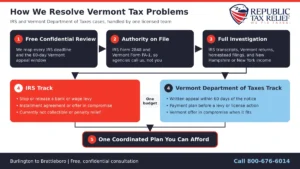
What happens after you call
- Confidential consultation. A short call about your notices, deadlines, and real monthly budget, including heating, property tax, and child care costs.
- Authority on file. We file IRS Form 2848 so the IRS contacts us instead of you, plus Vermont Form PA-1 so we can speak with the Department of Taxes.
- Full investigation. We pull IRS transcripts and check unfiled years, homestead filings, rental income, and any New Hampshire, New York, or Canadian earnings.
- Protection first. Where the law allows, we act to stop levies and protect the 60-day Vermont appeal window while we build your case.
- One coordinated plan. We negotiate with each agency in the right order and explain every option in plain English.
| Common concern | How we handle it |
|---|---|
| “Vermont is threatening my license.” | We contact Collections under your power of attorney and work toward a plan that keeps your account in good standing. |
| “The IRS levied my account in the off-season.” | We review the levy and show the IRS what your income looks like across a full seasonal year. |
| “I owe both the IRS and Vermont.” | We build one household budget so each plan fits alongside the other. |
| “Can a California firm really help me in Vermont?” | Yes. IRS representation works the same in all 50 states, and we handle Vermont matters under written authority. |
IRS Tax Relief in Burlington, Vermont and Throughout the State
A nurse in Burlington, an innkeeper in Manchester, and a dairy farmer in Orleans County face very different tax problems. We start with Burlington, Vermont’s largest city, and serve every region of the state.
Focus Area: Burlington and Chittenden County
Burlington is the state’s center for healthcare, higher education, and tech, with a large chip-making employer nearby in Essex Junction. A busy rental market, a growing remote workforce, and many side businesses mean plenty of income that never had tax withheld.
Medical staff, university employees, and Church Street business owners.
Retail owners, professionals, and rental property investors.
Manufacturing and tech workers, new Vermonters, and 1099 contractors.
Farm families, builders, and home-based businesses.
Vermont Regions, Cities, and Towns We Serve
Greater Burlington
Cities and towns: Burlington, South Burlington, Winooski, Essex Junction, Colchester, Williston, Milton
Healthcare, tech, education, and rental income.
Champlain Valley and Addison County
Cities and towns: Middlebury, Vergennes, Bristol, Shelburne, Charlotte
Dairy and orchard farms, college staff, and small makers.
Northwest Vermont
Cities and towns: St. Albans, Swanton, Enosburg Falls, Georgia, South Hero
Farm families, lake camps, and Quebec border income.
Central Vermont and Lamoille
Cities and towns: Montpelier, Barre, Waterbury, Stowe, Morrisville, Northfield
State employees, granite trades, and ski-season businesses.
Northeast Kingdom
Cities and towns: St. Johnsbury, Newport, Lyndonville, Derby, Island Pond, Hardwick
Dairy, logging, and maple producers with seasonal income.
Rutland Region
Cities and towns: Rutland, Killington, Castleton, Fair Haven, Brandon, Poultney
Ski resort workers, healthcare staff, and New York commuters.
Upper Valley and Windsor County
Cities and towns: White River Junction, Hartford, Norwich, Woodstock, Springfield, Windsor, Randolph
New Hampshire commuters, hospital staff, and inn owners.
Southern Vermont
Cities and towns: Brattleboro, Bennington, Manchester, Wilmington, Bellows Falls, Dover
Second-home owners, artists, and Massachusetts or New York income.
Don’t see your town? We help taxpayers in every corner of Vermont. Call 800-676-6014 and we will tell you right away whether we can help.
You can also browse all of our service locations.
Expert Insight: Tax Attorney and Enrolled Agent Views on Handling IRS Problems Alone or With AI
Vermonters are used to fixing things themselves. With tax debt, the costly mistakes we see come from good intentions, a missed form, and advice meant for a different state.
- Treating every deadline the same. Vermont gives 60 days to appeal an assessment, while an IRS levy hearing request is often due in 30. Mixing them up can cost you your appeal rights.
- Appealing a bill that is correct. An appeal is for disputing the amount. Filing one just to buy time can delay a payment plan or offer while interest grows.
- Skipping the Homestead Declaration. People behind on income taxes often stop filing everything, including Form HS-122. That can mean a higher property tax bill on top of the tax debt.
- Using New Hampshire advice. A friend across the river may pay no tax on wages. That advice does not apply to a Vermont return.
- AI gets Vermont’s rules wrong. Chatbots often say Vermont has no offer in compromise, quote old credit amounts, or mix up homestead and nonhomestead rates. A confident wrong answer can cost you a settlement or a deadline.
- Feeding private data to public tools. Pasting returns, notices, or your Social Security number into a free chatbot is a privacy risk you can’t undo. AI also can’t sign a power of attorney or negotiate with a revenue officer.
Our take: Use AI to learn the vocabulary, not to make the decisions. A licensed enrolled agent, CPA, or tax attorney should choose the strategy and speak for you. We explain why in Can AI get a better settlement than a tax attorney?
Free tax help in Vermont
Not everyone needs a paid firm, and we would rather you know your options. Free help is available for many taxpayers:
- Volunteer Income Tax Assistance (VITA) and AARP sites offer free tax preparation for many low-income and older Vermonters.
- Free File through the IRS lets eligible taxpayers e-file a federal return at no cost, and Vermont offers its own free filing options.
- Vermont Legal Aid runs a Low-Income Taxpayer Clinic, and vtlawhelp.org explains tax credits and IRS disputes in plain language. Legal services in Vermont like these can help with smaller IRS cases.
- The IRS Taxpayer Advocate Service has an office in Burlington and can step in when a case is stuck or causing hardship.
If your balance is large, involves a business, or both agencies are collecting, that is when professional representation pays off. Want to read more first? Try our Offer in Compromise guide, IRS payment plans explained, and tax negotiation insights.
Why Vermont Taxpayers Choose Republic Tax Relief for Tax Help
Choosing who to trust with a tax debt is a big decision. Since 2005, founding partner Mark Ladd and our in-house team of enrolled agents, CPAs, and tax attorneys have helped individual and business clients nationwide resolve IRS and state tax problems. We work every case ourselves, with no outsourcing.
| Cases resolved | 18,000+ |
| Client balances settled | $220M+ |
| Average client rating | 4.9 / 5 |
| Credentials | Enrolled agents, CPAs, and tax attorneys |
| Scheduling | Eastern time morning, lunch, and evening call windows |
| Languages | English and Spanish |
- IRS and Vermont handled together. One team, one budget, and one plan for both agencies.
- State offers taken seriously. We check whether a Vermont offer in compromise fits before you settle for a long payment plan.
- Seasonal budgets. We present your income the way it really arrives, not as twelve even paychecks.
- Border-smart. We check New Hampshire, New York, Massachusetts, and Canadian income before anything is filed.
- Honest answers. If a settlement isn’t realistic, we tell you and show you a better path.
- Recognized work. See our awards and recognition.
Results vary based on each taxpayer’s facts and finances. Past results do not guarantee a similar outcome.
Green Mountain privacy. Bank-grade encryption. Your documents stay yours.
Vermont Tax Relief and IRS Tax Debt Frequently Asked Questions
Can you help me if you don’t have an office in Vermont?
Yes. IRS and Vermont tax cases are handled by phone, mail, and secure online systems, and we work under signed authorization forms. Our team works from California and serves taxpayers throughout Vermont, including Burlington.
What are Vermont’s income tax rates?
Vermont has four income tax rates: 3.35%, 6.6%, 7.6%, and 8.75%. Bracket thresholds depend on filing status and are adjusted each year. Vermont has no local income tax.
Does Vermont have an offer in compromise program?
Yes. The Vermont Department of Taxes accepts offers based on doubt as to collectibility, doubt as to liability, or economic hardship. You must be current on all filings, the balance must be final, and most offers include a good faith payment of at least 5%.
How long do I have to appeal a Vermont tax assessment?
Your written appeal generally must be received within 60 days of the mailing of the notice of assessment. The notice itself lists the deadline. If the bill is correct but you can’t pay it, a payment plan or offer is usually the better route.
What penalties does Vermont charge for late filing and late payment?
Late filing costs 5% of the unpaid tax per month, plus a $50 penalty if the return is more than 60 days late. Late payment of individual income tax adds 1% per month. Combined penalties are capped at 25%, and interest is charged at a rate set each year.
Can Vermont suspend my professional license over back taxes?
Yes. The Vermont Department of Taxes can seek revocation of business or professional licenses and suspension of the authority to do business. Setting up and keeping a payment plan is often the best way to protect a license.
Who is eligible for the Vermont property tax credit?
Generally, Vermont residents for the whole year who owned and lived in their home on April 1, filed a Homestead Declaration, and have household income under the yearly limit. The claim is filed on Form HS-122 with Schedule HI-144, generally by April 15.
Will Vermont take my tax refund if I owe back taxes?
Yes. Vermont applies your state tax refunds, including refundable credits, to your balance. Payments owed to you for goods or services may also be applied.
Does the IRS give tax relief after Vermont floods?
When FEMA declares a disaster area, the IRS usually postpones many filing and payment deadlines and applies the relief automatically to taxpayers with an address of record in the covered area. It postpones deadlines but does not erase a balance owed.
I live in Vermont and work in New Hampshire. Do I owe Vermont tax?
Generally, yes. Vermont taxes its residents on all of their income, and there is no reciprocity agreement. Because New Hampshire does not tax wages, nothing may be withheld, so you may need to make estimated payments to Vermont.
What should I bring to my free consultation?
Any IRS or Vermont Department of Taxes letters, your latest tax returns if you have them, W-2s, 1099s, and a rough idea of your monthly income and bills, including heating and property taxes. If records are missing, we can request IRS transcripts for you.
More answers: tax resolution questions, tax debt relief questions, IRS offer in compromise questions, IRS notices questions, and penalty abatement FAQs.
Sources
- Vermont Department of Taxes: Collections
- Vermont Department of Taxes: Offer in Compromise
- U.S. Attorney’s Office, District of Vermont: Richmond Business Owner Sentenced for Tax Evasion
Republic Tax Relief is a private firm and is not affiliated with the IRS, the Vermont Department of Taxes, any Vermont town, or any agency of the State of Vermont. This page offers general guidance, not legal advice or tax advice for your specific situation. Tax laws, deadlines, and agency procedures change, so consult a qualified tax professional or contact the Vermont Department of Taxes directly before acting.
Speak With a Tax Relief Professional About Your Vermont Tax Debt
Don’t let this follow you into another mud season. Let’s put a plan in place today.
Whether the letter came from the IRS or the Vermont Department of Taxes, one short call shows you where you stand, what is at risk, and which options you may qualify for. Your consultation is free and confidential.
About Republic Tax Relief
Republic Tax Relief helps individuals and businesses nationwide resolve IRS and state tax problems, including back taxes, levies, liens, unfiled returns, audits, and payroll tax debt. Since 2005, our in-house team of enrolled agents, CPAs, and tax attorneys has resolved more than 18,000 cases. From our offices in Corona and Laguna Hills, California, we represent clients in all 50 states and the District of Columbia. Call 800-676-6014 or contact us online for a free, confidential consultation.