
From Detroit and Grand Rapids to Traverse City and the U.P.
Michigan Tax Relief for Every Taxpayer: IRS Tax Debt, Michigan Department of Treasury Collections, Payment Plans, and Offer in Compromise Help
Michigan paychecks rise and fall with the auto plants, the seasons, and the weather. When a layoff, a strike, a slow tourist summer, or a spring of severe storms throws your budget off, tax bills from the IRS and the State of Michigan can pile up fast.
Autoworkers, suppliers, retirees, contractors, farmers, nurses, and small business owners across both peninsulas work with our team by phone, video, and secure upload. Nationwide reach, Eastern time hours.
Federal and state balances, one team
W-2, 1099, flow-through, and payroll filers
In-house team since 2005
Spanish-speaking clients welcome
Owing taxes in Michigan often means owing more than one agency. The Internal Revenue Service wants the federal balance, the Michigan Department of Treasury wants the state balance, and if you live or work in Detroit or one of the state’s other income tax cities, a city bill may be in the mix too.
Republic Tax Relief helps individuals and businesses resolve all of it. Our licensed enrolled agents, CPAs, and tax attorneys work as one team from our California offices and represent Michigan taxpayers in every county, from Wayne and Oakland to Marquette and Grand Traverse.
On This Page
- Why Michigan Taxpayers Owe the IRS and the State
- Severe Storms, Tornadoes, and IRS Disaster Relief
- From an IRS Notice to a Levy or Tax Lien
- Michigan Department of Treasury Collections
- Michigan Offer in Compromise for State Tax Debt
- A Real Michigan IRS Case: Unpaid Payroll Taxes
- IRS Tax Relief Options and Who May Qualify
- Michigan Business Tax Debt: Sales, Withholding, and Payroll
- Canada, Neighboring States, and City Income Taxes
- Our Tax Resolution Process Without a Local Office
- IRS Tax Relief in Detroit and Across Michigan
- Expert Insight: DIY and AI Risks With IRS Problems
- Why Michigan Taxpayers Choose Republic Tax Relief
- Frequently Asked Questions
- Speak With a Tax Relief Professional
Why Michigan Taxpayers End Up With IRS Tax Debt and State Tax Debt at the Same Time
Michigan’s economy has always moved in cycles. Good years at the plant bring overtime and bonuses, and lean years bring layoffs, strikes, and buyouts. Taxes rarely keep pace with those swings, and that is where most of the cases we see begin.
These are the patterns we hear about most from Michigan households:
- Auto industry layoffs, strikes, and buyouts. A buyout check, a 401(k) withdrawal to cover a strike, or unemployment pay with no withholding can leave a large federal tax bill and a state bill to match.
- Side work and gig income. Skilled trades jobs, rideshare driving, and online selling often pay with no tax taken out. Missed estimated tax payments turn into penalties and interest.
- Retirees with pensions. Michigan’s retirement income rules have shifted over the years, and pension withholding set years ago may not match what you owe today.
- Seasonal business owners. Up north, many resorts, orchards, marinas, and charter operators earn most of the year’s income in a few months. When the season is short, quarterly payments are the first thing to slip.
- Unfiled returns after a divorce, an illness, or a stretch of unemployment. Our unfiled tax returns service brings missing federal and Michigan returns current before new penalties build.
Not sure how much you owe or for which years? Our back tax help confirms every federal and state balance before anyone makes promises about your tax liabilities.
What you tell us stays with us. Your tax matter is protected by attorney-client and tax professional privilege standards, and only the licensed professional handling your case ever sees it.
Severe Storms, Tornadoes, and Flooding: How IRS Disaster Tax Relief Works for Michigan Taxpayers
Michigan weather is more than an inconvenience. Ice storms, tornadoes, and flooding have closed businesses, destroyed homes, and knocked out power across large parts of the state, and the IRS has granted Michigan disaster relief several times.
After the most recent round of severe storms, tornadoes, and flooding, the IRS postponed federal filing and payment deadlines for people and businesses in 37 counties under FEMA declaration 4925-DR. Covered counties ran from Washtenaw, Kalamazoo, and Saginaw to Grand Traverse, Alpena, Marquette, and Iron (IRS: Tax relief for Michigan severe storms, tornadoes and flooding).
What disaster relief does, and what it does not do
| Disaster relief can | Disaster relief does not |
|---|---|
| Push back deadlines to file income tax returns and make tax payments | Forgive the tax owed itself |
| Remove late filing and late payment penalties for the postponed period | Cover balances that were already past due before the storm |
| Let you claim uninsured storm losses on the current or prior year’s return | Pause collection forever once the postponement ends |
| Waive fees for copies of past returns needed to rebuild records | Apply automatically if your IRS address is outside the disaster area |
When the postponement ends, the clock starts again. If a storm year left you unable to pay, the IRS still expects a plan. Taxpayers who did not qualify for disaster relief may still qualify for reasonable cause penalty abatement, and a storm-related hardship can support a payment plan or a pause in collection.
Learn more in our penalty abatement insights and the penalty abatement FAQs.
From a Notice From the IRS to a Levy or Tax Lien: How Much Time You Really Have
The IRS does not start by taking property. It sends a series of letters, and each one is more serious than the last. Where your newest letter falls tells you how fast you need to act.
- Balance due notices. The first bills show the tax owed, plus penalties and interest.
- Reminder and urgent notices. The wording gets sharper, and enforcement is mentioned.
- Notice of Federal Tax Lien. A public claim recorded with your county register of deeds. It can stall the sale or refinance of a home, a cottage, or farmland.
- Final Notice of Intent to Levy. You generally have 30 days to request a Collection Due Process hearing.
- Levy. The IRS can take bank funds, wages through a wage garnishment, some pension income, and part of your Social Security.
Seasonal workers, take note. Bank levies and wage garnishments often hit right when spring work or a summer season starts and money finally comes in. If you have a final notice in hand during the slow months, that is the time to call.
See how IRS collections defense works, plus our bank levy help, wage garnishment relief, and tax lien help. Our guide to common IRS notices explains each letter.
Michigan Department of Treasury Collections, Liens, and Levy Powers
Many people fix the IRS side and let the state bill sit. That is a mistake. The Michigan Department of Treasury runs its own collection process, and it does not wait for your IRS case to finish.
Who is collecting from you
Newer state balances are handled by Treasury’s own collections staff. Older balances are often turned over to the Michigan Accounts Receivable Collection System (MARCS), which works with a private collection agency. Many people ignore those calls, thinking they are a scam, and lose valuable time.
Michigan payment plans and state tax liens
Treasury offers monthly installment agreements on Form 990. Here is the part that surprises people: the state files liens on real and personal property even when you are on a payment plan and current with it, and those liens are public records (Michigan Department of Treasury: What If I Can’t Pay?).
That matters if you plan to sell, refinance, or borrow. We weigh the state plan against your timeline and look at whether paying a balance down first, or choosing a different option, avoids a lien on your property at a bad moment.
| Michigan Treasury action | What it means for you |
|---|---|
| Letter of Inquiry or Intent to Assess | A proposed bill. You can generally ask for an informal conference within 60 days to dispute it. |
| Bill for Taxes Due (Final Assessment) | The tax is now assessed. Appeal windows to the Michigan Tax Tribunal or Court of Claims are short, often 35 or 90 days. |
| State tax lien | A recorded claim that can show up on credit and title searches and block a sale. |
| Bank levies and wage garnishments | Treasury can reach bank accounts and paychecks to collect unpaid state tax. |
| Refund offsets | Your state tax refund, and in some cases your federal refund, can be applied to what you owe. |
See our IRS and state back tax relief services for how we handle both agencies together.
Michigan Offer in Compromise: Can You Settle Your Tax Debt With the State?
Michigan is one of the states that lets taxpayers settle a tax debt for less than the full amount owed. The state program has its own rules, and they are stricter than many people expect.
Before Treasury will look at an offer
- All returns filed. Every outstanding period must be on file first.
- Appeal rights used up. Your time to request an informal conference or contest the debt in the Tax Tribunal or court must have run out.
- A real offer, not a stall. Offers made only to delay collection, such as a levy, are not accepted, and you cannot have an open bankruptcy.
- Money up front. You must send a payment of $100 or 20% of your offer, whichever is greater. It is not refunded, even if the offer is rejected (Michigan Department of Treasury: Offer in Compromise Eligibility).
The IRS-matched offer
Here is a Michigan advantage few people know about. If the IRS accepts your federal offer, Treasury may accept the same percentage on matching state income tax, withholding, or corporate income tax years. If the IRS takes 35% of the federal balance, the state may take 35% of the state balance for the same year.
That is why the order matters. In many cases, we work the federal offer first, then use the accepted IRS offer to support the Michigan offer. Learn how the federal side works in how the Offer in Compromise program works and the IRS Offer in Compromise questions page.
A Real Michigan IRS Case: When Unpaid Payroll Taxes Become a Federal Crime
Most tax debt is a money problem, not a crime. Falling behind on tax payments you cannot afford is civil. Keeping money withheld from employees’ paychecks is treated very differently, and this Detroit-area case shows why.
The case: The owner of a Detroit-area software company withheld about $691,000 in employment taxes from his workers’ wages over several years but did not file the payroll returns or send the money to the IRS. Meanwhile, company funds paid for his mortgage, luxury car leases, and personal shopping. The total tax loss topped $1.1 million.
The outcome: He pleaded guilty and was sentenced to 12 months and one day in federal prison (U.S. Department of Justice).
The lesson: Payroll taxes are trust money. If your business has fallen behind, a licensed tax professional can help you get current and negotiate the balance through civil channels before the IRS treats it as willful.
Behind on deposits? Start with payroll tax debt relief and our payroll tax debt guide.
IRS Tax Relief Options and Who May Qualify
The right choice depends on your income, allowable living expenses, assets, and how much time is left on the IRS collection clock. In much of Michigan, living costs are lower than the national averages people read about online, and that changes the math.
| Relief option | What it does | Often fits |
|---|---|---|
| Installment agreement | A monthly IRS payment plan that holds off levies while you make payments | Plant workers, nurses, and salaried staff with steady pay |
| Offer in compromise | Settles for less than the full amount owed, based on ability to pay, if the offer is accepted | Modest income and few assets compared with the amount you owe |
| Currently not collectible | Pauses collection during financial hardship | Laid-off workers, storm-hit families, and seniors on fixed income |
| Penalty abatement | Removes failure to pay and failure to file penalties for a clean history or reasonable cause | Serious illness, a death in the family, or storm-damaged records |
| Innocent spouse relief | Separates you from a spouse’s tax debt on a joint return | Errors or hidden income from a current or former spouse |
| Audit representation | We deal with the auditor so you do not have to | A tax audit letter, document request, or proposed balance |
For the bigger picture, see our complete guide to tax resolution services, our tax debt relief options, and the facts about the IRS Fresh Start Program.
Michigan Business Tax Debt: Sales Tax, Withholding, Payroll, and Tax Liens
Michigan business owners juggle federal payroll deposits, state sales, use, and withholding tax, and sometimes city withholding on top. When cash gets tight, these are the accounts that fall behind first.
- Sales and withholding are trust money. Michigan can hold owners and officers personally responsible for unpaid sales, use, and withholding tax after the business fails to pay.
- Federal payroll taxes. Missed deposits can lead to the Trust Fund Recovery Penalty against owners and officers personally.
- Flow-through entity owners. LLC and S corporation owners who pick up business income on their personal return can owe federal and state income tax with no withholding at all.
- Cannabis businesses. Licensed Michigan dispensaries and growers face a federal rule that blocks most business deductions while marijuana stays federally restricted. Many owe far more to the IRS than their profits would suggest.
The Michigan businesses we help most often include:
- Auto suppliers, tool and die shops, and manufacturers. See business tax resolution services.
- Builders, roofers, and storm repair contractors. See construction tax resolution.
- Restaurants, bars, and resort businesses from Greektown to Mackinaw City. Read our restaurant tax resolution insights.
- Medical and dental practices. See tax resolution for medical professionals.
- Landlords and real estate agents. See real estate tax resolution.
- Online sellers. See e-commerce tax resolution.
Also see small business tax relief, business tax debt relief, and the business tax debt relief questions page.
No drive across the state, no stack of papers in the mail. Upload returns, pay stubs, and bank statements through bank-grade 256-bit encryption that fully complies with federal data protection and security standards.
Canada, Neighboring States, and City Income Taxes: Michigan Tax Return Problems Others Don’t Have
Michigan sits on an international border and shares long lines with Ohio, Indiana, and Wisconsin. Add more than twenty cities with their own income tax, and you get filing mistakes that show up years later as a bill.
Crossing to Canada for Work
Nurses, engineers, and tradespeople who commute through Detroit, Port Huron, or Sault Ste. Marie may owe in two countries. Foreign tax credits and foreign account reports are easy to get wrong.
Working Across a State Line
Michigan has reciprocal agreements with Illinois, Indiana, Kentucky, Minnesota, Ohio, and Wisconsin. When an employer withholds for the wrong state, you can owe one and wait on a refund from the other.
City Income Taxes
Detroit, Grand Rapids, Lansing, Flint, Saginaw, and other cities tax residents and people who work there. The state processes Detroit’s city returns, so a Detroit balance can travel with your state account.
Explore our neighboring guides for Ohio, Indiana, and Wisconsin.
Our Tax Resolution Process for Michigan Taxpayers Without a Local Office
We want to be upfront: we do not have an office in Michigan. Our team works from our offices in Corona, California and Laguna Hills, California, with calls scheduled around Eastern time.
That works because the IRS handles nearly all cases by phone, mail, and secure online systems, and an enrolled agent can represent taxpayers anywhere in the country. For someone in Ironwood or Alpena, it also means no long drive to an office.
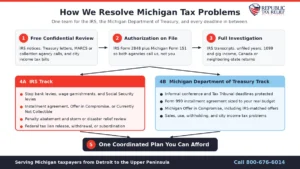
What happens after you call
- Confidential consultation. A short call about your letters, deadlines, and monthly budget.
- Authorization on file. We file IRS Form 2848 so the IRS contacts us instead of you, plus Michigan Form 151 so we can speak with Treasury and MARCS.
- Full investigation. We pull IRS transcripts, check unfiled returns and 1099 income, and review any Canadian or neighboring-state filings.
- Protection first. Where the law allows, we act to stop levies and protect appeal deadlines while we build your case.
- One coordinated plan. We negotiate in the right order and explain every option in plain English.
| Common concern | How we handle it |
|---|---|
| “A collection agency keeps calling about my Michigan taxes.” | We confirm whether it is MARCS, verify the balance, and take over the calls. |
| “The storms wrecked my records and my business.” | We request IRS transcripts, rebuild what is missing, and seek penalty relief where it fits. |
| “The IRS and the state both want monthly payments.” | We build both plans from one household budget so neither falls apart. |
| “Can a California firm really help me in Michigan?” | Yes. IRS representation works the same everywhere, and we handle state matters under written authority. |
IRS Tax Relief in Detroit and Across Michigan
A supplier in Warren, an orchard owner near Traverse City, and a retired miner in Marquette face very different tax problems. We start with Metro Detroit, then cover every region of the state.
Focus Area: Detroit and Metro Detroit
Metro Detroit is where many of our Michigan cases come from. Detroit residents can owe the IRS, the state, and the city at once, and the region’s auto plants, suppliers, hospitals, and small shops all feel the same economic swings.
Autoworkers, city income tax filers, small landlords, and new businesses.
Plant workers, family businesses, and Arabic-speaking households.
Warren and Sterling Heights suppliers, skilled trades, and contractors.
Troy, Southfield, and Novi professionals with complex income.
Michigan Regions and Cities We Serve
Southeast Michigan
Cities: Detroit, Dearborn, Livonia, Warren, Sterling Heights, Troy, Farmington Hills, Ann Arbor, Ypsilanti, Monroe
Auto industry workers, university staff, and health care professionals.
West Michigan
Cities: Grand Rapids, Wyoming, Kentwood, Holland, Kalamazoo, Battle Creek, Muskegon
Furniture and food manufacturers, farms, and family businesses.
Mid-Michigan and the Thumb
Cities: Lansing, East Lansing, Flint, Saginaw, Bay City, Midland, Port Huron
State employees, GM retirees, and storm-hit Saginaw Valley households.
Northern Lower Peninsula
Cities: Traverse City, Petoskey, Gaylord, Alpena, Cadillac, Mackinaw City
Resort and tourism businesses, orchards, and seasonal workers.
Upper Peninsula
Cities: Marquette, Sault Ste. Marie, Escanaba, Iron Mountain, Houghton, Menominee
Loggers, miners, retirees, and cross-border workers.
Southwest Michigan
Cities: St. Joseph, Benton Harbor, Niles, Jackson, Coldwater
Workers commuting to Indiana and small manufacturers.
Don’t see your city? We help taxpayers in all 83 Michigan counties. Call 800-676-6014 and we will tell you right away whether we can help. You can also browse all of our service locations.
Expert Insight: Tax Attorney and Enrolled Agent Views on Handling IRS Problems Alone or With AI
Michiganders are known for fixing things themselves. That spirit serves you well in a garage, but tax cases handled alone tend to go wrong in a few predictable ways, and some mistakes cannot be undone.
- The state offer has a trap door. Michigan will not review an offer until your appeal rights have expired. File the offer too early and it is turned away. Wait too long on an assessment and you may lose the right to dispute it at all.
- The order of offers matters. An accepted IRS offer can support a matching Michigan offer. Go to the state first, or file the two out of sync, and you may give up that advantage.
- Your financial statement is sworn. Payment plans and settlements often require a financial statement signed under penalty of perjury. A missing asset, such as a cottage or a pension account, can sink the deal.
- A payment plan can still bring a lien. Many people sign up for a state plan thinking it protects their home sale, then find a lien on the title.
- Trusting AI on old announcements. Chatbots often repeat expired storm deadlines or list the wrong counties. A confident wrong answer can cost you a penalty waiver or a hearing right.
- Pasting private data into public tools. Uploading returns or your Social Security number to a free chatbot creates a privacy risk you cannot take back. AI also cannot sign a power of attorney or speak with a revenue officer.
Our take: AI is fine for learning what a term means. A licensed enrolled agent, CPA, or tax attorney should make the decisions. We explain why in Can AI get a better settlement than a tax attorney?
Want to read more first? Try our Offer in Compromise guide, IRS payment plans explained, and tax settlement insights.
Why Michigan Taxpayers Choose Republic Tax Relief
Hiring help with tax debt is a trust decision. Since 2005, founding partner Mark Ladd and our in-house team of tax experts, including enrolled agents, CPAs, and tax attorneys, have helped individuals and businesses nationwide resolve IRS and state tax problems. We work every case ourselves, with no outsourcing.
| Cases resolved | 18,000+ |
| Client balances settled | $220M+ |
| Average client rating | 4.9 / 5 |
| Credentials | Enrolled agents, CPAs, and tax attorneys |
| Scheduling | Eastern time morning, lunch, and evening call windows |
| Languages | English and Spanish |
- Federal and state handled together. One team, one budget, one plan for the IRS and Michigan Treasury.
- Michigan offer know-how. We time federal and state offers so an accepted IRS offer can help your state case.
- Deadlines tracked. We watch the IRS 30-day hearing window and Michigan’s informal conference and Tax Tribunal deadlines.
- Storm-aware. We check whether disaster postponements or reasonable cause relief apply to your penalties.
- Honest answers. If a settlement is not realistic, we say so and show you a better path.
- Recognized work. See our awards and recognition.
Results vary based on each taxpayer’s facts and finances. Past results do not guarantee a similar outcome.
Built Michigan tough on privacy. Encrypted. Confidential. Never shared.
Michigan Tax Debt and IRS Tax Relief Frequently Asked Questions
Can you help me if you don’t have an office in Michigan?
Yes. IRS cases are handled by phone, mail, and secure online systems, and we represent you under a signed power of attorney. Our team works from California and serves clients in all 83 Michigan counties, including Detroit.
I owe both the IRS and the Michigan Department of Treasury. Can you handle both?
Yes. We review both balances, build one household budget, and negotiate with the IRS and the state in the right order so the two plans fit together.
Does Michigan have an offer in compromise program?
Yes. Michigan lets taxpayers settle state tax debt for less than the full amount owed. You must have all returns filed, your appeal rights must have expired, and you must send a payment of $100 or 20% of the offer, whichever is greater.
If the IRS accepts my offer, will Michigan accept one too?
It may. For matching income tax, withholding, or corporate income tax years, Treasury may accept the same percentage the IRS accepted. It can also reject the offer or use its own analysis, so the state offer still has to be done right.
Will a Michigan payment plan put a lien on my property?
It can. Michigan Treasury files liens even when a taxpayer is on a payment plan and current with it. If you plan to sell or refinance, talk to us before choosing a plan.
Who is MARCS, and why are they calling me about my taxes?
MARCS is the Michigan Accounts Receivable Collection System, which collects older state tax balances with help from a private agency. The calls are usually real. Verify the balance before you pay, and do not ignore it.
I was hit by the storms, tornadoes, and flooding. Does disaster relief cancel my tax debt?
No. IRS disaster relief postpones deadlines and removes certain penalties for a set period. It does not forgive the tax. Once the postponement ends, you still need a plan, though storm hardship may support penalty relief or a pause in collection.
How long do I have to dispute a Michigan tax assessment?
The windows are short. You can generally request an informal conference within 60 days of an Intent to Assess. After a final assessment, appeals to the Michigan Tax Tribunal or Court of Claims must be filed within strict deadlines, often 35 or 90 days.
Can Michigan hold me personally liable for my business’s unpaid taxes?
Yes. Owners and officers responsible for sales, use, and withholding tax can be held personally liable when the business does not pay. The IRS can do the same for unpaid federal payroll taxes through the Trust Fund Recovery Penalty.
What should I bring to my free consultation?
Any IRS or Michigan Treasury letters, your latest tax return if you have one, any 1099s or pay stubs, and a rough idea of your monthly income and bills. If you are missing records, we can request IRS transcripts for you.
More answers: tax resolution questions, tax debt relief questions, IRS collections defense questions, and IRS payment plan questions.
Sources
- IRS: Tax relief for Michigan severe storms, tornadoes and flooding (FEMA 4925-DR)
- Michigan Department of Treasury: What If I Can’t Pay?
- Michigan Department of Treasury: Offer in Compromise Eligibility
Republic Tax Relief is a private firm and is not affiliated with the IRS, the Michigan Department of Treasury, MARCS, the Michigan Tax Tribunal, or any agency of the State of Michigan. This page offers general guidance, not legal advice or tax advice for your specific situation. Tax laws, deadlines, and agency procedures change, so consult a qualified tax professional or contact the agency directly before acting.
Speak With a Tax Relief Professional About Your Michigan Tax Debt
Your paycheck, your home, and your business are worth protecting. Let’s start today.
Whether the letter came from the IRS, Michigan Treasury, MARCS, or your city, one short call shows you where you stand, what is at risk, and which options fit. Your consultation is free and confidential.
About Republic Tax Relief
Republic Tax Relief helps individuals and businesses nationwide resolve IRS and state tax problems, including back taxes, levies, liens, unfiled returns, audits, and payroll tax debt. Since 2005, our in-house team of enrolled agents, CPAs, and tax attorneys has resolved more than 18,000 cases. From our offices in Corona and Laguna Hills, California, we represent clients in all 50 states and the District of Columbia. Call 800-676-6014 or contact us online for a free, confidential consultation.