
From Capitol Hill to Georgetown, Petworth to Anacostia
Washington, DC Tax Relief for Every Taxpayer: IRS Back Taxes, Penalty Abatement, and DC Office of Tax and Revenue Help
In most of the country, the IRS is a faraway agency. In the District, it is the building down the street, and your paycheck may come from the same federal government that is sending you collection letters.
Federal employees, government contractors, nonprofit staff, embassy workers, restaurant owners, and rowhouse landlords across all eight wards work with our team by phone, video, and secure upload. Nationwide reach, Eastern time hours.
Federal and District balances, one team
W-2, 1099, franchise tax, and payroll filers
In-house team since 2005
Spanish-speaking clients welcome
Owing taxes in the District comes with stakes most people elsewhere never face. A balance with the IRS can follow you into a security clearance review, and a balance with the DC Office of Tax and Revenue can block the business license or city contract you depend on.
Republic Tax Relief helps individuals and businesses that owe the Internal Revenue Service, the District, or both. Our licensed enrolled agents, CPAs, and tax attorneys work as one team from our California offices and represent DC residents and business owners in every ward and neighborhood.
Looking for help in Washington State? Visit our Washington State tax relief guide for Seattle, Spokane, and Tacoma.
On This Page
- Why DC Taxpayers Owe the IRS and the District
- Federal Employees, Clearance Holders, and Contractors
- IRS Penalty Relief and Abatement for DC Taxpayers
- From an IRS Notice to a Levy or Tax Lien
- DC Office of Tax and Revenue Collections and Appeals
- Clean Hands: When DC Tax Debt Blocks a License
- A Real DC IRS Case: Unreported Income
- IRS Tax Relief Options for DC Taxpayers
- DC Business Tax Problems: Franchise, Sales, and Payroll
- DC, Maryland, and Virginia: Commuter Tax Issues
- Our Tax Resolution Process Without a Local Office
- IRS Tax Relief Across All Eight DC Wards
- Expert Insight: DIY and AI Risks With IRS Problems
- Why DC Taxpayers Choose Republic Tax Relief
- Frequently Asked Questions
- Speak With a Tax Relief Professional
Why DC Taxpayers End Up Owing Federal Tax and District Tax at the Same Time
The District’s economy runs on government, contracting, nonprofits, law, hospitality, and health care. Many of those jobs pay well, but a surprising number pay without proper withholding, and that is where most DC tax problems begin.
These are the patterns we see most in District households:
- Consulting and contract work. Former federal staff and policy experts who start consulting often owe self-employment tax and skip estimated tax payments in their first year.
- Embassy and international organization jobs. U.S. citizens working for a foreign embassy or an international organization usually receive pay with no tax withheld. They owe income tax and self-employment tax and must send quarterly payments on their own.
- Job changes and workforce cuts. Buyouts, early retirement, lump-sum leave payouts, and Thrift Savings Plan withdrawals can push a household into a large tax bill.
- Moving in or out of the District. Part-year residents who keep Maryland or Virginia withholding, or who forget to file a DC return, can owe the District with penalties stacked on top.
- Unfiled returns after a divorce, an illness, or a stretch of unemployment. Our unfiled tax returns service brings missing federal and DC returns current and stops new penalties from building.
Not sure how much you owe or for which years? Our back tax help confirms every federal and District balance before anyone makes promises about your tax liability.
In a town built on discretion, so are we. Your tax matter stays inside our firm, protected by attorney-client and tax professional privilege standards and seen only by the licensed professional on your case.
Federal Employees, Clearance Holders, and Government Contractors With IRS Tax Debt
Federal workers carry a special kind of tax risk. The IRS can reach federal pay and federal retirement benefits through its own levy program, and an unpaid tax bill can raise questions in a background investigation.
Federal salary and retirement levies
Through the Federal Payment Levy Program, the IRS can take a set share of each federal paycheck or annuity payment, month after month, until the debt is resolved. It does not need a court order, and it keeps going until a plan is in place.
Security clearances and tax debt
- The questions are direct. The background investigation form asks whether you have failed to file or pay federal, state, or other taxes in recent years.
- Silence looks worse than debt. Adjudicators generally view a documented payment plan or settlement more favorably than an ignored balance.
- Timing matters. Starting a resolution before a periodic reinvestigation is far better than explaining a levy during one.
Shutdowns, furloughs, and missed pay
Lapses in appropriations can leave federal workers and contractors without income for weeks. Treasury has at times given affected federal employees extra time to file, but the IRS does not cancel tax due because of a shutdown. If a furlough knocked your tax payment schedule off track, a hardship review or payment plan is often the fix.
IRS Penalty Relief and Penalty Abatement: What Relief for Taxpayers Really Covers
Penalties and interest can make up a big share of an IRS balance. The good news is that some penalties can come off, and many taxpayers who qualify for relief never ask for it.
| Type of penalty relief | Who may be eligible for relief |
|---|---|
| First-time abate | An administrative penalty waiver for people with a clean penalty history for the prior three years who have filed all required returns. |
| Reasonable cause | Serious illness, a death in the family, lost tax records, or other events outside your control that kept you from filing or paying on time. |
| Disaster postponement | After a federal disaster declaration, the IRS announces relief and postpones deadlines for addresses in the disaster area, often including estimated tax payments and payroll and excise tax deposits. |
| Interest relief | Interest usually comes off only when the penalty it was charged on is removed, or when an IRS error or delay caused it. |
How a request for penalty relief is made
Some requests can be made by phone. Others need a written statement or Form 843, the claim for refund and request for abatement, along with proof. The form 843 instructions are short, but the explanation you attach is what wins or loses the request.
When the IRS announces tax relief, read the fine print. Broad relief usually postpones a deadline or waives one type of penalty. It rarely forgives the tax itself, and the IRS will automatically apply it only to accounts that match its records.
Learn more on our IRS penalty abatement page, our penalty abatement insights, and the penalty abatement FAQs.
From an IRS Notice to a Levy or Tax Lien: How Much Time a DC Taxpayer Really Has
The IRS does not start by taking property. It sends a series of letters, and each one is more serious than the last. Where your newest letter falls in this order tells you how fast you need to act.
- Balance due notices. The first bills show the tax, plus penalties and interest.
- Reminder and urgent notices. The wording gets sharper, and enforcement is mentioned.
- Notice of Federal Tax Lien. A public claim recorded with the DC Recorder of Deeds. It can stall the sale or refinance of a rowhouse or condo.
- Final Notice of Intent to Levy. You generally have 30 days to request a Collection Due Process hearing.
- Levy. The IRS can take bank funds, wages through a wage garnishment, federal salary and retirement payments, and some Social Security benefits.
Don’t try to walk it in. Living close to IRS headquarters does not give you faster answers. Most collection work happens by mail and phone, and showing up in person does not stop the 30-day clock. If you have a final notice, call us before that window closes.
See how IRS collections defense works, plus our bank levy help, wage garnishment relief, and tax lien help. Our guide to common IRS notices explains each letter.
DC Office of Tax and Revenue Collections, Payment Agreements, and Appeals
Many people fix the IRS side and let the District bill sit. That is a mistake. The DC Office of Tax and Revenue runs its own collection process, and it does not wait for an IRS case to finish.
DC payment plans and when a lien gets filed
OTR offers online payment agreements for smaller balances, with a down payment and automatic bank withdrawals. All missing returns must be filed first. A lien is filed automatically on balances over $25,000, and on smaller balances when the plan runs longer than 12 months (DC Office of Tax and Revenue: Installment Agreements).
That lien rule matters if you plan to sell, refinance, or borrow. We size the District plan against your real budget and your timeline so a lien does not land at the worst moment.
| DC issue | What it means for you |
|---|---|
| Notice of Proposed Assessment | The District’s proposed bill. It starts a short clock to dispute the amount. |
| DC tax lien | A recorded claim that can show up in title searches and slow a sale or refinance. |
| Bank levy and wage garnishment | OTR can reach bank accounts and paychecks to collect unpaid tax. |
| Officer assessment | Unpaid business sales tax or withholding can be assessed against the owners and officers personally. |
| Refund offsets | District refunds, including credits like the DC earned income tax credit, can be applied to what you owe. |
The 30-day protest window
If you disagree with a proposed assessment or a refund denial, you can protest to the DC Office of Administrative Hearings. The petition must be filed within 30 days of the notice date, and filing pauses collection until a final decision (DC Office of Tax and Revenue: Taxpayer Rights, Appeals and Reconsiderations). Miss it, and your options narrow fast.
See our IRS and state back tax relief services for how we handle both agencies together.
Clean Hands: When DC Tax Debt Blocks a License, Permit, or Contract
The District has a rule most states do not. To get or renew many business and professional licenses, permits, city contracts, or grants, you need a Certificate of Clean Hands showing you are current with the District.
Owing more than $1,000 in taxes, fees, fines, or penalties to OTR or the Department of Employment Services, or missing required District tax returns, leads to a denial (DC Office of Tax and Revenue: Certificate of Clean Hands).
- Who gets caught off guard: restaurant and bar owners renewing licenses, contractors bidding on city work, home improvement businesses, and licensed professionals.
- Why it hurts: a small, old DC balance can freeze a much larger business opportunity.
- What helps: filing missing returns and resolving the balance, often through a payment plan, before your renewal or bid date.
If a Clean Hands denial is holding up a license or contract, call us at 800-676-6014. We work backward from your deadline.
A Real DC IRS Case: When Unreported Income Becomes a Federal Tax Crime
Most tax debt is a money problem, not a crime. Owing tax you cannot pay is civil. Hiding income from the IRS is a different matter, and this District case shows where that line sits.
The case: A Washington, DC man took a $1 million security deposit from a foreign airline for aircraft that were never delivered. He spent much of the money and left at least $448,000 of it off his federal tax return, causing a tax loss of more than $140,000.
The outcome: He pleaded guilty to tax evasion in federal court in the District. He was sentenced to 18 months in prison and three years of supervised release, and ordered to repay the IRS and the airline (U.S. Attorney’s Office for the District of Columbia).
The lesson: All income must be reported, whatever its source. If you have income you left off a return, a licensed tax professional can help you correct it through civil channels before the IRS finds it first.
Facing an audit or questions about past returns? See our IRS audit representation guide and the IRS audit representation questions page.
IRS Tax Relief Options and Federal Tax Relief Programs for DC Taxpayers
For an individual or business tax balance, the right choice depends on income, allowable living expenses, assets, and how much time is left on the IRS collection clock. DC’s high housing costs often change the math in your favor.
| Relief option | What it does | Often fits |
|---|---|---|
| Installment agreement | A monthly IRS payment plan that holds off levies | Federal employees and salaried professionals with steady pay |
| Offer in Compromise | Settles the debt for less than the full amount, based on ability to pay | Modest income and high DC living costs compared with the debt |
| Currently Not Collectible | Pauses collection during financial hardship | Laid-off workers, seniors on fixed income, and furloughed families |
| Penalty abatement | Removes penalties for a clean history or reasonable cause | Serious illness, a death in the family, or lost records |
| Innocent spouse relief | Separates you from a spouse’s tax debt | Errors or hidden income from a current or former spouse |
| Audit representation | We deal with the auditor so you do not have to | A tax audit letter, document request, or proposed balance |
For the bigger picture, see our complete guide to tax resolution services, our tax debt relief options, and the facts about the IRS Fresh Start Program.
DC Business Tax Problems: Franchise Tax, Sales Tax, and Payroll Tax Deposits
Running a business in the District means more tax accounts than most places. Federal payroll deposits, DC withholding, sales tax, and the District’s own business franchise tax all run on separate schedules.
- Unincorporated business franchise tax. The District taxes many sole proprietors, LLCs, and partnerships with DC gross receipts over $12,000, with limited exceptions for certain personal service businesses. New consultants often learn about it only when a bill arrives.
- Federal payroll taxes. Missed tax deposits can lead to the Trust Fund Recovery Penalty against owners and officers personally.
- Sales tax collected but not sent. This is trust money, and OTR can assess the responsible officers.
- Restaurant and hospitality swings. Changing wage rules, tip reporting, and slow seasons can squeeze cash flow until deposits slip.
The DC businesses we help most often include:
- Government contractors and consulting firms. See business tax resolution services.
- Restaurants and bars along 14th Street, H Street, and the Wharf. Read our restaurant tax resolution insights.
- Medical and dental practices. See tax resolution for medical professionals.
- Rowhouse renovators and contractors. See construction tax resolution.
- Landlords and real estate agents. See real estate tax resolution.
- Online sellers. See e-commerce tax resolution.
Behind on payroll? Start with payroll tax debt relief, then see small business tax relief and business tax debt relief.
No Metro ride to a stranger’s office. Upload returns, pay stubs, and bank statements through bank-grade 256-bit encryption that fully complies with federal data protection and security standards.
DC, Maryland, and Virginia: Commuter and Multistate Tax Filing Problems
Hundreds of thousands of people cross the District line for work every day. The rules for who taxes whom are unusual here, and mistakes tend to show up years later as a bill from one jurisdiction or another.
Living in DC, Working Outside It
DC residents who work in Maryland or Virginia generally owe income tax to the District. If an employer withholds for the wrong place, you can end up owing DC with penalties.
Living Outside DC, Working In It
The District does not tax the wages of people who live in Maryland or Virginia. Those workers owe their home state, and DC withholding taken in error has to be sorted out.
Movers and Part-Year Residents
Moving across the line mid-year means two part-year returns and two sets of rules. Skipping one is a common cause of a surprise bill.
Explore our neighboring guides for Maryland and Virginia.
Our Tax Resolution Process for DC Taxpayers Without a Local Office
We want to be upfront: we do not have an office in Washington, DC. Our team works from our offices in Corona, California and Laguna Hills, California, with calls scheduled around Eastern time.
That works because the IRS handles nearly all cases by phone, mail, and secure online systems, and an enrolled agent can represent taxpayers anywhere in the country. For busy DC professionals, it also means no time off work for an office visit.
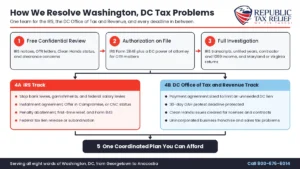
What happens after you call
- Confidential consultation. A short call about your letters, deadlines, clearance or license concerns, and monthly budget.
- Authorization on file. We file IRS Form 2848 so the IRS contacts us instead of you, plus a DC power of attorney for District matters.
- Full investigation. We pull IRS transcripts, review contractor and 1099 income, and check any Maryland or Virginia returns.
- Protection first. Where the law allows, we act to stop levies and protect protest deadlines while we build your case.
- One coordinated plan. We negotiate in the right order and explain every option in plain English.
| Common concern | How we handle it |
|---|---|
| “I hold a clearance and I’m worried about my job.” | We move fast to put a documented resolution in place you can point to. |
| “My license renewal was denied for Clean Hands.” | We find the balances and missing returns behind the denial and work to clear them before your deadline. |
| “The IRS and the District both want monthly payments.” | We build both plans from one household budget so neither falls apart. |
| “Can a California firm really help me in DC?” | Yes. IRS representation works the same everywhere, and we handle District matters under written authority. |
IRS Tax Relief Across All Eight Wards of Washington, DC
A lobbyist on K Street, a nurse in Congress Heights, and a restaurant owner on H Street face very different tax problems. We start with two focus areas, then cover every ward in the city.
Focus Area: Downtown, K Street, and Capitol Hill
The center of federal Washington is home to agencies, congressional offices, law firms, trade groups, and the consultants who serve them. Our cases here often involve high earners with complex income, clearance holders, and professionals who left government for private work.
Lobbyists, attorneys, and consulting firm partners.
Hill staff, federal employees, and rowhouse landlords.
Contractors, condo owners, and hospitality businesses.
Embassy and international organization staff with no withholding.
Focus Area: East of the River (Wards 7 and 8)
Across the Anacostia River, many families rely on hourly work, small businesses, and refundable credits. Here, tax trouble often looks like a held refund, an old balance from a side job, or a property tax problem on a long-owned home.
Health care workers, rideshare drivers, and gig earners.
Longtime homeowners and small shop owners.
Federal retirees and two-income households.
Inherited homes with unpaid taxes or missing property tax relief.
Wards and Neighborhoods We Serve
Ward 1
Neighborhoods: Columbia Heights, Adams Morgan, U Street, Mount Pleasant
Restaurant owners, freelancers, and Spanish-speaking families.
Ward 2
Neighborhoods: Georgetown, Dupont Circle, Logan Circle, Penn Quarter
Professionals, shop owners, and high earners with complex returns.
Ward 3
Neighborhoods: Tenleytown, Cleveland Park, Chevy Chase DC, Palisades
Consultants, retirees, and international organization staff.
Ward 4
Neighborhoods: Petworth, Brightwood, Takoma, Shepherd Park
Federal workers, homeowners, and small landlords.
Ward 5
Neighborhoods: Brookland, NoMa, Eckington, Ivy City
University staff, tradespeople, and new small businesses.
Ward 6
Neighborhoods: Capitol Hill, H Street, Navy Yard, Southwest Waterfront
Hill staff, bar and restaurant owners, and condo investors.
Ward 7
Neighborhoods: Deanwood, Hillcrest, Benning, Minnesota Avenue
Working families, seniors, and neighborhood businesses.
Ward 8
Neighborhoods: Anacostia, Congress Heights, Bellevue, Washington Highlands
Health care workers, gig earners, and military families near Joint Base Anacostia-Bolling.
Don’t see your neighborhood? We help taxpayers in every corner of the District. Call 800-676-6014 and we will tell you right away whether we can help. You can also browse all of our service locations.
Expert Insight: The Risks of Handling IRS Problems Alone or With AI
DC is full of people who read regulations for a living, so it is natural to think you can handle the IRS yourself, or ask a chatbot to write the letter. We respect that. But tax cases handled alone tend to go wrong in a few predictable ways, and some mistakes cannot be undone.
- Knowing the rules is not knowing the playbook. Policy experts know how law is written. Collection cases turn on internal IRS procedures, local expense standards, and what a revenue officer will actually accept.
- Your financial statement is sworn. Payment plans and settlements often require a Collection Information Statement signed under penalty of perjury. A wrong number there can follow you into a clearance review.
- DC housing costs work for you, if you claim them right. The IRS uses local standards for housing and utilities. Getting those allowances right can lower a required payment or make a settlement possible.
- Two agencies, two clocks. The IRS hearing window and the District’s 30-day protest window run separately. Fixing one while the other expires is a common and costly error.
- Trusting AI on old announcements. Chatbots often repeat expired IRS relief dates or mix up DC with Washington State. A confident wrong answer can cost you a hearing right or a penalty waiver.
- Pasting private data into public tools. Uploading returns, pay stubs, or your Social Security number to a free chatbot creates a privacy risk you cannot take back. AI also cannot sign a power of attorney or speak with a revenue officer.
Our take: AI is fine for learning what a term means. A licensed enrolled agent, CPA, or tax attorney should make the decisions and give the tax advice. We explain why in Can AI get a better settlement than a tax attorney?
Want to read more first? Try our Offer in Compromise guide, IRS payment plans explained, and tax negotiation insights.
Why DC Taxpayers Choose Republic Tax Relief
Hiring help with tax debt is a trust decision. Since 2005, founding partner Mark Ladd and our in-house team of enrolled agents, CPAs, and tax attorneys have helped individuals and businesses nationwide resolve IRS and state tax problems. We work every case ourselves, with no outsourcing.
| Cases resolved | 18,000+ |
| Client balances settled | $220M+ |
| Average client rating | 4.9 / 5 |
| Credentials | Enrolled agents, CPAs, and tax attorneys |
| Scheduling | Eastern time morning, lunch, and evening call windows |
| Languages | English and Spanish |
- Federal and District handled together. One team, one budget, one plan for both agencies.
- Clearance-aware. We understand why speed and documentation matter for federal workers and contractors.
- Clean Hands experience. We work backward from license renewals and contract bid dates.
- Deadlines tracked. We watch the 30-day DC protest window and the 30-day IRS hearing window.
- Honest answers. If a settlement is not realistic, we say so and show you a better path.
- Recognized work. See our awards and recognition.
Results vary based on each taxpayer’s facts and finances. Past results do not guarantee a similar outcome.
Capitol-level discretion. Bank-grade encryption. Zero leaks.
Washington, DC Tax Relief Frequently Asked Questions
Can you help me if you don’t have an office in Washington, DC?
Yes. IRS cases are handled by phone, mail, and secure online systems, and we represent you under a signed power of attorney. Our team works from California and serves clients in all eight wards of the District.
I owe both the IRS and the DC Office of Tax and Revenue. Can you handle both?
Yes. We review both balances, build one household budget, and negotiate with the IRS and the District in the right order so the two plans fit together.
Will a DC payment plan put a lien on my property?
It can. OTR files a lien automatically on balances over $25,000, and on smaller balances when the plan lasts longer than 12 months. If you plan to sell or refinance, talk to us before choosing a plan.
Can DC tax debt stop me from getting a business license or city contract?
Yes. Many licenses, permits, contracts, and grants require a Certificate of Clean Hands. Owing more than $1,000 to the District, or missing required DC returns, can lead to a denial until the issue is resolved.
I’m a federal employee. Can the IRS take part of my paycheck?
Yes. Through the Federal Payment Levy Program, the IRS can take a portion of federal salary and retirement payments each pay period until the debt is resolved. A payment plan or other resolution can stop it.
Will IRS debt affect my security clearance?
It can come up, because background forms ask about unfiled returns and unpaid taxes. Adjudicators generally view a documented resolution, such as an active payment plan, more favorably than an unaddressed balance.
How long do I have to protest a DC tax assessment?
Generally 30 days from the date of the notice. Protests go to the DC Office of Administrative Hearings, and filing on time pauses collection while your case is decided.
How do I request IRS penalty abatement?
Some requests, such as first-time abate, can be made by phone. Others need a written explanation or Form 843 with proof of reasonable cause. A clear, well-supported request is far more likely to succeed.
I live in Maryland or Virginia but work in DC. Do I owe the District income tax?
Generally no. The District does not tax the wages of people who live in Maryland or Virginia. If DC tax was withheld from your pay by mistake, that needs to be corrected so your home state is paid.
What should I bring to my free confidential consultation?
Any IRS or OTR letters, your latest tax return if you have one, any 1099s or pay stubs, and a rough idea of your monthly income and bills. If you are missing records, we can request IRS transcripts for you.
More answers: tax resolution questions, IRS notices questions, IRS collections defense questions, and IRS payment plan questions.
Sources
- DC Office of Tax and Revenue: Installment Agreements
- DC Office of Tax and Revenue: Taxpayer Rights, Appeals and Reconsiderations
- DC Office of Tax and Revenue: Certificate of Clean Hands
Republic Tax Relief is a private firm and is not affiliated with the IRS, the DC Office of Tax and Revenue, the DC Office of Administrative Hearings, or any agency of the District of Columbia. This page offers general guidance, not legal advice or tax advice for your specific situation. Tax laws, deadlines, and agency procedures change, so consult a qualified tax professional or contact the agency directly before acting.
Speak With a Tax Relief Professional About Your Washington, DC Tax Debt
Your career, your license, and your paycheck are worth protecting. Let’s start today.
Whether the letter came from the IRS, the District, or both, one short call shows you where you stand, what is at risk, and which options fit. Your consultation is free and confidential.
About Republic Tax Relief
Republic Tax Relief helps individuals and businesses nationwide resolve IRS and state tax problems, including back taxes, levies, liens, unfiled returns, audits, and payroll tax debt. Since 2005, our in-house team of enrolled agents, CPAs, and tax attorneys has resolved more than 18,000 cases. From our offices in Corona and Laguna Hills, California, we represent clients in all 50 states and the District of Columbia. Call 800-676-6014 or contact us online for a free, confidential consultation.