
From Lake Michigan to the Ohio River
Indiana Tax Relief for IRS and Indiana Department of Revenue Back Tax Debt
A demand notice from the Indiana DOR, a federal tax notice, or a county sheriff asking for payment? We help Hoosiers stop the pressure where the law allows and resolve the tax problem with a plan they can afford.
Individuals, families, and business owners across all 92 counties work with us by phone, video, and secure upload. No trip to Indianapolis required.
Both agencies, one plan
From Gary to Evansville
In-house team since 2005
Spanish-speaking clients welcome
Most Indiana taxpayers who call us did not plan to fall behind. A layoff at a plant, a slow season, a divorce, or a few years of 1099 income without estimated payments can turn into a tax bill that grows every month. Then the letters start coming from two directions.
The Internal Revenue Service collects federal tax, and the Indiana Department of Revenue collects state and county income tax, sales tax, and withholding. Indiana’s process is different from most states because unpaid state tax can move to your county clerk, your county sheriff, and a private collection agency. Republic Tax Relief helps you get help with tax debt on both sides, from our California offices, without a local storefront adding to your bill.
On This Page
- Why IRS Tax Debt and Indiana Tax Bills Pile Up
- How the Indiana DOR Collects: Demand Notices and Tax Warrants
- Federal Tax Lien vs. Indiana Tax Warrant
- Payment Plan Options for Paying Your Back Taxes
- Other Ways to Resolve Your Tax Debt in Indiana
- Business Tax Debt: Sales Tax, Withholding and Payroll
- How We Help Indiana Taxpayers Without a Local Office
- Indiana Cities and Regions We Serve
- Expert Insight: Why DIY and AI Fixes Backfire
- Tax Attorneys, CPAs and EAs on Your Side
- Indiana Tax Relief FAQs
- Speak With a Tax Relief Professional
Why IRS Tax Debt and Indiana Tax Bills Pile Up Together
Indiana’s income tax return starts from your federal adjusted gross income. So when the IRS changes your federal numbers after an audit or a mismatch letter, the Indiana DOR usually learns about it and sends its own bill later. One federal tax problem often becomes two.
Indiana also adds a county income tax in every county, collected on the same state return. A missed or late income tax return means you owe the state and county share, plus penalties and interest, on top of anything you owe the IRS.
Here is what Indiana clients most often bring to us:
- A notice from the IRS about unreported income from a side job, gig work, or contract work, followed by a matching state bill. See our back tax help services.
- Several years of unfiled tax returns after a job loss, illness, or business closure. Our unfiled tax returns service explains how we catch you up.
- A tax warrant from a county sheriff that showed up on a credit report or title search.
- A garnished paycheck or frozen bank account with little warning.
- Unpaid sales tax or withholding from a small business that ran short on cash.
- A defaulted payment plan, including plans set up during a past state amnesty window.
Not sure where you fit? Our tax resolution services start by confirming the amount you owe, to whom, and for which tax year.
What you tell us is protected. Every conversation and file is handled under attorney-client and tax professional privilege standards, so you can be fully honest about your situation without worry.
How the Indiana DOR Collects a Tax Problem: Demand Notices, Tax Warrants and Sheriffs
The Indiana DOR follows a clear path. If a bill is not paid or protested within 60 days, the department sends a demand notice that gives you about 20 days to pay or show reasonable cause. If you do not respond, the department issues a tax warrant (Indiana DOR Taxpayer Bill of Rights).
Once a warrant is filed with your county clerk, it becomes a judgment lien on your property in Indiana and a public record. The county sheriff can then garnish wages, levy bank accounts, or sell property to collect the tax due, plus penalties, interest, a collection fee, and clerk costs.
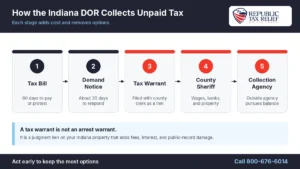
A few things surprise most Indiana taxpayers:
- A tax warrant is not an arrest warrant. It is a claim for money. It can still damage your credit and block a home sale or refinance (Indiana DOR: Sheriff’s Warrant).
- Fees stack up fast. The warrant amount can include sheriff costs, clerk costs, and a collection fee that is generally 10% of the unpaid tax.
- Warrants can move. If the sheriff does not collect, the warrant can be assigned to a private collection agency working for the state.
- Warrants last. A judgment lien from a warrant generally runs for 10 years and can be renewed.
- Paying the sheriff is not instant. Payments through the sheriff can take up to two weeks to clear on the lien.
Waiting rarely helps. Every stage adds cost and removes options. Learn how we handle IRS collection defense, wage garnishment relief, and bank levy help.
Federal Tax Lien vs. Indiana Tax Warrant: Two Collectors, Two Rulebooks
The IRS can place a lien on your property too, but its process looks different. Here is a side-by-side view of how each agency works to collect the tax debt.
| Collection step | IRS (federal tax) | Indiana DOR (state tax) |
|---|---|---|
| Warning | Series of notices, then a final notice of intent to levy | Bill, then a 20-day demand notice |
| Lien | Notice of Federal Tax Lien | Tax warrant filed with the county clerk as a judgment lien |
| Who collects | Federal collection staff or assigned private agencies | County sheriff, then a private collection agency |
| Wages and bank | Continuous wage levy and bank levy | Sheriff garnishment and bank account levy |
| Refunds | Federal tax refund applied to old balances | State refund applied to state balances |
| Online account | Federal online tax account | INTIME portal |
| Representation form | Form 2848 | Form POA-1 |
Clearing one does not clear the other. A paid Indiana warrant does nothing for a federal tax lien, and the reverse is true. See our guide to federal tax lien help.
Payment Plan Options for Paying Your Back Taxes in Indiana
For many people, the most realistic path is to pay your tax debt over time. Both agencies offer payment arrangements, but the rules are very different.
Indiana DOR payment plan limits
The Indiana DOR generally requires a balance over $100 for individuals or over $500 for businesses, and your tax return must be processed first. The amount you owe sets the longest plan allowed (Indiana DOR Payment Plans).
| Individual balance | Longest Indiana plan |
|---|---|
| $100 or less | Pay in full |
| $101 to $1,000 | Up to 12 months |
| $1,001 to $5,000 | Up to 24 months |
| $5,001 and above | Up to 36 months |
That 36-month cap is the catch. A $30,000 state balance spread over three years means payments of about $833 a month before interest, which many families cannot carry alongside an IRS payment plan. When the numbers do not fit, we look at hardship and settlement options instead of agreeing to a plan that will fail.
IRS payment plan basics
An installment agreement or payment plan with the IRS can often stretch longer than Indiana allows, and some plans can be set up without a full financial review. Penalties and interest keep running until you pay the tax bill in full, so the plan type matters. Read how IRS payment plans work.
Making both plans fit one budget
- Set up a payment plan on each side in the right order. State warrants usually move faster, but federal balances are often larger.
- Keep tax payments automatic. Indiana plans paid by bank draft through INTIME carry no fee. Federal tax payments can go through the Electronic Federal Tax Payment System.
- Stay current on new taxes. A missed estimated tax payment or a new balance can default either plan.
Other Ways to Resolve Your Tax Debt With the IRS and Indiana
A payment plan is not the only answer. The right fit depends on your income, expenses, assets, and how many years are open.
| Relief option | With the IRS | With the Indiana DOR | Often fits |
|---|---|---|---|
| Settlement | Offer in compromise based on ability to pay | Offer in compromise through the Taxpayer Advocate Office | People who cannot pay in full, even over time |
| Hardship | Currently Not Collectible status | Hardship program with a hardship financial statement | Income that barely covers basic living costs |
| Penalty relief | First-time or reasonable cause abatement | Penalty waiver request for reasonable cause | Clean history, illness, or a disaster |
| Dispute | Appeals and audit reconsideration | Written protest within 60 days, then Indiana Tax Court | Bills that are simply wrong |
Can you settle your tax debt for less?
Sometimes. Both the IRS and Indiana accept offers from taxpayers who truly cannot pay. Indiana’s offer program runs through its Taxpayer Advocate Office, asks for a down payment with the application, and does not pause collection while the offer is reviewed. Before anyone tries to settle your tax debt, we test the numbers. Learn how the OIC program works.
Hardship, penalty relief, and spousal relief
- Hardship status: Indiana’s hardship program can pause collection, but it does not cancel the taxes you owe. The IRS version is Currently Not Collectible status.
- Penalty abatement: An IRS penalty or state penalty tied to illness, a death in the family, or a disaster may be removed. Explore IRS penalty abatement.
- Innocent spouse relief: Protection when a current or former spouse caused the problem. Review the four types of innocent spouse relief.
- Warrant expungement: Once an Indiana balance is paid, you may be able to ask the state to remove the warrant from public record.
For a wider look, see our tax debt relief options and the IRS Fresh Start Program.
Indiana Business Tax Debt: Sales Tax, Withholding and Federal Payroll Problems
Business tax debt is serious because some of that money belonged to someone else. Sales tax collected from customers and income tax withheld from employees are trust taxes. When they go unpaid, Indiana can hold the responsible owners and officers personally liable.
Federal law has its own version for unpaid payroll taxes, called the Trust Fund Recovery Penalty. One struggling company can create two personal bills for its owner. We see this often with:
- RV and manufacturing suppliers around Elkhart and Goshen, where boom-and-bust cycles strain cash flow. Start with our payroll tax debt relief.
- Contractors and trades in the growing Hamilton County suburbs. Learn about construction tax resolution.
- Restaurants and bars in Indianapolis, Bloomington, and Fort Wayne that also owe food and beverage tax. See our restaurant tax resolution insights.
- Medical and dental practices near Indiana’s large hospital systems. Read about tax resolution for medical professionals.
- Trucking and logistics firms along I-65, I-69, and I-70, plus online sellers sorting out e-commerce tax resolution.
- Real estate investors and agents with rental or flip income. See real estate tax resolution.
Owners can also review our business tax resolution services and small business tax relief. Facing a tax audit? See business audit help.
Your documents are locked down. Tax returns, Social Security numbers, and bank statements you upload are protected with bank-grade 256-bit encryption and stored to federal data protection and security standards.
How We Help With Tax Debt in Indiana Without a Local Office
We want to be straightforward: we do not have an office in Indiana. Our team works from our offices in Corona, California and Laguna Hills, California.
That does not slow your case. The IRS and the Indiana DOR handle nearly all resolution work by phone, mail, fax, and secure online systems. Once your power of attorney is on file, your representative can contact the IRS and the state for you.

What working with us looks like
- Free confidential review. A short call about your tax situation, your letters, and any urgent deadlines.
- Power of attorney. We file IRS Form 2848 and Indiana Form POA-1 so the agencies deal with us.
- Full investigation. We pull federal transcripts, check your Indiana tax account, and look up any open warrants.
- Protection first. Where the law allows, we act to stop or prevent garnishments and levies while we build your case.
- One coordinated plan. We negotiate the federal and state sides together and explain every option in plain English.
| Common concern | How we handle it |
|---|---|
| “I work shifts and can’t take calls during the day.” | We schedule around your shifts, including early and evening times when available. |
| “Can a firm outside Indiana really help?” | Federal representation works the same in every state, and the Indiana DOR accepts authorized representatives through Form POA-1. |
| “I live in Northwest Indiana but work in Chicago.” | We sort out your Indiana resident return and Illinois filing together, since the two states do not have a reciprocal agreement. |
| “The sheriff already has my warrant.” | We confirm the full balance with fees, then work toward payment or the right resolution before collection escalates. |
Indiana Cities and Regions We Serve
A steelworker in Gary, a nurse in Fort Wayne, and a farmer near Vincennes face very different tax problems. We help Indiana taxpayers in every county. Here is how we see the state.
Indianapolis Metro
Cities: Indianapolis, Carmel, Fishers, Noblesville, Westfield, Greenwood, Lawrence, Avon, Plainfield
Life-science and healthcare workers, logistics staff, and self-employed consultants. Stock compensation and 1099 income without estimates often create federal tax debt. The Indiana DOR is headquartered downtown.
Fort Wayne and Northeast Indiana
Cities: Fort Wayne, New Haven, Huntington, Auburn, Angola, Warsaw
Manufacturing, defense, and healthcare workers, plus family businesses and orthopedic device suppliers near Warsaw. Payroll and withholding balances drive many cases here.
Northwest Indiana
Cities: Gary, Hammond, Merrillville, Crown Point, Valparaiso, Portage, Michigan City
Steel and refinery workers and Chicago commuters. Working in Illinois while living in Indiana can leave gaps on two state returns if credits are missed.
Michiana
Cities: South Bend, Mishawaka, Elkhart, Goshen, Nappanee
RV and manufactured housing workers and suppliers. Overtime swings, layoffs, and contract work make back tax balances common when the industry slows.
Central and West Central Indiana
Cities: Lafayette, West Lafayette, Kokomo, Muncie, Anderson, Terre Haute, Bloomington, Columbus
University employees, auto and engine plant workers, and small business owners. Missed estimated payments and unfiled returns are frequent issues.
Southern Indiana
Cities: Evansville, Jasper, Vincennes, Jeffersonville, New Albany, Clarksville, Lawrenceburg
Farm families, river-industry workers, and Louisville and Cincinnati commuters. Uneven farm income and cross-border jobs often lead to surprise balances.
Don’t see your town? We serve clients across Indiana. Call 800-676-6014 and we will tell you right away whether we can help. You can also browse our other service locations.
Expert Insight: Why DIY and AI Fixes Backfire With the IRS and Indiana DOR
Many Indiana clients tried to handle things alone first. They meant well. These are the mistakes we see most often, and they are easy to make.
- Paying the wrong office. Once a warrant is with the sheriff or a collection agency, a payment sent somewhere else can sit unapplied while fees keep growing. Always confirm who holds the warrant.
- Locking in a plan that cannot last. Indiana’s 36-month cap can force high payments. A plan that defaults can restart collection, and setting up a new one is harder.
- Ignoring the 60-day protest window. If a state bill is wrong, the protest must be in writing and on time. Miss it and your strongest argument may be gone.
- Trusting an AI chatbot with your case. AI tools cannot see your federal transcript, your INTIME account, or county warrant records. They often mix federal rules with another state’s rules, and they cannot sign a power of attorney or take responsibility when advice is wrong.
- Using tax software to fix a collection case. Tax software can file a return. It cannot negotiate a settlement, request penalty relief, or talk to a sheriff.
- Pasting sensitive data into free tools. Uploading your Social Security number or bank statements to a public chatbot creates privacy risk you cannot undo.
Our take: AI is a fine tool for learning the terms. A credentialed tax professional should make the decisions. We explain why in Can AI get a better settlement than a tax attorney?
Got a notice from the IRS you do not recognize? Start with our guide to common tax notices.
A Tax Attorney, CPA, or Enrolled Agent on Your Side: Why Indiana Taxpayers Choose Us
Choosing a tax firm is a trust decision. Since 2005, founding partner Mark Ladd and our in-house team have helped individuals and businesses resolve problems with the IRS and state agencies. We handle every case ourselves, with no outsourcing.
| Cases resolved | 18,000+ |
| Client balances settled | $220M+ |
| Average client rating | 4.9 / 5 |
| Credentials | Enrolled agents, CPAs, and tax attorneys |
| Languages | English and Spanish |
- Federal and state in one place. No hand-off between a federal firm and a separate Indiana firm.
- Honest answers. If you do not qualify for tax relief through a settlement, we say so and show you a better path.
- Recognized work. See our awards and recognition.
Results vary based on each taxpayer’s facts and finances. Past results do not guarantee a similar outcome.
Your secrets are safe with us. Encrypted files, privileged conversations, and federal-grade security. Nothing more to worry about.
Indiana Tax Relief FAQs
Can you help me if you don’t have an office in Indiana?
Yes. Federal and state cases are handled by phone, mail, and secure online systems, and we represent you under a signed power of attorney. Our team works from California and serves clients across Indiana.
Is an Indiana tax warrant the same as an arrest warrant?
No. An Indiana tax warrant is a claim for unpaid tax, fees, penalties, and interest. When it is filed with the county clerk, it becomes a judgment lien on your Indiana property and a public record, and the sheriff can collect it through garnishment, bank levies, or property sales.
How long can an Indiana DOR payment plan last?
Generally up to 36 months for individual balances of $5,001 or more, 24 months for $1,001 to $5,000, and 12 months for $101 to $1,000. Balances of $100 or less must be paid in full.
Does Indiana offer an offer in compromise?
Yes. The Indiana DOR’s Taxpayer Advocate Office reviews offers from people who cannot pay the full amount. A down payment goes in with the application, and collection does not stop during the review, so it pays to test the numbers first.
Can you handle my IRS debt and my Indiana state tax debt at the same time?
Yes. We plan both cases together so a federal payment does not leave you short on the state side. Indiana warrants often move faster, while federal balances are usually larger, so the order matters.
What happens if I ignore an Indiana demand notice?
If you do not pay or respond within about 20 days, the Indiana DOR can issue a tax warrant. That adds a collection fee and court costs and sends the balance to your county sheriff or a collection agency.
Do you help Spanish-speaking taxpayers in Indiana?
Yes. We serve Spanish-speaking clients in Indianapolis, Fort Wayne, Elkhart, Northwest Indiana, and throughout the state.
What should I have ready for my free consultation?
Any IRS or Indiana DOR letters, any sheriff or collection agency notices, your most recent tax return if you have one, and a rough idea of your monthly income and bills. Missing documents are fine. We can request records from the agencies.
More answers: tax debt relief questions, offer in compromise questions, payment plan questions, and back tax help questions.
Sources
- Indiana Department of Revenue: Taxpayer Bill of Rights
- Indiana Department of Revenue: Sheriff’s Warrant
- Indiana Department of Revenue: Payment Plans
Republic Tax Relief is a private firm and is not affiliated with the IRS or the Indiana Department of Revenue. This page offers general information, not legal or tax advice for your specific situation. Tax rules and agency procedures change, so speak with a qualified professional before acting.
Speak With a Tax Relief Professional
A demand notice gives you days, not months.
Whether the letter came from the IRS, the Indiana DOR, or your county sheriff, a short call can show you where you stand and what to do next. The consultation is free and confidential.
About Republic Tax Relief
Republic Tax Relief helps individuals and businesses nationwide resolve IRS and state tax problems, including back taxes, levies, liens, unfiled returns, and payroll tax debt. Since 2005, our in-house team of enrolled agents, CPAs, and tax attorneys has resolved more than 18,000 cases. From our offices in Corona and Laguna Hills, California, we represent clients in all 50 states, including Indiana. Call 800-676-6014 or contact us online for a free, confidential consultation.