
From Honolulu to Hilo, Kahului to Lihue, and every island in between
IRS Tax Relief in Hawaii: Tax Help for Every Honolulu and Island Taxpayer, From Severe Storms and Disaster Area Deadlines to Back Taxes Owed to the IRS and the State of Hawaii
Living 2,500 miles from the mainland changes how tax trouble feels. The IRS phone lines open before sunrise in Honolulu, the general excise tax works nothing like a sales tax, and storm, fire, and earthquake deadlines keep shifting. We step in between you and both tax agencies.
Hotel workers in Waikiki, contractors rebuilding in Lahaina, coffee farmers in Kona, and vacation rental owners on Kauai work with our team by phone, video, and secure upload. Nationwide reach, island-friendly scheduling.
Federal and state balances, one team
W-2, 1099, GET, TAT, and payroll filers
In-house team since 2005
Spanish-speaking clients welcome
Hawaii has the highest cost of living in the country, and many families here work two or three jobs just to keep up. So when a tax bill lands, there is rarely a cushion to absorb it. Add a season of severe storms, a wildfire, or an earthquake, and paperwork falls behind fast.
Republic Tax Relief helps individuals and business owners who owe the Internal Revenue Service, the Hawaii Department of Taxation, or both. Our licensed enrolled agents, CPAs, and tax attorneys work as one team from our California offices and represent clients in Honolulu and on every inhabited island, from Kauai to the Big Island.
On This Page
- Why Hawaii Taxpayers Owe the IRS and the State
- IRS Disaster Tax Relief for Hawaii Severe Storms, Fires, and the Earthquake
- What Disaster Relief Does Not Fix
- A Hawaii IRS Case: The Honolulu Business Owners
- Hawaii Department of Taxation Collections and Liens
- General Excise Tax, TAT, and Payroll Debt for Hawaii Businesses
- IRS vs. Hawaii Department of Taxation Compared
- IRS Tax Relief Options for Hawaii Residents
- Tourism, Military, Farming, and Rebuilding Tax Problems
- Moving to the Mainland With Hawaii Tax Debt
- How Tax Resolution Works Without a Local Office
- IRS Tax Relief in Honolulu and on Every Island
- Expert Insight: DIY and AI Risks With IRS Problems
- Why Hawaii Taxpayers Choose Republic Tax Relief
- Frequently Asked Questions
- Contact Us for a Free Consultation
Why a Hawaii Taxpayer Ends Up Owing Both the IRS and the State
Hawaii uses graduated income tax rates, and its top rate has long been one of the highest in the nation. The state has been phasing in tax cuts over several years, which helps with future returns. It does nothing for a balance you already owe, and old balances only grow while penalties and interest run.
Hawaii also builds much of its income tax return from federal figures. When the IRS changes your federal return, a state bill often follows months later. These are the patterns we see most in island households:
- Several jobs, not enough withholding. Two part-time W-2 jobs and a weekend side gig can each withhold correctly on their own and still leave a balance when combined.
- Tips and service income. Hotel, restaurant, and tour workers who report tips unevenly can get a CP2000 notice years later.
- Vacation rental and side business income. A condo rented to visitors brings federal income tax plus state general excise tax and transient accommodations tax. Many owners miss at least one of them.
- Retirement and early withdrawals. Pulling from an IRA or 401(k) to cover rent or repairs often creates a federal bill, and sometimes the 10% early distribution tax.
- Unfiled tax returns after a storm, a fire, a move, or a family loss. Our unfiled tax returns service brings missing federal and Hawaii returns current and stops new penalties.
Not sure which years you owe or how much? Our back tax help confirms every federal and Hawaii balance before anyone makes a promise about your tax debt.
On small islands, word travels. Your tax story will not. Every Hawaii case is protected under attorney-client and tax professional privilege standards, and only your assigned licensed professionals ever see your financial details.
IRS Disaster Tax Relief in Hawaii: Filing and Payment Relief for Those Impacted by Severe Storms, Wildfires, and the Earthquake
Hawaii sees more disaster declarations than most states its size. When one happens, the IRS often announces tax relief that postpones filing and payment deadlines for each affected taxpayer in the covered disaster area. Here is where things stand for recent Hawaii events.
The Kona Low: flooding and mudslides due to severe storms
The IRS grants tax relief to victims of flooding and mudslides due to severe storms that began on March 10, 2026. The disaster declaration covered Hawaii, Honolulu, Kauai, and Maui counties. The relief postpones various tax filing and payment deadlines, first to July 8, 2026, and then, in an update the IRS posted in May, to Aug. 20, 2026 (IRS: Hawaii severe storms relief).
The relief applies to individual income tax returns and payments, quarterly estimated income tax payments, and many business tax returns, including quarterly payroll and excise tax returns. Penalties on payroll and excise tax deposits due during the period were to be abated if deposits were made by the postponed date. The state also offered its own penalty and interest waiver through Form L-115 for state income tax filers.
The Hawaii County earthquake: deadline still open
The IRS has announced tax relief for individuals and businesses in Hawaii County affected by the earthquake that began on May 22, 2026. Affected taxpayers now have until Feb. 1, 2027, to file various federal individual and business tax returns and make tax payments that fall in the postponement period (IRS: Hawaii County earthquake relief).
- Covered: extended individual income tax returns for last year, quarterly payroll and excise tax returns normally due July 31 and Nov. 2, 2026, and estimated tax payments in the window.
- Not covered: last year’s balance due payment that was due on April 15. That money was already late before the earthquake.
- Payment plans: the IRS says an installment agreement stays in effect even if payments due during the window are made by Feb. 1, 2027.
Hurricanes, wildfires, and other recent relief
| Event | Who it covers | Relief |
|---|---|---|
| Kona Low severe storms (March 2026) | Hawaii, Honolulu, Kauai, and Maui counties | IRS deadlines postponed to Aug. 20, 2026; state waiver through Form L-115 |
| Hawaii County earthquake (May 2026) | Hawaii County | IRS deadlines postponed to Feb. 1, 2027 |
| Hurricane Lala (August 2026) | Affected state taxpayers | State waiver of penalties and interest through Oct. 20, 2026, on Form L-115A. A waiver, not an extension |
| Hurricane Lowell (September 2026) | Affected state taxpayers | Separate state request on Form L-115B |
| Maui wildfires (2023) | Hawaii wildfire victims, mainly in Maui and Hawaii counties | IRS deadlines were postponed; those dates have passed, but penalty relief questions still come up |
Simplified summary. Deadlines change, and the IRS may provide additional disaster relief in the future. Check the IRS disaster assistance and emergency relief for individuals and businesses page, and the Hawaii Department of Taxation, before you rely on a date.
How to qualify for tax relief if you live outside the disaster area
The IRS automatically identifies taxpayers by their IRS address of record and applies relief to anyone located in the disaster area. That works for most people. It misses others:
- You moved after the storm. If your address of record is outside the covered disaster area, the IRS may not know you were affected.
- Your records were in the disaster area. Taxpayers whose records needed to meet a deadline were in the covered area can also qualify.
- Relief workers with a recognized government or charitable group in the area may qualify too.
An affected taxpayer outside the disaster area may contact the IRS Special Services line at 866-562-5227 to request relief. If you get a penalty notice from the IRS for a date that falls inside a postponement period, call the number on the notice and ask for the penalty to be removed. Or let us make those calls for you.
Other disaster relief available to affected taxpayers
- Casualty losses. Uninsured disaster losses can be claimed on the return for the disaster year or the year before. Write the disaster name the IRS gives, such as “Hawaii, Severe Storms,” on the return.
- Retirement withdrawals. Qualified disaster distributions may avoid the 10% early distribution tax and can be spread over three years.
- Free copies of old returns. The IRS waives fees for affected taxpayers who request past returns or transcripts.
- Grants are usually not income. Qualified disaster relief payments for living expenses or home repairs are generally excluded from income.
For simple returns, eligible households can use IRS Free File guided tax software at no cost or a volunteer site. Those tools prepare returns. They do not negotiate a balance, stop a levy, or fix several years of filings.
Disaster Relief vs. Back Tax Debt: What Penalty Relief Does Not Fix for an Affected Taxpayer
Every time the IRS has announced tax relief for Hawaii, our phones get busier with a hopeful question: “Does this wipe out what I owe?” Sadly, no. A disaster postponement moves current deadlines. It does not reduce old balances.
| Disaster relief can | Disaster relief cannot |
|---|---|
| Push back filing and payment deadlines that fall in the window | Erase tax owed for earlier years |
| Remove late penalties for dates inside the window | Stop interest on balances that were already overdue |
| Give more time to claim a refund | Release an existing tax lien or levy on its own |
| Let you tell IRS collectors how the disaster hurt you | Apply to state tax unless you file the state request |
The good news: a disaster can support other relief. If the IRS contacts you on a collection or audit matter, explain how the disaster affected you. A fire, a flood, or lost records can support reasonable cause IRS penalty abatement on older penalties, and a lost job can support a hardship status.
A Real Hawaii IRS Case: The Business Owners Who Stopped Filing
Most tax debt is a money problem, not a crime. This Honolulu case shows what can happen when people follow bad advice and stop filing altogether.
The case: A Hawaii husband and wife ran two companies that sold heating pads and other products. They became followers of so-called “tax protestors” and stopped filing valid returns for more than a decade, even as their businesses paid them hundreds of thousands of dollars a year.
The outcome: A federal judge in Honolulu sentenced the husband to 36 months in prison and the wife to 12 months. The court ordered nearly $3.9 million in combined restitution and $350,000 in fines, and both agreed to an IRS civil fraud assessment that could add about $3 million more (U.S. Attorney’s Office, District of Hawaii).
The lesson: No argument makes wages or business income “not taxable,” no matter how convincing it sounds online. If you stopped filing because of bad advice, fear, or a disaster, talk to a licensed professional and come forward on your terms, before the IRS comes to you.
Worried about past years? We review what was filed, pull IRS transcripts, and, where needed, bring in a tax attorney before anything is sent to the IRS.
Hawaii Department of Taxation Collections: Liens, Levies, and Refunds Kept to Pay Your Tax Return Balance
Many people fix the IRS side and let the state bill sit. That is risky. The Hawaii Department of Taxation, headquartered in Honolulu, has its own collection tools and can act without waiting for the IRS.
| Hawaii collection tool | What it means for you |
|---|---|
| Certificate of tax lien | A public claim against your property that can stall a home sale or refinance. Hawaii law now requires the lien certificate to show the assessment date, and a certificate of discharge once the debt is paid or no longer enforceable. |
| Wage levy | Part of each paycheck goes to the state before you see it. |
| Bank levy | Money in your account can be frozen and taken. |
| Refund offset | Your Hawaii refund, and possibly your federal refund, is applied to the balance. |
| Out-of-state enforcement | The state has sought outside law firms to enforce Hawaii tax liens on the mainland. Moving away does not end the debt. |
Hawaii installment agreements and settlements
The Department of Taxation offers installment agreements, and many requests start in Hawaii Tax Online. Interest keeps running, and a missed payment or a missed new return can end the agreement. Settling a Hawaii tax debt for less is uncommon and handled case by case, so an IRS settlement never guarantees a state one.
See how we handle tax lien help, bank levy help, and wage garnishment relief.
General Excise Tax, TAT, and Payroll Debt: Business Tax Help for Hawaii Owners
Hawaii does not have a sales tax. It has the general excise tax, or GET, and that difference trips up new business owners every year. GET is a tax on the business’s gross receipts, including most services, not a tax on the customer.
- GET on nearly everything. Consultants, landscapers, therapists, and food trucks all owe GET on gross receipts, and most counties add a surcharge. Periodic returns plus an annual return are required, even in a year with no income.
- Transient accommodations tax. Vacation rental owners owe state TAT and county TAT on top of GET and income tax. Missing one layer can stack up several years of balances.
- Federal payroll tax deposits. Missed deposits can lead to the Trust Fund Recovery Penalty against owners personally. Start with payroll tax debt relief.
- Hawaii withholding. State income tax withheld from paychecks is filed and paid on its own schedule.
- Tax clearance for contracts. Contractors bidding on state or county work need a tax clearance certificate. An unpaid GET balance can block a job you need to pay the IRS.
The Hawaii businesses we help most often include:
- Builders and trades rebuilding after fires and storms. See construction tax resolution.
- Restaurants, plate lunch spots, and food trucks. Read our restaurant tax resolution insights.
- Medical and dental practices. See tax resolution for medical professionals.
- Vacation rental owners and agents. See real estate tax resolution.
- Online sellers shipping island goods. See e-commerce tax resolution.
Explore our business audit help, business tax resolution services, small business tax relief, and business tax debt relief.
No interisland mail. No lost envelopes. Your returns, Social Security number, and bank statements travel to us through bank-grade 256-bit encryption and stay protected under federal data security standards.
IRS vs. Hawaii Department of Taxation: How Federal and State Tax Problems Compare
If you owe both agencies, the rules are not the same. A plan that satisfies the IRS can still leave Hawaii collecting, and the reverse.
| Question | IRS (federal tax) | Hawaii Department of Taxation |
|---|---|---|
| Income tax | Graduated federal rates | Graduated state rates, among the highest at the top |
| Business tax | Income, payroll, and excise taxes | GET, TAT, withholding, and income tax |
| Disaster relief | Usually automatic by address of record | Usually a waiver you must request on Form L-115 or a variation |
| Before a levy | Final notice with 30 days to request a hearing | Assessment and collection notices, then levy |
| Paying over time | Installment agreement | Installment agreement |
| Settling for less | Offer in compromise based on ability to pay | Uncommon, case by case |
| Hardship pause | Currently Not Collectible status | Case by case |
| Phone hours | Set on Pacific time, so lines open in the early morning for Hawaii callers | Hawaii business hours |
IRS Tax Relief Options for Hawaii Residents: Payment Plans, Offers, CNC, and Penalty Relief
The right option depends on your income, allowable living expenses, equity, and how much time is left on the collection clock. Here is how the main federal programs fit island households.
| Relief option | What it does | Often fits |
|---|---|---|
| IRS payment plan | Monthly installments while levies are held off | Steady paychecks that cannot cover the balance at once |
| Offer in compromise | Settles IRS debt for less based on ability to pay | Low income and low equity compared with what you owe |
| Currently Not Collectible | Pauses collection during financial hardship | Kupuna on fixed income, or workers who lost jobs after a disaster |
| Penalty relief | Removes penalties for a clean history or reasonable cause | A fire, flood, hospital stay, or records lost in a storm |
| Innocent spouse relief | Separates you from a spouse’s tax debt | Errors or hidden income caused by a current or former spouse |
High home values and high living costs cut both ways
The IRS uses national and local expense standards when it reviews what you can pay. Hawaii housing costs are among the highest allowed, which can help keep a payment plan realistic. But Hawaii home equity is also high, and the IRS counts it when you ask to settle for less. Learn how the OIC program works.
Penalty relief can shrink the bill quickly
A first-time abatement can remove IRS penalties for one year if your record is otherwise clean. Taxpayers who do not qualify for disaster tax relief may still qualify for reasonable cause relief. Because penalties and interest can make up a big share of the total, this is one of the first places we look.
For the bigger picture, see our tax debt relief options, IRS payment plans, Currently Not Collectible status, innocent spouse relief, and the truth about the IRS Fresh Start Program.
Tourism, Military, Farming, and Rebuilding: Hawaii Tax Problems We See Often
The island economy creates tax problems that generic national guides miss. These come up again and again in our calls.
- Hospitality and tourism workers. Hotel, restaurant, tour, and activity staff live with seasonal swings, tip income, and hours that drop after a storm or a slow visitor season.
- Military families. Joint Base Pearl Harbor-Hickam, Schofield Barracks, and Marine Corps Base Hawaii bring frequent moves, spouse income in different states, and confusion about which state can tax whom.
- Farmers and ranchers. Kona coffee, macadamia, and ranching income is uneven, and many growers sell direct at farmers markets without tracking GET.
- Contractors and trades. Rebuilding in West Maui and storm repairs statewide brought new contractors, new hires, and new payroll obligations fast.
- Rideshare, delivery, and gig workers. 1099 income with nothing withheld, plus GET that many gig workers never knew applied to them.
- Kupuna on fixed income. Retirees who took a large retirement withdrawal for repairs can owe federal tax they did not expect.
Moving to the Mainland With Hawaii Tax Debt: What Follows You
Many island families eventually move to Las Vegas, the West Coast, or the Pacific Northwest for lower costs. Moving often happens in a hurry, and tax mail goes to an old address. That is when small balances become levies.
The “Ninth Island” in Las Vegas
Nevada has no state income tax, but Hawaii can still tax you for the part of the year you lived in the islands, and it can still collect old balances.
California, Washington, and Oregon
A move year can mean part-year returns in two high-tax states. Our California team works with the Franchise Tax Board every day.
Your IRS address of record
If you move and never update your address, IRS notices and disaster relief go by the old one. You can miss a final levy notice without knowing it was sent.
Explore our state guides for Nevada, California, Washington, Oregon, and Alaska.
How Our Tax Resolution Services Work for Hawaii Residents Without a Local Office
We want to be upfront: we do not have an office in Hawaii. Our team works from our offices in Corona, California and Laguna Hills, California. California runs two to three hours ahead of Hawaii, so we are already working when your day starts.
The IRS handles nearly all cases by phone, mail, and secure online systems, and it works with authorized representatives from any state. Once you sign the forms, we contact the IRS and the Hawaii Department of Taxation for you. No more 4 a.m. calls to an IRS hold line.
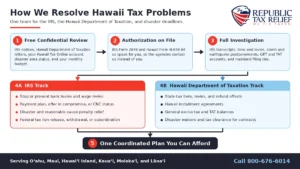
What happens after you call
- Free confidential consultation. A short call about your letters, any disaster deadlines, and your monthly budget.
- Authorization on file. We file IRS Form 2848 so the IRS contacts us instead of you, plus Hawaii Form N-848 for state matters.
- Full investigation. We pull IRS transcripts, check whether a postponement covers you, and review your Hawaii Tax Online account for GET, TAT, and income tax balances.
- Protection first. Where the law allows, we act to stop the IRS and Hawaii from levying while we build your case.
- One coordinated plan. We negotiate in the right order and explain every option in plain English.
| Common concern | How we handle it |
|---|---|
| “I don’t know if the storm relief covers me.” | We check your address of record, the tax periods, and the postponement dates, then ask the IRS to fix any penalties it charged in error. |
| “The IRS and Hawaii both want monthly payments.” | We build both plans from one household budget so the payments fit together. |
| “My vacation rental is behind on GET and TAT.” | We sort out every layer, state and county, and build a plan the property can carry. |
| “Can a California firm really help me in Hawaii?” | Yes. Federal representation works the same in every state, and we handle Hawaii matters under written authority. |
IRS Tax Relief in Honolulu and on Every Island in Hawaii
A hotel manager in Waikiki, a rancher in Waimea, and a retiree in Kihei face very different IRS problems. We start with Honolulu, then cover every county in the state.
Focus City: Honolulu and Oahu
Honolulu is Hawaii’s capital, home to the Hawaii Department of Taxation, the state’s federal courthouse, and most of the state’s population. The City and County of Honolulu covers all of Oahu, from Waikiki high-rises to North Shore farms, and each part of the island brings its own tax issues.
Hotel staff, restaurant owners, and condo rental owners.
Military families, working households, and multigenerational homes.
New homeowners, commuters, and 1099 earners with missed estimates.
Small business owners, surf and tour operators, and retirees.
Islands and Regions We Serve Across Hawaii
Maui: Central, South, and Upcountry
Towns: Kahului, Wailuku, Kihei, Wailea, Makawao, Pukalani, Paia
Resort workers, vacation rental owners, and storm-affected Upcountry households.
West Maui
Towns: Lahaina, Kaanapali, Napili, Kapalua
Wildfire survivors, rebuilding contractors, and displaced business owners.
Hawaii Island: East Side
Towns: Hilo, Pahoa, Keaau, Volcano, Honokaa
Earthquake-affected households, farmers, and University of Hawaii staff.
Hawaii Island: Kona and Kohala
Towns: Kailua-Kona, Captain Cook, Waimea, Waikoloa, Hawi
Coffee growers, ranchers, resort staff, and retirees.
Kauai
Towns: Lihue, Kapaa, Princeville, Koloa, Poipu, Waimea, Hanapepe
Tour operators, vacation rental owners, and small farms.
Molokai and Lanai
Towns: Kaunakakai, Maunaloa, Lanai City
Rural families, resort workers, and residents far from any tax office.
Don’t see your town? We help taxpayers in all four Hawaii counties, on every inhabited island. Call 800-676-6014 and we will tell you right away whether we can help. You can also browse all of our service locations.
Expert Insight: The Risks of Handling Hawaii IRS Problems Alone or With AI
Island families are resourceful, and many try to sort out tax problems on their own before calling anyone. We respect that. But self-managed cases tend to go wrong in a few predictable ways, and some mistakes cannot be undone.
- Assuming disaster relief fixed everything. People hear that the IRS has announced relief and stop opening their mail. The old balance keeps growing, and the levy notice gets missed.
- Forgetting the state is not automatic. IRS disaster relief usually applies itself. Hawaii’s waiver usually has to be requested, and it often has a different deadline.
- Calling GET a sales tax. Owners who think customers owe the tax often never set it aside, then face years of GET and penalties at once.
- Fighting the clock. IRS phone hours for Hawaii follow Pacific time, so lines open in the dark. Hours on hold before work lead to rushed, incomplete answers on calls that matter.
- Trusting AI on Hawaii rules. Chatbots mix up federal and state disaster dates, describe GET as a retail sales tax, or invent a “Maui tax forgiveness program.” A confident wrong answer leads to a costly decision.
- Pasting private data into public tools. Uploading returns, bank statements, or your Social Security number to a free chatbot creates a privacy risk you cannot take back. AI also cannot sign a power of attorney, pull transcripts, or talk to a revenue officer.
Our take: AI is fine for learning what a term means. A licensed enrolled agent, CPA, or tax attorney should make the decisions and give the advice. We explain why in Can AI get a better settlement than a tax attorney?
Want to learn more first? Read our common IRS notices guide, IRS tax relief insights, and IRS collections defense.
Why Hawaii Taxpayers Choose Republic Tax Relief
Hiring help with tax debt is a trust decision. Since 2005, founding partner Mark Ladd and our in-house team of enrolled agents, CPAs, and tax attorneys have helped individuals and businesses resolve IRS and state tax problems. We work every case ourselves, with no outsourcing.
| Cases resolved | 18,000+ |
| Client balances settled | $220M+ |
| Average client rating | 4.9 / 5 |
| Credentials | Enrolled agents, CPAs, and tax attorneys |
| Scheduling | Hawaii-friendly morning and midday call windows |
| Languages | English and Spanish |
- Federal and Hawaii handled together. One team, one budget, one plan for every agency.
- Disaster-aware case reviews. We check every postponement window before we accept a single penalty as correct.
- We know GET and TAT. State and county layers shape how we sequence a business case.
- Mainland move experience. Nevada, California, Washington, and Oregon balances are part of our everyday work.
- Honest answers. If a settlement is not realistic, we say so and show you a better path.
- Recognized work. See our awards and recognition.
Results vary based on each taxpayer’s facts and finances. Past results do not guarantee a similar outcome.
Encrypted files. Sealed lips. Island peace of mind.
Hawaii IRS Tax Relief Frequently Asked Questions
Can you help me if you don’t have an office in Hawaii?
Yes. IRS cases are handled by phone, mail, and secure online systems, and we represent you under a signed power of attorney. Our team works from California and serves clients in all four Hawaii counties.
Does IRS disaster relief erase the taxes I already owe?
No. Disaster relief postpones filing and payment deadlines that fall inside the relief window and removes late penalties for those dates. It does not reduce balances from earlier years, but a disaster can support other relief, such as reasonable cause penalty abatement or a hardship status.
I live on the Big Island. What does the earthquake relief cover?
The IRS postponed many federal filing and payment deadlines for Hawaii County taxpayers to Feb. 1, 2027, for dates falling on or after May 22, 2026. It covers extended returns and quarterly filings in that window, but not last year’s balance due payment from April.
I moved after the storms. How do I get disaster relief?
The IRS applies relief by your address of record. If that address is outside the covered disaster area but you were affected, or your records were there, call IRS Special Services at 866-562-5227, or let us request the relief for you.
Is the Hawaii general excise tax the same as a sales tax?
No. GET is a tax on the business’s gross receipts, including most services. Businesses may pass the cost along, but the business owes the tax either way and must file even in a year with no income.
Can Hawaii collect my state tax debt if I move to the mainland?
Yes. Moving does not end a Hawaii tax debt. The state can keep refunds, file liens, and has sought outside law firms to enforce Hawaii tax liens out of state.
Can you handle my Hawaii state tax debt and my IRS debt together?
Yes. We review both balances, build one household budget, and negotiate with the IRS and the Hawaii Department of Taxation in the right order so the two plans fit together.
Can the IRS take my wages or bank account in Hawaii?
Yes. After the required notices, including a final notice of intent to levy, the IRS can levy wages, bank accounts, and other assets. Acting before that final notice expires keeps the most options open, including the right to a hearing.
What should I bring to my free consultation?
Any IRS or Hawaii letters, your latest tax return if you have one, and a rough idea of your monthly income and bills. If records were lost in a storm or fire, that is fine. We can request IRS transcripts for you.
More answers: tax relief questions, penalty abatement questions, IRS payment plan questions, and business tax debt questions.
Sources
- IRS: Tax Relief for Taxpayers Impacted by Severe Storms in the State of Hawaii
- IRS: Tax Relief for Taxpayers Impacted by the Earthquake in Hawaii County
- U.S. Attorney’s Office, District of Hawaii: Hawaii Couple Sentenced for Tax Violations
Republic Tax Relief is a private firm and is not affiliated with the IRS, the Hawaii Department of Taxation, or any Hawaii county. This page offers general guidance, not legal or tax advice for your specific situation. Tax laws, disaster deadlines, and agency procedures change, so consult a qualified tax professional or contact the IRS directly before acting.
Free Consultation: Speak With a Tax Relief Professional About Your Hawaii Tax Debt
Storm season ends. Tax letters don’t. Let us answer them for you.
Whether the letter came from the IRS, the Hawaii Department of Taxation, or a mainland state, a short call can show you where you stand, whether disaster relief applies, and which options fit. Your consultation is free and confidential.
About Republic Tax Relief
Republic Tax Relief helps individuals and businesses nationwide resolve IRS and state tax problems, including back taxes, levies, liens, unfiled returns, audits, and payroll tax debt. Since 2005, our in-house team of enrolled agents, CPAs, and tax attorneys has resolved more than 18,000 cases. From our offices in Corona and Laguna Hills, California, we represent clients in all 50 states, including Hawaii. Call 800-676-6014 or contact us online for a free, confidential consultation.