
From the Columbia River to the Klamath Basin
Oregon Tax Relief: Help With IRS Back Taxes, Department of Revenue Tax Debt, Penalty Bills, and Settlement Options for Every Family and Business That Owes
A distraint warrant recorded at the county clerk. A garnishment notice at work. A kicker credit you were counting on, kept to pay an old balance. We take over the calls, move to protect your paycheck and bank account where the law allows, and build a plan that fits your real budget.
Tech workers in Hillsboro, nurses in Salem, contractors in Bend, and growers in the Rogue Valley work with our tax relief service by phone, video, and secure upload.
Federal, state, and Metro area taxes
W-2, 1099, payroll, CAT, and corporate
In-house team since 2005
Spanish-speaking clients welcome
Oregon has no sales tax, so the state leans hard on personal income tax. That makes Oregon one of the most expensive places in the country to fall behind on an income tax return. When the federal return goes unfiled or unpaid, the Oregon bill almost always follows, with its own penalties stacking on top.
Republic Tax Relief offers Oregon tax relief for individuals and business owners who owe the IRS, the Oregon Department of Revenue, or both. Our enrolled agents, CPAs, and tax attorneys work from our California offices as one coordinated team, and we serve Portland and every corner of the state.
On This Page
- Why Oregon Taxpayers Owe Federal and State Income Tax Together
- Portland’s Extra Layer: Metro SHS and Preschool for All Income Tax
- How Oregon Penalties and Interest Grow When You Don’t File or Pay
- Oregon Department of Revenue Collection and Garnishments
- Kicker Credit, Tax Credits, and Refund Offsets on Your Account
- IRS vs. Oregon Department of Revenue Compared
- IRS Payment and Settlement Options for Oregon Taxpayers
- Oregon Settlement Offers, Payment Plans, and Penalty Waivers
- Corporate, CAT, and Payroll Tax Debt Help for Oregon Businesses
- How We Help Oregon Taxpayers Without a Local Office
- IRS Tax Relief in Portland and Every Oregon Region
- Expert Insight: DIY and AI Risks With IRS Tax Problems
- Why Oregon Taxpayers Choose Republic Tax Relief
- Frequently Asked Questions
- Contact Us and Speak With a Tax Relief Professional
Why an Oregon Taxpayer Often Owes Federal and Oregon Income Tax at the Same Time
Your Oregon personal income tax return starts with the income reported on your federal income tax return. If the federal return is late or wrong, the Oregon return almost always is too. When the IRS later changes your income, Oregon can use that same change to bill you for more state tax.
Because Oregon’s top income tax rates are among the highest in the nation, even a modest IRS adjustment can create a real state balance. These are the patterns we see most often:
- Vancouver, Washington residents who work in Portland. Washington has no income tax on wages, but Oregon taxes the wages you earn in Oregon. Many commuters never file an Oregon nonresident return until the bill arrives. If you live and work in Washington, see our Washington tax help page instead.
- Stock pay in the Silicon Forest. RSUs and stock sales at the big Hillsboro and Beaverton employers often get too little withholding, leaving a large federal and Oregon balance in April.
- Self-employed and 1099 income from Portland’s freelance, creative, and gig economy, where nobody withholds federal, state, or local tax for you.
- Several years of unfiled returns after a layoff, a divorce, a wildfire, or a business that stalled. Our unfiled tax returns service helps you catch up without guessing.
- Seasonal farm, timber, and fishing income in the Willamette Valley, Southern Oregon, and the coast that arrives in large lumps and skips estimated payments.
- Missing the April 15 deadline. Oregon’s due date matches the federal one, so one missed tax season creates two late returns at once.
Not sure what you owe or to whom? Our back tax help starts by pulling your records and confirming each balance, agency, and year involved.
Your story stays between you and your case team. Every detail you share is protected under attorney-client and tax professional privilege standards and released only to the agencies negotiating your case.
Portland’s Extra Layer: Metro SHS and Preschool for All Income Tax You May Not Know You Owe
Most states stop at federal and state income tax. The Portland area does not. Higher earners in the Metro district can owe a Supportive Housing Services (SHS) personal income tax, and Multnomah County residents can also owe a Preschool for All (PFA) personal income tax.
Neither tax is collected by the Oregon Department of Revenue. The City of Portland Revenue Division runs both for Metro and Multnomah County, and each one needs its own separate return and payment (City of Portland Revenue Division: Personal Tax).
| Tax | Who it reaches | Who collects it |
|---|---|---|
| Oregon personal income tax | Residents, plus nonresidents on Oregon-source income | Oregon Department of Revenue |
| Metro SHS income tax | Higher earners living in the Metro district or with Metro-source income | City of Portland Revenue Division |
| Multnomah County PFA income tax | Higher earners living in Multnomah County or with county-source income | City of Portland Revenue Division |
| Statewide and local transit taxes | Wages, plus self-employed people in the TriMet and Lane Transit districts | Oregon Department of Revenue |
Income thresholds and rates for SHS and PFA change over time, so we check the current figures for each open year. Self-employed people and Washington commuters are hit hardest, because no employer is withholding these local taxes for them.
Why this matters for your plan: Settling with the IRS and Salem while a Portland Revenue Division balance keeps growing is not a real fix. Every collector has to fit inside one budget.
How Oregon Penalties and Interest Climb When You Don’t File or Pay
Oregon’s late penalties stack in layers, and the later you file, the bigger each layer gets. The Department of Revenue lists them on its penalty waiver page (Oregon Department of Revenue: Penalty Waivers).
| What happened | Oregon penalty on unpaid tax |
|---|---|
| Tax not paid by the due date | 5% failure-to-pay penalty |
| Return filed more than 3 months late | An extra 20% failure-to-file penalty |
| Still not filed within 30 days of a Notice of Determination and Assessment | An extra 25%, bringing the filing penalty to about 50% |
| No return filed for three years in a row | A 100% penalty for the third year |
Simplified summary. Interest is charged on top of penalties, and the exact total depends on your account history.
Practical tip: If Oregon has filed a return for you based on its own estimate, the 30-day window after that notice is the most expensive deadline on this page. File, or call us, before it closes, even if you cannot pay yet.
Oregon Department of Revenue Collection: Warrants, Garnishments, Offsets, and License Suspension
The Department of Revenue in Salem (often called the DOR) collects personal income tax, corporate taxes, withholding, and transit taxes. It also collects debts for other state agencies. Its collection tools go well beyond a letter in the mail (Oregon Department of Revenue: Collections Process When Owing Tax).
| Oregon collection action | What it means for you |
|---|---|
| Distraint warrant | Recorded in the county clerk lien record, it acts like a lien against your property and opens the door to other collection steps. |
| Wage garnishment | Your employer sends part of each paycheck to the state. |
| Bank garnishment | Money in your checking or savings account is frozen and taken. |
| Refund offset | State refunds, including the kicker, can be kept and applied to what you owe. |
| Professional license suspension | State-issued professional licenses can be suspended over unpaid tax. |
| Delinquent taxpayer list | Large unpaid balances can be published by name. |
| Business seizures and collection agencies | Cash from business registers can be seized, and older accounts can be sent to private collection agencies. |
Making payments is not the same as stopping garnishments
Sending money on your own does not always stop collection. Oregon generally needs an approved payment plan before it will hold off on garnishments, and refunds can still be offset while you are on a plan.
Why a recorded warrant hurts more than it sounds
A warrant on public record can block a refinance, slow down a home sale in a tight Portland or Bend market, and scare off lenders for a business. Clearing the balance or getting it into an approved arrangement is the first step toward getting it released.
See how we handle wage garnishment relief, bank levy help, and tax lien help.
Your Kicker Credit, Tax Credits for Your Family, and Refund Offsets on Your Account
Oregon is the only state with a kicker. When state revenue beats the official estimate by more than 2% over a two-year budget, the surplus goes back to taxpayers as a refundable credit. It is figured from your prior year Oregon tax liability, and you have to file both returns to claim it.
- The kicker can be offset. If you owe the Department of Revenue, your kicker can be applied to that debt instead of reaching your bank account.
- Not filing can cost you the kicker. Missing the required return means missing the credit, which is one more reason to catch up on unfiled years.
- Some people donate it. Taxpayers can choose to make a contribution of their kicker to the state school fund instead of keeping it.
Tax credits that low-income and working families often miss
Many families who owe back taxes are also eligible for credits they never claimed. Oregon offers an earned income credit, the Working Family Household and Dependent Care Credit, and the Oregon Kids Credit for low-income households with young children.
A missed refundable credit on an unfiled return can shrink or wipe out what a family in Oregon thinks it owes. We review these tax credits every time we prepare back returns, so you are not paying more than the law requires.
A note regarding property tax
Property tax in Oregon is billed and collected by your county, not the Department of Revenue. The state does run a property tax deferral program for qualifying seniors and people with disabilities. If a county property tax bill is part of your squeeze, we factor it into your budget so it does not undercut your income tax plan.
IRS vs. Oregon Department of Revenue: Federal and State Collection Side by Side
The Internal Revenue Service and the Oregon Department of Revenue follow different rules and timelines. Seeing them together shows why a plan that covers only one agency rarely holds up.
| Collection step | IRS (federal tax) | Oregon DOR (state tax) |
|---|---|---|
| Filing deadline | April 15 for most individuals | April 15 for personal income tax |
| Lien | Notice of Federal Tax Lien | Distraint warrant recorded with the county clerk |
| Wages and bank | Levies after a final notice of intent to levy | Wage and bank garnishments |
| Refunds | Federal refunds offset against federal debt | State refunds and kicker offset, even during a plan |
| Paying over time | Installment agreement | Payment plan through Revenue Online or by phone |
| Settling for less | Offer in compromise | Settlement offer |
| Penalty relief | First-time abatement or reasonable cause | Penalty waiver request |
| Extra pressure | Passport certification for seriously delinquent debt | License suspension and public delinquent list |
Oregon and the IRS do not coordinate their deadlines for you. Learn how our IRS collections defense works and read our guide to common IRS notices.
IRS Payment and Settlement Options for Oregon Taxpayers: Which Option Fits
No single program is right for every federal tax debt. The best option depends on your income, monthly expense, equity, and how much time is left on the IRS’s collection clock.
| Relief option | What it does | Often fits |
|---|---|---|
| Installment agreement | Monthly payments while levies are held off | Steady income but no way to pay in full |
| Offer in compromise | Settles the debt for less based on ability to pay | Low income and equity compared with the total owed |
| Currently Not Collectible | Pauses collection during hardship | Income that barely covers basic living costs |
| Penalty abatement | Removes penalties for a clean history or reasonable cause | Wildfire, ice storm, serious illness, or a death in the family |
| Innocent spouse relief | Separates you from a spouse’s tax debt | Errors or unpaid tax caused by a current or former spouse |
When you need to pay over time
Most people who cannot pay in full can get an IRS payment plan. Lower monthly payments can require more financial disclosure, and interest keeps running either way. Read how IRS payment plans work, or see when Currently Not Collectible status makes more sense.
How an IRS settlement is judged
The IRS weighs your income, allowable expenses, and equity in a home, vehicles, land, or retirement accounts. Rising home values in the Portland area and Central Oregon have sunk many offers that looked good on paper, so we test the numbers before anything is filed. Learn how the OIC program works.
Penalty relief after wildfires and storms
Oregon wildfires and winter storms have led to federal disaster declarations. When the IRS announces relief for listed counties, filing and payment deadlines are postponed automatically. We confirm that postponement was applied to your account before we ask for any other penalty relief. Explore IRS penalty abatement and the four types of innocent spouse relief.
For the bigger picture, see our tax debt relief options and the IRS Fresh Start Program.
Oregon Settlement Offers, Payment Plans, and Penalty Waivers With the Oregon Department of Revenue
Oregon has its own versions of the federal programs, with their own forms and rules. The state has said its settlement decisions often differ from the IRS when it looks at a taxpayer’s ability to pay, so a federal approval does not guarantee a state one.
- Payment plans. Many plans can be set up through Revenue Online or by phone. Shorter plans are usually easier to get approved, while longer ones may need more financial detail.
- Settlement offers. For people who owe more tax than they can pay, and not everyone will qualify. The program is built mainly for individuals, it is not available while you have an open appeal, and approval comes with a three-year compliance period after the final payment.
- Penalty waivers. Oregon can waive some penalties for a good filing history or reasonable cause, such as a serious illness or a disaster. Requests can be made through Revenue Online or in writing.
- Hardship review. When even a small payment is not possible, the department can look at your full financial picture before deciding what to collect.
Practical tip: Oregon adds a penalty for repeated bounced payments. Never pick a monthly amount you cannot cover. We build plans around a realistic budget so the agreement does not create a new problem.
If you disagree with an Oregon assessment itself, appeals go through the department and then the Oregon Tax Court. Deadlines for appeals are short, so share any notice with us right away. Read our tax settlement insights to learn more.
Corporate, CAT, and Payroll Tax Debt Help for Oregon Businesses
Oregon businesses face a tax mix you will not find in most states. There is no sales tax to collect, but there is a gross receipts tax, a corporate excise tax, transit payroll taxes, and payroll programs that run through more than one agency.
- Corporate Activity Tax (CAT). Businesses must register once Oregon commercial activity reaches $750,000. Tax is owed on taxable activity over $1 million, at $250 plus 0.57% of the amount above that line.
- Corporate excise and income tax. C corporations pay Oregon corporate tax, including a minimum tax tied to Oregon sales, even in a loss year.
- Payroll and withholding. State withholding, transit taxes, and Paid Leave Oregon contribution amounts all have to be reported and paid on time. Unpaid trust fund taxes can follow owners personally. Start with payroll tax debt relief.
- Cannabis retailers and growers. Oregon dispensaries juggle the state marijuana retail tax and federal rules that have long limited normal business deductions, which leaves many owing far more federal tax than expected.
The Oregon businesses we help most often include:
- Builders and trades in fast-growing Bend, Redmond, and the Portland suburbs. See construction tax resolution.
- Restaurants, breweries, and food carts in Portland and Eugene, juggling tipped payroll and thin margins. Read our restaurant tax resolution insights.
- Wineries, nurseries, and farms in the Willamette Valley and Hood River with uneven seasonal income.
- Physicians and practice owners tied to major health systems in Portland, Salem, and Medford. See tax resolution for medical professionals.
- Online sellers and real estate investors with income in more than one state. See e-commerce tax resolution and real estate tax resolution.
Facing an audit instead of a balance? With representation in place, the examiner contacts us instead of you. See our business audit help, business tax resolution services, small business tax relief, and business tax debt relief.
Upload with confidence. Every return, Social Security number, and bank statement you send is locked behind bank-grade 256-bit encryption and kept in full compliance with federal data protection standards.
How Our Tax Professionals Provide Assistance to Oregon Taxpayers Without a Local Office
To be direct: we do not have an Oregon office. Our team works from our offices in Corona, California and Laguna Hills, California. The good news for Oregon clients is that we share the same Pacific time zone, so our business hours are your business hours.
You do not need a firm on a downtown Portland street corner to fix an IRS problem. Federal cases are handled by phone, mail, fax, and secure online systems, and the IRS works with authorized representatives from any state. Oregon also lets you authorize a representative to speak for you.
Free programs like VITA and low-income taxpayer clinics are a good fit for a simple current return or a small dispute. Negotiating a large balance across several agencies is a different job, and our CPAs, enrolled agents, and tax attorneys handle each part with the right professional.
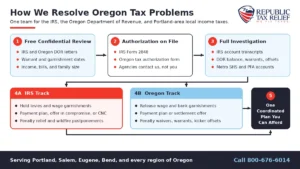
What working with us looks like
- Free confidential consultation. A short call about your letters, deadlines, and budget.
- Authorization on file. We file IRS Form 2848 and Oregon’s authorization form so both agencies call us instead of you.
- Full investigation. We pull IRS transcripts, review your Oregon account, warrants, and offsets, and check Portland Revenue Division balances.
- Protection first. Where the law allows, we act to stop or prevent levies and garnishments while we build your case.
- One coordinated plan. We negotiate each agency together and explain every option in plain English.
| Common concern | How we handle it |
|---|---|
| “I live in Vancouver. Why is Oregon billing me?” | Oregon taxes wages earned in Oregon. We confirm which years are open, file the nonresident returns, and check Metro and county taxes on that income. |
| “Oregon kept my kicker.” | We confirm the offset was applied correctly and work to stop the balance from eating future refunds. |
| “I hold a state license and got a suspension warning.” | We move quickly to get an approved arrangement in place so your ability to work is protected. |
| “Can a California firm really help me?” | Yes. Federal representation works the same everywhere, and Oregon accepts authorized representatives. |
IRS Tax Relief in Portland and Every Oregon Region
A software engineer in Hillsboro, a vineyard owner in Yamhill County, and a retired mill worker in Roseburg face very different tax problems. We start with Portland, where we work with the most Oregon clients, then cover every region of the state.
Our Focus City: Portland
Oregon’s largest city stacks federal tax, Oregon income tax, Metro SHS, Multnomah County Preschool for All, and transit taxes onto one paycheck. That is why Portland cases are rarely a one-agency problem.
Professionals and tech workers with stock pay and layered local tax.
Working families, trades, and small shops balancing garnishments and payment plans.
Port, warehouse, and logistics workers, plus Vancouver commuters crossing the I-5 and I-205 bridges.
Regions We Serve Across Oregon
Portland Metro
Cities: Portland, Gresham, Hillsboro, Beaverton, Tigard, Lake Oswego, Tualatin, Oregon City, Happy Valley, West Linn
Tech, healthcare, and logistics workers. Metro and county income taxes and Washington commuters drive many balances.
Willamette Valley
Cities: Salem, Keizer, Eugene, Springfield, Corvallis, Albany, McMinnville, Woodburn
State employees in Salem, university towns, wineries, and farms with seasonal income and estimated payment gaps.
Central Oregon
Cities: Bend, Redmond, Prineville, Sisters, La Pine, Madras
Builders, short-term rental owners, and remote workers. Fast-rising home equity often shapes settlement options.
Southern Oregon
Cities: Medford, Ashland, Grants Pass, Roseburg, Klamath Falls, Central Point
Growers, healthcare staff, and retirees. Wildfire recovery has left some taxpayers with missed years to sort out.
Oregon Coast
Cities: Astoria, Seaside, Tillamook, Lincoln City, Newport, Florence, Coos Bay, Brookings
Fishing, tourism, and hospitality income that swings with the seasons and rarely has tax withheld.
Columbia Gorge and Eastern Oregon
Cities: Hood River, The Dalles, Pendleton, Hermiston, La Grande, Baker City, Ontario
Orchards, ranches, food processing, and data center construction. Idaho and Washington border income adds multi-state filing.
Don’t see your town? We help taxpayers throughout Oregon. Call 800-676-6014 and we will tell you right away whether we can help. You can also browse our other service locations.
Expert Insight: The Risks of Dealing With IRS Tax Problems Alone or With AI
Most of our Oregon clients tried to fix things on their own first. That is normal. But self-handled cases tend to go wrong in a few predictable ways, and each one narrows your options.
- Paying one collector and forgetting two others. We meet Portland clients who set up plans with the IRS and Salem, then got a separate bill from the Portland Revenue Division for SHS or PFA tax they never knew existed.
- Counting on the kicker to cover a balance. The kicker only comes in certain years, and it can be offset before you see it. Building a plan around it is a gamble.
- Letting the 30-day window pass. Ignoring a Notice of Determination and Assessment can push the late filing penalty toward 50% of the unpaid tax.
- Mixing up federal and state programs. AI chatbots often blend the IRS offer in compromise with Oregon’s settlement offer. The forms, rules, and math are different, and an approval from one does not bind the other.
- Trusting an AI answer about local tax. SHS and PFA thresholds and rates change, and general AI tools often quote the wrong figure for the year you are fixing.
- Pasting sensitive data into public tools. Uploading your Social Security number, W-2s, or tax letters to a free chatbot creates privacy risk you cannot take back. AI also cannot pull transcripts, sign a power of attorney, or speak for you.
Our take: AI is a fine way to learn what a term means. A licensed tax attorney, CPA, or enrolled agent should make the decisions and sign the paperwork. We explain why in Can AI get a better settlement than a tax attorney?
Want to understand your choices first? Read IRS payment plans explained and our tax negotiation insights.
Why Oregon Taxpayers Choose Republic Tax Relief
Hiring help with tax debt is a trust decision. Since 2005, founding partner Mark Ladd and our in-house team have helped individuals and businesses resolve IRS and state tax liability. We work every case ourselves, with no outsourcing.
| Cases resolved | 18,000+ |
| Client balances settled | $220M+ |
| Average client rating | 4.9 / 5 |
| Credentials | Enrolled agents, CPAs, and tax attorneys |
| Time zone | Pacific, the same as Oregon |
| Languages | English and Spanish |
- One team for every level. IRS, Oregon, and Portland-area balances handled together, not by three different offices.
- We know Oregon’s pressure points. Warrants, garnishments, kicker offsets, and the 30-day assessment window shape how fast we move.
- Honest answers. If a settlement is not realistic, we say so and show you a better path.
- Recognized work. See our awards and recognition.
Clients often tell us the worst part was not knowing what came next. Once we are on your case, dealing with the IRS and Salem becomes our job instead of yours.
Results vary based on each taxpayer’s facts and finances. Past results do not guarantee a similar outcome.
Locked down, not passed around. Your documents stay encrypted, privileged, and private from first upload to final resolution.
Oregon Tax Relief Frequently Asked Questions
Can you help me if you don’t have an office in Oregon?
Yes. Federal and state cases are handled by phone, mail, and secure online systems, and we represent you under a signed authorization. Our team works from California, in the same Pacific time zone, and serves clients throughout Oregon.
Does Oregon have an offer in compromise for state tax debt?
Oregon’s version is called a settlement offer. It is meant for people who owe more tax than they can pay, it is not available during an open appeal, and Oregon’s decision can differ from the IRS even when both look at the same finances.
Can the Oregon Department of Revenue garnish my wages or bank account?
Yes. The department can garnish wages, bank accounts, and other payments owed to you, and it can record a distraint warrant with your county clerk. An approved payment plan is usually what stops further collection.
Will Oregon keep my kicker if I owe back taxes?
It can. The kicker is a refundable credit, and the Department of Revenue can apply it to money you owe. Refunds can be offset even while you are on a payment plan.
I live in Vancouver, Washington, and work in Portland. Do I owe Oregon tax?
Usually, yes. Oregon taxes wages earned in Oregon even when you live in Washington, and higher earners may also owe Metro SHS or Multnomah County PFA tax on that income. Each open year should be reviewed.
Who collects the Metro SHS and Preschool for All taxes?
The City of Portland Revenue Division collects both, not the Oregon Department of Revenue. Each tax has its own return and payment, so an Oregon payment plan does not cover them.
Can Oregon waive penalties on my account?
Oregon can waive some penalties for a good filing history or reasonable cause, such as a serious illness or a disaster. Interest is generally not waived, and the request has to explain and document what happened.
What should I bring to my free consultation?
Any IRS, Oregon Department of Revenue, or Portland Revenue Division letters, your latest tax return if you have one, and a rough idea of your monthly income and bills. Missing documents are fine. We can request IRS transcripts and state records for you.
More answers: tax debt relief questions, wage garnishment questions, penalty abatement FAQs, and unfiled tax returns questions.
Sources
- Oregon Department of Revenue: Collections Process When Owing Tax
- Oregon Department of Revenue: Penalty Waivers
- City of Portland Revenue Division: Personal Tax
Republic Tax Relief is a private firm and is not affiliated with the IRS, the Oregon Department of Revenue, or the City of Portland Revenue Division. This page offers general guidance, not legal or tax advice for your specific situation. Tax laws and agency procedures change, so consult a qualified tax professional before acting.
Contact Us: Speak With a Tax Relief Professional About Your Oregon Tax Debt
Warrants and garnishments move fast. Your next step can be faster.
Whether the letter came from the IRS, Salem, or the Portland Revenue Division, one short call can show you where you stand and what to do next. Your consultation is free and confidential.
About Republic Tax Relief
Republic Tax Relief helps individuals and businesses nationwide resolve IRS and state tax problems, including back taxes, levies, liens, unfiled returns, and payroll tax debt. Since 2005, our in-house team of enrolled agents, CPAs, and tax attorneys has resolved more than 18,000 cases. From our offices in Corona and Laguna Hills, California, we represent clients in all 50 states, including Oregon. Call 800-676-6014 or contact us online for a free, confidential consultation.