
From Jackson to the Gulf Coast, the Delta, and the Hill Country
IRS Tax Relief for Mississippi Taxpayers: Fix Missed Deadlines, Unfiled Tax Returns, and Mississippi Tax Debt
In Mississippi, a tax bill runs on a short clock. You generally get 60 days after a state assessment before a public lien can reach everything you own in the state, and state wage levies are not held to the usual limits.
Farmers, shipyard crews, casino workers, state employees, and storm-hit families work with our team by phone, video, and secure upload. Nationwide reach, Central time hours.
Federal and state balances, one team
W-2, 1099, farm, and payroll filers
In-house team since 2005
Spanish-speaking clients welcome
Owing taxes in Mississippi usually means dealing with two separate collectors. The Internal Revenue Service wants the federal balance, and the Mississippi Department of Revenue wants the state balance. They do not share deadlines, payment rules, or settlement standards.
Republic Tax Relief helps individuals and businesses resolve both. Our licensed enrolled agents, CPAs, and tax attorneys work as one team from our California offices and represent taxpayers in all 82 Mississippi counties, from Hinds and Harrison to DeSoto and Washington.
On This Page
- Why Mississippi Taxpayers Fall Behind
- IRS Disaster Tax Relief for Mississippi
- IRS vs. Mississippi Department of Revenue
- Mississippi State Liens and Levies
- Mississippi Payment Plans and the IRS
- Mississippi Offer in Compromise Rules
- A Real Jackson IRS Case
- IRS Offers and Who May Qualify
- Mississippi Business Tax Debt
- Casinos, Retirement, and Border Filers
- Our Process Without a Local Office
- IRS Tax Relief in Jackson and Across Mississippi
- Expert Insight: DIY and AI Risks
- Why Mississippi Taxpayers Choose Republic Tax Relief
- Frequently Asked Questions
- Speak With a Tax Relief Professional
What brought you here today?
A State Assessment Arrived
The 60-day clock is running, even if you are still talking with an auditor.
See what happens next ↓
A Storm Hit Your County
Some deadlines may have moved. Others, like payroll deposits, usually do not.
Check what is postponed ↓
Your Bank or Paycheck Was Hit
This is the time to call, not read. Have the letter in hand.
800-676-6014
Why Mississippi Taxpayers End Up With Federal Tax and Mississippi Tax Owed
Most people who call us did not set out to avoid anything. A bad crop year, a storm, a layoff at the plant, or a 1099 with nothing withheld turned one missed tax payment into several.
These are the patterns we hear about most throughout Mississippi:
- Farm income that swings. Delta row crop and catfish operations can earn most of their income in one sale, then owe estimated tax on money already spent on seed, fuel, and equipment.
- Contract work on the Coast. Shipyard subcontractors, offshore crews, and charter captains may be paid on a 1099, so no one withholds federal or state tax.
- Timber, poultry, and trucking. Owner-operators often earn well on paper, then find depreciation and equipment payments did not line up with the tax year.
- Plant layoffs and overtime swings. Canton, Blue Springs, and Pascagoula paychecks can change fast, and a withdrawal from a retirement account during a layoff can add a federal bill.
- Unfiled returns after a death, a divorce, or a storm that destroyed the records. Our unfiled tax returns service brings missing federal and state returns current before more penalties build.
Not sure what you owe or for which years? Our back tax help confirms each balance before anyone makes promises about your tax liability.
Mississippi lawmakers have been cutting the state income tax rate, and more cuts are planned. Lower future rates do not reduce an old bill. Past years are still owed at the rates that applied then, plus interest and penalties.
What you tell us stays with us. Every Mississippi case is handled under attorney-client and tax professional privilege standards, so you can be honest about what went wrong.
IRS Disaster Tax Relief for Mississippi: What Affected Taxpayers Should Check
Few states see tornadoes, flooding, ice storms, and tropical systems the way Mississippi does. When the Federal Emergency Management Agency issues a disaster declaration for parts of Mississippi, the Internal Revenue Service usually follows with a notice that postpones certain deadlines.
Those notices change often and name exact counties, so always confirm yours on the IRS disaster relief page for Mississippi. Applying for FEMA disaster assistance is a separate process, so look at what the IRS is offering for your own county and dates. Recent IRS notices have reached Gulf Coast counties after a tropical storm, southwest counties after severe storms, and other parts of the state after winter weather.
How tax relief in disaster situations works
When a storm is declared a federal disaster, the relief postpones various tax filing and payment deadlines for people in a covered disaster area. It moves dates. It does not reduce what you owe.
When the IRS announces tax relief: tax payments due and estimated tax
Here is what the relief includes, and where people get tripped up:
| What the IRS provides | What to watch for |
|---|---|
| More time for individual and business tax returns that fall due inside the relief window | The window has exact start and end dates. A return due one day before it starts is not covered. |
| A valid extension to file can be moved to the new date | An extension gives you more time to file your return, not more time to pay your tax. If your payment was due before the window opened, it may not qualify. |
| Estimated tax payments due inside the window are postponed | Payments are due in full on the new date, which can mean several tax payments due at once. |
| Penalty relief for filing and payment dates inside the window | Payroll and excise deposits usually get only a short grace period, not the full postponement. |
| Casualty loss options for a federally declared disaster | You may claim the loss on your federal income tax return for the disaster year or the year before, which can speed up a tax refund. |
Lost records and income tax forms after a storm
Records lost in a flood can often be rebuilt from IRS transcripts and income tax forms on file. The IRS waives its usual fees for copies of past returns when you put the FEMA declaration number on Form 4506 or 4506-T.
Who counts as disaster victims and affected taxpayers
Individuals who live in the area and businesses with a principal place of business there qualify. In general, the IRS automatically provides filing and penalty relief to anyone with an IRS address of record in a federally declared disaster area. If you moved, or your records were in the area but you were not, you may need to contact the IRS and explain.
Penalty relief when the IRS provides more time but a bill still arrives
- A late notice inside the window. The IRS says to call the number on the notice and ask to have the penalty removed.
- A collection or audit contact. Disaster victims should explain how the storm affected them so the IRS can take that into account.
- You did not qualify for tax relief. You may still ask for reasonable cause penalty relief.
- You took a disaster distribution. Special retirement plan rules may apply, and the income may be spread over three years.
- You owed from earlier years. Disaster relief moves deadlines. It does not erase tax already owed for other periods.
Does the Mississippi state deadline move too?
Often, yes. After recent storms, the Mississippi Department of Revenue said it would follow the federal extensions for Mississippi individual income tax returns, corporate income and franchise returns, pass-through returns, and quarterly estimated payments in the named counties. Separately, a federal extension of time to file also counts for your Mississippi return, but it does not extend the time to pay.
Read the type of tax on every notice. The state notices we reviewed list income and franchise filings. If yours does not mention sales tax or withholding, do not assume those due dates moved. Ask before you file late.
Need help only with a simple return? IRS Free File eligibility depends on your federal adjusted gross income, and VITA sites offer free tax preparation to those who qualify. VITA sites normally cannot help claim disaster losses, and they do not negotiate back taxes. That is where we come in.
Storm wrecked your records or your income? Let us sort out what is postponed and what is not.
IRS vs. Mississippi Department of Revenue: Tax Information Side by Side
The IRS collects federal tax. The Mississippi Department of Revenue (DOR) collects state tax. They use different forms, deadlines, and settlement rules, and some of the state rules are tougher than people expect.
| Issue | IRS | Mississippi DOR |
|---|---|---|
| Window to dispute | Usually 30 days to request a hearing after a final levy notice | 60 days from the Notice of Assessment to pay or appeal to the Review Board |
| Tax lien | Generally ends with the collection period, usually 10 years | Seven years, and it can be continued again and again until paid |
| Wage levy | Leaves you an exempt amount based on filing status and dependents | Usual garnishment limits do not apply to a state Distress Warrant, though DOR says it should usually take less than everything |
| Finding your bank | Levy notices with a 21-day bank hold | State law allows a quarterly electronic match with participating banks |
| Settlement test | Based on your reasonable collection potential | Debt at least four years old and over $3,000, decided by the Governor |
| How many settlements | No lifetime limit | Not eligible for a second compromise |
| Public record | Recorded liens are public, and limited details of accepted offers are open to inspection for a year | Lien registry is searchable by anyone, and an approved offer loses tax confidentiality |
We work both columns at once. See our IRS and state back tax relief services for how the two tracks fit together.
Mississippi State Collections: From a Missed Due Date to a Lien and Levy
Mississippi moves on a clear clock. Once a Notice of Assessment is mailed, the 60-day period is the most important date in your case.
| Stage | What it means for you |
|---|---|
| Late return or late payment | Interest runs at 1/2% per month. A late payment penalty of 1/2% per month can also apply, up to 25%. |
| Notice of Assessment | You have 60 days from the mailing date to pay or appeal. Talking with the auditor does not stop the clock. |
| Review Board appeal | A panel of DOR staff outside the audit group hears the case. Missing the hearing or written deadline withdraws your appeal. |
| Board of Tax Appeals, then Chancery Court | Each step has its own deadline, generally 60 days. At the Board, mailing your request by day 60 is not enough. It must be received. |
| State Tax Lien Registry | After the appeal period ends, a lien covers all your Mississippi property, including property you get later. Anyone can search it. |
| Distress Warrant | The state can levy wages, bank funds, and other money owed to you. |
A lien can stop a closing. DOR says you cannot sell property until a lien is paid and removed. It generally cancels a lien after full payment, by the next business day for cash, money order, or a cashier’s check, and within up to 15 days for other methods. Lien enrollment itself cannot be appealed.
Why a bank levy can feel sudden
Mississippi law sets up an automated data match. The state may send participating banks a quarterly file of people with enrolled tax debts, and the bank reports matching accounts and balances. A levy can follow, and it binds funds on deposit up to the warrant amount until the bank answers.
On the federal side, see IRS collections defense, bank levy help, wage garnishment relief, and tax lien help. Our guides to common IRS notices and wage garnishment explain the letters and the timing.
Got a Notice of Assessment? Your 60 days started when it was mailed.
Mississippi Individual Income Tax Returns and Payment Plans: Why the IRS Often Goes First
This is one of the most useful Mississippi rules to know, and one of the easiest to get backward. The state installment agreement filed with an individual income tax return has two tracks:
| Amount owed on the return | Payment term | Key condition |
|---|---|---|
| $75 to $3,000 | 12 equal monthly payments | Clean filing and payment history for five years, and no installment agreement in the past five years |
| More than $3,000 | Up to 60 months | The same history, plus an approved IRS installment agreement for the same tax year |
- Timing matters. The form goes with a return filed by its due date or valid extension.
- The IRS approval has to exist first. You must attach the approved IRS notification, so the order of the two cases can decide whether a 60-month term is available.
- One slip can end it. DOR may terminate the agreement if a payment is late or another tax liability goes unpaid when due.
- Interest keeps running at 1/2% per month, so ask for a final payoff figure before the last payment.
Balances already assessed or in collection may need a different arrangement with DOR, so we confirm which path applies. For the federal side, see IRS payment plans and our IRS payment plan questions page.
Mississippi Tax Relief Through an Offer in Compromise: A Narrow Door
Mississippi can settle a tax debt for less than the full amount, but the state calls this a step for extraordinary circumstances. The Governor, on the advice of the Commissioner of Revenue, makes the call on a doubtful claim.
Who Can Apply
All required returns must be filed. The debt must be over $3,000, and no period under four years old can be included. An open bankruptcy disqualifies you.
Who Is Shut Out
Collected but unpaid trust fund taxes, debts from criminal activity, and anyone who already received a state compromise for another tax liability.
The Starting Math
The minimum offer should be your monthly disposable income times 12, plus the market value of your assets. Some home, vehicle, and personal property equity is left out.
The fine print that surprises people
- Money up front. You send the greater of $100 or 20% of the offer. It is nonrefundable and goes toward your debt either way.
- No appeal. If the offer is not accepted, you cannot appeal that decision.
- Collection does not pause. Liens stay in place, and interest and penalties keep growing while it is reviewed.
- Refunds are kept. DOR keeps any refund for tax periods through the calendar year of the offer.
- Privacy is limited. You must sign a notarized waiver, and an approved offer is not protected by state tax confidentiality.
- Heavy paperwork. Expect 12 months of bank statements, a recent credit report, and at least two loan denials (Mississippi DOR: Offer in Compromise Instructions).
Because a Mississippi taxpayer generally gets one shot, a weak or early offer can waste the only chance. We run the numbers before you send a dollar.
Learn how the federal program differs in how the Offer in Compromise program works and the IRS Offer in Compromise questions page.
A Real Jackson IRS Case: When a Tax Preparer Files False Returns
Most tax debt is a money problem, not a crime. But people in Jackson learned that who fills out your return matters a great deal.
The case: Workers at a Jackson return preparation business claimed inflated refunds for clients, using false education credits, itemized deductions, and business profits or losses. Over the years, they prepared thousands of fraudulent returns, causing more than $3.5 million in tax loss.
The outcome: A federal court sentenced those convicted to prison terms that reached 100 months (IRS Criminal Investigation).
The lesson: You sign your return, so you are generally responsible for what is on it. If an unusually large refund later turned into an IRS letter, have a licensed professional review those years before you answer.
Received a letter about old refunds? Start with our IRS audit representation questions and IRS notices questions.
IRS Offers Tax Relief in Several Ways: Options, Mississippi Counterparts, and Who May Qualify
Federal options are often wider than state options. The right choice depends on your income, allowable expenses, assets, and how long each agency has to collect.
| IRS option | What it does | Mississippi counterpart | Often fits |
|---|---|---|---|
| Installment agreement | Monthly plan that holds off levies while you pay | Installment agreement, up to 60 months with an IRS plan | Salaried workers with steady pay |
| Offer in compromise | Settles for less than the full amount, if accepted | Doubtful claim settlement approved by the Governor | Limited income and few assets compared with the debt |
| Currently not collectible | Pauses collection during financial hardship | No formal program published; hardship is raised directly with DOR | Unemployed workers and seniors on fixed income |
| Penalty abatement | Removes penalties for a clean history or reasonable cause | Review Board appeal within 60 days, giving reasonable cause | Serious illness, a death in the family, or storm losses |
| Innocent spouse relief | Separates you from a spouse’s debt on a joint return | Handled separately with DOR | Errors or hidden income from a former spouse |
| Audit representation | We deal with the auditor so you do not have to | Review Board, Board of Tax Appeals, then Chancery Court | An audit letter or proposed bill |
For the bigger picture, see our complete guide to tax resolution services, our tax debt relief options, and the facts about the IRS Fresh Start Program.
Mississippi Business Tax Debt: Sales Tax, Withholding, and Personal Liability
Sales tax and payroll withholding are money you collected for someone else. Mississippi treats them that way, and so does the IRS through the Trust Fund Recovery Penalty.
- The state settlement door is mostly closed. Mississippi says collected but unpaid trust fund taxes generally make you ineligible for its compromise program.
- Owners can be personally responsible. DOR can treat an individual as a responsible person for a company’s tax debts.
- Buying a business can bring its debts. A buyer who failed to set aside money from the purchase price may be responsible for unpaid sales and withholding taxes.
- Permits are at stake. A suspended or revoked permit generally has a shorter 30-day appeal window.
- Payroll deposits rarely move in a storm. Check the disaster notice before you assume you have more time.
The Mississippi businesses we help most often include:
- Restaurants and catfish houses from Fondren to Bay St. Louis. Read our restaurant tax resolution insights.
- Builders and storm repair contractors. See construction tax resolution.
- Clinics and rural medical practices. See tax resolution for medical professionals.
- Landlords and real estate agents, including Coast vacation rental owners. See real estate tax resolution.
- Farms, timber, trucking, and oil field service companies. See business tax resolution services.
- Online sellers. See e-commerce tax resolution.
Behind on deposits? Start with payroll tax debt relief. Also see small business tax relief and business tax debt relief.
From Tupelo to Pascagoula, your documents get the same protection. Each return and statement you upload is guarded by bank-grade 256-bit encryption and full compliance with federal data protection and security standards.
Casinos, Retirement, Military Pay, and Border Filers: What Counts for Tax Purposes in Mississippi
A handful of Mississippi rules create problems that a general article will miss.
Casino Winnings
Mississippi casinos withhold a 3% state tax at payout, and residents do not report those winnings on the state return. The federal side is different. Your winnings still belong on your federal return, and the 3% does nothing to pay that tax.
Retirement Income
Mississippi generally does not tax qualifying retirement income, pensions, and annuities. Federal tax can still apply, so a Gulf Coast or Hill Country retiree can owe the IRS with no state bill at all.
Memphis Commuters
Mississippi residents report all income, wherever earned. Credit for tax paid elsewhere requires actual income tax paid to the other state. A DeSoto County resident working in Tennessee should check that Mississippi tax is being handled.
Louisiana and Alabama Work
Coast and river county workers may file in two states. The Mississippi credit requires a copy of the other state’s return, and a missing copy can turn into a state bill.
Guard, Reserve, and Base Families
Combat zone hazardous duty pay is exempt, and the first $15,000 of Guard or reserve salary is excluded for Mississippi. Keesler, Columbus, Meridian, and Camp Shelby families can still owe on spouse and side income.
No Return Filed
DOR generally reviews filed returns within 36 months. If no return was filed, there is no limit. A year you skipped can come back at any time.
Explore our neighboring guides for Alabama, Louisiana, Arkansas, and Tennessee.
Our Tax Resolution Process for Mississippi Taxpayers Without a Local Office
We want to be upfront: we do not have an office in Mississippi. Our team works from our offices in Corona, California and Laguna Hills, California, with calls scheduled around Central time.
That works because the IRS and DOR handle nearly all cases by phone, mail, and secure online systems, including the state Taxpayer Access Point. For someone in Clarksdale or Pass Christian, it also means no long drive to an office.
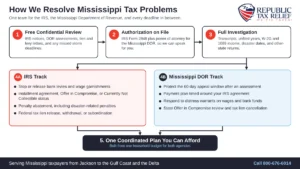
What happens after you call
- Confidential consultation. A short call about your letters, deadlines, and monthly budget.
- Authorization on file. We file IRS Form 2848 so the IRS contacts us instead of you, plus a power of attorney for DOR.
- Full investigation. We pull IRS transcripts, check unfiled years, W-2G and 1099 income, disaster dates, and other-state filings.
- Protection first. Where the law allows, we act to release levies and preserve appeal deadlines while we build your case.
- One coordinated plan. We negotiate in the right order and explain every option in plain English.
| Common concern | How we handle it |
|---|---|
| “The state took money from my bank account.” | We review the warrant, the underlying assessment, and what can still be done. |
| “The closing on my land is stuck because of a lien.” | We confirm the payoff and work out how the lien can be cleared before the sale. |
| “The IRS and the state both want monthly payments.” | We build both plans from one household budget so neither falls apart. |
| “Can a California firm really help me in Mississippi?” | Yes. IRS representation works the same everywhere, and we handle state matters under written authority. |
IRS Tax Relief in Jackson and Throughout Mississippi
A shipyard welder in Pascagoula, a farmer near Indianola, and a state employee in Jackson face very different tax problems. We start with Jackson, then cover every region of the state.
Focus Area: Jackson
The capital is home to the state agencies that send these letters and to many of the people who receive them. Medical center paychecks, government jobs, and small family businesses each bring their own tax questions.
State workers, attorneys, and medical center staff with side income.
Restaurant owners, boutique retailers, and independent professionals.
Home care workers, tradespeople, and families behind on unfiled years.
Commuters, consultants, small landlords, and business owners.
Mississippi Regions, Cities, and Towns We Serve
Metro Jackson and the Capital Area
Cities and towns: Jackson, Clinton, Ridgeland, Madison, Canton, Flowood, Brandon, Pearl, Byram, Richland
State employees, hospital staff, Canton auto plant workers, and small professional firms.
Mississippi Gulf Coast
Cities and towns: Gulfport, Biloxi, Pascagoula, Moss Point, Gautier, Ocean Springs, D’Iberville, Long Beach, Bay St. Louis
Shipyard crews, casino workers, Keesler personnel, charter and seafood businesses, and storm-affected households.
DeSoto County and North Mississippi
Cities and towns: Southaven, Olive Branch, Horn Lake, Hernando, Tunica, Oxford, Holly Springs
Memphis commuters, warehouse and logistics workers, casino winners, and university staff.
Northeast Mississippi and the Golden Triangle
Cities and towns: Tupelo, Corinth, New Albany, Columbus, Starkville, West Point
Furniture and auto supplier workers, Columbus Air Force Base families, and college staff.
Mississippi Delta
Cities and towns: Greenville, Greenwood, Clarksdale, Cleveland, Indianola, Yazoo City
Row crop and catfish farmers, agricultural suppliers, and family-owned shops.
Pine Belt and East Mississippi
Cities and towns: Hattiesburg, Laurel, Petal, Meridian, Philadelphia
Timber and poultry businesses, oil field contractors, nurses, and Camp Shelby and NAS Meridian families.
Southwest Mississippi and the River Counties
Cities and towns: Vicksburg, Natchez, McComb, Brookhaven, Crystal Springs
Federal and river industry workers, casino staff, contractors, and retirees.
Don’t see your town? We help taxpayers in all 82 Mississippi counties. Call 800-676-6014 and we will tell you right away whether we can help. You can also browse all of our service locations.
Expert Insight: Tax Attorney and Enrolled Agent Views on Handling IRS Problems Alone or With AI
Mississippi is a place where people fix their own trucks and settle things with a handshake. Tax collection does not reward that instinct, because the costly mistakes here are about order and timing.
- Filing the state plan before the IRS plan. The 60-month Mississippi term depends on an approved IRS agreement. Reverse the order and you may be stuck with far higher payments.
- Spending your only state offer too soon. A rejected offer cannot be appealed, your payment stays with the state, and an accepted one cannot be repeated.
- Trusting a phone call to stop the clock. Talking with an auditor does not extend the 60-day appeal period.
- Assuming a storm covers everything. Disaster notices list specific counties, dates, and taxes. Payroll deposits are a common trap.
- Moving assets to get away from a levy. Transfers can make a civil debt look like evasion, which is a much bigger problem.
- AI blends the rule books. Chatbots often apply IRS levy and settlement rules to Mississippi cases, or repeat deadlines from an expired disaster notice. A confident wrong answer can cost you an appeal right.
- Pasting private data into public tools. Uploading returns or your Social Security number to a free chatbot creates a privacy risk you cannot take back. AI also cannot sign a power of attorney or speak with a revenue officer.
Our take: AI is fine for learning what a term means. A licensed enrolled agent, CPA, or tax attorney should make the decisions. We explain why in Can AI get a better settlement than a tax attorney?
Want to read more first? Try our Offer in Compromise guide, IRS payment plans explained, and tax settlement insights.
Why Mississippi Taxpayers Choose Republic Tax Relief
Hiring help with tax debt is a trust decision. Since 2005, founding partner Mark Ladd and our in-house team of tax experts, including enrolled agents, CPAs, and tax attorneys, have helped individuals and businesses nationwide resolve IRS and state tax problems. We work every case ourselves, with no outsourcing.
| Cases resolved | 18,000+ |
| Client balances settled | $220M+ |
| Average client rating | 4.9 / 5 |
| Credentials | Enrolled agents, CPAs, and tax attorneys |
| Scheduling | Central time morning, lunch, and evening call windows |
| Languages | English and Spanish |
- Federal and state handled together. One team, one budget, one plan for the IRS and the Mississippi DOR.
- Sequence-aware. We plan the IRS and state steps so one does not close the door on the other.
- Settlement honesty. We compare a state offer against its cost, its privacy trade-off, and your other options.
- Deadlines tracked. We watch the IRS 30-day hearing window, the 60-day state appeal, and any disaster postponement dates.
- Honest answers. If a settlement is not realistic, we say so and show you a better path.
- Recognized work. See our awards and recognition.
Results vary based on each taxpayer’s facts and finances. Past results do not guarantee a similar outcome.
Southern hospitality. Vault-level security. Your file stays private.
Mississippi Tax Debt and IRS Tax Relief Frequently Asked Questions
Can you help me if you don’t have an office in Mississippi?
Yes. IRS and Mississippi Department of Revenue cases are handled by phone, mail, and secure online systems, and we work under signed power of attorney forms. Our team works from California and serves taxpayers throughout Mississippi, including Jackson.
I owe both the IRS and the Mississippi Department of Revenue. Can you handle both?
Yes. We confirm both balances, build one household budget, and work the two cases in the right order. That order matters in Mississippi because one state payment plan depends on having an approved IRS agreement for the same tax year.
How long do I have to appeal a Mississippi tax assessment?
You generally have 60 days from the date the Department of Revenue mailed or delivered the Notice of Assessment to pay or appeal to its Review Board. If you miss that window, the assessment generally becomes final and a state tax lien can follow.
How long does a Mississippi state tax lien last?
A lien enrolled on the State Tax Lien Registry lasts seven years, and the Department of Revenue can file continuations that add seven more years each time. It covers all property in Mississippi, including property you acquire later, and the registry is open to public search.
Can Mississippi garnish my whole paycheck for state taxes?
State rules say a Distress Warrant for state taxes is not bound by the usual garnishment limits, so entire disposable earnings can be subject to levy. The same rule says the amount taken should, in most cases, be less than the entire amount because of the hardship it causes.
Does Mississippi have an offer in compromise program?
Yes, but it is narrow. The debt must be at least four years old and more than $3,000, returns must be filed, and debts from collected but unpaid trust fund taxes generally do not qualify. The Governor, on the advice of the Commissioner of Revenue, decides whether to settle, and a person who already received a compromise cannot get a second one.
Can I get a 60-month payment plan with Mississippi?
The state installment agreement filed with your income tax return allows 60 months only when you owe more than $3,000 and have an approved IRS installment agreement for the same tax year. Balances from $75 to $3,000 are spread over 12 months. Other eligibility rules apply, including a clean five-year filing and payment history.
I live in a county covered by an IRS disaster declaration. Do I still owe my taxes?
Yes. Disaster relief postpones certain filing and payment deadlines, but it does not erase the tax. Check the exact covered counties and dates in the IRS announcement. If you received a late penalty notice for a date inside the postponement period, the IRS says to call the number on the notice.
Does a disaster extension from the IRS also apply to my Mississippi return?
Often, but not automatically for every type of tax. The Mississippi Department of Revenue has followed federal extensions for income tax filings after recent storms, and each state notice lists the taxes and counties it covers. Do not assume a sales or withholding deadline moved unless the notice says so.
What should I bring to my free consultation?
Any IRS or Mississippi Department of Revenue letters, your latest tax return if you have one, W-2s, 1099s, W-2G forms from casinos, and a rough idea of your monthly income and bills. If records are missing, we can request IRS transcripts for you.
More answers: tax resolution questions, tax debt relief questions, IRS collections defense questions, bank levy questions, and penalty abatement FAQs.
Sources
- Internal Revenue Service: Around the Nation, Mississippi Disaster Relief Announcements
- Mississippi Department of Revenue: Offer in Compromise Instructions for Individuals
- Mississippi Department of Revenue: State Tax Lien Registry
Republic Tax Relief is a private firm and is not affiliated with the IRS, the Mississippi Department of Revenue, the Federal Emergency Management Agency, the Mississippi Board of Tax Appeals, or any agency of the State of Mississippi. This page offers general guidance, not legal advice or tax advice for your specific situation. Tax law, deadlines, and agency procedures change, so consult a qualified tax professional or contact the agency directly before acting.
Speak With a Tax Relief Professional About Your Mississippi Tax Debt
Your paycheck, your land, and your peace of mind are worth protecting. Let’s start today.
Whether the letter came from the IRS or the Mississippi Department of Revenue, one short call shows you where you stand, what is at risk, and which options fit. Your consultation is free and confidential.
About Republic Tax Relief
Republic Tax Relief helps individuals and businesses nationwide resolve IRS and state tax problems, including back taxes, levies, liens, unfiled returns, audits, and payroll tax debt. Since 2005, our in-house team of enrolled agents, CPAs, and tax attorneys has resolved more than 18,000 cases. From our offices in Corona and Laguna Hills, California, we represent clients in all 50 states and the District of Columbia. Call 800-676-6014 or contact us online for a free, confidential consultation.