
From the Twin Cities to the Iron Range and the Red River Valley
Minnesota Tax Relief for Your IRS and State Tax Debt: IRS Tax Relief and Resolution Services for Any Tax Problem, Levy, Unfiled Return, or Penalty
A wage levy notice from St. Paul. An IRS letter that says your refund is gone. A professional license renewal that suddenly stalls because of an old state balance. We stand between you and both agencies, act to protect your paycheck and bank accounts where the law allows, and build a plan that fits your real budget.
Hospital staff in Rochester, contractors in the north metro, shop owners on Lake Street, and farm families near Moorhead work with our team by phone, video, and secure upload.
Federal and state balances, one plan
W-2, 1099, farm, and payroll filers
In-house team since 2005
Spanish-speaking clients welcome
Minnesota is a high-tax state with a revenue department that collects firmly and quickly. When a federal tax balance goes unpaid, a state balance is usually close behind, because your Minnesota return starts with the numbers on your federal return. That means two agencies, two sets of letters, and two collection clocks running at once.
Republic Tax Relief helps individuals and businesses who owe the IRS, the Minnesota Department of Revenue, or both. Our enrolled agents, CPAs, and tax attorneys work as one team from our California offices and represent clients in Minneapolis, St. Paul, and all 87 Minnesota counties.
On This Page
- Why Minnesota Taxpayers Owe the IRS and the State Together
- How the Minnesota Department of Revenue Collects
- Minnesota Offer in Compromise and Payment Agreement Rules
- A Minnesota IRS Case: Hidden Income and Unfiled Returns
- North Dakota, Wisconsin, and Cross-Border Income Tax
- IRS vs. Minnesota Department of Revenue Compared
- IRS Tax Relief Options for Minnesota Taxpayers
- Federal Changes, Property Tax Refunds, and Social Security
- IRS Disaster Relief After Minnesota Storms and Flooding
- Payroll, Sales Tax, and Business Tax Debt
- How We Help Minnesota Taxpayers Without a Local Office
- IRS Tax Relief in Minneapolis, St. Paul, and Every Region
- Expert Insight: DIY and AI Risks With IRS Tax Problems
- Why Minnesotans Choose Republic Tax Relief
- Frequently Asked Questions
- Contact Us for a Free Consultation
Why Minnesota Taxpayers Often Owe Federal Tax and Minnesota State Tax at the Same Time
Minnesota’s top state income tax rate is one of the highest in the country, so a missed payment grows faster here than in many states. And because the state return is built from your federal taxable income, a problem on one return almost always shows up on the other.
These are the patterns we see most among the Minnesotans who call us:
- Side income with nothing withheld. Rideshare and delivery drivers in the metro, travel nurses, consultants, and Etsy or Amazon sellers often get 1099s with no tax taken out at all.
- Missed estimated payments. Self-employed people, landlords, and retirees with investment income are expected to pay during the year. Skipping those payments adds a penalty on both returns.
- Old federal changes nobody reported. When the IRS adjusts your return, Minnesota expects to hear about it. If you never filed that report, a state bill can arrive years later. More on that below.
- Cross-border paychecks. Wages earned in Wisconsin, North Dakota, or Iowa can leave withholding in the wrong state while Minnesota still expects its share.
- Years of unfiled returns after a divorce, a layoff, an illness, or a business that faded out. Our unfiled tax returns service brings back years current and stops new penalties from stacking up.
Not sure what you owe or for which year? Our back tax help starts by confirming every balance with both agencies before anyone makes a promise.
What you tell us stays with us. Your case is protected under attorney-client and tax professional privilege standards, so the hard parts of your story are heard only by the professionals fixing it.
How the Minnesota Department of Revenue Collects Tax Debt: Levy, Lien, and License Actions
The Minnesota Department of Revenue (MDOR) works out of St. Paul, and it has more tools than many people expect. Once a balance stays unpaid after its notices, the department can move from letters to enforced collection.
The department lists these enforced collection actions: wage levies, bank levies, seizure and sale of property, revoking or denying a business or professional license, taking payments a state agency owes you as a vendor, and revoking a sales tax permit (Minnesota Department of Revenue: Enforced Collection Actions).
| Minnesota collection action | What it means for you |
|---|---|
| Wage levy | Your employer sends part of each paycheck to the state, and it can continue until the debt is paid or released. |
| Bank levy | Money in your bank accounts can be frozen and taken, often with little time to react. |
| State tax lien | A public claim on your property that can block a sale, a refinance, or a business loan. |
| License revocation or denial | Nurses, contractors, real estate agents, and other licensed workers can lose or be denied a license renewal. |
| Sales tax permit revocation | A business can lose the right to make taxable sales legally. |
| Refund offsets and Revenue Recapture | State refunds, including property tax refunds, can be kept and applied to what you owe. |
| Tax delinquency lists | The state publishes lists of delinquent liquor and cannabis sellers, who cannot buy product for resale until they pay. |
Getting help before a levy hits keeps far more options open. See how we handle wage garnishment relief, bank levy help, and tax lien help.
Minnesota Tax Relief Options From the State: Offer in Compromise and Payment Agreement Rules
Minnesota is one of the states that will consider settling a tax debt for less than the full amount. State law also allows payment agreements so you can pay over time. Both come with rules that trip up people who apply on their own.
The Minnesota offer in compromise
By law, each offer must include a nonrefundable payment, which the state can waive for financial hardship. The state’s guidelines must allow basic living expenses, leave out the value of one vehicle (two for a joint debt), and cannot reject a low-income taxpayer’s offer just because of its size. If an offer is rejected, you can ask for reconsideration (Minnesota Statutes section 270C.52).
The state still expects proof. A weak offer with missing bank statements or a budget that does not add up is the fastest way to a rejection, and the money sent with it is not returned.
Minnesota payment agreements
A payment agreement must be in writing and signed by both you and the state. Interest keeps running on the unpaid balance, and the agreement may include a confession of judgment that lets the state record a court judgment if you default.
The catch most people miss: The state can end your agreement after a 14-day notice if you miss a payment, your finances change, or you fail to file or pay a new tax that comes due. That last one sinks many agreements. Staying current on this year’s return matters as much as paying the old balance.
A Real Minnesota IRS Problem: How Hidden Income and Unfiled Returns Became a Federal Tax Case
Most people who fall behind face civil penalties, not prison. But this case from federal court in Minnesota shows what happens when someone spends years actively hiding from the IRS.
The case: A Hopkins man ran a one-person software training business for decades and stopped filing individual returns in the late 1990s. Prosecutors said he gave clients a made-up tax ID number, routed payments into accounts that could not be traced to him, and turned income into silver hidden in his home.
The outcome: A jury convicted him on four counts of tax evasion. He was sentenced to 27 months in prison and ordered to pay about $336,000 in restitution (U.S. Attorney’s Office, District of Minnesota).
The lesson: Falling behind is a civil problem. Hiding money turns it into a criminal one. People who come forward with accurate returns before the IRS comes to them have far better choices.
If you have unfiled years, the answer is a careful, private plan. We review your full picture first, then decide how and when to bring you back into compliance.
North Dakota, Wisconsin, and Iowa: Tax Help for Minnesota Taxpayers Who Work Across State Lines
Thousands of people cross the Red River, the St. Croix, or the Iowa line for work. Minnesota has income tax reciprocity with North Dakota and Michigan, but not with Wisconsin or Iowa. That difference creates surprise bills every year.
| Your situation | What it usually means |
|---|---|
| Live in Moorhead, work in Fargo | Reciprocity applies to wages, so you generally pay income tax only to Minnesota. If North Dakota tax was withheld, you file there to get it back. |
| Live in Fargo, work in Moorhead | Give your employer Form MWR each year so Minnesota tax is not withheld from your pay. |
| Live in Hudson or River Falls, work in the Twin Cities | No reciprocity. You file a Minnesota nonresident return and claim a credit back home in Wisconsin. |
| Live in Duluth, work in Superior | You file in both states. Minnesota taxes all your income but gives a credit for tax paid to Wisconsin. |
| Live near Albert Lea, work in Iowa | Two returns and a credit at home. Withholding often goes only to Iowa, leaving a Minnesota balance. |
Simplified summary. Reciprocity covers wages and similar pay, not business income. Each open year should be reviewed based on your residency and paperwork.
A common story: a couple in Duluth works across the bridge in Superior for years, assuming Wisconsin withholding covers everything. Then Minnesota sends bills for several years at once. Filing accurate returns quickly usually costs far less than waiting for the state to estimate them.
IRS vs. Minnesota Department of Revenue: How Federal Tax and Minnesota State Collection Compare
The IRS and MDOR use different forms, timelines, and rules. Seeing them side by side shows why fixing one while ignoring the other rarely lasts.
| Collection step | IRS (federal tax) | Minnesota DOR (state tax) |
|---|---|---|
| Before a levy | Final notice of intent to levy, with a 30-day window to request a hearing | Notices, then wage, bank, and continuous levies |
| Lien | Notice of Federal Tax Lien | State tax lien |
| Paying over time | Installment agreement | Written payment agreement |
| Settling for less | Offer in compromise based on ability to pay | State offer in compromise with a nonrefundable payment |
| Hardship pause | Currently Not Collectible status | Reviewed case by case |
| Career pressure | Passport limits for seriously delinquent debt | Professional license and sales tax permit revocation |
| Representative form | Form 2848 | Form REV184i (individuals) or REV184b (businesses) |
Should you contact the IRS yourself? You can, but every word you say goes on your record. Learn how our IRS collections defense works and read our guide to common IRS notices.
Tax Relief Options to Resolve Your IRS Debt: Installment Agreement, OIC, and CNC
The federal IRS offers several paths, and the right one depends on your income, expenses, equity, and how much time is left on the collection clock. Here is how each one fits.
| Relief option | What it does | Often fits |
|---|---|---|
| Installment agreement | A monthly payment plan while levies are held off | Steady income but not enough to pay in full now |
| Offer in compromise (OIC) | Settles tax debt for less based on ability to pay | Low income and equity compared with the full amount owed |
| Currently Not Collectible (CNC) | Pauses collection during financial hardship | People unable to pay beyond basic living costs |
| Penalty abatement | Removes penalties for a clean history or reasonable cause | Illness, a death in the family, or storm and flood damage |
| Innocent spouse relief | Separates you from a spouse’s tax debt | Errors or unpaid tax caused by a current or former spouse |
Who may qualify to settle tax debt for less
The IRS compromise program looks at your income, allowable living expenses, and equity in your home, vehicles, land, and retirement accounts. In the Twin Cities, high home values can block a settlement even when monthly cash is tight. We test the numbers before anything is filed. Learn how the OIC program works.
Facing an audit instead of a bill
With representation in place, the IRS examiner or state auditor contacts us, not you. We gather the records, answer the questions, and push back on assessments that are not supported.
For the bigger picture, see our tax debt relief options, how to apply for a payment plan through IRS payment plans, Currently Not Collectible status, IRS penalty abatement, the IRS Fresh Start Program, and the four types of innocent spouse relief.
Federal Tax Changes, Property Tax Refunds, and Social Security: Three Minnesota Tax Issues Most People Miss
Minnesota has a few rules that do not exist in most states. Each one can either create a surprise bill or put money back in your pocket.
- Reporting federal changes. When the IRS changes your federal return after an audit or a notice, Minnesota generally expects you to report the change within 180 days. People who skip that step can get a state assessment long after they thought the matter was closed.
- Property tax refunds and the renter’s credit. Homeowners can claim a property tax refund, and renters can claim a renter’s credit. Both depend on filed returns, so people with unfiled years often leave real money unclaimed. When we prepare back years, we check for them.
- Social Security. Minnesota is one of the few states that can still tax part of your Social Security, although many lower and middle-income retirees qualify for a subtraction. Separately, the IRS can levy part of your benefits for an unpaid federal balance.
- Refund offsets. A state refund, including a property tax refund, can be applied to an old debt first. We plan for that so it does not catch you off guard.
A missed refund or credit can shrink a state balance before a single dollar is negotiated. That is why every case starts with a full review, not a payment demand.
IRS Tax Relief After Minnesota Storms, Flooding, and Disasters
Spring flooding, summer straight-line winds, and tornadoes have all led to IRS deadline postponements in Minnesota counties. The IRS has also granted relief tied to a tribal disaster declaration for the Leech Lake Band of Ojibwe.
- Relief is usually automatic for people and businesses with an address of record in a covered area.
- A postponed deadline is not forgiveness. When the new date passes, the tax is due, and collection can resume.
- State deadlines do not always move with federal ones. We check both so one agency’s relief does not hide the other’s deadline.
- Penalties for dates inside the window should be removed. If your county was left off the list, reasonable-cause penalty abatement may still help.
Payroll, Sales Tax, and Business Tax Debt: Tax Relief Helps Minnesota Businesses Stay Open
Business tax problems in Minnesota often start the same way. Cash runs short, and money that was withheld from employees or collected from customers gets used to cover rent or inventory. That money was never the owner’s to spend, and both the IRS and the state treat it seriously.
- Payroll and withholding. Unpaid federal payroll taxes can lead the IRS to assess the Trust Fund Recovery Penalty against owners and managers personally. Start with payroll tax debt relief.
- Collected but unpaid sales tax. Responsible officers can be held personally liable, and the permit itself can be revoked.
- Liquor and cannabis sellers. A delinquent balance can put a bar, restaurant, or dispensary on the state’s public list and cut off its supply.
- Use tax on purchases. Equipment bought from out-of-state sellers without sales tax often owes Minnesota use tax, and audits find it.
The Minnesota businesses we help most often include:
- Doctors, nurses, and clinic owners in Rochester and across the metro. See tax resolution for medical professionals.
- Builders and trades in fast-growing suburbs like Lakeville, Blaine, and Woodbury. See construction tax resolution.
- Restaurants and bars from Eat Street to Grand Avenue. Read our restaurant tax resolution insights.
- Online sellers and real estate investors. See e-commerce tax resolution and real estate tax resolution.
- Farms and ag businesses in the Red River Valley and southern Minnesota dealing with price swings and equipment equity.
Explore our business audit help, business tax resolution services, small business tax relief, and business tax debt relief.
Your documents are locked down from the first upload. Tax returns, Social Security numbers, and bank statements are protected with bank-grade 256-bit encryption and handled in full compliance with federal data security standards.
How Our Tax Relief Works for Minnesota Taxpayers Without a Local Office
We want to be upfront: we do not have a Minnesota office. Our team works from our offices in Corona, California and Laguna Hills, California. Minnesota is two hours ahead of us on Central time, so we book calls that fit your workday.
You do not need an office on Nicollet Mall to fix an IRS problem. Federal cases run by phone, mail, fax, and secure online systems, and the IRS works with authorized representatives from any state. The Minnesota Department of Revenue also accepts representatives named on its power of attorney form.
Free help, such as volunteer tax sites, works well for a simple current return. Negotiating a large balance with two agencies is a different job. Our nationwide team handles each part with the right credential, and we deal with the IRS on your behalf from day one.
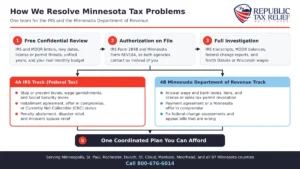
What working with us looks like
- Free confidential consultation. A short call about your letters, deadlines, and monthly budget.
- Authorization on file. We file IRS Form 2848 and the Minnesota power of attorney form so both agencies contact us instead of you.
- Full investigation. We pull IRS transcripts, confirm state balances, check for unreported federal changes, and review any North Dakota or Wisconsin income.
- Protection first. Where the law allows, we act to stop or prevent levies, garnishments, and license actions while we build your case.
- One coordinated plan. We negotiate with both agencies together and explain every option in plain English.
| Common concern | How we handle it |
|---|---|
| “The state says my nursing license renewal is on hold.” | We contact the department, confirm the balance, and work toward an agreement that clears the hold. |
| “I work in Wisconsin. Why does Minnesota want money?” | We explain the residency rules, file what is required, and fix your withholding so it stops happening. |
| “I got a state bill for a year the IRS already closed.” | We trace the federal change, check the state math, and challenge any error before you pay. |
| “Can a California firm really help me?” | Yes. Federal representation works the same in every state, and the state accepts authorized representatives. |
IRS Tax Relief in Minneapolis, St. Paul, and Every Region of Minnesota
A restaurant owner in Northeast Minneapolis, a state employee in St. Paul, and a miner on the Iron Range face very different tax problems. We start with the Twin Cities, then cover the rest of the North Star State.
Focus City: Minneapolis
Minneapolis is the state’s largest city and home to major corporate, healthcare, and finance employers. Its tax problems range from executive stock income to small shops with sales tax balances.
Professionals and consultants with stock compensation and missed estimates.
Breweries, artists, and makers juggling sales tax and 1099 income.
Family-owned shops and restaurants, many run by Spanish-speaking owners.
Corporate employees and business owners with higher balances and home equity.
Focus City: St. Paul
St. Paul is the capital and the home of the Minnesota Department of Revenue itself. State government, healthcare, insurance, and colleges drive the local economy.
State workers and contractors with side income and no withholding.
Small retailers and restaurants managing payroll and sales tax.
Families and business owners who often prefer to work in Spanish.
Wisconsin commuters and growing families facing levies after a few hard years.
Regions We Serve Across Minnesota
Twin Cities Metro
Cities: Minneapolis, St. Paul, Bloomington, Brooklyn Park, Plymouth, Maple Grove, Eagan, Burnsville, Lakeville, Blaine
Corporate, healthcare, and service jobs, plus Wisconsin commuters on the east side.
Southeast Minnesota
Cities: Rochester, Winona, Red Wing, Austin, Owatonna, Faribault
Medical professionals, manufacturing workers, and river-town small businesses.
South Central and Southwest
Cities: Mankato, New Ulm, Albert Lea, Fairmont, Marshall, Worthington
Farm families, food processing workers, and Iowa commuters near the border.
Central Minnesota and the Lakes
Cities: St. Cloud, Brainerd, Willmar, Alexandria, Little Falls, Elk River
Seasonal resort businesses, contractors, and dairy and turkey operations.
Duluth and the Arrowhead
Cities: Duluth, Hibbing, Virginia, Grand Rapids, Cloquet, Ely
Iron Range miners, port and shipping workers, and Superior commuters across the bridge.
Northwest and the Red River Valley
Cities: Moorhead, Bemidji, Fergus Falls, Detroit Lakes, Thief River Falls, Crookston
Sugar beet and grain farms, plus Fargo commuters covered by reciprocity.
Don’t see your town? We help taxpayers throughout the state. Call 800-676-6014 and we will tell you right away whether we can help. You can also browse our other service locations, including nearby Wisconsin and Nebraska.
Expert Insight: The Risks of Handling IRS and Minnesota Tax Issues Alone or With AI
Many Minnesotans try to work things out with the IRS and the state before they call us. That makes sense. But self-managed cases tend to fail in a few predictable ways, and each mistake can close a door.
- Fixing the IRS and forgetting the state. People settle a federal audit, feel relieved, and never report the change to Minnesota. The state bill that follows comes with extra interest.
- Signing a payment agreement you cannot keep. A plan sized for a good month fails in a bad one. A default can mean a court judgment if the agreement included a confession of judgment.
- Sending a thin offer. A Minnesota offer without full financial proof is likely to be rejected, and the payment that came with it is not refunded.
- Ignoring a license notice. For nurses, contractors, and real estate agents, a state tax balance can become a work problem fast.
- Trusting AI on state-specific rules. Chatbots often mix up which states have reciprocity, repeat old Social Security rules, or miss the federal change reporting rule entirely. A confident wrong answer leads to a wrong return.
- Pasting private data into public tools. Uploading your Social Security number, W-2s, or bank statements to a free chatbot creates a privacy risk you cannot take back. AI also cannot pull transcripts, sign a power of attorney, or speak to an agency for you.
Our take: AI is fine for learning what a term means. A licensed tax professional should make the decisions and sign the paperwork. We explain why in Can AI get a better settlement than a tax attorney?
Want more information about tax settlements first? Read our offer in compromise insights and tax negotiation insights.
Why Minnesota Taxpayers Choose Our Tax Relief Services
Hiring help with tax debt is a trust decision. Since 2005, founding partner Mark Ladd and our in-house team of enrolled agents, CPAs, and tax attorneys have helped individuals and businesses resolve IRS and state tax problems. We work every case ourselves, with no outsourcing.
| Cases resolved | 18,000+ |
| Client balances settled | $220M+ |
| Average client rating | 4.9 / 5 |
| Credentials | Enrolled agents, CPAs, and tax attorneys |
| Scheduling | Call times set around Central time |
| Languages | English and Spanish |
- One team for both agencies. IRS and state balances handled together, not by two offices that never talk.
- We know Minnesota’s pressure points. License holds, the federal change rule, reciprocity gaps, and payment agreement terms shape how fast we move.
- Help in Spanish. Many families on Lake Street, St. Paul’s West Side, and in Worthington and Willmar prefer to talk through their case in Spanish, and we welcome that.
- Honest answers. If a settlement is not realistic, we say so and show you a better path.
- Recognized work. See our awards and recognition.
Results vary based on each taxpayer’s facts and finances. Past results do not guarantee a similar outcome.
Encrypted files. Privileged conversations. Zero exceptions.
Minnesota Tax Relief Frequently Asked Questions
Can you help me if you don’t have an office in Minnesota?
Yes. IRS and state cases are handled by phone, mail, and secure online systems, and we represent you under a signed power of attorney. Our team works from California, schedules calls around Central time, and serves clients in all 87 Minnesota counties.
Will Minnesota settle my state tax debt for less?
Sometimes. Minnesota law allows an offer in compromise. Each offer must include a nonrefundable payment, which can be waived for financial hardship, and the state reviews your income, living expenses, and assets before it decides.
Can the Minnesota Department of Revenue take my professional license?
It can. Revoking or denying a business or professional license is one of the state’s enforced collection actions, along with wage levies, bank levies, and sales tax permit revocation. Setting up a payment agreement or other resolution early can often prevent it.
The IRS changed my return. Do I have to tell Minnesota?
Generally, yes. Minnesota expects you to report federal changes, usually within 180 days. If the change raises your federal income, it often raises your state tax too, so it is better to report it on your terms than wait for a state assessment.
I live in Minnesota and work in North Dakota or Wisconsin. What do I owe?
Minnesota and North Dakota have reciprocity, so your wages are generally taxed only by Minnesota. Wisconsin has no reciprocity with Minnesota, so you file in both states and claim a credit at home for tax paid to the other state.
What happens if I miss a payment on a Minnesota payment agreement?
The state can end the agreement after giving you at least 14 days’ notice. You can ask for reconsideration, but collection can resume once the notice period ends. If the agreement included a confession of judgment, the state can also record a court judgment.
Can the IRS take my Social Security if I live in Minnesota?
Yes. The IRS can levy part of your Social Security benefits for unpaid federal tax. A payment plan or hardship status can often stop or prevent that levy.
What should I bring to my free consultation?
Any IRS or state letters, your latest tax return if you have one, and a rough idea of your monthly income and bills. Missing documents are fine. We can request IRS transcripts and state records for you.
More answers: tax relief questions, offer in compromise questions, wage garnishment questions, and IRS payment plan questions.
Sources
- Minnesota Department of Revenue: Enforced Collection Actions
- Minnesota Statutes section 270C.52: Payment Agreements and Offers in Compromise
- U.S. Attorney’s Office, District of Minnesota: Hopkins Man Sentenced to Prison for Tax Evasion
Republic Tax Relief is a private firm and is not affiliated with the IRS or the Minnesota Department of Revenue. This page offers general guidance, not legal or tax advice for your specific situation. Tax laws and agency procedures change, so consult a qualified tax professional before acting.
Free Consultation: Speak With a Tax Relief Professional About Your Minnesota Tax Situation
The IRS and St. Paul won’t wait. Neither should you.
Whether the letter came from the IRS or the Minnesota Department of Revenue, a short call can show you where you stand and what to do next. Your consultation is free and confidential.
About Republic Tax Relief
Republic Tax Relief helps individuals and businesses nationwide resolve IRS and state tax problems, including back taxes, levies, liens, unfiled returns, audits, and payroll tax debt. Since 2005, our in-house team of enrolled agents, CPAs, and tax attorneys has resolved more than 18,000 cases. From our offices in Corona and Laguna Hills, California, we represent clients in all 50 states, including Minnesota. Call 800-676-6014 or contact us online for a free, confidential consultation.