
From Johnson County to the Air Capital and out to the High Plains
Kansas Tax Relief for IRS and Kansas Tax Debt: Tax Resolution Help With Tax Warrants, Back Taxes, and Homestead Property Tax Refunds
A tax warrant filed at the county courthouse. An IRS letter that says your paycheck is next. A homestead refund that never showed up because an old balance swallowed it. We step between you and both agencies, act to protect your wages and accounts where the law allows, and build a plan around what you can really afford.
Aerospace workers in Wichita, consultants in Overland Park, wheat growers near Dodge City, and shop owners in Topeka work with our team by phone, video, and secure upload.
Federal and state balances, one plan
W-2, 1099, farm, and payroll filers
In-house team since 2005
Spanish-speaking clients welcome
Kansas does not chase tax debt quietly. When a state balance goes unpaid, the Kansas Department of Revenue can file a tax warrant in district court, and that warrant acts as a lien on what you own. Meanwhile, the IRS runs its own collection clock on the federal side. Two agencies, two sets of rules, and very little patience.
Republic Tax Relief helps individuals and business owners who owe the IRS, the Kansas Department of Revenue (KDOR), or both. Our enrolled agents, CPAs, and tax attorneys work as one team from our California offices and represent clients in Wichita, Overland Park, and all 105 Kansas counties.
On This Page
- Why Kansans Owe the IRS and the State Together
- Kansas Tax Warrants and KDOR Collections
- Kansas Payment Plans and the Petition for Abatement
- A Kansas IRS Case: Unpaid Payroll Taxes in Wichita
- Kansas Homestead Refunds and Property Tax Relief Programs
- Kansas and Missouri: Cross-Border Income Tax
- IRS vs. Kansas Department of Revenue Compared
- IRS Tax Relief Options for Kansas Taxpayers
- Farm, Aerospace, Military, and Disaster Tax Issues
- Payroll, Sales Tax, and Business Tax Debt
- How We Help Kansans Without a Local Office
- IRS Tax Relief in Wichita, Overland Park, and Every Region
- Expert Insight: DIY and AI Risks With IRS Tax Problems
- Why Kansans Choose Republic Tax Relief
- Frequently Asked Questions
- Contact Us for a Free Consultation
Why Kansas Taxpayers Often Owe IRS Tax and Kansas State Tax at the Same Time
Your Kansas individual income tax return starts with your federal adjusted gross income. So when something goes wrong on the federal return, the same mistake usually flows straight onto the Kansas return. One missed payment becomes two balances.
These are the patterns we see most among the Kansans who call us:
- A Missouri paycheck with Kansas still expecting its share. Thousands of Johnson and Wyandotte County residents work across State Line Road. Withholding often goes to Missouri only, and the Kansas bill shows up later.
- Side income with no withholding. Rideshare drivers, travel nurses, contract machinists, and online sellers get 1099s with nothing taken out.
- Missed estimated tax payments. Self-employed people, landlords, and farmers with a strong harvest year are expected to pay during the year. Skipping those payments adds penalties on both returns.
- Layoffs, severance, and early 401(k) withdrawals. Wichita’s aviation economy has seen hiring swings, and cashing out retirement funds without enough withheld creates a surprise balance.
- Years of unfiled returns after a divorce, an illness, or a business that faded out. Our unfiled tax returns service brings back years current and stops new penalties from stacking up.
Not sure what you owe or for which year? Our back tax help starts by confirming every balance with both agencies before anyone makes a promise.
Say it once, to the right people. Everything you share is held under attorney-client and tax professional privilege standards, so your money troubles stay between you and the professionals resolving them.
How the Kansas Department of Revenue Collects: Tax Warrants, Liens, and Asset Seizures
The single most important word in Kansas tax collection is warrant. A Kansas tax warrant is not an arrest warrant. It is a court filing that turns an unpaid state tax balance into a lien on your property, and it opens the door to stronger collection.
KDOR files tax warrants with the district court in the county where you live or do business. Anyone can look them up through the Kansas District Court case search, which means a lender, landlord, or business partner may see it too.
| Kansas collection step | What it means for you |
|---|---|
| Billing notices | Letters showing the balance, penalty, and interest. This is the cheapest time to act. |
| Tax warrant filed | A public court record that works as a lien on your assets and can block a sale, refinance, or business loan. |
| Bank and wage garnishment | Once a warrant is in place, the state can pursue money in your accounts and part of your paycheck. |
| Business asset seizure | KDOR agents, often with the county sheriff, can close a business and seize its assets for unpaid sales or withholding tax. Seized items can be sold at auction. |
| Refund setoff | State refunds can be kept and applied to what you owe the state. |
| Warrant release | After full payment, including interest, penalties, and filing fees, KDOR now files the release with the court for you. |
Business owners should take one detail seriously. KDOR has a long record of closing businesses on the spot for unpaid sales tax, then reopening them only after an acceptable payment arrangement. Getting help before agents arrive keeps far more options open.
See how we handle wage garnishment relief, bank levy help, and tax lien help.
Kansas Tax Relief From the State: Payment Plan Rules and the Petition for Abatement
The state offers two main ways out of a balance you cannot pay today. One spreads the debt over time. The other can reduce it. Both have rules that catch people who apply on their own.
Kansas payment plans
- A $25 administration fee applies to approved plans longer than 90 days.
- A tax warrant is filed for plans over 12 months. Many people agree to a long plan without realizing it puts a public lien on record.
- A warrant can also be filed if the collection time limit is set to run out during the plan.
- You must stay current. Every new return and estimated payment has to be filed and paid on time, or the plan can fail.
Why plan length matters: A 12-month plan and a 13-month plan can look almost the same on paper. In Kansas, one may keep your record clean while the other adds a court-filed warrant. We size the plan with that line in mind.
The Kansas Petition for Abatement
Kansas calls its version of a settlement a Petition for Abatement. It can reduce a final tax liability when there is real doubt the state can collect, such as insolvency, a long-term disability, or income limited to Social Security with nothing to levy. A second version challenges whether the debt is correct at all.
The rules are strict. All returns must be filed, current estimated payments must be made, and a $50 application fee is due upfront. Payments sent with the offer are not refunded if it is rejected, and collection can continue while KDOR reviews it. The department generally will not accept an offer if you could pay in full through a payment plan (Kansas Department of Revenue: Petition for Abatement).
Penalties are a separate question. Kansas can waive penalties in situations much like those the IRS accepts, such as serious illness or a disaster. Interest, on the other hand, is rarely forgiven.
A Real Kansas IRS Case: How Unpaid Payroll Taxes Followed a Wichita Business Owner
Most people who fall behind on taxes face civil penalties, not a courtroom. But payroll taxes are different, and this Wichita case shows why.
The case: The owner of a Wichita floor maintenance company withheld federal taxes from his employees’ paychecks. Instead of sending that money to the IRS, he spent it on personal expenses, including gambling.
The outcome: He pleaded guilty to failing to pay over withheld taxes. The court sentenced him to two years of supervised release and ordered about $256,000 in restitution (U.S. Attorney’s Office, District of Kansas).
The lesson: Payroll tax money belongs to your employees and the government from the moment it is withheld. When it is used for anything else, the debt can follow the owner personally. Owners who get help early, before the IRS opens a case, have far more choices.
If your business is behind on payroll deposits, the answer is a fast, private plan. We review the full picture first, protect you from personal assessments where possible, and work toward a resolution that keeps the doors open.
Kansas Homestead Refund and Property Tax Relief Programs: Seniors, Disabled Veterans, and Low-Income Homeowners
Here is a part of the Kansas tax picture most tax debt firms skip. The state runs three property tax refund programs through the Kansas Department of Revenue. For a homeowner who is behind on taxes, these refunds matter in two ways: they can be lost when returns go unfiled, and they can be taken to pay old debts.
Kansas lets each household file just one of the three claims each year. The department recommends that seniors who qualify for SAFESR also complete the Homestead and SVR claims to see which pays the most. SAFESR is not available if you have delinquent property tax (Kansas Department of Revenue: Property Tax Relief for Low Income Seniors).
| Program and form | Who may qualify | How the refund works |
|---|---|---|
| Homestead refund Form K-40H |
Full-year Kansas homeowners under the yearly household income limit who are 55 or older, blind or disabled, a disabled veteran, or raising a dependent child under 18 | A percentage of property taxes paid, based on household income, up to $700. Home value cannot exceed $350,000. |
| SAFESR (Safe Senior) Form K-40PT |
Low-income homeowners 65 or older for the full year | 75% of general property tax paid. The first half must be paid on time, and delinquent property tax disqualifies you. |
| SVR (Seniors and Disabled Veterans) Form K-40SVR |
Homeowners 65 or older, qualifying disabled veterans, and certain surviving spouses, with a higher income limit | Refunds the increase in property tax above a base year, which works like a freeze. Any refund is applied first to delinquent property tax. |
Simplified summary. Income limits are adjusted each year, Homestead counts half of Social Security while SAFESR counts all of it, and SVR uses the Kansas adjusted gross income of everyone in the household. Renters no longer qualify for the Homestead refund.
How these refunds connect to tax debt
- Unfiled returns can mean unclaimed refunds. SVR household income is based on Kansas adjusted gross income, which may require a Kansas return for each household member. When we prepare back years, we check every property tax relief claim you may have missed.
- Old balances can absorb new refunds. A state refund can be applied to a debt you owe the state before you ever see it. Planning for that keeps a promised refund from vanishing.
- Delinquent property tax closes doors. Falling behind with the county treasurer can knock you out of SAFESR and shrink an SVR refund.
- The deadline is firm. These claims are generally due by April 15, the same day as your Kansas return. An optional advancement program can send part of next year’s refund straight to your county treasurer to help with the first half of your property taxes.
Some Kansas cities, such as Derby, have offered local property tax relief that builds on approval for one of these state programs. That gives eligible homeowners one more reason to keep their state filings current.
Kansas and Missouri: Income Tax Help for Kansas Residents Who Work Across State Line
The Kansas City metro sits on two states, and Kansas and Missouri do not have an income tax reciprocity agreement. That single fact creates more surprise bills in Johnson and Wyandotte counties than almost anything else we see.
| Your situation | What it usually means |
|---|---|
| Live in Overland Park, work in downtown Kansas City, Missouri | You file a Missouri nonresident return and a Kansas resident return, then claim a Kansas credit for tax paid to Missouri. Kansas City, Missouri also charges its own earnings tax on nonresidents who work there. |
| Live in Lee’s Summit, work in Lenexa | Kansas taxes the wages you earn in Kansas. You file a Kansas nonresident return and claim a credit back home in Missouri. |
| Remote job with a Missouri employer | Withholding often stays with Missouri out of habit, leaving the Kansas return short. A new Kansas withholding form usually fixes it going forward. |
| Moved across State Line Road mid-year | Part-year returns in both states, with income split by the date you moved. |
Simplified summary. Each open year should be reviewed based on your residency, work location, and paperwork.
A common story: a couple in Olathe both work in Missouri for years and assume their withholding covers everything. Then Kansas sends bills for several years at once. Filing accurate returns quickly usually costs far less than waiting for the state to estimate them. Our Kansas City area clients can also see our Missouri tax relief page.
IRS vs. Kansas Department of Revenue: How Federal and State Tax Collection Compare
The IRS and KDOR use different forms, timelines, and pressure points. Seeing them side by side shows why fixing one while ignoring the other rarely lasts.
| Collection step | IRS (federal tax) | Kansas DOR (state tax) |
|---|---|---|
| Before a levy | Final notice of intent to levy, with a 30-day window to request a hearing | Billing notices, then a tax warrant filed in district court |
| Lien | Notice of Federal Tax Lien | The tax warrant itself acts as the lien |
| Paying over time | IRS installment agreement | KDOR payment plan, with a warrant filed if longer than 12 months |
| Settling for less | Offer in compromise based on ability to pay | Petition for Abatement, with a $50 fee |
| Hardship pause | Currently Not Collectible status | Reviewed case by case, often through abatement |
| Business pressure | Trust Fund Recovery Penalty on owners | On-site business closures and asset seizures |
| Representative form | Form 2848 | Form DO-10 |
Should you call the IRS yourself? You can, but every word goes on your record. Learn how our IRS collections defense works and read our guide to common IRS notices.
IRS Tax Relief Options for Kansas Taxpayers: Installment Agreement, Offer in Compromise, and CNC
The IRS offers several paths, and the right one depends on your income, expenses, equity, and how much time is left on the collection clock. Here is how each one fits.
| Relief option | What it does | Often fits |
|---|---|---|
| IRS installment agreement | A monthly payment plan while levies are held off | Steady income but not enough to pay in full now |
| Offer in compromise | Settles tax debt for less based on ability to pay | Low income and equity compared with the full amount owed |
| Currently Not Collectible (CNC) | Pauses collection during financial hardship | People unable to pay beyond basic living costs |
| Penalty abatement | Removes penalties for a clean history or reasonable cause | Illness, a death in the family, or tornado and wildfire damage |
| Innocent spouse relief | Separates you from a spouse’s tax debt | Errors or unpaid tax caused by a current or former spouse |
Who may qualify to settle tax debt for less
The IRS looks at your income, allowable living expenses, and equity in your home, vehicles, land, and retirement accounts. In Kansas, farmland and equipment can carry real equity even when cash is tight, which can block a settlement. We test the numbers before anything is filed. Learn how the OIC program works.
Facing an audit instead of a bill
With representation in place, the IRS examiner or KDOR auditor contacts us, not you. We gather the records, answer the questions, and push back on assessments that are not supported.
For the bigger picture, see our tax debt relief options, IRS payment plans, Currently Not Collectible status, IRS penalty abatement, the IRS Fresh Start Program, and the four types of innocent spouse relief.
Farm Income, Aerospace Jobs, Military Families, and Disasters: Kansas Tax Issues We See Often
Kansas has a few industries and life situations that shape tax problems in ways most national guides miss.
- Farm and ranch families. Wheat, cattle, and grain income swings with prices and weather. Federal rules give farmers special estimated tax options, but a big year followed by a drought year can leave a balance with no cash to pay it.
- Aviation and manufacturing workers. In Wichita, the Air Capital of the World, a layoff can bring severance, unemployment, and a retirement withdrawal in the same year, all underwithheld.
- Military households. Families tied to Fort Riley, Fort Leavenworth, and McConnell Air Force Base move often and may file in more than one state. The IRS has specific relief for service members, including extra time in some situations.
- Retirees. Kansas no longer taxes Social Security benefits, but the IRS still can tax part of them. The IRS can also levy part of your benefits for an unpaid federal balance.
- Tornadoes, hail, floods, and wildfires. Severe weather has led to IRS deadline postponements in Kansas counties. A postponed deadline is not forgiveness, and state deadlines do not always move with federal ones. We check both.
Payroll, Sales Tax, and Business Tax Debt: Helping Kansas Businesses Stay Open
Business tax trouble in Kansas usually starts the same way. Cash runs short, and money withheld from employees or collected from customers gets used for rent or supplies. That money was never the owner’s to spend, and both the IRS and KDOR treat it that way.
- Payroll and withholding. Unpaid federal payroll taxes can lead to the Trust Fund Recovery Penalty against owners and managers personally. Start with payroll tax debt relief.
- Collected but unpaid sales tax. This is the balance most likely to bring KDOR agents to your door with a warrant and a padlock.
- Kansas withholding tax. State withholding you took from paychecks but never sent carries steep penalties and personal exposure.
- Use tax on equipment. Machinery and supplies bought from out-of-state sellers without sales tax often owe Kansas use tax, and audits find it.
The Kansas businesses we help most often include:
- Doctors, dentists, and clinic owners in Wichita and Johnson County. See tax resolution for medical professionals.
- Builders, roofers, and trades, especially after storm seasons bring a rush of work and payroll. See construction tax resolution.
- Restaurants and bars from Old Town Wichita to downtown Lawrence. Read our restaurant tax resolution insights.
- Online sellers and real estate investors. See e-commerce tax resolution and real estate tax resolution.
- Trucking, ag services, and feedlot operations across western Kansas.
Explore our business audit help, business tax resolution services, small business tax relief, and business tax debt relief.
Send your paperwork without second-guessing it. Returns, Social Security numbers, and bank statements travel and rest under bank-grade 256-bit encryption, fully compliant with federal data protection standards.
How Our Tax Resolution Works for Kansas Taxpayers Without a Local Office
We want to be upfront: we do not have a Kansas office. Our team works from our offices in Corona, California and Laguna Hills, California. Most of Kansas is two hours ahead of us on Central time, so we book calls that fit your workday.
You do not need an office on Douglas Avenue or College Boulevard to fix an IRS problem. Federal cases run by phone, mail, fax, and secure online systems, and the IRS works with authorized representatives from any state. KDOR accepts representatives named on its power of attorney form, too.
Free help, such as volunteer tax sites, works well for a simple current return. Negotiating a large balance with two agencies is a different job. Our nationwide team handles each part with the right credential and deals with the IRS on your behalf from day one.
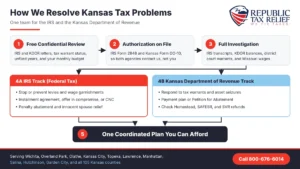
What working with us looks like
- Free confidential consultation. A short call about your letters, any tax warrant, and your monthly budget.
- Authorization on file. We file IRS Form 2848 and Kansas Form DO-10 so both agencies contact us instead of you.
- Full investigation. We pull IRS transcripts, confirm KDOR balances, search for filed warrants, and review any Missouri income.
- Protection first. Where the law allows, we act to stop or prevent levies, garnishments, and seizures while we build your case.
- One coordinated plan. We negotiate with both agencies together and explain every option in plain English.
| Common concern | How we handle it |
|---|---|
| “There is a tax warrant on file in Sedgwick County.” | We confirm the balance, stop it from growing where possible, and plan the path to a recorded release. |
| “I work in Missouri. Why does Kansas want money?” | We explain the residency rules, file what is required, and fix your withholding so it stops happening. |
| “My homestead refund never came.” | We check whether it was filed, applied to an old balance, or blocked by delinquent property tax. |
| “Can a California firm really help me?” | Yes. Federal representation works the same in every state, and KDOR accepts authorized representatives. |
IRS Tax Relief in Wichita, Overland Park, and Every Region of Kansas
An aerospace machinist in south Wichita, a sales executive in Overland Park, and a feedlot owner near Garden City face very different tax problems. We start with our two focus cities, then cover the rest of the Sunflower State.
Focus City: Wichita
Wichita is the state’s largest city and a center for aircraft manufacturing, healthcare, and small business. Its tax problems range from payroll balances to retirement withdrawals after a layoff.
Restaurants, bars, and shops managing sales tax and payroll.
Plant workers and contractors facing layoffs, severance, and 401(k) tax bills.
Family-owned businesses, many run by owners who prefer to work in Spanish.
Military families near McConnell and homeowners with property tax refund questions.
Focus City: Overland Park
Overland Park is the heart of Johnson County and the Kansas side of the metro. Corporate jobs, tech, and healthcare bring higher incomes, stock compensation, and plenty of Missouri commuters.
Executives and consultants with stock income and missed estimates.
Boutiques, studios, and restaurants with sales tax balances.
Families with Missouri paychecks and Kansas balances that crept up for years.
Business owners and professionals with higher balances and home equity.
Regions We Serve Across Kansas
Kansas City Metro
Cities: Overland Park, Olathe, Kansas City, Shawnee, Lenexa, Leawood, Prairie Village, Gardner
Corporate and healthcare jobs, plus the state’s biggest group of Missouri commuters.
Wichita and South Central
Cities: Wichita, Derby, Andover, Hutchinson, Newton, El Dorado, Augusta, Wellington
Aviation, manufacturing, oil field services, and the state’s largest small business base.
Northeast Kansas and the Capital
Cities: Topeka, Lawrence, Leavenworth, Emporia, Atchison, Ottawa
State employees, university staff, and military families near Fort Leavenworth.
Flint Hills and North Central
Cities: Manhattan, Junction City, Salina, Abilene, McPherson, Concordia
Fort Riley households, cattle ranchers, and Main Street businesses.
Southeast Kansas
Cities: Pittsburg, Coffeyville, Independence, Parsons, Chanute, Fort Scott
Manufacturing workers, retirees on fixed incomes, and family farms.
Western Kansas and the High Plains
Cities: Garden City, Dodge City, Liberal, Hays, Great Bend, Goodland
Wheat and cattle operations, meatpacking workers, and Spanish-speaking families.
Don’t see your town? We help taxpayers throughout the state. Call 800-676-6014 and we will tell you right away whether we can help. You can also browse our other service locations, including nearby Oklahoma, Nebraska, and Colorado.
Expert Insight: The Risks of Handling IRS and Kansas Tax Issues Alone or With AI
Many Kansans try to work things out with the IRS and KDOR before they call us. That makes sense. But self-managed cases tend to fail in a few predictable ways, and each mistake can close a door.
- Agreeing to a long state plan without knowing the cost. A Kansas plan over 12 months brings a court-filed warrant. People often learn this only when a lender runs a search.
- Filing a Petition for Abatement that was never going to work. If the state believes you can pay in full over time, it will deny the petition and keep the fee and any payments.
- Fixing the IRS and forgetting Kansas. A federal audit change usually means a Kansas change too. The state bill that follows comes with extra interest.
- Letting a refund disappear. Missing a homestead, SAFESR, or SVR claim, or letting property tax go delinquent, can cost a senior hundreds of dollars a year.
- Trusting AI on Kansas-specific rules. Chatbots often confuse the Kansas homestead refund with unrelated homestead laws, repeat the old rule that renters qualify, or assume Kansas and Missouri have reciprocity. A confident wrong answer leads to a wrong return.
- Pasting private data into public tools. Uploading your Social Security number, W-2s, or bank statements to a free chatbot creates a privacy risk you cannot undo. AI also cannot pull transcripts, sign a power of attorney, or speak to an agency for you.
Our take: AI is fine for learning what a term means. A licensed tax professional should make the decisions and sign the paperwork. We explain why in Can AI get a better settlement than a tax attorney?
Want to learn more about settlements first? Read our offer in compromise insights and tax settlement insights.
Why Kansas Taxpayers Choose Our Tax Relief Services
Hiring help with tax debt is a trust decision. Since 2005, founding partner Mark Ladd and our in-house team of enrolled agents, CPAs, and tax attorneys have helped individuals and businesses resolve IRS and state tax problems. We work every case ourselves, with no outsourcing.
| Cases resolved | 18,000+ |
| Client balances settled | $220M+ |
| Average client rating | 4.9 / 5 |
| Credentials | Enrolled agents, CPAs, and tax attorneys |
| Scheduling | Call times set around Central time |
| Languages | English and Spanish |
- One team for both agencies. IRS and KDOR balances handled together, not by two offices that never talk.
- We know Kansas pressure points. Tax warrants, the 12-month plan line, abatement rules, and property tax refunds shape how we build your plan.
- Help in Spanish. Many families in Wichita’s North End, Garden City, Dodge City, Liberal, and Kansas City, Kansas prefer to talk through their case in Spanish, and we welcome that.
- Honest answers. If a settlement is not realistic, we say so and show you a better path.
- Recognized work. See our awards and recognition.
Results vary based on each taxpayer’s facts and finances. Past results do not guarantee a similar outcome.
Your secrets stay sealed. Your files stay encrypted. Period.
Kansas Tax Relief Frequently Asked Questions
Can you help me if you don’t have an office in Kansas?
Yes. IRS and state cases are handled by phone, mail, and secure online systems, and we represent you under a signed power of attorney. Our team works from California, schedules calls around Central time, and serves clients in all 105 Kansas counties.
What is a Kansas tax warrant?
It is a filing the Kansas Department of Revenue makes in district court when a state tax balance stays unpaid. It is not an arrest warrant. It works as a lien on your property and can lead to garnishment or seizure. After the debt is paid in full, KDOR files a release with the court.
Will Kansas settle my state tax debt for less?
Sometimes. Kansas uses a Petition for Abatement when there is real doubt the state can collect, such as insolvency or a long-term disability. It requires all returns filed, a $50 application fee, and a payment with the offer. The state generally denies it if you could pay in full through a payment plan.
Does a Kansas payment plan create a public record?
It can. KDOR files a tax warrant for payment plans longer than 12 months, and it may also file one if the collection time limit would expire during the plan. Plans longer than 90 days also carry a $25 administration fee.
Can I get a Kansas homestead refund if I owe back taxes?
You may still qualify, but a state refund can be applied to debts you owe the state. For seniors, delinquent property tax rules out a SAFESR refund, and an SVR refund is applied to delinquent property tax first. We review both your debt and your refund options together.
Which property tax relief program is best for seniors and disabled veterans?
It depends on your income, age, and property taxes. Each household can file only one claim: Homestead (K-40H), SAFESR (K-40PT), or SVR (K-40SVR). The Kansas Department of Revenue suggests completing all the claims you qualify for to see which refund is largest.
I live in Kansas and work in Missouri. What do I owe?
Kansas and Missouri do not have reciprocity. You generally file a Missouri nonresident return and a Kansas resident return, then claim a Kansas credit for tax paid to Missouri. If you work in Kansas City, Missouri, the city’s earnings tax may apply too.
What should I bring to my free consultation?
Any IRS or Kansas letters, your latest tax return if you have one, any property tax statements, and a rough idea of your monthly income and bills. Missing documents are fine. We can request IRS transcripts and state records for you.
More answers: tax relief questions, offer in compromise questions, IRS payment plan questions, and business tax debt questions.
Sources
- Kansas Department of Revenue: Petition for Abatement Forms
- Kansas Department of Revenue: Kansas Property Tax Relief for Low Income Seniors (SAFESR)
- U.S. Attorney’s Office, District of Kansas: Wichita Business Owner Sentenced in $250,000 Tax Case
Republic Tax Relief is a private firm and is not affiliated with the IRS or the Kansas Department of Revenue. This page offers general guidance, not legal or tax advice for your specific situation. Tax laws, income limits, and agency procedures change, so consult a qualified tax professional before acting.
Free Consultation: Speak With a Tax Relief Professional About Your Kansas Tax Situation
A warrant moves fast. So do we.
Whether the letter came from the IRS or the Kansas Department of Revenue, a short call can show you where you stand and what to do next. Your consultation is free and confidential.
About Republic Tax Relief
Republic Tax Relief helps individuals and businesses nationwide resolve IRS and state tax problems, including back taxes, levies, liens, unfiled returns, audits, and payroll tax debt. Since 2005, our in-house team of enrolled agents, CPAs, and tax attorneys has resolved more than 18,000 cases. From our offices in Corona and Laguna Hills, California, we represent clients in all 50 states, including Kansas. Call 800-676-6014 or contact us online for a free, confidential consultation.