
From the Kansas City Riverfront to the Gateway Arch
Missouri Tax Relief and IRS Tax Relief Services: Tax Help for IRS and State Tax Problems in All Parts of Missouri
A garnishment order from the Missouri Department of Revenue. A levy notice from the IRS. A Kansas City or St. Louis earnings tax bill you never saw coming. We take over the calls, protect your paycheck and bank account where the law allows, and build a plan that fits your budget.
Families, commuters, farmers, and business owners from Kansas City and St. Louis to Springfield, Columbia, and the Bootheel work with us by phone, video, and secure upload.
Three collectors, one plan
Plus the City of St. Louis
In-house team since 2005
Spanish-speaking clients welcome
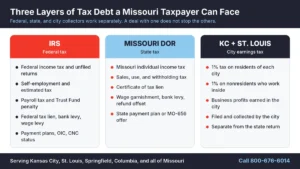
Missouri is one of the few states where a single taxpayer can owe three different collectors at once. The IRS handles federal tax. The Missouri Department of Revenue handles state income, sales, and withholding tax. And if you live or work in Kansas City or the City of St. Louis, a separate city earnings tax sits on top of both.
None of these offices share your budget with the others. A payment plan with one does nothing to stop the next garnishment from another. Republic Tax Relief helps Missouri residents and business owners sort out all three from our California offices, with enrolled agents, CPAs, and tax attorneys working one coordinated case.
On This Page
- Why Missouri Taxpayers Owe the IRS and the State Together
- Missouri DOR Tax Debt Help: Liens, Garnishments, and License Holds
- Kansas City and St. Louis Earnings Tax Problems
- IRS vs. Missouri DOR Collection Compared
- IRS Tax Relief Options: Payment Plans, Offers, and CNC
- Missouri Offer in Compromise for State Tax Debt
- Business Tax Problems for Missouri Owners and Employers
- How Our Tax Attorney Team Helps Without a Missouri Office
- Tax Relief Services in Missouri Cities and Regions
- Expert Insight: DIY and AI Risks With IRS Tax Issues
- Why Missouri Taxpayers Choose Our Tax Relief Firm
- Missouri Tax Relief Frequently Asked Questions
- Speak With a Tax Relief Professional
Why Missouri Taxpayers Often Owe Missouri and IRS Balances at the Same Time
Your Missouri return starts with the numbers on your federal tax return. When the federal return is late or wrong, the state return usually is too. When the IRS later adjusts your income, the Department of Revenue can use that change to bill you for more state tax years after the fact.
Missouri’s income brackets are also narrow, so most working people hit the top state rate well before they feel “high income.” Small gaps in withholding add up fast. Here is what we see most often:
- Kansas City commuters who live in Kansas, work in Missouri, and file in only one state. Our back tax help starts by confirming which years and which states are open.
- Metro East commuters who live in Illinois and work in downtown St. Louis, Clayton, or the Cortex district.
- Unfiled returns for several years after a job loss, a divorce, or a business that stalled. See our unfiled tax returns service.
- Gig, rideshare, and 1099 workers who never paid estimated tax and now owe both the IRS and the state.
- Property and business sellers who heard that Missouri stopped taxing capital gains and assumed the IRS did too. It did not.
- Seasonal workers in Branson and the Lake of the Ozarks whose income swings make a steady payment plan hard to keep.
Not sure what you owe or to whom? Our tax resolution services begin by pulling your records and confirming each balance, agency, and year involved.
What you tell us stays with us. Your tax history, debts, and family details are protected under attorney-client and tax professional privilege standards, and shared only with the agencies we negotiate with for you.
Owe Missouri? Missouri DOR Tax Debt Help for Liens, Garnishments, and License Holds
The Missouri Department of Revenue in Jefferson City collects state income tax, corporate tax, sales and use tax, and the withholding employers hold for their workers. Unpaid balances keep growing with interest and additions to tax until they are paid in full.
When notices go unanswered, the state has several ways to collect state tax debt:
| Missouri DOR action | What it means for you |
|---|---|
| Certificate of tax lien | Filed with the local circuit court, it attaches to your property and shows up when you sell or refinance. |
| Wage garnishment | Your employer is ordered to send part of each paycheck to the state. |
| Bank levy | Funds in a personal or business account can be frozen and taken. |
| Refund offset | Future state and federal tax refunds can be applied to the Missouri balance. |
| License and permit problems | Unpaid state tax can block renewal of a sales tax license, a local business license, or certain professional licenses. |
A few Missouri details catch people off guard:
- Online plans have limits. Missouri allows many taxpayers to request an installment agreement online, but larger or older balances often need a person to negotiate terms.
- Interest never pauses. A payment plan stops the escalation, not the interest, so the payoff number changes month to month.
- Licenses are tied to tax compliance. Missouri has long linked professional license renewals to state tax status, and lawmakers have debated those rules. We check what applies to your license today.
- New returns must stay current. Missing a future filing or payment can cancel a state plan or a settlement.
See how we handle tax lien help, wage garnishment relief, and bank levy help once a balance reaches enforcement.
Kansas City and St. Louis Earnings Tax: The Third Layer of Missouri Tax Issues
Kansas City and the City of St. Louis are the only Missouri cities that charge a city earnings tax. Each city taxes residents at 1% of earnings, and it also taxes nonresidents on what they earn while working inside city limits. Business profits earned in the city are covered too.
This tax is filed with and collected by the city, not the state. That is why it is so easy to miss:
- Self-employed residents often have no employer withholding the city tax at all.
- Suburban commuters to downtown Kansas City or St. Louis may owe on in-city work even though they live in Lee’s Summit, Overland Park, Chesterfield, or Belleville.
- St. Louis County is not the City of St. Louis. Living in Clayton, Kirkwood, or Florissant does not create the city tax, but working downtown can.
- Kansas City, Kansas is a different city. The Kansas City earnings tax applies to Kansas City, Missouri only.
- Remote work changes the math. Days worked from home outside city limits can change what a nonresident owes, so records matter.
When we review a Kansas City or St. Louis case, the city account is part of the investigation from day one. Fixing the IRS and state balances while a city bill keeps growing is not a real fix.
IRS vs. Missouri DOR Collection: How the IRS Side and the State Side Compare
Federal and Missouri collection run on separate tracks with separate rules. Seeing them side by side shows why a plan for both matters.
| Collection step | IRS (federal tax) | Missouri DOR (state tax) |
|---|---|---|
| Warning | A series of notices, then a final notice of intent to levy | Billing notices, then a formal assessment |
| Lien | Notice of Federal Tax Lien | Certificate of tax lien filed with the circuit court |
| Bank and wages | Bank levy and continuous wage levy | Bank levy, wage garnishment, refund offsets |
| Personal liability | Trust Fund Recovery Penalty for unpaid payroll taxes | Responsible officers for unpaid sales tax and withholding |
| Paying over time | IRS installment agreement | Missouri installment agreement |
| Settlement | Offer in compromise based on ability to pay | Missouri offer in compromise (Form MO-656) |
| Help inside the agency | Taxpayer Advocate Service offices in Kansas City and St. Louis | DOR collections and taxpayer relief resources |
Here is a local quirk: many IRS letters mailed across the country carry a Kansas City, Missouri return address because the IRS runs a large processing campus there. A Kansas City address does not mean your case is local. It is just where the paperwork is handled. Learn how our IRS collections defense works and read our guide to common IRS notices.
Tax Relief Options for IRS Debt: Payment Plans, Offers, and Hardship Status
There is no single best program for IRS debt. The right answer depends on your income, expenses, equity, and how much time is left before the debt expires.
| Relief option | What it does | Often fits |
|---|---|---|
| Installment agreement | Spreads the balance into monthly payments while levies are held off | You cannot pay your full tax now but have steady income |
| Offer in compromise | Settles for less based on what you can realistically pay | Limited income and equity compared with the debt |
| Currently Not Collectible (CNC) | Pauses collection during financial hardship | Income that barely covers basic living costs |
| Penalty abatement | Removes penalties for a clean history or reasonable cause | Illness, a storm, or a first-time problem |
| Innocent spouse relief | Separates you from a spouse’s tax debt | Errors or unpaid tax caused by a current or former spouse |
Monthly IRS payment plans
Most people who cannot pay in full can set up an IRS payment plan. The type of plan matters, because a lower monthly payment can require more financial disclosure, and interest keeps running either way. Read how IRS payment plans work.
Currently not collectible status when money is tight
If any payment would leave you short on rent, food, or utilities, Currently Not Collectible status can stop levies. The debt remains and a lien may be filed, but the pressure stops while you recover.
Settling for less with the IRS
The IRS accepts an offer when your income, expenses, and asset equity show you cannot pay the full balance. Many offers fail because of overlooked equity in a home, farmland, or retirement accounts, so we test the numbers before anything is filed. Learn how the OIC program works.
Penalties, storms, and disaster area relief
Penalties often make up a large share of an old balance. After severe storms and tornadoes, the IRS grants tax relief by postponing deadlines for people in a federally declared disaster area, and the St. Louis region has received that relief more than once. Missouri does not always match federal postponements, so we check both sides when a notice ignores them. Explore IRS penalty abatement and the four types of innocent spouse relief.
For a wider view, see our tax debt relief options and the IRS Fresh Start Program.
Missouri Offer in Compromise: Can Missouri Taxpayers Settle State Tax Debt?
Yes, in some cases. Missouri law lets the Department of Revenue accept less than the full amount owed. The request is made on Form MO-656 and must include the amount you are offering and the reason for it (Missouri Department of Revenue: Offer in Compromise).
Missouri recognizes three bases for an offer:
- Doubt as to liability. There is a real question about whether the tax is owed or the amount is correct.
- Doubt as to collectibility. Your assets and income are less than the balance, so full payment is unlikely.
- Exceptional circumstances. Situations such as natural disasters, fires, or theft that make collection unfair.
Two rules make a careful filing important. Missouri treats offer payments as non-refundable, and a past settlement or open filing gaps in any tax type can disqualify you. Lower-income taxpayers may qualify for a shorter form, MO-656A.
Practical tip: A Missouri offer and an IRS offer use different forms and different reviewers. We line up the financial numbers so the two filings tell the same story, because conflicting figures invite rejection on both sides.
Tax Debt Help for Missouri Business Owners and Employers
When cash gets tight, owners often fall behind on the taxes they hold for others: payroll withholding and sales tax. The IRS and the state both treat that money as held in trust, and both can pursue responsible owners personally. A business tax balance can also block a sales tax license or a local business license renewal.
The Missouri businesses we help most often include:
- Trucking and logistics companies along the I-70 and I-44 corridors with payroll gaps after a slow quarter. Start with payroll tax debt relief.
- Contractors and roofers who grow fast after storm seasons in the St. Louis and Joplin areas. See construction tax resolution.
- Restaurants and bars in Westport, the Crossroads, Soulard, and the Delmar Loop, where sales tax and tipped payroll add up quickly. Read our restaurant tax resolution insights.
- Physicians and practice owners in the St. Louis and Kansas City medical districts. See tax resolution for medical professionals.
- Real estate agents, investors, and landlords. Explore real estate tax resolution.
- Online sellers collecting sales tax in several states. Read about e-commerce tax resolution.
Facing a tax audit instead of a balance? With representation in place, the examiner contacts us instead of you. See our business audit help, plus our business tax resolution services, small business tax relief, and business tax debt relief.
Send it securely, once. Every tax return, bank statement, and Social Security number you share travels through bank-grade 256-bit encryption and is stored in full compliance with federal data protection standards.
Need a Tax Attorney for a Missouri Case? How We Get Tax Help to You Without a Local Office
To be direct: we do not have a Missouri office. Our team works from our offices in Corona, California and Laguna Hills, California, and we schedule calls around Central time.
You do not need a firm in Kansas City or St. Louis to fix a federal IRS problem. Federal tax matters are handled by phone, mail, fax, and secure online systems, and the IRS works with authorized representatives from every state. Once your authorization is on file, we contact the IRS and the state so you do not have to.
Many Missourians start with the person who does their tax preparation. A preparer or CPA firm is a great fit for tax filing, but negotiating with collectors every day is a different job. Our team includes CPAs, so you still get CPA-level review where the numbers matter, alongside enrolled agents and tax attorneys for complex cases.
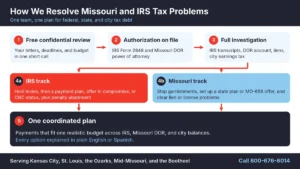
What working with us looks like
- Free confidential consultation. A short call about your letters, deadlines, and budget.
- Authorization on file. We file IRS Form 2848 and a Missouri power of attorney so both agencies call us.
- Full investigation. We pull IRS transcripts, review your DOR account, and check for liens and any city earnings tax balance.
- Protection first. Where the law allows, we act to stop or prevent levies and garnishments while we build your case.
- One coordinated plan. We negotiate each side together and explain every option in plain English.
| Common concern | How we handle it |
|---|---|
| “I live in Overland Park and work in downtown Kansas City.” | Missouri taxes the wages you earn there, Kansas credits that tax, and the city may tax in-city work. We sort out all three. |
| “I live in Edwardsville and work at a hospital in St. Louis.” | We reconcile the Missouri nonresident return, the Illinois return, and the St. Louis earnings tax as one case. |
| “I sold rental property and thought there was no tax.” | Missouri lets individuals subtract capital gains, but the IRS still taxes them. We address the federal balance and any penalties. |
| “Can a firm outside Missouri really help me?” | Yes. Federal representation works the same everywhere, and the state accepts authorized representatives. |
Tax Relief Services in Missouri: Cities and Regions We Serve
A trucker in Joplin, a nurse in St. Louis, and a rice farmer near Kennett face very different tax problems. We serve every part of Missouri, from the two big metros to the Ozarks, Mid-Missouri, and the Bootheel.
Kansas City Metro
Cities: Kansas City, Independence, Lee’s Summit, Blue Springs, Liberty, Gladstone, Raytown, Grandview, Belton, Raymore, Platte City
Engineering and tech employees, auto plant workers, logistics companies, and Kansas commuters. City earnings tax and two-state filing drive many cases.
St. Louis City and County
Cities: St. Louis, Clayton, Florissant, Chesterfield, Kirkwood, Ballwin, University City, Webster Groves, Maryland Heights
Healthcare, aerospace, and biotech workers, plus Illinois commuters. Storm-related deadline relief and the St. Louis earnings tax often come up.
St. Charles and Jefferson Counties
Cities: St. Charles, O’Fallon, St. Peters, Wentzville, Lake Saint Louis, Arnold, Festus, Hillsboro
Fast-growing suburbs with many small business owners and contractors. Estimated tax and payroll gaps are common starting points.
Springfield, Joplin, and the Ozarks
Cities: Springfield, Nixa, Ozark, Republic, Branson, Joplin, Carthage, Lebanon, Camdenton, Osage Beach
Tourism and entertainment workers, trucking firms, and lake-area businesses. Seasonal income makes payment plans and estimated tax tricky.
Columbia, Jefferson City, and Mid-Missouri
Cities: Columbia, Jefferson City, Fulton, Sedalia, Rolla, Warrensburg, Waynesville, St. Robert
State employees, university staff, and military families at Fort Leonard Wood and Whiteman Air Force Base. Moves and residency questions leave returns unfiled.
North Missouri, Southeast, and the Bootheel
Cities: St. Joseph, Maryville, Kirksville, Hannibal, Cape Girardeau, Sikeston, Poplar Bluff, Kennett, Farmington
Row-crop and livestock farms, river towns, and small manufacturers. Land and equipment equity shapes which IRS options are realistic.
Don’t see your town? We help taxpayers throughout Missouri. Call 800-676-6014 and we will tell you right away whether we can help. You can also browse our other service locations.
Expert Insight: The Risks of Handling IRS Tax Issues Alone or With AI
Most of our Missouri clients tried to fix things themselves first. That is normal. But IRS issues handled alone tend to go wrong in a few predictable ways, and each one narrows your options.
- Fixing two layers and forgetting the third. We regularly meet people who settled with the IRS and the state, then found a city earnings tax balance still growing in Kansas City or St. Louis.
- Treating a state break as a federal one. Missouri’s capital gains subtraction and other state tax deductions do not lower what you owe the IRS. Assuming they do leads to a surprise federal bill a year or two later.
- Filing a Missouri offer without a plan. Offer payments are non-refundable. A weak or incomplete MO-656 can cost money and months without reducing the debt.
- Agreeing to a payment you cannot keep. A quick plan offered on the phone may feel like a win, but a default makes the next request harder.
- Letting an AI chatbot write your response. AI tools often mix up Kansas City, Missouri with Kansas City, Kansas, blend in other states’ rules, or miss the city earnings tax entirely. They also cannot pull IRS transcripts, sign a power of attorney, or speak for you.
- Trusting tax software to fix collection. Online tax software is built to prepare a return, not to negotiate a balance, stop a garnishment, or argue penalties.
- Pasting sensitive data into public tools. Uploading your Social Security number, bank statements, or IRS letters to a free chatbot creates privacy risk you cannot take back.
Our take: AI is useful for learning what a term means. A licensed tax attorney, CPA, or enrolled agent should make the decisions and sign the paperwork. We explain why in Can AI get a better settlement than a tax attorney?
Want to understand your options first? Read our tax negotiation insights and IRS payment plans explained.
Why Missouri Taxpayers Choose Our Tax Relief Firm
Hiring help with tax matters is a trust decision. Since 2005, founding partner Mark Ladd and our in-house team have helped individuals and businesses resolve IRS debt and state tax liabilities. We work every case ourselves, with no outsourcing.
| Cases resolved | 18,000+ |
| Client balances settled | $220M+ |
| Average client rating | 4.9 / 5 |
| Credentials | Enrolled agents, CPAs, and tax attorneys |
| Languages | English and Spanish |
- One team for every layer. No hand-off between a federal firm, a state firm, and a city accountant.
- Honest answers. If a settlement is not realistic, we say so and show you a better path.
- Staying current. We help you file and pay on time going forward, so the problem does not come back.
- Recognized work. See our awards and recognition.
Clients often tell us the hardest part was not knowing what came next. Once we are on your case, dealing with the IRS becomes our job instead of yours.
Results vary based on each taxpayer’s facts and finances. Past results do not guarantee a similar outcome.
Bank-grade encryption and privileged conversations, every single time. Hand us the paperwork and finally stop worrying.
Missouri Tax Relief Frequently Asked Questions
Can you help me if you don’t have an office in Missouri?
Yes. Federal and state cases are handled by phone, mail, and secure online systems, and we represent you under a signed authorization. Our team works from California and serves clients throughout Missouri.
Does Missouri have an offer in compromise for state tax debt?
Yes. The Missouri Department of Revenue reviews offers filed on Form MO-656 based on doubt as to liability, doubt as to collectibility, or exceptional circumstances. Offer payments are non-refundable, so the application should be complete and well supported.
I live in Kansas and work in Kansas City, Missouri. What do I owe?
Usually a Missouri nonresident return on wages earned in Missouri, a Kansas resident return with a credit for Missouri tax, and the Kansas City earnings tax on work done inside city limits. Missing any one of these can create a balance.
Does Missouri’s capital gains exemption mean I don’t owe the IRS?
No. Missouri lets individuals subtract capital gains from their state taxable income, but federal capital gains tax still applies (Missouri Department of Revenue). A large sale can still create an IRS bill.
Can the Missouri DOR garnish my wages?
Yes. After notices go unanswered, the state can garnish wages, levy bank accounts, file a certificate of tax lien, and take state and federal refunds. A payment plan or other resolution can stop further action while you stay current.
Can unpaid Missouri taxes affect my professional or business license?
They can. Unpaid sales tax can block a sales tax license or local business license renewal, and Missouri has tied certain professional licenses to state tax compliance. We confirm what applies to you and work to clear it before a deadline.
Where is the Taxpayer Advocate Service in Missouri?
The Taxpayer Advocate Service, an independent office within the IRS, has local offices in Kansas City and St. Louis. It can help when normal IRS channels fail or a tax problem causes financial hardship (Taxpayer Advocate Service).
What should I bring to my free consultation?
Any IRS, Missouri DOR, or city letters, your latest tax return if you have one, and a rough idea of your monthly income and bills. Missing documents are fine. We can request IRS transcripts and state records for you.
More answers: tax relief questions, offer in compromise questions, wage garnishment questions, and back tax help questions.
Sources
- Missouri Department of Revenue: Offer in Compromise
- Missouri Department of Revenue: Capital Gains Subtraction for Individuals
- Taxpayer Advocate Service
Republic Tax Relief is a private firm and is not affiliated with the IRS, the Missouri Department of Revenue, or any city tax office. This page offers general information, not legal or tax advice for your specific situation. Tax laws and agency procedures change, so speak with a qualified tax professional before acting.
Speak With a Tax Relief Professional and Get Tax Help in Missouri
Every month you wait, interest and penalties grow.
Whether the letter came from the IRS, the Missouri Department of Revenue, or your city, one short call can show you where you stand and what to do next. Your consultation is free and confidential.
About Republic Tax Relief
Republic Tax Relief helps individuals and businesses nationwide resolve IRS and state tax problems, including back taxes, levies, liens, unfiled returns, and payroll tax debt. Since 2005, our in-house team of enrolled agents, CPAs, and tax attorneys has resolved more than 18,000 cases. From our offices in Corona and Laguna Hills, California, we represent clients in all 50 states, including Missouri. Call 800-676-6014 or contact us online for a free, confidential consultation.