
From the Old Market to the Sandhills and the Panhandle
Nebraska Tax Relief for IRS and State Tax Problems: Help With Tax Debt, Missed Deadlines After a Severe Storm in Nebraska, and Property Tax Relief Questions
A Demand for Payment from Lincoln. A bank levy that cleared out your account before harvest money came in. A hailstorm or wildfire that wrecked your records and scrambled every deadline. We step in between you and the IRS and the Nebraska Department of Revenue, move to protect your income where the law allows, and build a plan you can actually keep.
Rail and insurance workers in Omaha, state employees in Lincoln, feedlot operators near Grand Island, and ranch families outside North Platte work with our team by phone, video, and secure upload.
Federal and state balances, one plan
W-2, 1099, farm, and sales tax filers
In-house team since 2005
Spanish-speaking clients welcome
Most Nebraskans who call us owe two agencies, not one. The IRS wants its federal tax, and the Nebraska Department of Revenue (DOR) wants its share of state income tax, sales tax, or withholding. Each agency sends its own letters, sets its own deadlines, and has its own tools for taking money once those deadlines pass.
Republic Tax Relief offers Nebraska tax relief for individuals and business owners who owe the IRS, the state, or both. Our enrolled agents, CPAs, and tax attorneys work as one team from our California offices and represent clients in Omaha, Lincoln, and all 93 Nebraska counties.
On This Page
- Why Nebraska Taxpayers Owe the IRS and the State Together
- IRS Tax Relief for Nebraska Storm and Wildfire Victims
- How the Nebraska Department of Revenue Collects
- Nebraska Settlement Requests and Payment Plans
- A Nebraska IRS Case: When Unfiled Returns Turn Criminal
- Iowa, South Dakota, and Cross-Border Income Tax
- IRS vs. Nebraska Department of Revenue Compared
- IRS Tax Relief Options for Nebraska Taxpayers
- Property Tax Credits, Social Security, and Prior Year Returns
- Sales Tax, Farm, and Business Tax Debt
- How We Help Nebraska Taxpayers Without a Local Office
- IRS Tax Relief in Omaha, Lincoln, and Every Region
- Expert Insight: DIY and AI Risks With IRS Tax Problems
- Why Nebraskans Choose Republic Tax Relief
- Frequently Asked Questions
- Contact Us and Speak With a Tax Relief Professional
Why Nebraska Taxpayers Often Owe Federal Tax and Nebraska State Tax at the Same Time
Your Nebraska income tax return starts with the federal adjusted gross income from your federal return. So when the federal return is late or wrong, the state return usually follows. And when the IRS changes your taxable income, the DOR can receive that change and send its own tax bill months later.
These are the patterns we see most among Nebraska taxpayers:
- Farm and ranch income swings. A strong cattle or corn year followed by drought, hail, or low prices leaves balances nobody planned for. Equipment sales and land deals can also create surprise tax liabilities.
- Contract and gig income. Travel nurses, truck drivers on I-80, rideshare drivers in Omaha, and construction subcontractors often get 1099s with no withholding at all.
- Missed estimated tax payments. Self-employed people and retirees with investment income are expected to pay estimated tax during the year. Skipping them adds penalties to both returns.
- Cross-border paychecks. Residents near Council Bluffs, Sioux City, and the Kansas line often earn wages in another state. Withholding goes to the wrong place, and Nebraska still expects its share.
- Years of unfiled returns after a divorce, an illness, or a business that stalled. Our unfiled tax returns service handles the tax filing for back years and stops new penalties from piling on.
Nebraska has been lowering its individual income tax rate in steps. That helps going forward, but it does not shrink old balances. Debts from earlier years are still owed at the rates in effect back then, plus penalties and interest. Not sure what you owe or for which tax year? Our back tax help starts by confirming every balance before anyone makes a promise.
Your case stays between you and your team. Everything you share, from late returns to hard choices, is held to attorney-client and tax professional privilege standards and never leaves the people working your file.
IRS Tax Relief for Affected Taxpayers After a Severe Storm, Tornado, or Wildfire in Nebraska
Nebraska gets hit hard and often. Hail, straight-line winds, tornadoes, floods along the Platte and Missouri, and wildfires in the Sandhills and Panhandle can all trigger filing and payment relief from the Internal Revenue Service.
Recent seasons have been busy. The IRS has postponed deadlines after wildfires in counties such as Lincoln, Keith, Dawson, Dawes, and Sioux, and after severe storms in counties such as Buffalo, Gage, Richardson, and Thurston. A newer federal law also lets the IRS grant relief based on a governor’s disaster declaration, so Nebraskans no longer always have to wait for a federal declaration first.
Most recently, the IRS announced tax relief for Knox County after a severe storm in Nebraska, moving many filing and payment deadlines into the following year (IRS: Tax Relief for Taxpayers Impacted by Severe Storm in Nebraska).
| What IRS disaster relief usually covers | What to know |
|---|---|
| Filing and payment relief | Most federal returns and tax payments due during the window move to one later deadline, including quarterly estimated tax payments. |
| Extended returns | If you had a valid extension, the extended return gets more time. The payment that was due in April usually does not. |
| Payroll and excise tax deposits | The deposits are not postponed. The IRS usually forgives late-deposit penalties on payroll and excise tax deposits due in the first couple of weeks if made by a short cutoff date. |
| Automatic filing and payment relief | People and businesses with an address of record in the covered county get relief automatically. |
| Records outside the area | If you live outside the county but your records were inside it, you must call the IRS disaster hotline at 866-562-5227 to request this tax relief. |
| Payment plans | Missed installment payments during the window do not default your agreement, but interest and late-payment penalties keep growing. |
A postponed deadline is still a deadline
Disaster relief postpones tax. It does not forgive it. When the new date passes, a storm victim who still cannot pay faces the same collection process as anyone else, often while paying for a new roof, fencing, or lost cattle.
If you get a late payment penalty notice for a date that fell inside the relief window, call the number on the notice to have the IRS abate the penalty. State deadlines do not always move with federal ones, so we check both. If your county was left off the list, IRS penalty abatement for reasonable cause may still remove storm-related penalties.
How the Nebraska Department of Revenue Collects Unpaid Tax: Liens, Levies, and the Delinquent Taxpayer List
The DOR usually starts with a balance due notice, then a Demand for Payment. If you do not respond, a state tax lien and levies can follow. State leaders have also pushed the department to collect more aggressively, and it now uses tools like bank data matching to find accounts it can levy.
| Nebraska collection action | What it means for you |
|---|---|
| Demand for Payment | The DOR sends a demand at least 10 days before it records a lien, except in rare jeopardy cases. This is your last easy window. |
| State tax lien | A public claim against your property that can block a home sale, a refinance, or a farm operating loan. |
| Bank levy | Nebraska banks must take part in a data match program, so the DOR can find and freeze accounts faster than many people expect. |
| Wage levy | Part of each paycheck goes to the state until the balance is cleared or the levy is released. |
| Permit revocation | For businesses, the DOR can revoke or suspend a sales tax permit, which can shut down your ability to sell legally. |
| Delinquent Taxpayer List | After multiple notices and a filed lien, your name can be published on the DOR’s public list. |
| Offsets | State refunds, and even certain gambling winnings, can be kept and applied to what you owe. |
Getting help before the lien is recorded keeps far more options open. See how we handle wage garnishment relief, bank levy help, and tax lien help.
Nebraska Tax Relief Options From the State: Settlement Requests and Payment Plans
Good news first: unlike some states, Nebraska will consider settling a delinquent income tax account for less than the full amount. The DOR calls this an individual income tax settlement request, and it reviews each one case by case.
The department says it may consider these requests for older unresolved accounts, hardship cases, retired or limited-income taxpayers, and nonresidents. A request needs a written proposal explaining why the settlement is in the state’s best interest, Form FHRIND-NE, recent bank statements, and recent pay stubs (Nebraska Department of Revenue: Individual Income Tax Settlement Requests).
The catch most people miss: Under the state’s collection rules, you generally cannot dispute the amount and ask for a settlement at the same time, and you cannot be in a bankruptcy case. So the order matters. If the bill is wrong, fix the assessment first. Only then does a settlement request make sense.
Nebraska payment plans
Once you receive a balance due notice, you can request a payment plan for individual or business tax online. Plans may carry fees, and interest keeps running on the unpaid amount the whole time. A plan sized too large for your budget is the most common reason people end up back in collection.
The petition window is short
If you disagree with a Nebraska deficiency notice, you generally have 60 days to file a written petition asking the Tax Commissioner to redetermine it. Miss that window and the conversation turns from “Is this right?” to “How will you pay?”
A Real Nebraska IRS Tax Case: When Unfiled Federal Tax Returns Turn Into Criminal Tax Cases
Most people who fall behind on filing face civil penalties, not prison. But this case from federal court in Omaha shows how far things can go when someone keeps ignoring the IRS on purpose.
The case: An IRS investigation found that a man earned about $272,000 over three years while living and working in Omaha. He owed roughly $52,800 in federal tax but did not file any federal returns for those years.
The outcome: A jury convicted him on three counts of tax evasion, and a federal judge sentenced him to 51 months in prison (U.S. Attorney’s Office, District of Nebraska).
The lesson: The tax owed was modest. The prison time came from years of willful silence. Coming forward with accurate returns before the IRS comes to you changes the whole outcome.
If you have years of unfiled returns, the right move is a careful plan, not panic. We review your situation privately first, then decide how and when to bring you back into compliance.
Iowa, South Dakota, and Kansas: Where Nebraska Taxpayers Owe State Income Tax
Thousands of people cross the Missouri River for work every day. Which state taxes those wages depends on where you live and where you earn the money, and the rules trip up plenty of careful people.
| Your situation | What it usually means |
|---|---|
| Live in Omaha or Bellevue, work in Council Bluffs | You file in both states. Nebraska taxes all your income but gives a credit for tax paid to Iowa, so you are not taxed twice. |
| Live in Iowa, work in Omaha | You usually owe a Nebraska nonresident return on wages earned in the state. |
| Live in South Sioux City, work in South Dakota | South Dakota has no income tax, so there is no credit to offset Nebraska’s. Employers often withhold nothing for Nebraska. |
| Live in the Panhandle, work in Wyoming or Colorado | Wyoming wages carry no state tax to credit. Colorado wages mean two returns and a credit at home. |
Simplified summary. Each open year should be reviewed based on your residency and paperwork.
A common story: a family in South Sioux City works across the river for years with no Nebraska withholding. Eventually the state catches up, and the bill covers several years at once. Filing accurate returns quickly usually costs far less than waiting for the state to estimate them.
IRS vs. Nebraska Department of Revenue: How Federal and State Tax Collection Compare
The IRS and the DOR use different forms, rules, and timelines. Putting them side by side shows why fixing one agency while ignoring the other rarely holds.
| Collection step | IRS (federal tax) | Nebraska DOR (state tax) |
|---|---|---|
| Lien | Notice of Federal Tax Lien | State tax lien after a Demand for Payment |
| Wages and bank | Levy after a final notice of intent to levy | Levy on an employer or financial institution |
| Paying over time | Installment agreement | Online payment plan after a balance due notice |
| Settling for less | Offer in compromise based on ability to pay | Settlement request, only when you do not dispute the tax |
| Hardship pause | Currently Not Collectible status | Hardship reviewed case by case |
| Disputing the bill | Appeals and Tax Court petitions | Written petition for redetermination, generally within 60 days |
| Public exposure | Lien recorded with the county | Lien plus possible Delinquent Taxpayer List |
| Representative form | Form 2848 | Nebraska Form 33, Power of Attorney |
Should you call the IRS or contact the IRS yourself? You can, but every word goes on your record. Learn how our IRS collections defense works and read our guide to common IRS notices.
IRS Tax Relief Options for Nebraska Taxpayers: How Tax Relief Works at the Federal Level
The IRS offers several paths, and the right one depends on your income, expenses, equity, and how much time is left on the collection clock. Here is how each one fits.
| Relief option | What it does | Often fits |
|---|---|---|
| Installment agreement | Monthly payments while levies are held off | Steady income but not enough to pay in full now |
| Offer in compromise | Settles federal debt for less based on ability to pay | Low income and equity compared with the balance |
| Currently Not Collectible | Pauses collection during financial hardship | Income that barely covers basic living costs |
| Penalty abatement | Removes penalties for a clean history or reasonable cause | Illness, a death in the family, or storm and fire damage |
| Innocent spouse relief | Separates you from a spouse’s tax debt | Errors or unpaid tax caused by a current or former spouse |
Who may qualify for tax relief through an IRS settlement
The IRS looks at your income, allowable living expenses, and equity in a home, vehicles, land, and retirement accounts. For farm and ranch families with machinery, cattle, and acreage, equity can block a settlement even when cash is tight, so we test the numbers before anything is filed. Learn how the OIC program works.
Facing an audit instead of a bill
With representation in place, the IRS examiner or DOR auditor contacts us, not you. We gather the records, answer the questions, and push back on tax assessments that are not supported.
For the bigger picture, see our tax debt relief options, IRS payment plans, Currently Not Collectible status, the IRS Fresh Start Program, and the four types of innocent spouse relief.
Nebraska Property Tax Relief Credits, Social Security, and Prior Year Tax Returns
Nebraska property tax bills are among the heaviest in the country, and that pressure often drains the cash people would have used for income tax payments. Catching up on old returns can also unlock state benefits you may have missed.
- The Nebraska Property Tax Incentive Act credit. This refundable income tax credit is based on school district and community college property taxes you paid. It is claimed on Form PTC with a filed state return, so people with unfiled years often leave it unclaimed. Amended forms can reach some prior years.
- Your property tax bill itself. Local property taxes are collected by the county treasurer, not the DOR. Unpaid amounts can lead to tax sale certificates sold to investors. We focus on IRS and state tax problems, but we factor your property tax rate and arrears into any budget we present.
- Social Security. Nebraska no longer taxes Social Security benefits. The IRS, however, can still levy part of those benefits for an unpaid federal balance.
- Refund offsets. A refund or refundable credit can be applied to an old state or federal debt first. We plan for that so it does not catch you off guard.
When we prepare back years, we look for every credit and deduction you are owed. A missed property tax credit can shrink a state balance before a single dollar is negotiated.
Sales Tax Permit Problems, Payroll Tax, and Business Tax Debt in Nebraska
Nebraska businesses collect sales and use tax under a sales tax permit, and that money belongs to the state from the moment you collect it. When cash runs short, owners sometimes use it to cover payroll or inventory. That is the start of many of the business cases we see.
- Collected but not remitted sales tax. The state treats this seriously, and responsible officers can be held personally liable for it.
- Use tax on purchases. Equipment and supplies bought from out-of-state sellers without sales tax often owe Nebraska use tax, and audits find it.
- Withholding and payroll. Unpaid state withholding and federal payroll taxes put owners at personal risk. The IRS can assess the Trust Fund Recovery Penalty against those who control the money. Start with payroll tax debt relief.
- Permit revocation. If a business stays delinquent, the DOR can revoke its permit and stop it from selling at all.
The Nebraska businesses we help most often include:
- Farms, ranches, and ag service companies across the Platte Valley and Sandhills dealing with weather swings, equipment equity, and estimated tax rules.
- Builders and trades in the Omaha and Lincoln metros, including storm-repair contractors. See construction tax resolution.
- Restaurants and bars from the Old Market to the Haymarket juggling sales tax and tipped payroll. Read our restaurant tax resolution insights.
- Doctors, dentists, and clinic owners serving rural and metro communities. See tax resolution for medical professionals.
- Online sellers and real estate investors. See e-commerce tax resolution and real estate tax resolution.
Explore our business audit help, business tax resolution services, small business tax relief, and business tax debt relief.
Upload with confidence. Returns, W-2s, and bank statements travel and rest under bank-grade 256-bit encryption, handled in full compliance with federal data protection and security standards.
How Our Tax Relief Helps Nebraska Taxpayers Without a Local Office
We want to be upfront: we do not have a Nebraska office. Our team works from our offices in Corona, California and Laguna Hills, California. Most of Nebraska is two hours ahead of us on Central time, and the western Panhandle is one hour ahead on Mountain time, so we book calls that fit your day.
You do not need an office on Dodge Street to fix an IRS problem. Federal cases run by phone, mail, fax, and secure online systems, and the IRS works with authorized representatives from any state. The DOR also accepts representatives named on Nebraska Form 33, Power of Attorney.
Free help, such as VITA sites, works well for a simple current return. Negotiating a large balance with two agencies is a different job, and our licensed team handles each part with the right credential.
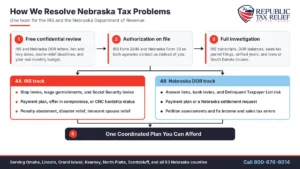
What working with us looks like
- Free confidential consultation. A short call about your letters, deadlines, and monthly budget.
- Authorization on file. We file IRS Form 2848 and Nebraska Form 33 so both agencies contact us instead of you.
- Full investigation. We pull IRS transcripts, confirm DOR balances, and check sales tax filings and any Iowa or South Dakota income.
- Protection first. Where the law allows, we act to stop or prevent levies and garnishments while we build your case.
- One coordinated plan. We negotiate with both agencies together and explain every option in plain English.
| Common concern | How we handle it |
|---|---|
| “I got a Demand for Payment from Lincoln.” | We contact the DOR right away and work to head off the lien and levy that usually come next. |
| “I work in South Dakota. Why does Nebraska want money?” | We explain your residency rules, file what is required, and set up withholding so it stops happening. |
| “Hail and wind ruined my records.” | We request transcripts, rebuild missing years, and check whether disaster relief or penalty abatement applies. |
| “Can a California firm really help me?” | Yes. Federal representation works the same in every state, and the DOR accepts authorized representatives. |
IRS Tax Relief in Omaha, Lincoln, and Every Region of the State of Nebraska
A rail worker in Omaha, a state employee in Lincoln, and a cow-calf operator near Valentine face very different tax problems. We start with our two focus cities, then cover the rest of the Cornhusker State.
Focus City: Omaha
Omaha is the state’s largest city and its business hub. Finance, insurance, rail, healthcare, and Offutt Air Force Base shape the tax problems we see here.
Restaurant and shop owners with sales tax balances and uneven cash flow.
Professionals, consultants, and business owners with missed estimated tax.
Military families and contractors with multi-state filing questions.
Growing suburbs where Iowa commuting and new home costs collide with old tax debt.
Focus City: Lincoln
Lincoln is the capital and home to the Nebraska Department of Revenue itself. State government, the university, insurance, and manufacturing drive the local economy.
State employees and contractors with side income and no withholding.
Small businesses, faculty, and staff juggling sales tax and 1099 work.
Growing families and contractors facing levies after a few hard years.
Part-time farmers and acreage owners with mixed farm and W-2 income.
Regions We Serve Across Nebraska
Omaha Metro
Cities: Omaha, Bellevue, Papillion, La Vista, Elkhorn, Gretna, Fremont, Blair
Finance, rail, healthcare, and Iowa commuters across the river.
Lincoln and Southeast Nebraska
Cities: Lincoln, Beatrice, Seward, York, Nebraska City, Falls City, Auburn
State workers and farm families. Gage, Richardson, and Nemaha counties have seen recent IRS storm relief.
Central Nebraska and the Tri-Cities
Cities: Grand Island, Kearney, Hastings, Lexington, Holdrege, St. Paul
Meatpacking, feedlots, and ag business. Buffalo and Howard counties have seen recent storm declarations.
Northeast Nebraska
Cities: Norfolk, Columbus, South Sioux City, Wayne, Creighton, Pender
Manufacturing, hog and grain farms, and South Dakota commuters. Knox and Thurston counties have seen recent relief.
West Central and the Sandhills
Cities: North Platte, Ogallala, McCook, Broken Bow, Valentine, Cozad
Rail crews, ranchers, and wildfire-affected taxpayers in Lincoln, Keith, and Dawson counties.
The Panhandle
Cities: Scottsbluff, Gering, Sidney, Alliance, Chadron, Kimball
Sugar beet and cattle operations, Wyoming and Colorado commuters, and wildfire areas in Dawes and Sioux counties.
Don’t see your town? We help taxpayers throughout the state of Nebraska. Call 800-676-6014 and we will tell you right away whether we can help. You can also browse our other service locations, including nearby Missouri and Colorado.
Expert Insight: The Risks of Handling IRS and Nebraska Tax Issues Alone or With AI
Many Nebraskans try to negotiate directly with the IRS and the state before they call us. That is understandable. But self-managed cases tend to go wrong in a few predictable ways, and each mistake can close a door.
- Disputing and settling at the same time. Nebraska’s settlement process generally requires that you not dispute the amount. People who send an angry letter and a settlement offer together often get neither reviewed the way they hoped.
- Letting the 60-day petition window pass. Once it closes, a wrong state assessment is far harder to fix.
- Ignoring the Demand for Payment. It feels like one more letter. In reality, it is often the last notice before a lien and a spot on the public Delinquent Taxpayer List.
- Treating storm relief as a long pause. Disaster postponements end on a fixed date. Anyone who waits past it is back in collection with penalties stacked on top.
- Trusting AI on moving targets. Nebraska keeps changing its tax rate schedule, its Social Security rules, and its property tax credits. Chatbots often repeat old rules or mix up Iowa and South Dakota treatment, and a wrong answer means a wrong return.
- Pasting sensitive data into public tools. Uploading your Social Security number, W-2s, or bank statements to a free chatbot creates a privacy risk you cannot undo. AI also cannot pull transcripts, sign a power of attorney, or speak to the DOR for you.
Our take: AI is fine for learning what a term means. A licensed tax attorney, CPA, or enrolled agent should make the decisions and sign the paperwork. We explain why in Can AI get a better settlement than a tax attorney?
Want to understand your options first? Read our offer in compromise insights and tax negotiation insights.
Why Nebraska Taxpayers Choose Our Tax Attorney, CPA, and Enrolled Agent Team
Hiring help with tax debt is a trust decision. Since 2005, founding partner Mark Ladd and our in-house team have helped individuals and businesses resolve IRS and state tax problems. We work every case ourselves, with no outsourcing.
| Cases resolved | 18,000+ |
| Client balances settled | $220M+ |
| Average client rating | 4.9 / 5 |
| Credentials | Enrolled agents, CPAs, and tax attorneys |
| Scheduling | Call times set around Central and Mountain time |
| Languages | English and Spanish |
- One team for both agencies. IRS and DOR balances handled together, not by two offices that never talk.
- We know Nebraska’s pressure points. The Demand for Payment, the 60-day petition window, the Delinquent Taxpayer List, and settlement rules shape how fast we move.
- Help in Spanish. Many families in Grand Island, Lexington, Schuyler, and South Omaha prefer to talk through their case in Spanish, and we welcome that.
- Honest answers. If a settlement is not realistic, we say so and show you a better path.
- Recognized work. See our awards and recognition.
Clients tell us the hardest part was not knowing what came next. Once we are on your case, dealing with the IRS and Lincoln becomes our job.
Results vary based on each taxpayer’s facts and finances. Past results do not guarantee a similar outcome.
Your tax problem is serious. Your data’s safety is not up for debate.
Nebraska Tax Relief Frequently Asked Questions
Can you help me if you don’t have an office in Nebraska?
Yes. IRS and state cases are handled by phone, mail, and secure online systems, and we represent you under a signed power of attorney. Our team works from California, schedules calls around Central and Mountain time, and serves clients in all 93 Nebraska counties.
Will Nebraska settle my state tax debt for less?
Sometimes. The Nebraska Department of Revenue will consider an individual income tax settlement request for hardship cases, older accounts, retirees, limited-income taxpayers, and nonresidents. You generally cannot be disputing the tax or be in bankruptcy, and you need to submit financial records with your request.
What happens after a Nebraska Demand for Payment?
If you do not pay or respond, the DOR can record a state tax lien at least 10 days after the demand. Levies on your bank account or wages can follow, and your name may later appear on the public Delinquent Taxpayer List.
I was affected by a Nebraska storm or wildfire. Do I still owe my taxes?
Yes. IRS disaster relief postpones filing and payment deadlines for people in the covered area, but the tax is still due when the postponed date passes. If you live outside the area but your records were inside it, call the IRS disaster hotline at 866-562-5227 to ask for relief.
I live in Nebraska and work in Iowa or South Dakota. What do I owe?
Nebraska taxes its residents on all of their income. If you work in Iowa, you file there too and claim a Nebraska credit for Iowa tax paid. If you work in South Dakota, there is no state tax to credit, so Nebraska tax is usually owed on the full amount.
Can I still claim the Nebraska property tax credit for past years?
Possibly. The credit for school district and community college property taxes is claimed with a filed Nebraska return, and amended forms can reach some earlier years. People with unfiled years often miss it, so we check for it when we catch you up.
Can the IRS take my Social Security if I live in Nebraska?
Yes. Nebraska does not tax Social Security benefits, but the IRS can still levy part of them for unpaid federal tax. A payment plan or hardship status can often stop or prevent that levy.
What should I bring to my free consultation?
Any IRS or DOR letters, your latest tax return if you have one, and a rough idea of your monthly income and bills. Missing documents are fine. We can request IRS transcripts and state records for you.
More answers: tax relief questions, offer in compromise questions, unfiled tax returns questions, and IRS collections defense questions.
Sources
- Internal Revenue Service: Tax Relief for Taxpayers Impacted by Severe Storm in Nebraska
- Nebraska Department of Revenue: Individual Income Tax Settlement Requests
- U.S. Attorney’s Office, District of Nebraska: Former Omaha Man Sentenced for Tax Evasion
Republic Tax Relief is a private firm and is not affiliated with the IRS or the Nebraska Department of Revenue. This page offers general guidance, not legal or tax advice for your specific situation. Tax laws and agency procedures change, so consult a qualified tax professional before acting.
Contact Us: Speak With a Tax Relief Professional About Your Nebraska Tax Debt
The IRS and Lincoln won’t wait. Neither should you.
Whether the letter came from the IRS or the Nebraska Department of Revenue, a short call can show you where you stand and what to do next. Your consultation is free and confidential.
About Republic Tax Relief
Republic Tax Relief helps individuals and businesses nationwide resolve IRS and state tax problems, including back taxes, levies, liens, unfiled returns, audits, and payroll tax debt. Since 2005, our in-house team of enrolled agents, CPAs, and tax attorneys has resolved more than 18,000 cases. From our offices in Corona and Laguna Hills, California, we represent clients in all 50 states, including Nebraska. Call 800-676-6014 or contact us online for a free, confidential consultation.