
From the Milwaukee lakefront to the Madison Isthmus and the Northwoods
Wisconsin Tax Relief for IRS Debt, Wisconsin Department of Revenue Back Taxes, and Severe Storm and Flooding Victims: Real Options for Individuals and Businesses Who Owe
A tax warrant filed with your county Clerk of Circuit Court. A bank levy that froze your checking account the week rent was due. A storm or flood that wrecked your records and your filing deadline at the same time. We step in between you and the IRS and the Wisconsin DOR, move to protect your paycheck and bank account where the law allows, and build a plan that fits what you can pay.
Machinists in Milwaukee, state workers and tech employees in Madison, dairy farmers in the Driftless, and contractors in the Fox Valley work with our tax relief service by phone, video, and secure upload.
Federal and state balances, one plan
W-2, 1099, Schedule F, and owners
In-house team since 2005
Spanish-speaking clients welcome
Wisconsin’s Department of Revenue charges interest on delinquent tax at 18% a year and adds a collection fee the moment a balance turns delinquent. On top of that, any unpaid account can have a tax warrant filed in your county, where it becomes a public record. Pair that with an IRS balance, and the pressure builds fast.
Republic Tax Relief offers Wisconsin tax relief for individuals and business owners who owe the IRS, the DOR, or both. Our enrolled agents, CPAs, and tax attorneys work from our California offices as one coordinated team, and we represent clients in Milwaukee, Madison, and all 72 Wisconsin counties.
On This Page
- Why Wisconsin Taxpayers Owe the IRS and the State Together
- IRS Disaster Relief for Wisconsin Storm, Tornado, and Flooding Victims
- How the Wisconsin Department of Revenue Collects Back Taxes
- Minnesota, Illinois, and Michigan Border Tax Issues
- IRS vs. Wisconsin Department of Revenue Compared
- IRS Relief Options for Wisconsin Taxpayers
- Wisconsin Petition for Compromise and Payment Plans
- Farm and Business Tax Debt in Wisconsin
- How We Help Wisconsin Taxpayers Without a Local Office
- IRS Tax Relief in Milwaukee, Madison, and Every Wisconsin Region
- Expert Insight: DIY and AI Risks With IRS Tax Problems
- Why Wisconsin Taxpayers Choose Republic Tax Relief
- Frequently Asked Questions
- Contact Us and Speak With a Tax Relief Professional
Why Wisconsin Taxpayers Often Owe the IRS and the Wisconsin Department of Revenue at the Same Time
Your Wisconsin income tax return begins with the federal adjusted gross income from your federal tax return. When the federal return is late or wrong, the state return usually is too. And when the IRS changes your income, Wisconsin can learn about it and send its own bill.
These are the patterns we see most often among Wisconsin residents:
- Manufacturing overtime and layoffs. Milwaukee, the Fox Valley, and the Chippewa Valley still run on factory shifts. Big overtime years, followed by a plant slowdown, leave people with balances they cannot cover.
- Farm income that swings. Dairy, cranberry, ginseng, and cash crop operations can earn a lot one year and lose money the next. Estimated payments often get skipped in the good years.
- 1099 and side work. Rideshare, contracting, and consulting income around Madison and Milwaukee often has no withholding at all.
- Seasonal tourism income from the Wisconsin Dells, Door County, and Northwoods resorts that arrives in summer and has to stretch through winter.
- Several years of unfiled returns after a divorce, a health crisis, or a business that stalled. Our unfiled tax returns service handles the tax preparation for back years and puts a stop to new penalties.
Not sure what you owe or to whom? Our back tax help starts by pulling your records and confirming each balance, agency, and tax year involved.
Talk to us like you would your lawyer. Every detail you share is protected by attorney-client and tax professional privilege standards, and it is used for one purpose only: resolving your case.
IRS Tax Relief for Wisconsin Victims of Severe Storms, Tornadoes, and Flooding
Wisconsin gets hit hard by spring tornadoes, summer straight-line winds, and flash flooding. After a federal disaster declaration, the Internal Revenue Service can postpone many filing and payment deadlines for people who live or have a business in the affected counties.
In recent seasons, the IRS has granted relief after flooding in Milwaukee, Washington, and Waukesha counties, and after severe storms, tornadoes, and flooding that reached dozens of counties and the Oneida Indian Reservation. That most recent relief applies to individuals and businesses in the covered area and gave them extra months to file and pay (IRS: Tax Relief for Wisconsin Severe Storms, Tornadoes, and Flooding).
| What disaster relief usually covers | What to know |
|---|---|
| Postponed filing deadline | Individual, business, and many other returns due in the disaster window move to one later date. |
| Postponed payments | Balances due with those returns and quarterly estimated payments move too. Interest rules can still apply once the window ends. |
| Automatic for most | The IRS applies relief based on the address on file. If you moved, or your records were in the area but you were not, you may need to call the IRS disaster line. |
| Casualty losses | Uninsured storm or flood losses may be claimed on the current or prior year return, using the FEMA declaration number. |
| Free transcripts | Fees for copies of past returns are usually waived, which helps if your records were destroyed. |
When the postponement ends, the bill comes due
Disaster relief delays deadlines. It does not erase what you owe. Once the postponed date passes, a storm victim who still cannot pay faces the same collection process as anyone else, often while paying for repairs.
If you missed the extended deadline, or you were affected but your county was not on the list, IRS penalty abatement for reasonable cause may still remove penalties tied to the storm.
How the Wisconsin Department of Revenue Collects Back Taxes: Warrants, Levies, and the Delinquent List
The DOR’s Compliance Bureau in Madison calls a tax “delinquent” once the due date passes and your appeal rights expire. From that point, the debt is subject to collection, and every delinquent debt can have a tax warrant filed against it (Wisconsin DOR: Delinquent Taxes FAQs).
| Wisconsin collection action | What it means for you |
|---|---|
| Delinquent fee and interest | A collection fee of 6.5% or $35, whichever is greater, plus interest at 18% a year on the unpaid tax. |
| Tax warrant | Filed with your county Clerk of Circuit Court. It acts as a lien on your real and personal property and is a public record that can affect credit or a home sale. |
| Bank levy | The DOR can take money from your accounts, either once or on a continuing basis. |
| Wage attachment | Your employer sends part of every paycheck to the state until the debt is paid. |
| License and permit actions | State credentials can be denied or revoked for unpaid tax, and a business can lose its seller’s permit. |
| Refund offsets | State refunds can be kept and applied to what you owe. |
| Online delinquent taxpayer list | Balances over $5,000 that stay unpaid more than 90 days after appeal rights expire can be posted publicly, with updates each quarter. |
The appeal window is short
If you think a Wisconsin assessment is wrong, you generally have 60 days after you receive the notice to file a petition for redetermination. After that, the balance becomes final and the question changes from “is this right?” to “how do I pay it?”
A payment plan does not always stop a warrant
Many people are surprised to learn that a Wisconsin installment agreement may not prevent a tax warrant from being filed. Getting the timing and terms right matters more than simply signing up.
See how we handle wage garnishment relief, bank levy help, and tax lien help.
Wisconsin Residents Who Work in Minnesota, Illinois, or Michigan: Where Your Income Tax Is Owed
Thousands of Wisconsinites cross a state line for work every day. Hudson and River Falls feed the Twin Cities, Kenosha and Racine feed northern Illinois, and Marinette and Superior sit right on the border. Which state gets your tax depends on where you live and the agreements between states.
| Your situation | What it usually means |
|---|---|
| Live in Wisconsin, work in Illinois, Indiana, Kentucky, or Michigan | Reciprocity applies. With the right exemption form, wages are taxed only by Wisconsin. |
| Live in Wisconsin, work in Minnesota | No reciprocity. You file a Minnesota nonresident return and claim a credit on your Wisconsin return for tax paid there. |
| Live in Minnesota, work in Wisconsin | You generally owe Wisconsin nonresident tax on those wages and claim a credit at home. |
| Moved into or out of Wisconsin during the year | A part-year return is usually required, and withholding is often split incorrectly. |
Simplified summary. Each open year should be reviewed based on your residency and paperwork.
Why this matters for your plan: We often see Hudson-area workers whose Minnesota employer withheld only for Minnesota while Wisconsin assumed nothing was paid. Before anyone agrees to a payment plan, we confirm which state is truly owed and file the credits that shrink the bill.
IRS vs. Wisconsin Department of Revenue: How Federal and State Tax Collection Compare
The IRS and the DOR follow different rules, forms, and timelines. Seeing them side by side shows why a plan that covers only one agency rarely holds.
| Collection step | IRS (federal tax) | Wisconsin DOR (state tax) |
|---|---|---|
| Lien | Notice of Federal Tax Lien | Tax warrant filed with the county Clerk of Circuit Court |
| Wages and bank | Levy after a final notice of intent to levy | Wage attachment and one-time or continuous bank levy |
| Cost of waiting | Penalties plus interest that changes each quarter | Collection fee plus 18% annual interest |
| Paying over time | Installment agreement | Payment plan request with the Compliance Bureau |
| Settling for less | Offer in compromise (Form 656) | Petition for Compromise of Taxes |
| Hardship pause | Currently Not Collectible status | Case-by-case; accounts can be written off as uncollectible but remain legal obligations |
| Public pressure | Passport certification for seriously delinquent debt | Online delinquent taxpayer list and license actions |
The two agencies do not coordinate deadlines for you. Learn how our IRS collections defense works and read our guide to common IRS notices.
IRS Tax Relief Options for Wisconsin Taxpayers: Payment Plan, Offer in Compromise, or Hardship Status
No single program fits every federal tax debt. The right choice depends on your income, monthly expenses, equity, and how much time remains on the IRS collection clock.
| Relief option | What it does | Often fits |
|---|---|---|
| Installment agreement | Monthly payments while levies are held off | Steady income but unable to pay the full amount now |
| Offer in compromise | Settles the debt for less based on ability to pay | Low income and equity compared with the amount owed |
| Currently Not Collectible | Pauses collection during financial hardship | Income that barely covers basic living costs |
| Penalty abatement | Removes penalties for a clean history or reasonable cause | Serious illness, a death in the family, or storm and flood damage |
| Innocent spouse relief | Separates you from a spouse’s tax debt | Errors or unpaid tax caused by a current or former spouse |
When you need to pay monthly
Most people who cannot pay in full can get an IRS payment plan. Lower monthly payments can require more financial disclosure, and interest keeps running either way. Read how IRS payment plans work, or see when Currently Not Collectible status makes more sense.
How the IRS judges a settlement
The IRS weighs your income, allowable expenses, and equity in a home, land, equipment, and retirement accounts. For Wisconsin farm families, owned acreage and machinery can make an offer look unrealistic on paper, so we test the numbers before anything is filed. Learn how the OIC program works.
Retirees and Social Security
Wisconsin does not tax Social Security benefits, but the IRS can still levy part of them for an unpaid federal balance. Retirees in places like Door County and the Northwoods are often shocked to see a smaller deposit. A plan or hardship status can usually stop that.
For the bigger picture, see our tax debt relief options, the IRS Fresh Start Program, and the four types of innocent spouse relief.
Wisconsin Petition for Compromise of Taxes and DOR Payment Plans: How to Resolve Wisconsin Tax Debt
Wisconsin has its own version of an offer in compromise, called a Petition for Compromise of Taxes. It lets you settle a state tax debt for less than the total due, and individuals, corporations, LLCs, and partnerships can all apply (Wisconsin DOR: Petition for Compromise FAQs).
- A sworn financial picture. The petition explains why you cannot pay in full and backs it up with income, expense, and asset details.
- Collection may continue. Levies and attachments already in place can keep running while the DOR reviews your petition.
- Conditions can apply. Some compromises require you to file and pay on time for a set period, and existing warrants are not satisfied until you meet every condition.
- A second look is possible. If a petition is rejected, you can ask the Compliance Bureau Director for a second review in writing.
Payment plans with the DOR
If you can pay over time, the DOR accepts payment plan requests by mail, fax, or email. A small fee is added, the DOR may require electronic payments, and interest keeps running on the balance. Missing a payment can restart collection.
Credits that can lower what you owe
Wisconsin has its own earned income credit for working families with children, and the homestead credit can help lower-income renters and homeowners. Both require a filed return. When we prepare back years, we check for these credits, because a missed credit can shrink the amount owed.
Read our tax settlement insights and answers to common offer in compromise questions.
Farm and Business Tax Debt in Wisconsin: Sales Tax, Withholding, and Personal Liability
Wisconsin businesses collect sales and use tax and withhold state income tax from employees. When cash gets tight, these trust fund taxes are often the first to slip, and they carry the biggest personal risk.
- Responsible person liability. Owners, officers, and employees who control the money can be held personally liable for unpaid Wisconsin sales tax and withholding, even if the business is an LLC or corporation.
- Seller’s permit revocation. Unpaid sales tax can cost you the permit you need to keep the doors open.
- Federal payroll tax. The IRS can assess the Trust Fund Recovery Penalty against owners personally. Start with payroll tax debt relief.
- Farm operations. Milk price drops, feed costs, and storm damage can wipe out a year’s income. Equipment and land equity also shape what the IRS expects you to pay.
The Wisconsin businesses we help most often include:
- Manufacturers and machine shops in Milwaukee, Waukesha, and the Fox Valley supplying larger plants.
- Builders and trades rebuilding after storms and keeping up with suburban growth. See construction tax resolution.
- Supper clubs, taverns, and restaurants managing tipped payroll and seasonal swings. Read our restaurant tax resolution insights.
- Physicians and clinic owners tied to major health systems in Madison, Milwaukee, and Marshfield. See tax resolution for medical professionals.
- Online sellers and real estate investors with income in more than one state. See e-commerce tax resolution and real estate tax resolution.
Facing an audit instead of a balance? With representation in place, the examiner contacts us instead of you. See our business audit help, business tax resolution services, small business tax relief, and business tax debt relief.
Upload with confidence. Your returns, Social Security number, and bank records travel and rest under bank-grade 256-bit encryption, handled in full compliance with federal data protection and security standards.
How Our Tax Professionals Help Wisconsin Residents Without a Local Office
To be direct: we do not have a Wisconsin office. Our team works from our offices in Corona, California and Laguna Hills, California. You are two hours ahead of us on Central time, so we schedule calls that fit your day.
You do not need a firm on a Milwaukee street corner to fix an IRS problem. Federal cases run by phone, mail, fax, and secure online systems, and the IRS works with authorized representatives from any state. The Wisconsin DOR also lets you name a representative with a power of attorney.
Free help such as VITA sites and low-income taxpayer clinics is a good fit for a simple current return. Negotiating a large balance with two agencies is a different job, and our licensed tax professionals handle each part with the right credential.
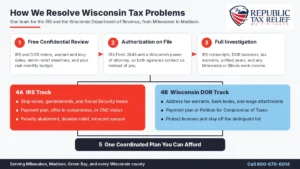
What working with us looks like
- Free confidential consultation. A short call about your letters, deadlines, and budget.
- Authorization on file. We file IRS Form 2848 and a Wisconsin power of attorney so both agencies contact us instead of you.
- Full investigation. We pull IRS transcripts and review your DOR balance, warrants, levies, and any out-of-state work income.
- Protection first. Where the law allows, we act to stop or prevent levies and attachments while we build your case.
- One coordinated plan. We negotiate with both agencies together and explain every option in plain English.
| Common concern | How we handle it |
|---|---|
| “There’s a tax warrant in my name at the courthouse.” | We confirm the balance behind it and work toward an arrangement that leads to satisfaction or release. |
| “The flood destroyed my records.” | We request transcripts and rebuild missing years, and we check whether disaster relief or penalty abatement applies. |
| “I work in Minnesota. Why is Wisconsin billing me?” | We review both returns and claim the credit for tax you already paid to Minnesota. |
| “Can a California firm really help me?” | Yes. Federal representation works the same everywhere, and the DOR accepts authorized representatives. |
IRS Tax Relief in Milwaukee, Madison, and Every Wisconsin Region
A machinist in Milwaukee’s Menomonee Valley, a software developer in Verona, and a dairy farmer outside Marshfield face very different tax problems. We start with our two focus cities, then cover every region of the state.
Focus City: Milwaukee
Milwaukee County is Wisconsin’s most populous county, and its tax problems mirror its economy: shift work, small manufacturers, and family businesses. It was also part of recent IRS flooding relief, so some residents are dealing with postponed deadlines that have now passed.
Professionals, creatives, and restaurant owners with 1099 income and no withholding.
Factory and warehouse workers, plus family businesses with payroll tax gaps.
Healthcare staff near the regional medical center and homeowners with garnishments.
Suburban owners and contractors, including flood-affected households.
Focus City: Madison
Madison is home to the state capitol, the University of Wisconsin, and a growing tech sector. The DOR itself is headquartered here, but being close to the agency does not make dealing with it any easier.
State employees, university staff, and graduate students with side income.
Tech and biotech workers with stock compensation that triggers surprise balances.
Young families and contractors in fast-growing suburbs.
Farm families and small-town business owners with uneven income.
Regions We Serve Across Wisconsin
Southeast Wisconsin
Cities: Milwaukee, Wauwatosa, West Allis, Waukesha, Brookfield, Racine, Kenosha, West Bend
Manufacturing, healthcare, and Illinois commuters. Recent flooding relief affected parts of this region.
South Central Wisconsin
Cities: Madison, Sun Prairie, Fitchburg, Middleton, Verona, Janesville, Beloit, Baraboo
State and university workers, tech employees, and Rock County residents near the Illinois line.
Fox Valley and Northeast
Cities: Green Bay, Appleton, Oshkosh, Neenah, Fond du Lac, Sheboygan, Manitowoc, Sturgeon Bay
Paper, food processing, and shipbuilding workers, plus Door County seasonal businesses.
Western Wisconsin
Cities: Eau Claire, La Crosse, Hudson, River Falls, Menomonie, Chippewa Falls
Twin Cities commuters with Minnesota filing issues and Driftless farm families.
Central Wisconsin
Cities: Wausau, Stevens Point, Marshfield, Wisconsin Rapids, Wisconsin Dells
Dairy and ginseng growers, healthcare workers, and tourism businesses with summer-heavy income.
Northwoods and Lake Superior
Cities: Rhinelander, Minocqua, Superior, Ashland, Rice Lake, Marinette
Resort owners, loggers, and retirees, plus border workers in Duluth and Michigan’s Upper Peninsula.
Don’t see your town? We help taxpayers throughout Wisconsin. Call 800-676-6014 and we will tell you right away whether we can help. You can also browse our other service locations, including nearby Illinois.
Expert Insight: The Risks of Handling IRS and Wisconsin Tax Problems Alone or With AI
Most of our Wisconsin clients tried to fix things on their own first. That is normal. But self-handled cases tend to go wrong in a few predictable ways, and each one narrows your options.
- Assuming storm relief covers everything. Disaster relief postpones deadlines. It does not cancel tax, and it ends on a fixed date. People who relied on it as a long-term pause often end up behind with penalties stacking up.
- Thinking a payment plan stops the warrant. In Wisconsin, it may not. Some people sign a plan, then discover a warrant was filed anyway and their home sale is stuck.
- Filing a compromise while levies keep running. A Petition for Compromise does not automatically stop collection already in motion. Paperwork without a protection strategy can cost you a paycheck.
- Trusting AI on border rules. Chatbots regularly say Wisconsin and Minnesota still have reciprocity. They do not, and that wrong answer leads to returns filed in the wrong state.
- Underestimating the clock. At 18% a year plus the delinquent fee, a Wisconsin balance can grow faster than a credit card. Waiting for the “perfect” time costs real money.
- Pasting sensitive data into public tools. Uploading your Social Security number, W-2s, or bank statements to a free chatbot creates privacy risk you cannot undo. AI also cannot pull transcripts, sign a power of attorney, or speak to the DOR for you.
Our take: AI is a fine way to learn what a term means. A licensed tax attorney, CPA, or enrolled agent should make the decisions and sign the paperwork. We explain why in Can AI get a better settlement than a tax attorney?
Want to understand your choices first? Read IRS payment plans explained and our tax negotiation insights.
Why Wisconsinites Choose Our Tax Attorney, CPA, and Enrolled Agent Team for Tax Relief Assistance
Hiring help with tax debt is a trust decision. Since 2005, founding partner Mark Ladd and our in-house team have helped individuals and businesses resolve IRS and state tax liability. We work every case ourselves, with no outsourcing.
| Cases resolved | 18,000+ |
| Client balances settled | $220M+ |
| Average client rating | 4.9 / 5 |
| Credentials | Enrolled agents, CPAs, and tax attorneys |
| Scheduling | Call times set around Central time |
| Languages | English and Spanish |
- One team for both agencies. IRS and Wisconsin balances handled together, not by two different offices.
- We know Wisconsin’s pressure points. County tax warrants, the 18% interest rate, the delinquent list, and the 60-day appeal window shape how fast we move.
- Honest answers. If a settlement is not realistic, we say so and show you a better path.
- Recognized work. See our awards and recognition.
Clients often tell us the worst part was not knowing what came next. Once we are on your case, dealing with the IRS and Madison becomes our job instead of yours.
Results vary based on each taxpayer’s facts and finances. Past results do not guarantee a similar outcome.
Encrypted. Privileged. Protected. Your tax problem is safe with us, and so is every document behind it.
Wisconsin Tax Relief Frequently Asked Questions
Can you help me if you don’t have an office in Wisconsin?
Yes. Federal and state cases are handled by phone, mail, and secure online systems, and we represent you under a signed power of attorney. Our team works from California, schedules calls around Central time, and serves clients in every Wisconsin county.
Does Wisconsin have an offer in compromise?
Yes. The Wisconsin Department of Revenue accepts a Petition for Compromise of Taxes, which can settle a state tax debt for less than the full amount. You must show why you cannot pay in full, and some compromises come with conditions such as filing and paying on time for a set period.
What is a Wisconsin tax warrant?
A tax warrant is filed with the Clerk of Circuit Court in your county when a state tax debt is delinquent. It acts as a lien on property you own and is a public record, so it can affect your credit and your ability to sell or refinance real estate.
I was affected by a Wisconsin storm or flood. Do I still owe my taxes?
Yes. IRS disaster relief postpones filing and payment deadlines for eligible taxpayers, but the tax itself is still due once the postponed date passes. If you missed that date because of the disaster, penalty abatement or a payment plan may help.
I live in Wisconsin and work in Minnesota. Which state do I owe?
Usually both file, but you should not pay twice. Wisconsin and Minnesota do not have reciprocity, so you file a Minnesota nonresident return and claim a credit on your Wisconsin return for tax paid to Minnesota.
How fast does Wisconsin tax debt grow?
Quickly. Delinquent Wisconsin tax carries interest at 18% a year, plus a collection fee of 6.5% or $35, whichever is greater. That is why setting up a plan early usually saves real money.
Can the IRS take my Social Security if I live in Wisconsin?
Yes. Wisconsin does not tax Social Security benefits, but the IRS can levy a portion of them for unpaid federal tax. A payment plan or hardship status can often stop or prevent that levy.
What should I bring to my free consultation?
Any IRS or Wisconsin DOR letters, your latest tax return if you have one, and a rough idea of your monthly income and bills. Missing documents are fine. We can request IRS transcripts and state records for you.
More answers: tax debt relief questions, IRS collections defense questions, penalty abatement FAQs, and IRS payment plan questions.
Sources
- Internal Revenue Service: Tax Relief for Wisconsin Taxpayers Affected by Severe Storms, Tornadoes, and Flooding
- Wisconsin Department of Revenue: Delinquent Taxes Common Questions
- Wisconsin Department of Revenue: Petition for Compromise of Taxes Common Questions
Republic Tax Relief is a private firm and is not affiliated with the IRS or the Wisconsin Department of Revenue. This page offers general guidance, not legal or tax advice for your specific situation. Tax laws and agency procedures change, so consult a qualified tax professional before acting.
Contact Us: Speak With a Tax Relief Professional About Your Wisconsin Tax Debt
At 18% interest, every month you wait costs more. One call can stop the climb.
Whether the letter came from the IRS or the Wisconsin DOR, a short call can show you where you stand and what to do next. Your consultation is free and confidential.
About Republic Tax Relief
Republic Tax Relief helps individuals and businesses nationwide resolve IRS and state tax problems, including back taxes, levies, liens, unfiled returns, and payroll tax debt. Since 2005, our in-house team of enrolled agents, CPAs, and tax attorneys has resolved more than 18,000 cases. From our offices in Corona and Laguna Hills, California, we represent clients in all 50 states, including Wisconsin. Call 800-676-6014 or contact us online for a free, confidential consultation.