
From the Oceanfront to Capitol Square
Virginia Tax Relief for Every Taxpayer: IRS, Federal Tax, and Local Tax Debt Help for Veterans, Families, and Businesses
A wage levy from Virginia Tax. A final notice from the IRS. A rebate or refund that never showed up because it went to an old balance. We take over the calls, protect your paycheck and bank account where the law allows, and build a plan that fits your budget.
Sailors, veterans, federal workers, and business owners from Virginia Beach, Chesapeake, Norfolk, and Richmond to Northern Virginia and the Blue Ridge work with us by phone, video, and secure upload.
Federal, state, and treasurer bills
Active duty, retirees, and veterans
In-house team since 2005
Spanish-speaking clients welcome
Virginia runs on a different calendar and a different map than most states. State returns are due May 1, not April 15. Many cities are independent of any county, so your local tax bill may come from a city treasurer in Norfolk or Chesapeake rather than a county office. And Hampton Roads holds one of the largest concentrations of active-duty sailors, Marines, and veterans in the U.S.
Those details shape how tax debt builds up here and how Virginia tax relief actually works. Republic Tax Relief helps Virginia individuals and business owners settle IRS debt, Virginia Department of Taxation balances, and the local bills that ride along with them. Our enrolled agents, CPAs, and tax attorneys work from our California offices as one coordinated team.
On This Page
- Why Virginia Taxpayers Owe Federal and State Tax Together
- Veteran and Military Tax Relief in Virginia
- Virginia Tax Collections: Liens, Levies, and Offsets
- Local Tax and Property Tax Problems in Virginia Cities and Counties
- IRS vs. Virginia Tax Collection Compared
- Federal Tax Relief Options and Who Can Qualify
- Virginia OIC and Hardship Relief at the State Level
- Business Tax Debt Help for Virginia Owners and Contractors
- How We Help Virginia Taxpayers Without a Local Office
- Tax Relief in Virginia Cities and Regions
- Expert Insight: DIY and AI Risks With IRS Tax Problems
- Why Virginia Taxpayers Choose Republic Tax Relief
- Virginia Tax Help Frequently Asked Questions
- Speak With a Tax Relief Professional
Why a Virginia Taxpayer Often Owes Federal Tax and Virginia State Tax at the Same Time
Your Virginia individual income tax return starts with the federal adjusted gross income from your federal tax return. When the federal filing is late or wrong, the state return usually is too. When the IRS later changes your income, Virginia can use that change to bill you for more state tax after the fact.
Virginia’s top rate also kicks in at a low level of taxable income, so most working households pay the top state rate. Small withholding gaps add up fast. These are the patterns we see most often:
- Military families after a PCS move. A move to or from Naval Station Norfolk, Oceana, Quantico, or Fort Belvoir can leave a return filed in the wrong state, or not filed at all. Our back tax help starts by confirming which years and which states are open.
- Northern Virginia commuters and contractors who work in D.C. or Maryland and assume the other jurisdiction handled their tax. Virginia residents generally owe Virginia on all income, wherever it is earned, and only some of the other state’s tax can come back as a credit.
- Families who claimed the wrong tax credit. Virginia has its own earned income tax credit tied to the federal one, so an IRS change to the federal credit often creates a second, smaller state bill.
- Federal workers and contractors who depend on the federal government, whose pay stops during a shutdown or a contract gap, then never catch up on estimated payments.
- Several years of unfiled returns after a deployment, a divorce, or a business that stalled. See our unfiled tax returns service.
- Gig, rideshare, and 1099 workers in Hampton Roads and Richmond who never paid estimated tax and now owe both the IRS and the state.
- People who filed on April 15 and forgot May 1. The two deadlines are easy to mix up, and a late state return brings its own penalty.
Not sure what you owe or to whom? Our tax resolution services begin by pulling your records and confirming each balance, agency, and year involved.
Your story stays between you and your tax team. Every detail you share is held to attorney-client and tax professional privilege standards, and disclosed only to the agencies we negotiate with on your behalf.
Veteran and Military Tax Relief: What Eligible Service Members and VA Retirees Should Know
Military life creates tax problems that civilians rarely face. Deployments delay filing, moves split a year across states, and retirement pay changes what is taxable. Virginia has several rules that help, but each one has limits.
| Rule or benefit | What it does | What it does not do |
|---|---|---|
| Virginia military benefits subtraction | Lets eligible retirees subtract up to $40,000 of military retirement pay or Survivor Benefit Plan income from Virginia taxable income | Does not lower federal tax, and does not cover TSP, CSRS, or FERS payments |
| VA disability benefits | Generally excluded from federal gross income, so they are not taxed at either level | Do not protect other income, such as a civilian job or a pension, from tax |
| Combat zone extensions | Extend federal filing and payment deadlines during and after qualifying service | Do not erase the tax; the clock restarts once the extension ends |
| Servicemembers Civil Relief Act | Can limit interest and allow deferrals on certain pre-service tax debts | Must be requested; it is not applied automatically |
| Free tax filing on base | VITA sites and MilTax help service members prepare a current tax return at no cost | Do not negotiate old balances, stop a levy, or argue penalties |
Virginia Tax confirms the subtraction cap reached $40,000 after a phase-in, and that each spouse can claim up to the cap on benefits they personally receive (Virginia Tax: Military Benefits Subtraction). We often find retirees who missed the subtraction on past state returns, overpaid, and then carried a federal balance they could have paid sooner.
Practical tip for veterans: A Virginia break on retirement pay does not travel to your federal return. If you retired from the Navy in Virginia Beach and took a civilian job at the shipyard, the IRS still taxes the full pension. We check both returns before any payment plan or offer is filed.
Virginia Tax Collections: How the Virginia Department of Taxation Collects State Tax Debt
The Virginia Department of Taxation in Richmond collects individual income tax, corporate tax, retail sales and use tax, and the withholding employers hold for their workers. Unpaid tax liabilities keep growing with penalties and interest until they are paid.
When notices go unanswered, Virginia Tax has strong tools to collect (Virginia Tax: Collections):
| Virginia Tax action | What it means for you |
|---|---|
| Wage levy | Your employer sends 25% of your net wages to the state until the balance, penalties, and interest are paid. |
| Bank levy | Your bank must send funds up to the balance due. |
| Memorandum of Lien | Filed in circuit court, it works like a court judgment, becomes public record, and can stay in force for 20 years or until paid. |
| Collection agency referral | Older accounts may be sent to a private agency that calls and writes for the state. |
| Field visits | Agents may visit a business during working hours to collect unpaid sales or withholding tax. |
| Refund and rebate offset | State refunds can be reduced for debts owed to Virginia Tax, other state agencies, localities, or the IRS. |
Why your Virginia rebate or refund may have disappeared
Virginia has sent one-time tax rebates to eligible taxpayers more than once. When someone owes Virginia Tax or a state or local agency, the rebate goes to that debt first. The same offset rule applies to regular state refunds, so a missing rebate is often the first sign of an older balance.
Hardship relief from a Virginia levy
Virginia Tax will review a levy that causes severe hardship, but it generally expects your last three years of returns to be filed. Households under 250% of the federal poverty guidelines may qualify for a much smaller payment plan. Getting those pieces in order is where professional help pays off.
See how we handle tax lien help, wage garnishment relief, and bank levy help.
Local Tax and Property Tax Problems in Virginia’s Independent Cities and Counties
Virginia has 95 counties and 38 independent cities. Virginia Beach, Chesapeake, Norfolk, and Richmond are all independent cities, which means the city itself assesses and collects local taxes. No county stands between you and the city treasurer.
Local balances are a separate obligation from your state and federal tax. They commonly include:
- Real estate property tax on your home, rental, or commercial building.
- Personal property tax, often called the car tax, on vehicles, boats, and business equipment.
- Business license tax (BPOL) charged by many localities on gross receipts.
- Meals and lodging taxes collected by restaurants and hotels for the locality.
Unpaid local taxes can lead to liens, garnishments, and holds on vehicle registration renewals. They can also offset your state refund. We review local accounts during every Virginia investigation so one office is not undoing progress with another.
Disabled veterans and property tax: Virginia exempts the primary home of a veteran rated 100% permanently and totally disabled from service-connected causes from real estate property tax, and surviving spouses may keep it. The exemption is applied for through your city or county, not the state, and it does not reach back to erase older unpaid bills.
IRS vs. Virginia Tax: How Federal and State Revenue Collection Compare
The IRS and Virginia Tax work on separate tracks with separate rules. Seeing them side by side shows why a plan that covers only one side rarely holds.

| Collection step | IRS (federal tax) | Virginia Tax (state tax) |
|---|---|---|
| Filing deadline | April 15 for most individuals | May 1 for individual income tax |
| Lien | Notice of Federal Tax Lien | Memorandum of Lien in circuit court |
| Wages | Continuous wage levy based on IRS exemption tables | Wage levy of 25% of net pay |
| Personal liability | Trust Fund Recovery Penalty for unpaid payroll taxes | Responsible officers for unpaid sales and withholding tax |
| Paying over time | IRS installment agreement | Virginia payment plan, with reduced plans for low income |
| Settlement | Offer in compromise based on ability to pay | Hardship offer, with payment within 5 months |
| Pause for hardship | Currently Not Collectible status | A similar state status, requested separately |
The IRS typically sends several notices before it levies, while a state wage levy can feel sudden if old letters went to a previous duty station. Learn how our IRS collections defense works and read our guide to common IRS notices.
Federal Tax Relief Options for Virginia Residents: Who Can Qualify and How
No single program is best for IRS debt. The right fit depends on your income, expenses, equity, and how much time is left before the debt expires.
| Relief option | What it does | Often fits |
|---|---|---|
| Installment agreement | Spreads the balance into monthly payments while levies are held off | Steady income but no lump sum |
| Offer in compromise | Settles for less than the full amount based on what you can realistically pay | Limited income and equity compared with the debt |
| Currently Not Collectible (CNC) | Pauses collection during financial hardship | Income that barely covers basic living expense |
| Penalty abatement | Removes penalties for a clean history or reasonable cause | A deployment, serious illness, or a hurricane |
| Innocent spouse relief | Separates you from a spouse’s tax debt | Errors or unpaid tax caused by a current or former spouse |
Monthly IRS payment plans
Most people who cannot pay in full can set up an IRS payment plan. The plan type matters, because a lower monthly payment can require more financial documentation, and interest keeps running either way. Read how IRS payment plans work.
Currently Not Collectible status when money is tight
If any payment would leave you short on rent, food, or utilities, Currently Not Collectible status can stop levies. The debt remains and a lien may be filed, but the pressure stops while you recover.
Settling with the Internal Revenue Service
The IRS accepts an offer when your income, allowable expenses, and asset equity show you cannot pay the full balance. Many offers fail because of overlooked equity in a home, a boat, or retirement accounts, so we test the numbers before anything is filed. Learn how the OIC program works.
Penalties, hurricanes, and disaster relief
Penalties often make up a large share of an old balance. After hurricanes and severe storms, the IRS can postpone deadlines for people in a federally declared disaster area, and coastal Virginia has received that relief before. We check whether a postponement was applied before arguing any penalty. Explore IRS penalty abatement and the four types of innocent spouse relief.
For the bigger picture, see our tax debt relief options and the IRS Fresh Start Program.
Virginia OIC and Hardship Relief: Settling Tax Liabilities at the State Level
Yes, Virginia will sometimes accept less than the full amount owed. Virginia Tax reviews three kinds of requests (Virginia Tax: Offer in Compromise):
- Doubtful collectibility. Financial hardship means you cannot pay in full. You must agree that you owe the debt.
- Doubtful liability. There is a real question about whether the tax is owed or the amount is right.
- Penalty waiver. Extenuating circumstances caused late filing or payment, for penalties above $2,000.
Hardship offers come with firm rules. All required returns must be filed first, a $50 non-refundable fee applies unless waived, and a Memorandum of Lien is filed while the offer is reviewed. If accepted, the new amount is due in full or within a payment plan of up to five months.
Practical tip: Virginia offers a CNC-style status for people already in IRS Currently Not Collectible status, but you must ask for it separately. We line up the IRS and Virginia financial statements so both agencies see the same numbers, because conflicting figures invite rejection on both sides.
Business Tax Debt Help for Virginia Owners, Contractors, and Employers
When cash runs short, owners often fall behind on the taxes they hold for others: payroll withholding and retail sales tax. The IRS and Virginia both treat that money as held in trust, and both can pursue responsible owners personally. Local BPOL and personal property tax on equipment can stack on top.
The Virginia businesses we help most often include:
- Shipyard and defense subcontractors in Norfolk, Portsmouth, Newport News, and Chesapeake whose payroll outruns slow government payments. Start with payroll tax debt relief.
- Builders and trades in fast-growing Chesapeake, Suffolk, Chesterfield, and Loudoun. See construction tax resolution.
- Restaurants and hotels along the Virginia Beach Oceanfront and in Richmond’s Scott’s Addition, juggling sales, meals, and tipped payroll tax. Read our restaurant tax resolution insights.
- Physicians and practice owners tied to the large health systems in Norfolk and Richmond. See tax resolution for medical professionals.
- Real estate agents, investors, and landlords with rental property near the bases. Explore real estate tax resolution.
- Trucking and logistics firms serving the Port of Virginia and the I-64, I-81, and I-95 corridors, plus e-commerce sellers collecting tax in several states.
Facing an audit instead of a balance? With representation in place, the examiner contacts us instead of you. See our business audit help, plus our business tax resolution services, small business tax relief, and business tax debt relief.
Every page you send is sealed. Tax returns, LES statements, bank records, and Social Security numbers move through bank-grade 256-bit encryption and are stored in full compliance with federal data protection standards.
How Our Tax Professional Team Helps Virginia Taxpayers Without a Local Office
To be direct: we do not have a Virginia office. Our team works from our offices in Corona, California and Laguna Hills, California, and we schedule calls early in our day so they land during Eastern business hours.
You do not need a firm in Norfolk or Richmond to fix an IRS problem. Federal tax matters are handled by phone, mail, fax, and secure online systems, and the IRS works with authorized representatives from every state. Military clients already know this pattern: much of your life runs remotely, and so can your tax case.
Free tax help on base and at VITA sites is a great fit for filing a simple return. Negotiating with collectors every day is a different job. Our team includes CPAs, enrolled agents, and tax attorneys, so you get the right professional for each part of the case.
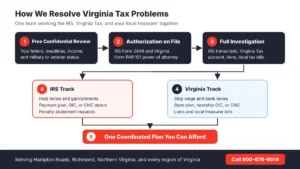
What working with us looks like
- Free confidential consultation. A short call about your letters, deadlines, budget, and any military or veteran status.
- Authorization on file. We file IRS Form 2848 and Virginia Form PAR 101 so both agencies call us.
- Full investigation. We pull IRS transcripts, review your Virginia Tax account, and check liens and local treasurer bills.
- Protection first. Where the law allows, we act to stop or prevent levies while we build your case.
- One coordinated plan. We negotiate each side together and explain every option in plain English.
| Common concern | How we handle it |
|---|---|
| “I’m stationed in Norfolk, but my home of record is Texas.” | Military pay usually follows your legal residence, not your duty station. We confirm which state can tax you before anything is paid. |
| “I live in Arlington and work in D.C. Didn’t my employer handle it?” | D.C. does not tax most nonresident wages, so Virginia expects the tax. We check withholding and fix the gap on both returns. |
| “Virginia Tax took 25% of my paycheck.” | We contact the state, request hardship review where it fits, and work toward a plan that releases the levy. |
| “Can a firm outside Virginia really help me?” | Yes. Federal representation works the same everywhere, and Virginia accepts authorized representatives. |
IRS Tax Relief in Virginia Cities and Regions, Including Virginia Beach, Chesapeake, Norfolk, and Richmond
A chief petty officer in Virginia Beach, a state employee in Richmond, and a cattle farmer in the Shenandoah Valley face very different tax problems. We start with the four cities where we work with the most Virginia clients, then cover every region of the Commonwealth.
Our Focus Cities
Virginia Beach
Oceana and JEB Little Creek-Fort Story families, military retirees, and Oceanfront tourism businesses with seasonal income and meals tax.
Chesapeake
Fast-growing suburbs full of contractors, port logistics workers, and shipyard commuters. Payroll and estimated tax gaps are common.
Norfolk
Home of Naval Station Norfolk, the port terminals, and a major medical center. Deployment-related unfiled returns and residency questions lead many cases.
Richmond
The capital and home of Virginia Tax. State employees, finance and healthcare workers, and small businesses in the city, Henrico, and Chesterfield.
Regions We Serve Across Virginia
Hampton Roads and the Peninsula
Cities: Virginia Beach, Chesapeake, Norfolk, Portsmouth, Suffolk, Hampton, Newport News, Williamsburg, Yorktown
Navy, Air Force, and Army families, shipbuilders, and port workers. Military residency, PCS moves, and veteran benefits drive many cases.
Greater Richmond and Tri-Cities
Cities: Richmond, Henrico, Chesterfield, Midlothian, Mechanicsville, Glen Allen, Petersburg, Colonial Heights, Hopewell
State and corporate employees, Army families near Petersburg, and growing small businesses facing sales and payroll tax issues.
Northern Virginia
Cities: Arlington, Alexandria, Fairfax, Reston, Herndon, Ashburn, Leesburg, Manassas, Woodbridge
Federal employees, contractors, and tech workers. Higher incomes, stock compensation, and D.C. and Maryland commuting create large federal balances.
Fredericksburg and Quantico
Cities: Fredericksburg, Stafford, Spotsylvania, Dumfries, Culpeper, King George
Marine Corps families, long-distance commuters, and new homeowners whose withholding has not kept up with their income.
Central Virginia and the Shenandoah Valley
Cities: Charlottesville, Lynchburg, Harrisonburg, Staunton, Waynesboro, Winchester, Front Royal
University staff, farms and orchards, and small manufacturers. Land and equipment equity shapes which IRS options are realistic.
Roanoke, Southside, and Southwest Virginia
Cities: Roanoke, Salem, Blacksburg, Christiansburg, Danville, Martinsville, Bristol, Abingdon
Healthcare, university, trucking, and former coal and textile workers. Fixed incomes often point toward hardship status or a state reduced plan.
Don’t see your town? We help taxpayers throughout Virginia. Call 800-676-6014 and we will tell you right away whether we can help. You can also browse our other service locations.
Expert Insight: The Risks of Handling IRS Tax Problems Alone or With AI
Most of our Virginia clients tried to fix things on their own first. That is normal. But self-handled cases tend to go wrong in a few predictable ways, and each one narrows your options.
- Applying a state break to the federal return. The Virginia military subtraction, the age deduction, and other state rules do not reduce IRS tax. Assuming they do leads to a surprise federal bill a year or two later.
- Fixing the IRS and forgetting the treasurer. We meet people who settled federal and state debt, then lost a refund to an unpaid car tax bill from their city.
- Using a stale address. Military families who move every few years often miss the letters that start appeal deadlines. A missed deadline can cost hearing rights you cannot get back.
- Filing a Virginia hardship offer too early. If any required return is missing, the application is denied and the fee is gone.
- Letting an AI chatbot write your response. AI tools often mix up Virginia with West Virginia, blend in other states’ rules, or confuse the U.S. Department of Veterans Affairs with the “VA” on a state form. They cannot pull transcripts, sign a power of attorney, or speak for you.
- Pasting sensitive data into public tools. Uploading your Social Security number, LES, or IRS letters to a free chatbot creates privacy risk you cannot take back.
Our take: AI is a fine way to learn what a term means. A licensed tax attorney, CPA, or enrolled agent should make the decisions and sign the paperwork. We explain why in Can AI get a better settlement than a tax attorney?
Want to understand your choices first? Read our tax negotiation insights and IRS payment plans explained.
Why Virginia Taxpayers Choose Republic Tax Relief
Hiring help with tax debt is a trust decision. Since 2005, founding partner Mark Ladd and our in-house team have helped individuals and businesses resolve IRS debt and state tax liabilities. We work every case ourselves, with no outsourcing.
| Cases resolved | 18,000+ |
| Client balances settled | $220M+ |
| Average client rating | 4.9 / 5 |
| Credentials | Enrolled agents, CPAs, and tax attorneys |
| Languages | English and Spanish |
- One team for every level. No hand-off between a federal firm, a state firm, and a local bookkeeper.
- Respect for service. We understand LES statements, PCS orders, and deployment gaps, and we plan around them.
- Honest answers. If a settlement is not realistic, we say so and show you a better path.
- Recognized work. See our awards and recognition.
Clients often tell us the worst part was not knowing what came next. Once we are on your case, dealing with the IRS becomes our job instead of yours.
Results vary based on each taxpayer’s facts and finances. Past results do not guarantee a similar outcome.
Locked files. Privileged conversations. Zero guesswork. Share your documents with confidence and let us carry the weight.
Virginia Tax Help Frequently Asked Questions
Can you help me if you don’t have an office in Virginia?
Yes. Federal and state cases are handled by phone, mail, and secure online systems, and we represent you under a signed authorization. Our team works from California and serves clients throughout Virginia.
Does Virginia have an offer in compromise for state tax debt?
Yes. Virginia Tax reviews offers based on doubtful collectibility, doubtful liability, or a penalty waiver. Hardship offers require all returns to be filed and a $50 non-refundable fee, and an accepted amount is paid in full or within five months.
Does the Virginia military retirement subtraction lower my IRS bill?
No. The subtraction lets eligible retirees remove up to $40,000 of military retirement or Survivor Benefit Plan income from Virginia taxable income only. Your federal tax on that pension is unchanged.
Why didn’t I receive my Virginia tax rebate or refund?
If you owe Virginia Tax, another state agency, a locality, or the IRS, your rebate or refund can be applied to that debt first. A missing payment is often the first sign of an older balance worth checking.
How much can Virginia Tax take from my paycheck?
A Virginia wage levy takes 25% of your net wages until the balance, penalties, and interest are paid. Hardship review and payment plans can stop or reduce it, especially once your recent returns are filed.
I’m stationed in Virginia but my legal residence is another state. Do I owe Virginia?
Usually not on your military pay, which generally follows your legal state of residence. Civilian income earned in Virginia and a spouse’s wages can follow different rules, so each return should be reviewed.
When is the Virginia state tax return due?
Virginia individual income tax returns are due May 1, about two weeks after the usual federal deadline. Filing the federal return on time does not satisfy the state deadline.
What should I bring to my free consultation?
Any IRS, Virginia Tax, or local treasurer letters, your latest tax return if you have one, and a rough idea of your monthly income and bills. Missing documents are fine. We can request IRS transcripts and state records for you.
More answers: tax relief questions, offer in compromise questions, wage garnishment questions, and unfiled tax returns questions.
Sources
- Virginia Tax: Offer in Compromise
- Virginia Tax: Collections
- Virginia Tax: Military Benefits Subtraction FAQ
Republic Tax Relief is a private firm and is not affiliated with the IRS, the Virginia Department of Taxation, the U.S. Department of Veterans Affairs, or any local treasurer. This page offers general guidance, not legal or tax advice for your specific situation. Tax law and agency procedures change, so consult a qualified tax professional before acting.
Speak With a Tax Relief Professional and Get Tax Help in Virginia
Every month you wait, interest and penalties grow.
Whether the letter came from the IRS, Virginia Tax, or your city treasurer, one short call can show you where you stand and what to do next. Your consultation is free and confidential.
About Republic Tax Relief
Republic Tax Relief helps individuals and businesses nationwide resolve IRS and state tax problems, including back taxes, levies, liens, unfiled returns, and payroll tax debt. Since 2005, our in-house team of enrolled agents, CPAs, and tax attorneys has resolved more than 18,000 cases. From our offices in Corona and Laguna Hills, California, we represent clients in all 50 states, including Virginia. Call 800-676-6014 or contact us online for a free, confidential consultation.