
Fresh Start vs. Offer in Compromise: IRS Tax Debt Help to Choose the Right Relief Option
You owe the IRS more than you can pay, and every ad seems to promise something different. One says “Fresh Start.” Another says “settle for pennies.” You just want to know which path actually fits your situation and how fast you can stop the letters, levies, and stress.
When it comes to Fresh Start vs. Offer in Compromise, the honest answer is that they are not rivals. The Fresh Start program is a set of friendlier collection rules, and an offer in compromise (OIC) is one specific tool inside that system. Picking the wrong one can cost you months, money, and leverage. Below, our resolution team explains how each works, who each fits, and how we help you choose the right one.
📞 Facing a wage garnishment or bank levy right now? Do not wait for the next notice. 800-676-6014 for a free, confidential review, or request a callback.
Table of Contents
- Fresh Start vs. Offer in Compromise: The Key Difference
- Option 1: Fresh Start Payment Options
- Option 2: What an Offer in Compromise Does
- Payment Plan vs. OIC: Side-by-Side Comparison
- Do You Qualify for a Payment Plan or an OIC?
- Which Option Fits Your Situation?
- What Choosing the Wrong Option Can Cost You
- Business Tax Debt: Payment Plans vs. Settlements
- The Risks of Going It Alone or Using AI
- How Our Team Chooses the Right Path for You
- Why Taxpayers Choose Our Team
- Fresh Start and OIC FAQs
- Talk to a Professional Today
Fresh Start vs. Offer in Compromise: The Key Difference
Think of Fresh Start as the rulebook and a settlement as one play in it. The Fresh Start initiative changed how the IRS handles payment plans, liens, and settlements so more people could get help. An OIC is the one option that can actually lower the tax you owe.
Here is the simplest way to see it:
- Fresh Start payment options help you pay your tax debt over time, usually in full, with less paperwork.
- An offer in compromise lets qualifying taxpayers resolve their balance for less than the full amount owed.
- Most people end up with an installment agreement. Only a smaller group truly qualifies for a settlement.
That last point matters. Many companies sell a settlement to people who would be better served by a simple plan, because a settlement sounds more exciting. An honest firm starts with your numbers, not the most attractive promise.
Option 1: Fresh Start Payment Options (Paying Over Time)
The Fresh Start program loosened IRS rules on tools it already had (IRS: Get Help With Tax Debt). For the full program overview, see our Fresh Start Program page. Here, we focus on the side most people land on: paying over time.
A Fresh Start installment agreement lets you pay off your balance in a monthly payment you can afford. For balances up to $50,000, it can often be set up without a detailed financial statement. While the plan stays current, it stops most levies.
What you trade for that simplicity:
- You still pay the full balance, plus interest and some penalties
- Federal tax liens may stay on record until you pay, though some can be withdrawn on a direct debit plan
- Missed payments can default the plan and restart collection
Learn how plans are set up on our IRS payment plans page.
Option 2: What an Offer in Compromise (OIC) Actually Does
An offer in compromise is a formal agreement where the IRS accepts less than you owe. It is the only option that can settle your tax debt for less in a single deal. That is why it gets so much attention.
The IRS accepts an offer on one of three grounds (IRS: Offer in Compromise):
- Doubt as to collectibility: you cannot pay the full amount before the collection deadline.
- Doubt as to liability: there is a real question about whether you owe the tax at all.
- Effective tax administration: you could pay, but doing so would cause serious hardship or be unfair.
Most offers rely on the first ground. The IRS looks at your income, expenses, and asset equity to estimate what it could realistically collect. If that number is below your balance, a settlement may make sense. For the full breakdown, see our page on how the OIC program works.
Payment Plan vs. OIC: Side-by-Side Comparison
Here is how the two most common paths compare.
| Factor | Fresh Start Installment Agreement | Offer in Compromise |
|---|---|---|
| Lowers the tax you owe? | No, you pay the balance in full | Yes, if accepted |
| Who it fits | People who can pay over time | People who cannot pay before the collection deadline |
| Paperwork | Often light for balances up to $50,000 | Detailed financial disclosure, signed under penalty of perjury |
| Upfront cost | Setup fee, often reduced online | $205 application fee plus an initial payment, unless low income |
| Typical timeline | Days to weeks | Often six months to two years |
| Collection protection | Stops most levies while current | Levies generally paused while pending |
| Interest and penalties | Keep adding until paid | Stop once the offer is accepted and paid |
| Main risk | Missed payments can default the plan | A rejected offer can extend the IRS’s time to collect |
Neither option is better in every case. The right choice depends on how your income, assets, and collection deadline line up.
Do You Qualify for a Payment Plan or an OIC?
Both paths share the same starting rule: your filings must be current. After that, the bar is very different.
| Requirement | Installment Agreement | Offer in Compromise |
|---|---|---|
| All required tax returns filed | Yes | Yes |
| Current-year estimated payments made | Yes | Yes |
| Federal tax deposits current, if you have employees | Yes | Yes |
| Detailed financial statement | Often not needed up to $50,000 | Always required |
| Must show you cannot pay in full | No | Yes, for most offers |
The IRS Fresh Start offer in compromise requirements also rule out anyone in an open bankruptcy case. If any piece is missing, the IRS returns the offer and you lose valuable time. Unfiled years are the most common problem we see, and our unfiled tax returns team handles those first. For deeper detail, visit our OIC questions page.
Which Relief Option Fits Your Situation?
Every case is different, but most taxpayers fall into one of these patterns.
| Your Situation | Option We Usually Explore First |
|---|---|
| Owe under $50,000 and have steady income | Streamlined installment agreement |
| Can pay something, but not the full balance before the deadline | Partial payment agreement or a settlement offer |
| Little or no income left after basic living costs | Currently Not Collectible status |
| Large penalties after a hardship or clean history | Penalty abatement, often paired with a plan |
| Real question about whether the tax is correct | An offer based on doubt as to liability, or an audit challenge |
| Federal tax lien hurting credit or a sale | Tax lien help through payoff, withdrawal, or a direct debit plan |
The flowchart below shows how we narrow it down.
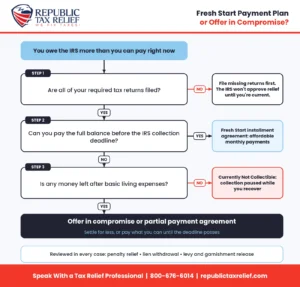
How we match taxpayers to an installment agreement, hardship status, or a settlement. Every case is also reviewed for penalty relief, lien withdrawal, and levy release.
What Choosing the Wrong Option Can Cost You
This is where many taxpayers lose real money. The wrong choice rarely looks wrong at the start.
- Filing an OIC you cannot win. The $205 fee and your initial payment are generally not refunded if the IRS processes and rejects the offer. You may also hand the IRS a detailed map of your assets.
- Extending the IRS clock. The 10-year collection period generally pauses while an offer is pending. A weak offer can give the IRS more time to collect.
- Paying in full when you could have settled. Some people sign up for monthly installments and pay thousands more than an accepted offer would have cost.
- Letting a levy run while you decide. Every week of delay can mean another garnished paycheck. See our wage garnishment relief and bank levy help if that is happening now.
The fastest way to avoid these mistakes is to have a tax professional run your numbers before you file anything.
Don’t guess with your paycheck or savings. Get a free review of your IRS options today. 800-676-6014 or contact us online.
Business Tax Debt: Payment Plans vs. Settlements
Business tax cases follow stricter rules. An operating business usually must stay current on payroll deposits before the IRS will approve a plan or an offer. Owners may also face personal liability for unpaid trust fund taxes.
For business owners, we often compare:
- In-business installment agreements that keep the doors open
- Business offers when the company truly cannot pay its tax liabilities
- Payroll tax debt relief and trust fund penalty defense
- Industry support for construction, medical practices, real estate, and e-commerce
Explore our business tax debt relief services for more.
The Risks of Going It Alone or Using AI
The IRS offers a free offer pre-qualifier tool, and many people now ask AI chatbots which option to pick. Both can be a starting point. Neither can tell you what the IRS will actually accept.
Expert Insights From Our Resolution Team
- The IRS may add back money you already spent. If you moved, gifted, or spent assets after the tax was owed, the IRS can count that “dissipated” value in your offer. Online calculators and chatbots rarely ask about it.
- Qualifying on paper is not the same as agreeing on numbers. Revenue officers often challenge car values, home equity, and expenses above IRS standards. Small differences can raise your offer by thousands.
- Sometimes waiting beats settling. If your collection deadline is close, hardship status or a partial payment agreement can cost far less than a settlement. AI tools cannot see your deadline.
- An accepted offer has strings attached. You must file and pay on time for five years, and the IRS generally keeps your refund for the year the offer is accepted. Missing those terms can bring back the full original debt.
- IRS form errors are costly. Forms 656 and 433-A must match your bank records and tax returns line by line. One mismatch can get an offer returned months later.
- Chatbots cannot negotiate. A real case involves phone calls, follow-up requests, and sometimes an appeal. AI cannot sign a power of attorney or speak to the IRS for you.
We explore this further in Can AI Get a Better Settlement Than a Tax Attorney? For scam warning signs, read Is the IRS Fresh Start Program Legit? To see how these choices played out for real taxpayers, browse our Fresh Start case examples.
How Our Tax Resolution Team Chooses the Right Path for You
Our process is built to stop the damage first and then find the option that costs you the least.
- Free consultation: We review your notices and tax issues at no cost.
- Protection: We file a power of attorney so the IRS contacts us, and we move fast on any levy.
- Investigation: We pull your IRS account records to confirm balances, penalties, and your collection deadline.
- Side-by-side math: We compare an installment agreement, a settlement, and hardship status using your real numbers.
- Resolution: We prepare every form, negotiate with the IRS, and follow your case to a final answer.
- Staying compliant: We help you stay current so the problem does not come back.
See our tax resolution services guide for the full picture.
Speak With a Tax Relief Professional
Every week you wait, penalties and interest keep growing. Find out which Fresh Start options fit your situation in a free, confidential consultation.
Why Taxpayers Choose Our Team
Since 2005, founding partner Mark Ladd and our in-house team have helped thousands of people resolve their IRS balances for good. We handle every case ourselves, with no outsourcing.
| Our Track Record | |
|---|---|
| Cases resolved | 18,000+ |
| Client balances settled | $220M+ |
| Average client rating | 4.9 / 5 |
| Years of experience | 20+ |
| Credentials | Enrolled agents, CPAs, and attorneys |
| Offices | Corona, CA and Laguna Hills, CA |
Real Client Experiences
“I filed my 2025 taxes just to find out I owed quite a bit – I spoke with Ryan who was super kind and helpful. He guided me through the process which was simple and easy. Turns out it was an old W-2 that I missed back in 2023. After finding out, Rebecca was able to help me get everything up to date. Definitely saved me a lot of time, stress, and money!”
Cristina Spruell, Google Review ★★★★★
Results vary based on each taxpayer’s facts and finances. Past results do not guarantee a similar outcome. See our awards and recognition.
Your Information Is Protected
🔒 Before we talk numbers, we protect them. Your returns, SSN, and bank records stay encrypted with bank-grade 256-bit security and guarded by strict tax privilege and federal compliance standards.
Fresh Start and OIC FAQs
Which is better: Fresh Start or an offer in compromise?
Neither is better for everyone. Fresh Start payment options work best if you can pay over time. An offer in compromise fits people who cannot pay the full amount before the IRS collection deadline. Your income, assets, and deadline decide which saves you more.
Is an offer in compromise part of the Fresh Start program?
Yes, in a sense. The settlement program existed before Fresh Start, but the Fresh Start initiative changed the math so more taxpayers could qualify. Today, an offer is one of several options under those friendlier rules.
What are the IRS Fresh Start offer in compromise requirements?
You generally must file all required tax returns, make current estimated payments, make required federal tax deposits if you have employees, and not be in an open bankruptcy. Then the IRS reviews your income, expenses, and assets to decide if an offer makes sense.
Can I switch from an installment agreement to a settlement offer?
Often, yes. Many taxpayers start with a plan and later file an offer when their finances change. A tax professional can help you time the switch so you do not default or lose protection from levies.
How much does an offer in compromise cost?
The IRS charges a $205 application fee plus an initial payment, unless you meet the low-income guidelines. If the IRS processes your offer but does not accept it, those amounts are generally not refunded.
Which option stops IRS collection faster?
A streamlined installment agreement can often be approved in days or weeks, and it stops most levies once it is in place. A pending offer also generally pauses levies, but the full review commonly takes six months to two years. If a levy is already active, a professional may request a release while either option is set up.
What happens if the IRS rejects my offer?
You generally lose the application fee and initial payment, and the IRS may resume collection. You can often appeal within 30 days, or switch to an installment agreement. A tax attorney or enrolled agent can tell you which move protects you best.
What happens if I miss payments after my offer is accepted?
An accepted offer requires you to file and pay on time for five years. If you default, the IRS can reinstate the original balance, minus what you already paid. That is why we plan for compliance before an offer is ever filed.
For more answers, see our IRS Fresh Start Program questions and payment plan questions pages.
About Republic Tax Relief
Republic Tax Relief has helped individuals and businesses resolve IRS and state tax problems since 2005. Our in-house team of enrolled agents, CPAs, and attorneys has resolved more than 18,000 cases and settled over $220 million in client balances. We negotiate payment plans and offers in compromise, stop wage garnishments and bank levies, and guide clients back to good standing. Visit our offices in Corona and Laguna Hills, call 800-676-6014, or contact us online for a free, confidential consultation.
Sources
- Internal Revenue Service, Get Help With Tax Debt
- Internal Revenue Service, Offer in Compromise
- Taxpayer Advocate Service, Offer in Compromise
This page provides general information and is not legal or tax advice for your specific situation. Speak with a qualified professional before making decisions about your tax debt.