
IRS Hardship Programs: How to Qualify and Stop IRS Collections When You Can’t Afford to Pay Your Tax Debt
When the IRS wants money you simply do not have, every notice feels like a threat. You may be choosing between rent, groceries, and a tax bill that keeps growing. That is exactly the kind of financial hardship the IRS has rules for, even if few people ever explain them clearly.
IRS hardship programs can pause collection, release a wage garnishment, or unfreeze a bank account when paying would leave you unable to cover basic living expenses. Below, we explain how the IRS considers hardship, who tends to qualify, and how the right tax professional can stop IRS collections while you get back on your feet.
Table of Contents
- What IRS Hardship Programs Really Are
- IRS Economic Hardship Criteria: Who Can Qualify
- Currently Not Collectible (CNC) Status Explained
- Stopping Wage Garnishments and Bank Levies
- Financial Disclosure and Form 433-A Rules
- Tax Hardship Relief Options Compared
- Low-Income Taxpayer Relief Options
- Hardship Relief for Business Owners
- The Risks of Requesting Hardship on Your Own or With AI
- How We Help You Apply for IRS Hardship Relief
- Why Taxpayers Trust Republic Tax Relief
- IRS Hardship Program FAQs
- Speak With a Tax Relief Professional
What IRS Hardship Programs Really Are
There is no single form called the “IRS hardship program.” The phrase covers a group of relief tools the IRS uses when collecting a tax debt would cause real financial harm. Each one has its own rules, paperwork, and limits.
The most common forms of hardship relief include:
- Currently Not Collectible status, which temporarily pauses most collection
- Hardship levy releases, which stop a wage garnishment or bank levy that leaves you unable to pay basic bills
- Partial payment plans, which let you pay a smaller amount you can actually afford
- An offer in compromise, which may settle your tax debt for less when you cannot pay in full
Many of these options became easier to reach after the IRS Fresh Start initiative in 2011. Our IRS Fresh Start Program page explains those changes. For a wider view of every path, see our guide to tax debt relief options.
IRS Economic Hardship Criteria: Who Can Qualify
Federal rules define economic hardship in a specific way. A levy creates hardship when it would leave you unable to pay your reasonable basic living expenses (Treas. Reg. § 301.6343-1(b)(4)). Feeling stretched thin is not enough. The IRS wants to see the math.
What the IRS Counts as Basic Living Expenses
The IRS measures your budget against its own Collection Financial Standards. These are national and local allowances for the costs every household faces. Common allowed expenses include:
- Housing and utilities, such as rent, mortgage, power, and water
- Food, clothing, and household supplies
- Transportation, including a car payment, insurance, and gas
- Health insurance, medical care, and prescriptions
- Court-ordered payments, such as child support
- Current tax payments and certain other necessary costs
The Simple Hardship Test
At its core, the IRS evaluates one question: after necessary expenses, is anything left to pay your tax bill? If your monthly income minus allowed expenses comes out to zero or less, you may qualify for hardship status.
Keep these factors in mind:
- Your actual bills may not count in full. Spending above the IRS standards can be cut, even if it is real.
- Assets matter. Equity in a home, savings, or a retirement account can disqualify you, even with low income.
- Life events help your case. Job loss, serious illness, disability, or a fixed income often support a claim of financial hardship.
- You must be honest and complete. Missing accounts or income can sink a request and damage your credibility.
Currently Not Collectible (CNC) Status Explained
Currently Not Collectible status is the closest thing to a true “hardship program.” The IRS uses it when it agrees you cannot pay your taxes and your basic living expenses at the same time (Taxpayer Advocate Service). Once approved, most collection stops.
What CNC Status Does for You
- Stops new wage garnishments and bank levies in most cases
- Requires the IRS to release levies already in place
- Ends the steady flow of collection letters and calls
- Lets the 10-year collection clock keep running, which can work in your favor
What CNC Status Does Not Do
The IRS is clear that CNC status does not forgive or erase the debt (IRS: Temporarily Delay the Collection Process). While you are in CNC status:
- Penalties and interest keep adding to your balance
- The IRS may still file a federal tax lien
- The IRS may keep your future federal tax refunds
- The IRS may review your finances later and resume collection if your income improves
For many families, temporarily pausing tax collection is the breathing room they need. Learn more on our Currently Not Collectible status service page, read our CNC status blog, or browse our CNC status FAQs.
Stopping Wage Garnishments and Bank Levies
A wage levy can take a large part of every paycheck. A bank levy can freeze your account the day rent is due. These are the moments when hardship rules matter most.
Federal law says the IRS must release a levy that is creating an economic hardship. That rule applies even before your full case is resolved. The key is proving the hardship quickly and correctly.
To stop a garnishment or levy, our team typically:
- Files a power of attorney so the IRS speaks with us, not you
- Contacts the IRS office that issued the levy the same day
- Submits proof that the levy blocks your rent, food, or medical costs
- Requests CNC status or puts a payment plan in place to keep the levy from returning
Timing matters with bank levies. Banks generally hold levied funds for 21 days before sending them to the IRS, so acting fast can protect your money. See our wage garnishment relief services, bank levy help, and IRS collections defense pages for more.
Financial Disclosure and Form 433-A Rules
Almost every hardship request runs through a financial statement. This is where most cases are won or lost. The IRS uses one of three forms, depending on your situation.
| Form | Who Uses It | What It Covers |
|---|---|---|
| Form 433-F | Many individuals working with IRS phone or automated collection | A shorter summary of income, expenses, and assets |
| Form 433-A | Wage earners and self-employed people, often with a revenue officer | A detailed look at income, expenses, assets, and business interests |
| Form 433-B | Corporations, partnerships, and LLCs | Business income, expenses, accounts, and assets |
Rules That Trip People Up
- These forms are signed under penalty of perjury. Every number must be true, complete, and supported.
- Proof is required. Expect to provide pay stubs, bank statements, bills, and loan records.
- Household income can count. A spouse or partner’s income may affect how expenses are shared.
- How you value assets matters. The IRS often looks at quick-sale value, not what you paid.
- Everything you disclose becomes part of your file. The IRS can use it later for other collection actions.
A carefully built financial statement protects your rights and supports the strongest relief option available. Our back tax help team prepares these forms every day.
Tax Hardship Relief Options Compared
Hardship status is not always the best long-term answer. Sometimes a payment plan or settlement leaves you in a better place. The table below compares the main tax relief options we review for clients facing hardship.
| Relief Option | Best For | Effect on Collection | Debt Reduced? |
|---|---|---|---|
| Currently Not Collectible | No money left after basic living expenses | Pauses most collection | No |
| Hardship levy release | An active garnishment or bank levy causing hardship | Releases the levy | No |
| Partial Payment Installment Agreement | Some monthly income, but not enough to pay in full | Stops most levies while current | Sometimes, in effect |
| Installment Agreement | Able to pay your tax debt over time | Stops most levies while current | No |
| Offer in Compromise | Cannot pay the full balance before the collection deadline | Pauses levies while pending | Yes |
| Penalty Abatement | Illness, disaster, or a clean filing history | No direct effect | Yes, penalties |
The flowchart below shows how we match a taxpayer’s finances to the right hardship option.
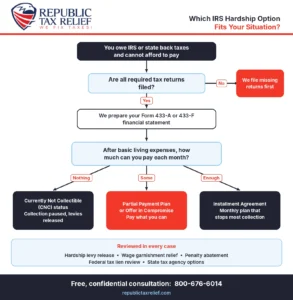
How we match taxpayers to the right IRS hardship program. Levy release, penalty relief, and lien review are part of every case.
Want to compare plans in more depth? Read our IRS payment plans explained blog or our offer in compromise guide.
Low-Income Taxpayer Relief Options
If your income is low or fixed, the IRS has extra protections built in. Retirees, people on disability, and workers who lost hours often qualify for more than they expect.
Low-income taxpayer relief options can include:
- Offer in compromise fee waivers for households at or below the IRS low-income guidelines
- Waived or reduced payment plan setup fees for qualifying low-income taxpayers
- Hardship release of a Social Security levy when it blocks basic living costs
- Taxpayer Advocate Service help when an IRS action is causing significant hardship
Even on a fixed income, the IRS may still file a tax lien or keep refunds. A tax professional can help you weigh which relief program protects you best now and in the future.
Hardship Relief for Business Owners
Businesses can face hardship too, but the IRS reviews them more strictly. An operating business is generally expected to stay current on payroll taxes before it receives any relief. Unpaid trust fund taxes can also become a personal debt for owners through the Trust Fund Recovery Penalty.
For business owners, we often help with:
- Form 433-B financial statements for the company
- Closed-business CNC requests when the company has no assets left
- In-business payment plans that keep the doors open
- Payroll tax debt relief and trust fund penalty defense
We support companies in construction, medical practices, real estate, and e-commerce. Explore our business tax debt relief services for more.
The Risks of Requesting Hardship on Your Own or With AI
You can contact the IRS directly and ask for hardship relief. Some people do, and some succeed. But hardship cases hinge on details that are easy to miss, and our team regularly cleans up requests that went sideways.
Expert Insights From Our Resolution Team
- “Hardship” on the phone is not hardship on paper. Telling an agent you are struggling to pay starts a conversation, not a decision. Without a complete financial statement and proof, many requests stall or get denied.
- The IRS budget is not your budget. Your real costs may be higher than what the IRS allows. Knowing which expenses can be defended, and how to document them, often decides the outcome.
- CNC can be the wrong answer. If you could qualify for an offer in compromise, years in CNC status may let penalties and interest pile up for no reason. Picking the right relief option is a strategy call.
- AI tools cannot see your IRS account. A chatbot cannot check your collection deadline, spot an unfiled year blocking your request, or know which IRS office holds your case. It may also apply outdated expense standards with total confidence.
- Pasting your finances into a chatbot puts your privacy at risk. Bank balances, Social Security numbers, and tax transcripts do not belong in public AI tools that may store what you type.
- A denied request can speed up collection. Once the IRS has your full financial picture, a rejected hardship claim can point an agent straight to your bank account or paycheck.
- Improving finances trigger reviews. People in CNC status are often surprised when a raise or new job reopens collection. Planning ahead keeps that from becoming a crisis.
A licensed tax professional can work with the IRS on your behalf, so you are not answering hard questions alone. For more context, read our tax negotiation guide.
How We Help You Apply for IRS Hardship Relief
Our process puts your protection first. We focus on stopping the immediate damage, then building a long-term plan that fits your financial situation.
- Free consultation: We listen to what is happening and review your notices at no cost.
- Immediate protection: We file a power of attorney and move quickly on any active levy or garnishment.
- Account investigation: We pull your IRS and state records to confirm balances, deadlines, and missing filings.
- Compliance check: If unfiled tax returns are blocking relief, we take care of them.
- Financial statement: We prepare and document your Form 433-A or 433-F to meet IRS standards.
- Negotiation: We present your case and request the hardship relief or settlement that fits best.
- Ongoing support: We help you stay compliant and prepare for future IRS reviews.
See the full picture in our tax resolution services guide or our tax relief services page.
Speak With a Tax Relief Professional
Every week you wait, penalties and interest keep growing. Find out which Fresh Start options fit your situation in a free, confidential consultation.
Why Taxpayers Trust Republic Tax Relief
When you are dealing with tax problems, you need people who know the IRS rules and treat you with respect. Since 2005, founding partner Mark Ladd and our in-house team have helped thousands of taxpayers find relief.
| Our Track Record | |
|---|---|
| Cases resolved | 18,000+ |
| Tax debt settled | $220M+ |
| Average client rating | 4.9 / 5 |
| Years of experience | 20+ |
| Credentials | Enrolled agents, CPAs, and tax attorneys |
What Our Clients Say
“I’ve had nothing but good outcome as a client of Republic Tax, everyone there is very helpful and knowledgeable and always there to listen and recommend the best roads to choose. Noel Merideth is the BEST he was very helpful and sympathetic to my needs and situation. I would recommend their services to a stranger. Noel.. You are the Greatest and I thank you so much for all your assistance.”
Donna Mazyck, Google Review ★★★★★
Results vary based on each taxpayer’s facts and finances. Past results do not guarantee a similar outcome. See our awards and recognition for more.
Your Information Is Protected
🔒 You are trusting us with the most private details of your life, and we guard them like our own. Bank-grade 256-bit encryption, strict tax privilege standards, and full federal security compliance protect every document you send.
IRS Hardship Program FAQs
What is the IRS hardship program?
It is a common name for the IRS tools that pause or reduce collection when paying would leave you unable to cover basic living expenses. The main one is Currently Not Collectible status. Hardship levy releases, partial payment plans, and offers in compromise are also used.
How do I qualify for IRS hardship status?
You generally need to show that, after the IRS-allowed living expenses, you have little or no money left to pay your tax debt. The IRS reviews your income, expenses, and assets, usually through Form 433-A or 433-F. You will need documents to back up every number.
Does CNC status make my tax debt go away?
No. CNC status pauses most collection, but the debt remains and interest and penalties continue to grow. However, the 10-year collection period usually keeps running, so some balances may expire while you are in CNC status.
Can a hardship request stop a wage garnishment?
Yes, in many cases. The IRS must release a levy that prevents you from paying your reasonable basic living expenses. Acting quickly and providing solid proof gives you the best chance of a fast release.
Will the IRS still file a tax lien if I am in hardship status?
It may. The IRS can file a federal tax lien to protect its interest, even while collection is paused. A lien can affect your credit and your ability to sell or refinance property.
How long does IRS hardship status last?
There is no fixed end date. The IRS may review your finances periodically, and it can resume collection if your income or assets improve. Many taxpayers stay in CNC status for a year or longer.
What if I own a business and cannot pay my tax debt?
Operating businesses face stricter rules and are usually expected to stay current on payroll taxes. Closed businesses, or owners facing personal liability, may have more hardship options. A tax professional can review both the business and personal side.
Do I need a tax attorney to apply for IRS hardship relief?
You are not required to hire one. Still, enrolled agents, CPAs, and tax attorneys know how the IRS evaluates hardship, which expenses can be defended, and when another relief option may be better. That experience often leads to faster, stronger results.
For more answers, visit our tax debt relief questions, wage garnishment questions, and tax resolution questions pages.
Speak With a Tax Relief Professional
You do not have to wait for the next levy notice to act. Whether you need to stop a garnishment, unfreeze a bank account, or find out if you qualify for hardship relief, our team is ready to help. Your first conversation is free and confidential.
Call 800-676-6014 or Request Your Free Consultation
About Republic Tax Relief
Republic Tax Relief helps individuals and businesses resolve IRS and state tax problems for good. Since 2005, our in-house team of enrolled agents, CPAs, and tax attorneys has resolved more than 18,000 cases and settled over $220 million in tax debt. We stop wage garnishments and bank levies, secure Currently Not Collectible status, negotiate offers in compromise and payment plans, and guide clients back to good standing. Call 800-676-6014 or contact us online for a free, confidential consultation.
Sources
- Internal Revenue Service, Temporarily Delay the Collection Process
- Taxpayer Advocate Service, Currently Not Collectible
- Treasury Regulation § 301.6343-1(b)(4), Release of Levy for Economic Hardship (Cornell LII)
This page provides general information and is not legal or tax advice for your specific situation. Speak with a qualified tax professional before making decisions about your tax debt.