
Serving Bridgeport, Stamford, New Haven, Hartford, Waterbury and All 169 Towns
Connecticut IRS Tax Relief: Stop Collections and Resolve Back Taxes With the IRS and the State
The IRS can take months to move. The state of Connecticut usually moves faster. Once a balance goes unpaid, the Department of Revenue Services (DRS) can serve a tax warrant on your bank or your employer after a short notice period, while interest keeps building every month.
Republic helps individuals and business owners in every corner of the state resolve federal and Connecticut tax debt by phone, video and secure upload. One licensed team works both agencies, so a deal with one does not leave you exposed to the other.
Free, confidential consultation by phone or video. Hablamos español.
Washington and Hartford handled in one plan
Enrolled agents, CPAs and tax attorneys
18,000+ cases resolved nationwide
See our awards and recognition
Where our team works: We do not have an office in the Nutmeg State, and we will not invent a local address to look nearby. Our licensed staff works from Southern California offices in Corona and Laguna Hills. Federal and Connecticut cases run on mail, phone and online systems, so you never need to drive to Hartford or sit in a waiting room.
Owing the IRS and the State at the Same Time
Your Connecticut return starts from your federal adjusted gross income. So when a missed estimated payment, an unreported 1099 or an IRS audit change raises your federal tax bill, a state bill for the same year usually follows.
The two agencies do not share a collection plan. A federal installment agreement does nothing to stop a Connecticut tax warrant, and a state deal does not pause a federal levy.
| Issue | IRS (federal) | State Revenue Department |
|---|---|---|
| Main collection tool | Levy on wages, bank accounts and other assets | Tax warrant served on a bank, employer or business |
| Interest | Federal rate set quarterly | 1% per month on unpaid tax, about 12% a year |
| Settlement program | Offer in compromise, Form 656 | Offer of Compromise, Forms CT-656 and CT-656A |
| If a settlement is rejected | You can appeal | The decision is final and not reviewable in court |
| Hardship pause | Currently Not Collectible status | Reviewed case by case, no matching formal program |
Because the rules differ, the order of your negotiations matters. We map both balances first, then build one plan that fits a single household or business budget.
Tax Warrants, Wage Executions and Other Collection Tools
State law gives the Commissioner of Revenue Services a tax warrant, which works much like a court execution. After a written notice period, it can reach money and property without a lawsuit.
- Bank warrants: A one-time sweep of funds in your account up to the balance owed.
- Wage executions: Your employer withholds part of each paycheck until the balance is paid or released.
- Business keepers and receivables: For businesses, the state can collect customer payments or place a keeper at the business to take in receipts.
- Refund offsets: State and federal refunds can be applied to an unpaid state income tax balance.
- Recorded claims on property: A state lien on real estate can block a sale or refinance.
On the federal side, collection follows its own notice chain before a levy. Our IRS collections defense page explains each stage, and our guide to common IRS notices decodes the letters.
Call right away if any of these just happened
- Your bank froze funds after receiving a Connecticut tax warrant
- Your payroll office says a wage execution arrived
- You received IRS Letter 1058 or LT11, the final notice before a federal levy
- A state notice of assessment arrived and the protest window is running
Speed matters here. See bank levy help and wage garnishment relief, or call 800-676-6014.
Why Connecticut Tax Balances Grow So Fast
Under Conn. Gen. Stat. § 12-735, unpaid income tax carries interest of 1% per month or part of a month until paid. That is roughly 12% a year, often higher than the federal rate.
Late-payment charges add to that, and they can usually be waived only with reasonable cause, such as a serious illness or a disaster. Interest itself is generally not waived. That is why waiting rarely helps.
- Federal side: First-time abatement or reasonable cause can remove qualifying charges. See IRS penalty abatement.
- State side: A written waiver request must show why the delay was outside your control.
- Both sides: If a spouse or former spouse caused the debt, innocent spouse relief may separate you from it.
Settling for Less: Federal Offers vs. the State Offer of Compromise
Both agencies can accept less than the full balance. The programs share a goal, but the eligibility rules and the risks are very different.
IRS offer in compromise
The agency compares what you owe with your reasonable collection potential: equity in assets plus a set amount of future income. If you qualify, the offer can wipe out the rest. Rejections can be appealed. Learn how the OIC program works.
State Offer of Compromise
The state uses Form CT-656 for business taxes and CT-656A for personal taxes, including income tax, according to the DRS offer and waiver page. A full financial statement is required, and accepted amounts are usually due soon after approval.
State guidance in IP 2004(31) says an offer is generally accepted when full collection is unlikely and the amount reasonably reflects what could be collected. The same guidance says offers are generally refused when:
- Any required state return is still unfiled
- You are being criminally prosecuted for a state tax liability
- Assets, income or other debts are left off the financial statement
- The state believes the balance could be paid in installments from future income
A refusal is final and cannot be taken to Superior Court. That makes the first submission the one that counts. We build the state offer from the same verified numbers used on the federal side, so both stories match. For more, read our offer in compromise guide.
Payment Plan and Hardship Options
Most people do not need a settlement. They need time and a monthly payment they can keep through a slow season, not just a good month.
| Your situation | Options to look at first |
|---|---|
| Steady income, balance too big to pay at once | IRS installment agreement plus a state installment agreement |
| Little equity and not enough income to pay in full | Federal offer, with a state Offer of Compromise if the numbers support it |
| Out of work, retired on a fixed income or disabled | Currently Not Collectible status federally and a hardship request to the state |
| Years of returns never filed | Unfiled return catch-up before any deal |
| A federal claim on your property blocking a sale or refinance | Federal lien release or withdrawal |
State plans tend to be shorter and stricter than federal plans, and accounts already in collection may need a negotiated agreement instead of the online option. When both agencies want a payment each month, we set the amounts so neither plan starves the other. For a wider view, see our guide to debt relief options and the IRS Fresh Start program.
Got a state warrant notice or a final IRS letter?
The window to act is short. Talk to a licensed professional today, before a bank sweep or a paycheck cut.
New York Commuters and Two-State Filing Problems
Thousands of residents ride Metro-North or drive I-95 into New York every workday. That usually means a New York nonresident return plus a home-state resident return that claims a credit for tax paid to New York.
When the numbers do not line up, the result can be notices from two states and the federal government for the same year. We see a few patterns again and again:
- Bonus and equity income: Finance and corporate bonuses, RSUs and stock options often come with too little withholding.
- Remote work days: Days worked from home are allocated differently by each state, which can create a gap in your credit.
- Missing credit claims: Skipping or miscalculating the credit for taxes paid to New York can create a balance on paper that you may not truly owe.
- Estimated payments: High earners who stop making quarterly payments get hit with interest on both returns.
Before negotiating any balance, we check whether it is correct. Fixing a credit error can cut a state bill before any installment deal is needed.
From the Gold Coast to the Quiet Corner: Cities and Regions We Serve
Tax trouble in a Greenwich office tower looks different from tax trouble in a Waterbury machine shop. Here is what we see in each part of the state.
Stamford and Fairfield County
Stamford, Greenwich, Norwalk, Westport, Fairfield, Danbury, Darien, New Canaan
Hedge funds, corporate headquarters and New York commuters. Large bonuses, under-withheld equity pay and two-state filing errors drive many of our calls here.
Bridgeport and the Lower Naugatuck
Bridgeport, Stratford, Trumbull, Shelton, Ansonia, Derby, Seymour
The state’s largest city is full of small businesses, contractors, home health aides and rideshare drivers. Self-employed income with no withholding is the most common way back taxes pile up.
New Haven and the Shoreline
New Haven, West Haven, Hamden, Milford, Branford, Guilford, Madison, Wallingford
University, hospital and biotech jobs bring fellowships, research stipends and side consulting that often have no tax taken out. Physicians who own practices also face payroll exposure.
Hartford and the Capitol Region
Hartford, West Hartford, East Hartford, New Britain, Manchester, Bristol, Glastonbury, Enfield
The Insurance Capital is also where the state revenue department is based. Retirees with pension and IRA withdrawals, plus divorced couples split over old joint returns, call us often.
Waterbury and the Naugatuck Valley
Waterbury, Naugatuck, Cheshire, Southington, Meriden, Torrington, Watertown
The Brass City still runs on machine shops, trades and family businesses. Missed payroll deposits and unpaid sales tax are the problems that grow fastest here.
Southeastern Shore and the Casino Corridor
New London, Groton, Norwich, Mystic, Ledyard, Montville, Old Saybrook
Shipyard workers, casino staff paid partly in tips and players with W-2G gambling income. Unreported tips and winnings often show up years later as federal notices.
Litchfield Hills and Middlesex County
Litchfield, New Milford, Middletown, Cromwell, Essex, East Haddam
Second homes, short-term rentals, farms and seasonal businesses. Rental income that was never reported is a common starting point.
The Quiet Corner and Tolland County
Putnam, Killingly, Willimantic, Storrs, Vernon, Tolland, Plainfield
Small farms, independent trades and university staff. Fixed incomes and modest assets often point toward hardship options many people never hear about.
Do not see your town listed? We help taxpayers in every town in the state, the same way: by phone, video and secure upload.
Business Tax Debt: Sales Tax, Withholding and Payroll
Sales tax and employee withholding are trust money. You collected it for the government, so both agencies treat unpaid trust taxes far more seriously than a late personal tax bill.
- Personal exposure: Owners and officers who were responsible for paying can be held personally liable, both under the federal Trust Fund Recovery Penalty and under state law.
- Sales tax permits: Unresolved sales tax can affect your permit and your ability to keep the doors open.
- Pass-through entity tax: Partnerships and S corporations have state entity-level filing rules that are easy to miss.
- Unemployment tax is separate: State unemployment contributions are handled by the Department of Labor, a different agency with its own collection process.
We work with owners in industries that run thin margins and uneven cash flow:
- Construction and trades
- Medical and dental practices
- Real estate agents and investors
- E-commerce sellers
- Restaurants and food service
Learn more about payroll tax resolution and business tax resolution services.
How Our Resolution Process Works
We confirm what you owe to each agency first, then match you to options you actually qualify for. No program gets sold before we see your file.
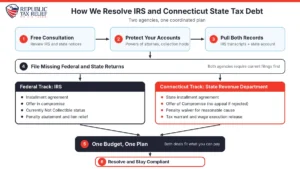
Upload with confidence. Your returns, bank statements and Social Security number are protected by bank-grade 256-bit encryption the moment they leave your device, and stored in full compliance with federal data protection standards.
Expert Insight: The Hidden Risks of Handling the IRS Alone or With AI
Many people start by calling the agency themselves or asking a chatbot. Here is what our resolution team sees go wrong, especially when a state balance is part of the picture.
One shot at a state settlement
Most AI answers describe only the federal offer, which can be appealed. A rejected state Offer of Compromise cannot be reviewed in court, so a rushed first try can waste your best chance.
Paying one agency with the other’s money
Cash pledged to a quick state deal may be counted by federal examiners as money you could have paid them. Sequencing the two offers is a strategy call, not a form-filling task.
Every call goes on the record
What you tell a collector, such as a 401(k) you could borrow from, lands in your file and shapes what they expect. Representatives know which facts help and which questions to answer in writing.
Sworn forms built on guesses
Financial statements are signed under penalty of perjury. A chatbot cannot see your transcripts, may use outdated expense standards and may miss a collection deadline it never knew existed.
Missing the 30-day window after a final IRS notice can also cost you the right to a Collection Due Process hearing. And pasting your Social Security number into a public chatbot is a privacy risk no one should take. We compare both paths in Can AI Get a Better Settlement Than a Tax Attorney? and our tax negotiation guide.
How to Choose a Tax Resolution Firm You Can Trust
We do not have a storefront on Asylum Street or in downtown Stamford. What we offer is two decades of focused resolution work and licensed representation delivered securely to wherever you live.
| Experience | Resolving federal and Connecticut tax problems since 2005 |
| Cases resolved | 18,000+ |
| Client balances settled | $220M+ |
| Credentials | Enrolled agents, a CPA team and tax attorneys |
| Time zone | We work Pacific time, three hours behind you, so calls after your workday are easy to book |
| Languages | English and Spanish |
Green flags and red flags
- Look for: A licensed professional who can sign a federal power of attorney, a written fee quote and an honest answer about whether you qualify.
- Look for: A firm that addresses the state balance too, not just the IRS.
- Avoid: Promises of “pennies on the dollar” before anyone has reviewed your finances.
- Avoid: Large upfront fees for an “investigation” that never explains your options.
Cost depends on how many years are involved, whether a business is part of the picture and whether both agencies need work. After we review your file, you get a clear written quote before any work begins.
Results vary based on each taxpayer’s facts and finances. Past results do not guarantee a similar outcome.
What you tell us stays with us. We protect every detail of your case under attorney-client and tax professional privilege standards, and nothing is released to anyone without your written consent.
Common Questions From Connecticut Taxpayers
Can you help me if your office is not in my state?
Yes. Once you sign a power of attorney, our licensed team can represent you before the IRS from anywhere in the country and work with the state revenue department on your behalf. Most cases are handled by mail, phone and secure upload.
Will the state settle my tax debt for less than I owe?
Sometimes. The state Offer of Compromise is generally accepted when full collection is unlikely and the amount offered reflects what could be collected. All returns must be filed, and a refusal is final and cannot be appealed in court.
What is a Connecticut tax warrant?
It is the state’s collection order for unpaid tax. After a written notice period, it can be served on your bank, your employer or your business to collect the balance without a court case.
If I set up a payment plan with the IRS, does it cover what I owe the state?
No. The two are separate agencies. Each balance needs its own agreement, and the two should be planned together so both payments fit your budget.
I live here but work in New York. Why do I owe both states?
New York taxes wages earned there, and Connecticut taxes all of your income but allows a credit for tax paid to New York. Errors in that credit or in remote work day counts often create a balance that should be checked before you pay it.
Can the state waive interest on my balance?
Interest is generally not waived. It runs at 1% per month on unpaid tax until paid. Late-payment charges may be waived for reasonable cause, so resolving the balance early is the best way to limit growth.
Can a business owner be personally responsible for unpaid sales or payroll taxes?
Yes. Owners and officers responsible for paying trust taxes can be held personally liable by federal and state authorities, even if the business closes. Acting early gives you more options.
What should I have ready before I call?
Any federal or state letters you have received, your most recent tax return and a rough idea of your monthly income and bills. If you do not have everything, call anyway. We can pull your federal records once you authorize us.
Have more questions? Visit our tax debt questions, collections defense questions and installment agreement questions pages.
Speak With a Tax Relief Professional About Your Federal and State Balances
Whether you commute from Stamford, run a shop in Waterbury or just got a warrant notice in Hartford, you do not have to face two tax agencies alone. One call shows you which options are realistic and what it will take to reach them.
Every month you wait adds interest. The sooner we start, the less there is to undo.
Locked. Private. Protected. Encrypted files, privileged conversations, zero exceptions.
About Republic Tax Relief
Republic helps individuals and businesses nationwide resolve IRS and state tax problems, including back taxes, unfiled returns, levies, wage garnishments and payroll tax problems. Founded in 2005, our in-house team serves clients in English and Spanish from offices in Corona and Laguna Hills, California. Learn more about our tax resolution services or browse all the states we serve. Call 800-676-6014 or contact us online.
Sources
- State Department of Revenue Services, IP 2004(31), Procedures for Making Offers of Compromise
- State Department of Revenue Services, Penalty Waiver Request, Offer of Compromise or Protest
- Conn. Gen. Stat. § 12-735, Failure to pay tax or make return
Republic is a private firm and is not affiliated with the IRS or any state agency. This page provides general information and is not legal or tax advice for your specific situation. Results depend on individual facts and agency decisions.