
IRS Fresh Start Program: Who Qualifies & How to Apply for Back Tax Relief
That stack of IRS letters on the counter does not have to be the end of the story. Every year, millions of people fall behind on their taxes because of a job loss, a slow season, a divorce, a medical bill, or a business that needed every dollar to stay open.
The IRS Fresh Start Program was built for exactly that moment. It is not a single form or a blanket forgiveness deal. It is a set of rules the IRS changed in 2011 to make payment plans easier to get, tax liens less likely, penalties easier to remove and settlements more realistic.
This guide explains who qualifies, which relief option fits which situation, how the application process works and where people most often go wrong. If you would rather talk it through now, call 800-676-6014 for a free, confidential review.
What This Guide Covers
- What Is the IRS Fresh Start Initiative?
- Who Qualifies for Fresh Start Tax Relief
- Fresh Start Tax Relief Options Compared
- Streamlined Installment Agreement ($50,000 Threshold)
- IRS Offer in Compromise Qualifications
- IRS Tax Liens and Federal Tax Lien Withdrawal
- First-Time Penalty Abatement and the New 2026 Penalty Rule
- How to Apply for the IRS Fresh Start Program
- Is There an IRS Forgiveness Program? Myths vs. Facts
- Expert Insight: The Risks of DIY and AI for IRS Tax Debt
- Fresh Start Tax Help for Business Owners
- Why Taxpayers Choose Republic Tax Relief
- Fresh Start Tax Program FAQs
- Speak With a Tax Relief Professional
What Is the IRS Fresh Start Initiative?
The IRS launched the Fresh Start initiative in 2011 and expanded it in 2012. The goal was simple: help taxpayers who owe the IRS get back into good standing instead of falling deeper behind.
Rather than creating one new program, the IRS loosened several existing rules at once. Here is what changed:
| Rule | Before Fresh Start | After Fresh Start |
|---|---|---|
| Payment plans with no detailed financial statement | Balances up to $25,000 | Balances up to $50,000 |
| Maximum term for a streamlined plan | 60 months | 72 months |
| General threshold for filing a Notice of Federal Tax Lien | About $5,000 | Generally over $10,000 |
| Lien withdrawal after a payment plan | Rarely available | Available with a qualifying direct debit plan |
| Settlement math | Counted 4 to 5 years of future income | Counts 12 months (lump sum) or 24 months (periodic) |
These changes still shape how the IRS handles back tax cases today. Knowing them gives you real leverage when you or your representative sit down to negotiate.
Who Qualifies for Fresh Start Tax Relief
There is no single application that says “approved” or “denied.” Each relief option has its own test. That said, almost every path shares the same basic requirements:
- You are current on filing. Every required federal tax return must be on file. The IRS will not approve an installment agreement or an offer while returns are missing. Our unfiled tax returns team handles this first.
- You are current going forward. That means proper withholding or estimated payments this year, and timely payroll deposits if you have employees.
- You are not in an open bankruptcy. Bankruptcy follows a separate set of rules.
- Your balance and finances fit the option. How much you owe, your income, your expenses and the equity in your assets decide which door opens.
Individuals, self-employed workers, couples who filed jointly and many small businesses can all qualify. The question is not “Can I use Fresh Start?” but “Which part of it fits my numbers?”
Fresh Start Tax Relief Options Compared
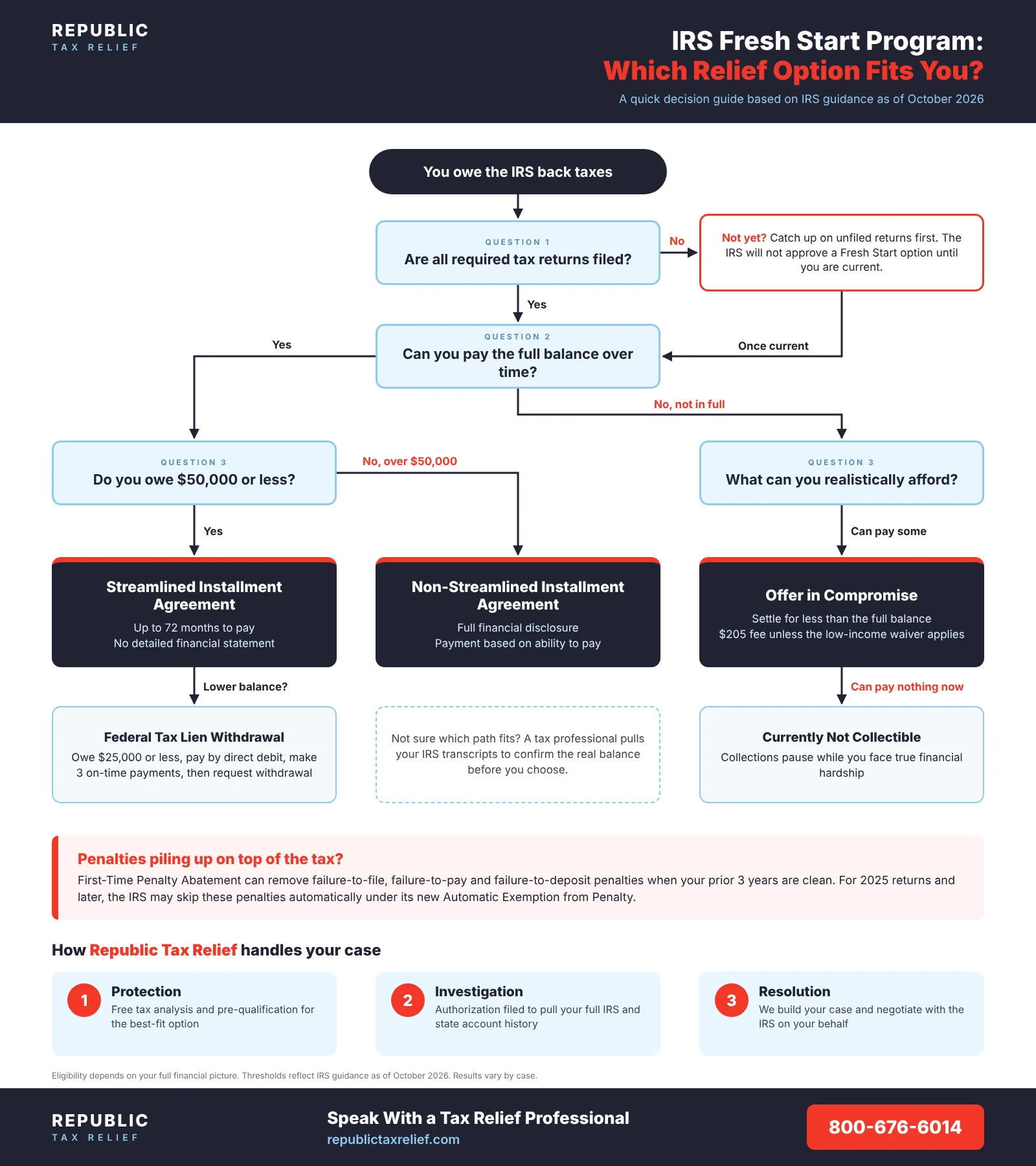
Use this table as a quick map of your IRS tax debt relief options. A tax professional can confirm the right fit after reviewing your IRS account transcripts.
| Relief Option | Best For | Key Threshold or Rule | What It Does |
|---|---|---|---|
| Streamlined installment agreement | People who can pay in full over time | Individuals owing $50,000 or less | Up to 72 months to pay with no detailed financial statement |
| Non-streamlined installment agreement | Larger balances | Over $50,000 | Monthly payment based on full financial disclosure |
| Offer in compromise (OIC) | People who cannot realistically pay the full tax bill | Offer must meet your reasonable collection potential | Settles tax debt for less than the full amount |
| Lien withdrawal | Taxpayers on a direct debit plan | $25,000 or less after 3 on-time payments | Removes the public Notice of Federal Tax Lien |
| First-time penalty abatement | People with a clean recent history | No penalties in the prior 3 years | Removes failure-to-file, pay or deposit penalties |
| Currently not collectible | True financial hardship | Income does not cover basic living costs | Pauses active collection |
Streamlined Installment Agreement ($50,000 Threshold)
This is the most common Fresh Start relief option. If you owe $50,000 or less in combined tax, penalties and interest, you can generally set up a payment plan of up to 72 months without handing the IRS a detailed breakdown of your income and assets.[2]
- Businesses: The online threshold is generally $25,000 or less for business balances.
- Over the limit? Paying the balance down below $50,000 can open the streamlined door.
- Cost to keep in mind: Interest and a reduced failure-to-pay penalty continue until the balance is paid.
A payment plan sounds simple, but choosing a monthly amount you cannot keep is the fastest way to default. Learn more on our IRS payment plan services page or read IRS payment plans explained.
IRS Offer in Compromise Qualifications
An offer in compromise lets you settle tax debt for less than the full balance. The IRS looks at your income, expenses, asset equity and ability to pay. It accepts an offer when the amount equals what it could realistically collect from you.[1]
To be considered, you generally must:
- Have all required tax returns filed
- Be current on estimated payments and, for employers, payroll deposits
- Not be in an open bankruptcy
- Include the $205 application fee and initial payment, unless you meet the low-income certification
The IRS keeps your fee and payments if the offer is rejected, so applying without strong numbers can cost you. See how the math works in how the offer in compromise program works, or browse our offer in compromise questions.
IRS Tax Liens and Federal Tax Lien Withdrawal
A federal tax lien is the government’s legal claim against your property. When the IRS files a public Notice of Federal Tax Lien, it can hurt your ability to borrow, refinance or sell. Under Fresh Start, the IRS generally does not file that notice unless you owe more than $10,000.
If a lien is already on file, Fresh Start created a path to withdrawal, which removes the public notice as if it had never been filed. You may qualify when:
- You owe $25,000 or less, or you pay the balance down to that level
- You are on a direct debit installment agreement
- You have made three consecutive on-time payments
- The plan pays the balance in full within 60 months or before the collection deadline
Withdrawal is not automatic. You have to request it, usually on Form 12277. Our tax lien help team can tell you whether withdrawal, release, discharge or subordination fits best.
First-Time Penalty Abatement and the New 2026 Penalty Rule
Penalties can add 25% or more to a tax bill. First-time penalty abatement removes failure-to-file, failure-to-pay and failure-to-deposit penalties if your prior three years are clean and you have filed all required returns.
Here is something many guides have not caught up on yet. Starting in summer 2026, the IRS began moving to an Automatic Exemption from Penalty (AEP). For 2025 tax year returns and 2026 quarterly returns going forward, a qualifying taxpayer simply is not charged those penalties. For older years, you still have to ask.[3]
| Feature | First-Time Abate | Automatic Exemption (AEP) |
|---|---|---|
| Tax years covered | Older years and periods | 2025 returns, 2026 quarterlies and later |
| Do you have to ask? | Yes | No |
| Penalty charged first? | Yes, then removed | Never charged |
Removing a penalty also removes the interest tied to it. If you do not qualify, reasonable cause relief may still work. Visit our IRS penalty abatement page or the penalty abatement FAQs.
For people facing real hardship, currently not collectible status can also pause collection while you get back on your feet.
How to Apply for the IRS Fresh Start Program
You do not apply for Fresh Start itself. You apply for the specific relief option that fits your case, and the right order matters. When Republic Tax Relief handles your case, the process looks like this:
- Protection. We start with a free tax analysis and pre-qualify you for the best resolution. If a levy or garnishment is active, stopping it comes first.
- Investigation. We file an IRS authorization form on your behalf and pull a full record of your federal and state accounts. This shows the real balance, every open year and the collection deadline for each debt.
- Resolution. We gather your documents, build the case and negotiate the agreement with the IRS. We stay on it until the plan, settlement or abatement is in place.
Before that first call, it helps to have your recent IRS notice, last few years of tax returns, pay stubs or business income records and a rough list of monthly bills. Do not worry if your paperwork is messy. Sorting it out is part of our job.
Already under pressure from collections? See IRS collections defense, wage garnishment relief or bank levy help.
Is There an IRS Forgiveness Program? Myths vs. Facts
Ads promising to make your IRS debt “disappear” are everywhere. Here is the truth behind the most common claims.
| Myth | Fact |
|---|---|
| Fresh Start is a forgiveness program that wipes out tax debt. | Most Fresh Start relief is a payment plan. Only an accepted settlement offer reduces what you owe. |
| Everyone can settle for “pennies on the dollar.” | The IRS accepts an offer only when the numbers show it cannot collect more. |
| You must sign up before a deadline. | Fresh Start rules are ongoing IRS policy. Anyone who says the “program ends Friday” is selling pressure. |
| Fresh Start covers state taxes too. | It is a federal IRS policy. State agencies, like the California FTB, have their own rules. |
Read more in our IRS tax relief blog and tax settlement guide.
Expert Insight: The Risks of DIY and AI for IRS Tax Debt
Our team reviews cases every week from people who tried to handle the IRS alone first. These are the mistakes we see most, including a newer one: relying on AI chatbots.
Risks of Handling the IRS Yourself
- Choosing the wrong option first. A pending settlement offer pauses the IRS collection clock. A rejected offer can add many months to the time the IRS has to collect, and the fee is gone.
- Saying too much on the phone. What you tell an IRS agent goes into your file. A casual comment about a side business or a paid-off car can raise your required payment.
- Overcommitting on a payment plan. Agreeing to a payment you cannot keep leads to default, and defaulting can bring back levies quickly.
- Missing hidden balances. Your notice may show one year. Your transcripts may show three more, plus a state balance you did not know about.
- Leaving money on the table. Few people know to request penalty abatement or lien withdrawal. The IRS will not offer them for you.
Risks of Using AI to Deal With the IRS
- Outdated rules. AI tools learn from older web pages. Many still describe penalty relief without the 2026 automatic exemption, or quote old fees and thresholds.
- Confident wrong answers. A chatbot can invent a form number, a deadline or an eligibility rule and present it as fact. The IRS does not accept “the AI told me” as reasonable cause.
- No privacy protection. Pasting your Social Security number, bank statements or tax returns into a public AI tool is not covered by tax professional confidentiality rules.
- No one to stand in your place. Only attorneys, CPAs and enrolled agents can represent you before the IRS with a power of attorney. An app cannot answer a revenue officer, attend an appeal or stop a levy.
- No judgment on strategy. AI can explain what an OIC is. It cannot read your transcripts, test your collection potential and tell you whether filing one now helps or hurts.
AI is a fine place to learn vocabulary. It is not a safe place to make decisions about your home, paycheck or business.
Fresh Start Tax Help for Business Owners
Business tax debt carries extra risk because the IRS treats unpaid payroll taxes as money held in trust for employees. Owners and managers can be held personally responsible through the Trust Fund Recovery Penalty.
- In-business plans: Businesses that owe $25,000 or less can often get a streamlined payment plan.
- Payroll deposits come first: The IRS will not approve relief while new deposits are being missed.
- Industry patterns matter: Construction, medical, real estate and online sellers each face different cash flow and audit risks.
Explore business tax debt relief, payroll tax debt relief and small business tax relief. We also help construction companies, medical practices, real estate professionals and e-commerce sellers.
Why Taxpayers Choose Republic Tax Relief
Republic Tax Relief is a full-service tax liability resolution firm that has handled IRS and state tax issues since 2005. All work is done in house by our enrolled agents, tax attorneys and CPAs.
| 18,000+ | Cases resolved |
| $220M+ | Tax debt settled |
| 20+ years | Serving taxpayers since 2005 |
| 4.9 / 5 | Average client rating, with an A+ BBB rating |
“Don Davis is the man! he was able to help me out a lot with my Tax Dept situation. I feel more comfortable now knowing these guys are fighting the IRS for me & will soon be able to be financially free again. I highly recommend”
Enrique Cardenas, Google Review ★★★★★
Your information stays protected. Every tax return, Social Security number and bank statement you share is guarded by strict tax professional confidentiality and bank-grade 256-bit encryption, so you can focus on getting relief, not on who might see your file.
See our awards and recognition or learn about our full tax resolution services.
Results vary based on each client’s facts and finances. Past results do not guarantee a similar outcome.
Fresh Start Tax Program FAQs
Is the Fresh Start program still available in 2026?
Yes. The Fresh Start changes from 2011 and 2012 remain part of everyday IRS collection policy, including the $50,000 streamlined payment plan and the lien withdrawal option. Some details, like penalty relief, have since been updated.
How much do I need to owe to qualify for Fresh Start?
There is no minimum. Individuals who owe $50,000 or less usually qualify for a streamlined payment plan. Larger balances can still be resolved through a non-streamlined plan or a settlement.
Does Fresh Start forgive tax debt?
Not by itself. Most options spread payments out or remove penalties. Only an accepted offer in compromise settles tax debt for less than the full amount owed.
Can Fresh Start remove a federal tax lien?
It can. If you owe $25,000 or less and make three on-time payments under a direct debit installment agreement, you can request withdrawal of the public lien notice.
What disqualifies someone from Fresh Start relief?
Unfiled tax returns, missed current-year payments or payroll deposits, an open bankruptcy and enough income or assets to pay in full are the most common reasons for denial.
How long does an offer in compromise take?
Many offers take several months to a year or more for the IRS to review. A complete, well-documented offer helps avoid delays and returned applications.
Can business owners use Fresh Start?
Yes. Businesses that owe $25,000 or less can often get a streamlined plan, and businesses may also qualify for a settlement or penalty abatement once deposits are current.
Do I need a tax professional to apply?
You can apply on your own, but a licensed tax professional can choose the right option, protect what you say to the IRS and avoid costly mistakes. Many clients save more than the cost of help.
Have more questions? Visit our tax debt relief questions, payment plan questions or tax resolution questions.
Speak With a Tax Relief Professional
You do not have to keep opening those letters alone. One conversation can tell you which Fresh Start option fits, what it may cost and how fast collections can stop.
Call 800-676-6014 or request your free, confidential consultation today.
About Republic Tax Relief: Republic Tax Relief helps individuals and businesses resolve IRS and state tax debt, stop wage garnishments and bank levies, remove penalties and negotiate payment plans and settlements. Since 2005, our in-house team of enrolled agents, tax attorneys and CPAs has resolved more than 18,000 cases. Call 800-676-6014 or visit our contact page for a free consultation.
Sources
- Internal Revenue Service, Offer in Compromise
- Internal Revenue Service, Payment Plans and Installment Agreements
- Internal Revenue Service, Administrative Penalty Relief
This page is for general information and is not legal or tax advice for your specific situation.