
Oct
An IRS letter can stop your day cold. It might be a balance due notice for a tax year you thought was settled, a warning about a levy, or a reminder that returns from three years ago never got filed. Most people in that spot do not need more fear. They need clear answers about what happens next and which relief programs fit their situation.
That’s why we built the Republic Tax Relief IRS Tax Relief Blog. Since 2005, our enrolled agents, tax attorneys, and CPAs have helped individuals and businesses resolve IRS and state tax problems, with more than 18,000 cases resolved. Here you’ll find plain-English IRS tax relief guides, a notice-by-notice roadmap, and a straight answer on when it’s time to bring in professional help.
Holding a notice with a deadline right now?
Call 800-676-6014 for a free, confidential review before the date passes. Deadlines run from the date printed on the letter, not the day you open it.
On This Page
- What Our IRS Tax Relief Guides Cover
- IRS Notice Roadmap: CP14, CP504, LT11 and More
- Find the Right Tax Help for Your Situation
- IRS Tax Relief Programs Explained
- Back Tax Help: Filing Compliance Comes First
- IRS Liens, Levies, and Wage Garnishments
- Business Tax Relief: Payroll Taxes and State Agencies
- Why AI and DIY Shortcuts Miss IRS Deadlines
- When to Get Professional IRS Tax Help
- IRS Tax Relief Tips to Stay Compliant
- Real Client Feedback
- IRS Notice and Tax Relief FAQ
- Key Takeaways
What Our IRS Tax Relief Guides Cover
Every article here is built around the questions people ask on their first call with us. We keep each guide focused on one problem, so you can find your answer fast and skip what doesn’t apply.
- Relief programs: payment plans, Offer in Compromise, Currently Not Collectible status, and penalty abatement
- Back tax help: unfiled returns and getting back into compliance
- Collection defense: liens, bank levies, and wage garnishments
- Business tax issues: payroll taxes, audits, and state tax agencies
- IRS tax relief updates: filing deadlines and rule changes that affect what you owe
Practical takeaway: Pull out your most recent IRS notice and find the notice number in the top-right corner, such as CP14, CP504, or LT11. That number shows where you are in the collection process and which guide to read first.
IRS Notice Roadmap: Where You Are in the Collection Process
IRS collection follows a predictable order. Each letter gets more serious, and some of them start a clock you cannot get back. Use this roadmap to see how close you are to a levy.
| Notice | What it means | Deadline to act | Urgency |
|---|---|---|---|
| CP14 | First bill for a balance due | Date printed on the notice, often 21 days | Low: most options open |
| CP501 / CP503 | Reminder, then second reminder | Date printed on the notice | Rising |
| CP504 | Notice of intent to levy, including your state refund | Date printed on the notice | High |
| LT11 / Letter 1058 | Final notice of intent to levy with hearing rights | 30 days to request a Collection Due Process hearing | Critical |
| Letter 3172 | A federal tax lien was filed | Hearing deadline printed in the letter | High |
| CP2000 | Income on your return does not match IRS records | Response date on the notice | Medium |
| CP3219A | Notice of deficiency (proposed tax increase) | 90 days to petition the U.S. Tax Court | Critical |
| CP523 | Your payment plan is about to be ended | Date printed on the notice | High |
Sample case: A CP2000 that almost became a balance due
A rideshare driver received a CP2000 saying he owed about $9,400 on unreported 1099 income. He had reported the income, but on the wrong schedule, and the IRS system did not match it.
His representative answered before the response date with a corrected breakdown and mileage records. The IRS reduced the proposed amount to a small fraction of the original, and no collection notices followed.
Illustrative example based on common case patterns. Names and details are not from a specific client, and results vary.
For a deeper look at the most common letters, read our guide to common IRS notices or see IRS notice questions.
Find the Right Tax Help for Your Situation
Your next step depends on what’s happening right now, not just on how much you owe. Use this table to match your situation to the right resource.
| If this is happening | What it usually means | Where to start |
|---|---|---|
| Balance due notice (CP14, CP501) | Early collection stage, most options still open | Tax Debt Relief Options |
| CP504 or Final Notice of Intent to Levy (LT11/Letter 1058) | A levy may be coming soon | IRS Collections Defense |
| Money frozen or taken from your bank account | A bank levy was issued | Bank Levy Help |
| Smaller paychecks | A wage levy is in place | Wage Garnishment Relief |
| Years of unfiled returns | The IRS may file returns for you | Unfiled Tax Returns |
| Notice of Federal Tax Lien | A public claim against your property | Tax Lien Help |
| Business behind on payroll deposits | Personal liability risk for owners | Payroll Tax Debt Relief |
Example: A freelance designer owes about $28,000 across two tax years and just received a CP504. She isn’t at the levy stage yet, but she’s close. Her best move is to confirm all returns are filed and get a resolution request in front of the IRS before the final notice arrives. (Illustrative example only.)
IRS Tax Relief Programs Explained
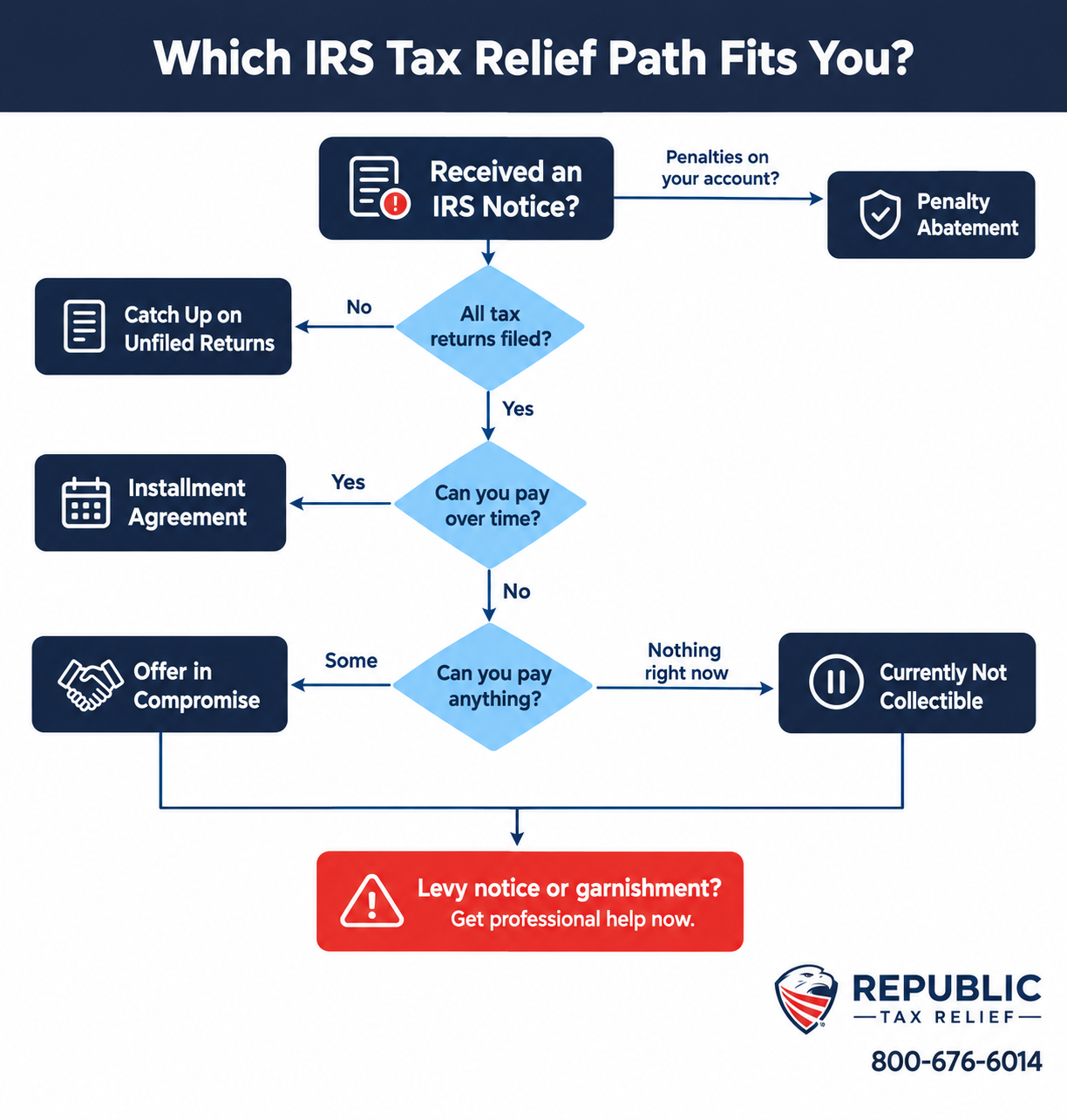
The IRS offers several tax relief programs. Which one fits depends on your income, expenses, assets, and filing history. If you would rather have a licensed team pick and pursue the right one, see our professional tax relief services.
Installment Agreements
An installment agreement lets you pay your balance over time in monthly payments. Penalties and interest keep adding up, but enforced collection like levies generally stops while the plan is in good standing. Learn more about IRS payment plans.
Offer in Compromise
An offer in compromise lets some taxpayers settle for less than the full amount owed. The IRS looks at your “reasonable collection potential,” which is roughly what it could collect from your income and assets. See how the OIC program works.
Currently Not Collectible Status
If paying anything would leave you unable to cover basic living expenses, the IRS may pause collection. The debt doesn’t disappear, but levies stop while your hardship continues. Read about Currently Not Collectible status and other IRS hardship programs.
Penalty Abatement: First-Time Abatement and Reasonable Cause
Penalties can make up a large share of what you owe. According to the IRS, first-time abatement may apply if you had no penalties in the prior three tax years, have filed all currently required returns, and have paid or arranged to pay the tax due. Reasonable cause relief may apply when events like serious illness or a disaster kept you from complying. Our penalty abatement guide covers both.
Innocent Spouse and Equitable Relief
If a current or former spouse caused the tax problem on a joint return, you may qualify for relief from some or all of that debt. Equitable relief can apply even when other types don’t. See our innocent spouse relief guide.
Practical takeaway: Relief options can work together. For example, a successful penalty abatement request can shrink your balance before you set up a payment plan on the rest.
Back Tax Help: Filing Compliance Comes First
The IRS generally won’t approve a payment plan or settlement until all required returns are filed. That’s why filing past-due tax returns is usually step one in any back tax case. Our Back Tax Help guide explains the full process.
- The failure-to-file penalty grows fast. It’s generally 5% of unpaid tax per month, up to 25%. The failure-to-pay penalty is 0.5% per month, also capped at 25%.
- The IRS may file for you. A Substitute for Return often leaves out deductions and credits you’re entitled to, so the balance is usually higher than it should be.
- Old refunds can be lost. You generally have three years from the original due date to claim a refund. After that, the money stays with the IRS.
- Six years is the usual focus. The IRS generally looks for the last six years of returns before it considers you back in compliance.
Example: A contractor with five unfiled years assumes he owes a fortune. Once a tax professional pulls his IRS transcripts and reconstructs his expenses, two of those years show refunds that offset part of what he owes. (Illustrative example only.)
IRS Collection Actions: Liens, Levies, and Garnishments
These terms get mixed up, but they work differently:
- Tax lien: A legal claim against your property that can block a sale or refinance. See tax lien help.
- Levy: The actual seizure of money or property, such as funds in a bank account. See bank levy help.
- Wage garnishment: A continuous levy that takes part of every paycheck until the debt is resolved or released. See wage garnishment relief.
You have rights during IRS collection. The Taxpayer Bill of Rights includes the right to challenge the IRS’s position and be heard. After a Final Notice of Intent to Levy, you generally have 30 days to request a Collection Due Process hearing, which can pause the levy while your case is reviewed.
Practical takeaway: Write down the date on any levy notice the day you receive it. Missing the 30-day window can cost you your strongest appeal rights.
Already received an LT11 or Letter 1058?
That 30-day window is your best chance to protect your paycheck and bank account. Let a licensed professional request your hearing and build the plan.
Business Tax Relief: Payroll Taxes, Audits, and State Agencies
Business tax debt can turn personal quickly. When payroll taxes go unpaid, the IRS can assess the Trust Fund Recovery Penalty against owners and other “responsible persons.” That makes the withheld portion of those taxes a personal debt.
State tax agencies add another layer. In California, business owners may face the FTB for income tax, the EDD for employment payroll tax controversies, and the CDTFA for sales tax. Each agency has its own rules and its own collection tools.
Helpful resources for business taxpayers:
- Business Tax Debt Relief
- Business IRS Audits
- Small Business Tax Relief and Resolution
- Industry guides for construction, real estate, medical practices, and e-commerce
Practical takeaway: If your business is behind on payroll deposits, make current-quarter deposits a priority. New unpaid quarters make any resolution harder to get.
Why AI and DIY Shortcuts Miss IRS Deadlines
We now see people arrive with a chatbot transcript in hand. The advice often sounds confident. The trouble is in what it cannot know.
Expert insight from our tax team
- AI does not know your notice date. IRS deadlines run from the date printed on the letter. A tool that says you have 30 days cannot tell you that 22 of them are already gone.
- Notice numbers get confused. We regularly meet taxpayers who treated an LT11 like a routine CP504 reminder and waited. That mistake can turn a pausable levy into a live one.
- Late appeals are weaker appeals. An equivalent hearing, the fallback after a missed deadline, does not stop collection and does not come with Tax Court review.
- Template letters can hurt you. A generic response can admit liability, waive a right, or skip the documents the IRS actually asked for.
- State and federal rules are not the same. California’s FTB and EDD follow their own timelines. Advice built for IRS notices may be wrong for a state letter.
Use AI to learn vocabulary. Use a licensed professional, with your transcripts in hand, to decide what to do and when.
When to Get Professional IRS Tax Help
Some tax problems can be handled with a phone call. Others carry real risk if handled alone. It’s time to talk to a tax professional if you:
- Received a Final Notice of Intent to Levy or have an active levy
- Have several years of unfiled returns
- Own a business with unpaid payroll taxes
- Are facing an IRS audit or a state tax exam
- Have tried calling the IRS and gotten nowhere
The Taxpayer Advocate Service is a free, independent organization within the IRS. It helps when you’re facing significant hardship or when normal IRS channels have failed. Here’s how it compares to private representation:
| Taxpayer Advocate Service | Private Tax Professional | |
|---|---|---|
| Cost | Free | Fee-based |
| Best for | Stuck cases and hardship | Full case strategy and negotiation |
| Speaks to the IRS for you | In specific cases | Yes, through a power of attorney (Form 2848) |
| Handles state tax agencies | No | Yes, depending on the firm |
When you hire Republic Tax Relief, we start by filing an authorization with the IRS and your state tax agency to review your full account history. From there, an enrolled agent, CPA, or tax attorney builds a resolution strategy around your actual numbers. See how our tax relief company handles each case.
IRS Tax Relief Tips to Stay Compliant
Rules, thresholds, and deadlines change from year to year. A few IRS tax relief tips hold up every time:
- File even if you can’t pay. It stops the larger failure-to-file penalty from growing.
- Watch the extension deadline. For most taxpayers who file an extension, the return is due October 15.
- Expect refund offsets. If you owe back taxes, the IRS can apply your refund to the old balance.
- Adjust withholding or estimated payments. Don’t let the current tax year add new debt while you resolve old years.
- Be wary of big promises. No honest firm can guarantee a settlement amount before reviewing your finances.
Practical takeaway: Keep a folder with every IRS letter and the date you received it. Response deadlines run from the notice date, not the date you open it. For news and law changes, follow our tax relief blog.
Real Client Feedback on IRS Tax Relief
“As of today, June 23rd, Republic Tax Relief has been awesome. I have always been skeptical of using these tax companies. But, I decided to take a chance because of I couldn’t get anywhere with the IRS by myself. I had 3 companies on my list, Republic Tax Relief, TRA Tax Relief and Optima Tax Relief. I was about to go with TRA but they were tremendously high, so I decided to call Republic and gave me an affordable price based upon my situation. I never got a chance to call Optima because I was impressed with the communication and cost with RTR. I started off with Ken at RTR, then I spoke to Chris, and now I’m working with Rebekah. All three have been great communicating and answering my very thorough questions. They gave me a level of comfort to trust them. Now, it is just a waiting game and in 3 years I will be able to come back and provide an update. Also, RTR has allowed me to pay my fees to them in 6 installments making it very worthy to use them. Thank you Ken, Chris, and Rebekah!”
Alwynn VanBuren, Google Review ★★★★★
IRS Notice and Tax Relief FAQ
What should I do first when I get an IRS notice?
Find the notice number in the top or bottom right corner and the response date printed on the letter. Then check whether all your returns are filed. Those three facts decide how much time you have and which relief programs are open to you.
Is a CP504 the same as a final notice?
No. A CP504 is a notice of intent to levy. It lets the IRS take your state tax refund and warns that other collection may follow. The final notice that gives you formal appeal rights before a levy on wages or bank accounts is usually an LT11 or Letter 1058.
What happens if I miss the 30-day deadline on an LT11 or Letter 1058?
You lose the right to a standard Collection Due Process hearing, which can pause a levy and lead to Tax Court review. You can usually still request an equivalent hearing within one year of the notice date, but it does not stop collection and does not come with the same court review.
Can I ignore a CP2000 if I disagree with it?
No. A CP2000 proposes changes based on income the IRS received from employers, banks, or other payers. If you do not respond by the date on the notice, the IRS can move ahead and assess the tax. Responding on time, with documents, is how you dispute it.
Does an IRS notice mean I am being audited?
Usually not. Most notices are about balances due, missing returns, or mismatched income. An audit letter will say it is an examination and ask for records. If you are not sure which you have, our IRS notices guide explains the most common letters.
Will the IRS take my refund if I owe back taxes?
Yes. The IRS can apply your refund to past-due federal tax debt, and some state tax debts can also be offset. This usually happens automatically during processing.
Can I get IRS tax relief if I haven’t filed my tax returns?
Most relief options require you to be current on required returns first. A tax professional can help you catch up on unfiled years and request relief at the same time.
How can I tell if an IRS letter is real?
Real IRS letters come by mail, carry a notice number, and match what you see in your IRS online account. The IRS does not demand payment by gift card, wire transfer, or cryptocurrency, and it does not threaten immediate arrest. When in doubt, check your account at IRS.gov or call us before you pay anyone.
Looking for more? See answers to 40 common tax relief questions.
Key Takeaways
- Your IRS notice number tells you where you are in the collection process.
- Deadlines run from the date printed on the notice, not when you open it.
- Filing compliance comes before almost every relief option.
- Installment agreements, offers in compromise, CNC status, and penalty abatement can work together.
- You have appeal rights, but they come with strict deadlines.
- Business owners can become personally liable for unpaid payroll taxes.
Bookmark this IRS tax relief blog and check back for new guides and tips. If your situation feels urgent, don’t wait for the next notice.
Explore the Tax Relief Series
Now that you know what your notice means, take the next step with the right guide.
Tax Relief BlogPenalties, audits, levies, and how new tax laws affect people who owe
Tax Relief QuestionsStraight answers to the 40 questions taxpayers ask most
IRS Collections DefenseHow the IRS collection process works and how to stop a levy
Want an honest second opinion? 800-676-6014 or request your free consultation.
🔒 Your information stays protected. Every notice, return, and bank statement you upload is protected with bank-grade 256-bit encryption and handled in full compliance with federal data protection standards, from first upload to final resolution.
Speak With a Tax Relief Professional
You don’t have to figure out the IRS alone. Our team will review your situation, explain your options in plain English, and tell you honestly what relief you may qualify for.
We serve taxpayers in all 50 states. Your consultation can take place by phone or online, and our offices in Corona and Laguna Hills are available if you prefer to meet in person.
About Republic Tax Relief: Since 2005, our in-house team of enrolled agents, tax attorneys, and CPAs has resolved more than 18,000 cases, including installment agreements, offers in compromise, penalty abatement, and lien and levy releases. Results vary based on individual circumstances.
😄 Congratulations, you now know more IRS notice numbers than most people learn in a lifetime. CP14 to LT11 is a trivia category nobody wants, so let’s get you off the IRS mailing list.
This page is for general information only and is not legal, tax, or financial advice. Results depend on your facts, and no outcome is guaranteed.
1 Comment
[…] Before anyone picks a program, three questions narrow the field. Answer them in this order. (If you are still figuring out what a specific letter means, start with our IRS notice roadmap.) […]